HOT NEWS !
Stay informed on the old and most recent significant or spectacular
nautical news and shipwreck discoveries

-
Wikileaks reveal Odyssey tension
- On 14/09/2011
- In Illegal Recoveries

By Brian Reyes - Gibraltar Chronicle
Leaked US diplomatic correspondence has laid bare the strain that the Odyssey controversy placed on bilateral relations between the UK and Spain.
The cable from the US embassy in Madrid to the Secretary of State in Washington was sent in 2007 shortly after Odyssey Marine Exploration returned to Gibraltar with a valuable treasure it had recovered in the Atlantic.
Spain claimed the “Black Swan” treasure and the presence of two Odyssey ships in the military base in Gibraltar prompted angry diplomatic exchanges at a time when Britain, Spain and Gibraltar were attempting to negotiate important agreements under the trilateral forum for dialogue.
On June 26 of that year, Britain´s then ambassador in Madrid, Denise Holt, paid a courtesy call on her US counterpart, Eduardo Aguirre, and spoke about the case in detail.
She said “...tensions with Spain over Odyssey were continuing to pose an unnecessary threat on the two countries´ bilateral relationship,” the cable noted.
“The British Embassy in Madrid is now intent in distancing themselves as much as possible from the dispute between Odyssey and Spain,” it added.
“Having suffered the brunt of the backlash both in the press and with their interactions with GoS, Ambassador Holt wants to salvage their relationship and improve cooperation between the two countries on the sensitive matter of Gibraltar.”
“The Ambassadors agreed that the Odyssey “treasure find” should not weaken bilateral relations between three allies and that both countries should encourage Odyssey and Spain to find a satisfactory solution to the dispute..”
Part of Spain´s concern was that the treasure had been flown from Gibraltar to Florida and officials in Madrid, initially at least, suspected that British authorities had aided the company. Likewise the two Odyssey ships were berthed in the Ministry of Defence naval base, where they had been regular callers for many years, prompting further suspicions.
Mrs Holt told the US ambassador that Britain was in no way linked to the Black Swan haul and that the only link was the contractual agreement with the MoD to salvage the wreck of an English galleon, HMS Sussex, which lay off Gibraltar.
She told Mr Aguirre that Britain´s contract with Odyssey would be reviewed “in an attempt to terminate” it.
“Holt noted that she would be describing to London the impact that the Odyssey controversy was having locally on bilateral relations (as well as on Gibraltar issues),” the cable said.
“She confirmed that though the two Odyssey vessels were in port in Gibraltar, the British would not aid the vessels when and if they should sail out.”
Both vessels sailed from the Rock some weeks after the cable was sent and both were detained by Spanish authorities in international waters and taken to Algeciras, where they were searched and later released.
-
The challenge of saving DeBraak's hull
- On 14/09/2011
- In Conservation / Preservation

By Molly Murray - Delmarvanow
The musket balls, once at the ready for an 18th century sea battle, are vacuum packed in the same plastic bags home cooks use to store leftovers.
The socks, a little stained, but otherwise perfect -- are spread out in acid-free boxes.
And the bilge pump rests in a specially built roller cart.
But the one piece of the 18th century HMS DeBraak -- raised from the sea floor off Lewes in the summer of 1986 -- that hasn't been carefully conserved and preserved is the largest of some 20,000 artifacts: the giant section of the 85-foot long vessel's hull.
For more than two decades, the hull section, about 30 percent of the original ship, has been stored in a warehouse near Lewes.
A steady stream of fresh water keeps the wood -- which dates to pre-1798 -- wet. And over time, it has washed away salt deposits, tiny bits of debris, mud and sand.
Now, state archaeologists are beginning to tackle their biggest conservation challenge yet with the DeBraak collection, considered world class by researchers and historians.
"There is no other vessel like this," said Charles H. Fithian, the state curator of archaeology, who has worked on the DeBraak since thousands of artifacts and the hull were raised from the sea floor in summers of 1984, 1985 and 1986.
Now, he said, they must develop a conservation plan for the hull remains. "We could make a serious mistake and ruin it," he said
-
Underwater footage of 1859 Royal Charter shipwreck
- On 13/09/2011
- In Museum News
From BBC News
Underwater video footage of one of Wales' most notable shipwrecks will be shown for the first time next month.
The steam clipper Royal Charter was smashed on rocks off Moelfre, Anglesey, by a force 12 hurricane - with the loss of least 459 passengers and crew on 26 October 1859.
The ship was returning from Melbourne on its way to Liverpool, laden with gold.
Chester Grosvenor Museum will show the film on 25 October.Diver Chris Holden, treasurer of the British Sub-Aqua Club's Chester branch, will show the film as part of a lecture to mark the 152nd anniversary of the maritime tragedy.
Mr Holden and his wife Lesley, of Higher Kinnerton, Flintshire, wrote a book about the shipwreck, called Life and Death on The Royal Charter.
Mary Tetley, chief executive of the British Sub-Aqua Club, said: "Chris and Lesley have done a phenomenal job in researching the story of the Royal Charter and the lecture will give us a new and fascinating insight into this maritime catastrophe."
Along with the unseen footage, it will be the first opportunity for many to see artefacts from the wreck, which include a small model of the vessel's newly invented lifting propeller system, recovered from the wreck site less than 12 months ago.
-
Sunken ship with thousands of bombs on board could collapse'
- On 11/09/2011
- In World War Wrecks
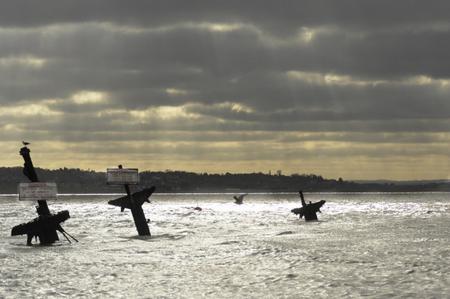
Photo Barry Crayford
By Gemma Constable - Kent OnlineA ship that sunk off the Kent coast with thousands of bombs on board is deteriorating more quickly than in recent years, experts have warned.
SS Richard Montgomery sank off Sheerness in 1944 after it became grounded on a bank and broke in two.
A salvage operation had to be abandoned and the wreck of the American liberty ship remains packed with a mixture of explosives.
They include more than 2,000 cases of cluster fragmentation bombs, nearly 600 500lb semi armour piercing bombs and at least 1,000 additional 1,000lb bombs.
An explosion could trigger a tidal wave up to one metre high, destroying some coastal communities and causing as much as £1 billion worth of damage.
A full report on the condition of the wreck is due to be published by the Maritime and Coastguard Agency (MCA), which is responsible for surveillance, in the next eight weeks.
This week, a summary of the report, based on surveys carried out in 2008 and 2009, was released by the Department for Transport following a Freedom of Information Act request.
There were greater levels of deterioration than has been seen in previous years, which may suggest the rate of its decline in some areas of the hull has accelerated.
The results point towards significant collapse and/or loss of munitions becoming a more realistic possibility in the medium term, although there appears to be no imminent danger.
-
Scientists explore wreck thought to be part of 1812 fleet
- On 11/09/2011
- In Underwater Archeology

By Lara Lutz - Bay Journal
Archaeologist Julie Schablitsky normally works on land. For this job, she learned to dive.
Then, in the murky waters of Maryland's Patuxent River, she touched a piece of the nation's past.
Schablitsky, chief archaeologist for the Maryland State Highway Administration, is helping to excavate an early U.S. vessel that fought British forces on the Chesapeake Bay during the War of 1812.
"It's a piece of Maryland history and heritage, a symbol of strength from 200 years ago," Schablitsky said.
Most of the sunken shipwreck is covered by 60 feet of silt that a team of archaeologists from the Maryland State Highway Administration, Maryland Historical Trust and U.S. Navy began to remove this summer.
Sediment - a pollutant that fouls Bay water quality - hangs heavy in the water, too, and makes work difficult. On a good day, divers can see about 12 inches in front of them. After rain, almost nothing.
The cloudy water hampered Schablitsky's first dive at the site but made it memorable, too.
"I'm used to picking up an artifact and letting my eyes see it," Schablitsky said. "But reaching through that water and having my hand 'see' it first just took me instantly back to the War of 1812. It gave me goose bumps."
The vessel was once part of "Barney's Flotilla," a small but scrappy collection of gunboats launched in 1814 to confront the British navy on the Chesapeake Bay. The superior British naval forces had run rampant through the Bay since the war began, raiding port towns and farmland at will.
Led by Commodore Joshua Barney, the flotilla moved easily through the Bay's shallow waters and bedeviled the British as they made their way toward Washington, D.C. British ships eventually chased the flotilla to the upper reaches of the Patuxent River.
On a stifling day in August 1814, the Americans faced defeat. Rather than leave the vessels in British hands, they destroyed the flotilla and continued on foot to help defend the nation's capital.
Fifteen gunboats and Barney's flagship, the USS Scorpion, sank to the bottom of the river.
Investigators have located a handful of sites that may hold remains from Barney's Flotilla. But the current site is the only one to be explored and dated to the War of 1812. -
Wreckage of Michigan WWII pilot's plane is located
- On 10/09/2011
- In Airplane Stories
By Sarah Lambert - Miami Herald
Like many men of his generation, Marshall native Charles Dobbins Sr. didn't talk much about his part in World War II.
But several years after his death, an archaeological find in Florida brought his son and namesake, Chuck, a reminder of the dangers his father faced defending the United States.
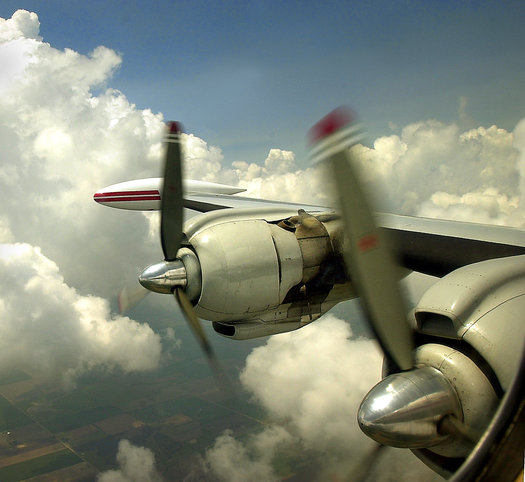
On Saturday, Florida archaeologist Kathy Couturier will visit Marshall to share the story of how she found the wreckage of a B-17 crash that Charles Dobbins Sr. survived in 1944.
Couturier will give a brief presentation at 9 a.m. at the Marshall Brooks Field Airport as part of the Historic Fly-in and Drive-in.
"It was a true history detective moment on the part of Kathy's institution and her archaeological dig," said Marshall resident Chuck Dobbins. "I got an email out of the blue that said 'Are you related to Charles Dobbins ?'"
The history investigation began about three years ago at the Avon Park Air Force Range in south-central Florida. Kathy Couturier took a job as the range's Cultural Resource Manager/Archaeologist.
Avon Park was once home to an Army Air Corps base, built in 1941. Young pilots such as Charles Dobbins Sr. were trained to fly combat planes there before heading overseas to war.
The base was open for just five years, and in that time, about 200 airplanes crashed occurred during training flights, Couturier said.
Her investigation into those crashes began not with the Dobbins B-17 plane, but with whispers about a B-26.
"We heard rumors of a B-26 crash site in the swamp," Couturier said. "I've been here almost three years. I heard the rumor and I just wouldn't give up until I found it."
Find it she did. The B-26 was resting in an alligator-infested swamp on the property, undisturbed for more than six decades. Her appetite whetted for war history, Couturier began pursuing tips that a B-17 was buried on the property.
That's when she discovered what she calls the Dobbins crash site.
World War II pilot Charles Dobbins Sr. was about 26 years old and married with his first child when he experienced what he later remembered as his biggest scare during the war - the day his plane crashed in a Florida swamp.
It was April 1944, and Dobbins was piloting a B-17 with 10 other crew members aboard. Nearly 70 years later, archaeologist Couturier read the official accident report.
"It took off at 3:30," Couturier said. "The co-pilot took off as the pilot (Dobbins) watched. The pilot took over. The number one engine oil pressure dropped at 200 feet."
The report stated that Dobbins attempted to restart the engine and tried to do an emergency landing on the runway.
"They attempted to land it on the runway, that didn't work, and they had to land it in the swamp," Chuck Dobbins said, recalling the story as his father told him years later."It was infested with alligators and snakes. He always told me that was the only thing, believe it or not, that he was scared of in the war - was the alligators."
-
WWII shipwrecks swimming in marine life
- On 09/09/2011
- In World War Wrecks
From MSNBC
World War II shipwrecks off the coast of North Carolina have more to offer than clues about past battles. Diving scientists are excavating the wrecks to learn about the thriving marine life the sunken ships support.
The waters off the North Carolina coast are known as the Graveyard of the Atlantic and Torpedo Junction. Here, dozens of ships — mostly merchant vessels — were sunk by German U-boats.The National Oceanic and Atmospheric Administration (NOAA) estimates that from January to August 1942, more than 50 vessels were lost to the U-boat assault. The remains of those ships, along with several U-boats, rest on the Atlantic Ocean seafloor.
In the nearly 70 years since they first hit the ocean floor, the shipwrecks have transformed into a habitat for an array of species. The nooks and crannies of these wrecks make them perfect artificial reefs.
"In addition to their cultural significance, shipwrecks function as important habitat for a wide variety of fishes, invertebrates and algal species," a NOAA study team wrote in a report on the area.
The wrecks are also uniquely located in an area that is home to both temperate and tropical species of fish and invertebrates, which should allow scientists to examine how the marine communities change as ocean temperatures rise as a result of climate change, according to the NOAA study.
To begin probing the living communities of the sites, last year scientists conducted biological and ecological investigations on four World War II shipwrecks (the Keshena, City of Atlanta, Dixie Arrow and EM Clark), as part of NOAA's Battle of the Atlantic research project.
At each shipwreck site, fish community surveys were conducted to characterize the mobile conspicuous fish, smaller prey fish, and immobile invertebrate and algal communities. The scientists also attached temperature sensors that were placed at all four shipwrecks, as well as at an additional shipwreck, the Manuela. -
Secrets of WTC Shipwreck Sleuthed Out
- On 08/09/2011
- In Parks & Protected Sites
From Christina Reed - Discovery News
Unraveling the mystery surrounding the shipwreck found last year during excavations of the World Trade Center site has resulted in several facts as well as theories.The 18th century vessel, likely a single-masted sloop, measured approximately 50 feet long, and had a shallow, double-ended draft aided by a small, tapered keel built of squared-off hickory that that ran from stem-to-stern.
The hull was built from Philadelphia oak trees -- one of which had lived for at least 111 years and was still growing in 1773, its youngest sapwood preserved in one of the boat's timbers.
Maritime historian Norman Brouwer had suggested that the unusually crafted sailboat was from a small rural shipyard and the trees for its timber from the same forest. "The data we see suggest something very similar," says Neil Pederson of the Lamont-Doherty Earth Observatory's Tree Ring Lab in Palisades, NY.
"It's an interesting intersection in experts," he told Discovery News. He was part of a four-person dendrochronology team from the Tree Ring Lab working on samples of the vessel's white oak planks and its hickory keel.
Other tree species used in the boat's construction included spruce and southern yellow pine, reported wood deterioration researcher Robert Blanchette of the University of Maine.
Looking up tree ring patterns for white oak timber samples is like hunting down a family's genealogy. To get the most accurate result, teams of people around the world need to have already done the manual labor of counting rings and entering forest timber chronologies into a database.Then it's a matter of sleuthing through generations of tree life-cycles to find a pattern that fits: where the timber samples and the trees share the same local climate of wet and dry years allowing them to make matching patterns of wide rings and skinny rings. So where to start ?