HOT NEWS !
Stay informed on the old and most recent significant or spectacular
nautical news and shipwreck discoveries

Hidden treasures: shipwrecks in Bay of Gibraltar
From Sam Jones - The Guardian
Researchers identify wrecks at the bottom of the sea from as far back as fifth century BC, from Europe and beyond.
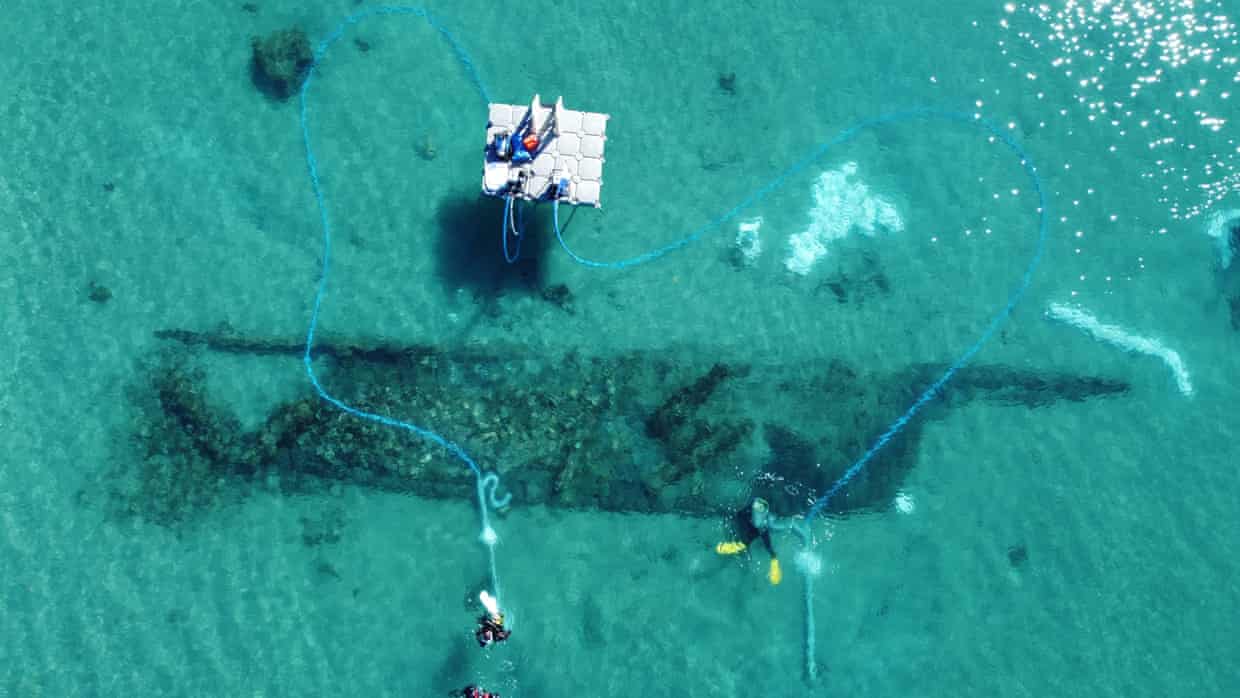
Spanish archaeologists exploring the bay that curves between the southern port of Algeciras and the Rock of Gibraltar have documented the wrecks of more than 30 ships that came to grief near the Pillars of Hercules between the fifth century BC and the second world war.
Over the millennia, the bay, which sits at the north end of the strait of Gibraltar that separates Europe from Africa, has swallowed everything from Phoenician and Roman vessels to British, Spanish, Venetian and Dutch ships – as well as the odd aeroplane. A three-year project led by the University of Cádiz has now identified 151 archaeological sites in the bay, among them 134 shipwrecks. To date, the researchers and their colleagues from the University of Granada have worked to document 34 of those wrecks.
The oldest is that of a Punic era ship dating to the fifth century BC, while other finds include 23 Roman ships, two late Roman ships, four medieval ships and 24 vessels from the early modern period.
Between them, the sunken items – which include an agile and fearsome 18th-century Spanish gunboat and the engine and propeller of a plane from the 1930s – tell the story of war, trade, exploration and settlement in and around one of the most strategically important waterways in the world.
Felipe Cerezo Andreo, a professor of archaeology at the University of Cádiz who led the investigation, which is called Project Herakles, said that area has long been a watery crossroads. “It’s one of those bottlenecks through which ships have always had to pass, whether on commercial shipping routes, voyages of discovery, or due to armed conflicts,” he said.
France’s deepest shipwreck found
:focal(2890x1927:2891x1928)/https://tf-cmsv2-smithsonianmag-media.s3.amazonaws.com/filer_public/b2/d7/b2d7aee9-5e52-4b50-8839-66f7d811025b/gettyimages-2272969088.jpeg)
From Ellen Wexler - Smithonian Magazine
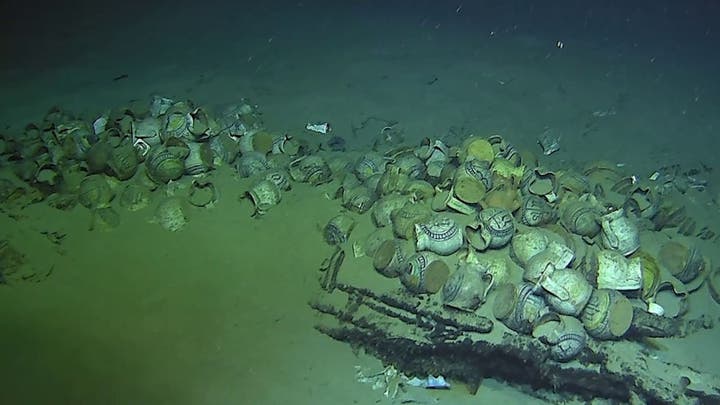
Known as the “Camarat 4,” the ship was loaded with cannons, cauldrons and hundreds of ceramics—which are still visible on the seafloor. Researchers are surveying the site and carefully recovering a small selection of artifacts.
At least 400 years ago, a merchant ship was sailing across the Mediterranean Sea when it sank off the southeastern coast of France. Its cargo, hundreds of carefully crafted ceramic plates and jugs, tumbled into the watery darkness and settled onto the seafloor. The handmade treasures wouldn’t be seen again for centuries.
Then, in 2025, the French Navy stumbled across the ship when it was conducting an exploratory deep-sea operation. The vessel was resting more than 1.5 miles below the surface—making it the deepest known shipwreck in French territorial waters.
“You have to be extremely precise so as not to damage the site, so as not to stir up sediment,” Sebastien, a navy officer who oversaw the first archaeological mission at the site, tells Agence France-Presse (AFP). The remotely operated robot is the only one of its kind in France that’s capable of functioning at such great depths.
The descent took an hour. In the hours that followed, its cameras captured eight pictures per second, producing 66,974 images that were then collated to generate a 3D model of the wreckage. The robots also installed topographic markers at the site, which will help them track any man-made or natural disturbances.
Researchers are now investigating the wreck, which they call the Camarat 4 after a nearby point on the French coastline. Over three days in April, they used an underwater robot to study the site and carefully recover a small selection of artifacts from the bottom of the Mediterranean.
Coins, cannon recovered from the San Jose
From CBS News
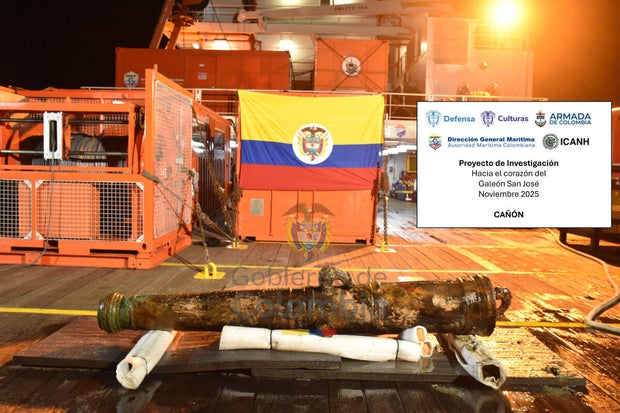
A cannon, three coins and a porcelain cup were among the first objects Colombian scientists recovered from the depths of the Caribbean Sea where the mythical Spanish galleon San José sank in 1708 after being attacked by an English fleet, authorities said Thursday.
The recovery is part of a scientific investigation that the government authorized last year to study the wreckage and the causes of the sinking. Colombian researchers located the galleon in 2015, leading to legal and diplomatic disputes. Its exact location is a state secret.
Dubbed the "holy grail of shipwrecks," the ship is believed to hold 11 million gold and silver coins, emeralds and other precious cargo from Spanish-controlled colonies, which could be worth billions of dollars if ever recovered.
President Gustavo Petro's government has said that the purpose of the deep-water expedition is research and not the treasure's seizure. Colombia's culture ministry said in a statement Thursday that the cannon, coins and porcelain cup will undergo a conservation process at a lab dedicated to the expedition. The wreckage is almost 2,000 feet deep in the sea.
Gold watch from the Titanic sold for $2.3 million !

By Emily Mae Czachor - CBS News
A pocket watch that once belonged to one of the Titanic's most renowned passengers has sold at an auction for $2.3 million — a record price for memorabilia related to the historic shipwreck, according to the auction house.
The 18-carat gold watch was gifted to its original owner, Isidor Straus, by his wife, Ida Straus, for his 43rd birthday,said Henry Aldridge and Son, the auction house that sold it on Saturday. It was recovered from his body after the Titanic sunk in the North Atlantic in April 1912.
Isidor Straus was an American businessman and politician who owned the Macy's department store in New York City. He and his wife were first-class passengers on the Titanic during its maiden voyage from England to New York, and the couple are remembered for their final act of selflessness while on board.
Witnesses who survived the Titanic wreck said afterward that the Strauses were offered two seats on a lifeboat once the ship had struck an iceberg, according to the U.K. government's National Archives.
But Isidor Straus refused his seat, instead insisting that it should have been offered to younger men, and Ida Straus followed him, reportedly saying, "Where you go, I go."
According to those archives, Isidor and Ida Straus were last seen standing arm in arm on the deck of the Titanic, before a wave crashed overhead and washed them out to sea.
The Strauses were the ancestors of Wendy Rush, wife of OceanGate founder Stockton Rush, who died in the infamous Titan submersible explosion in 2023 en route to the Titanic wreck site.
South Korea uncovers 600-year-old shipwreck
From Fairtrade
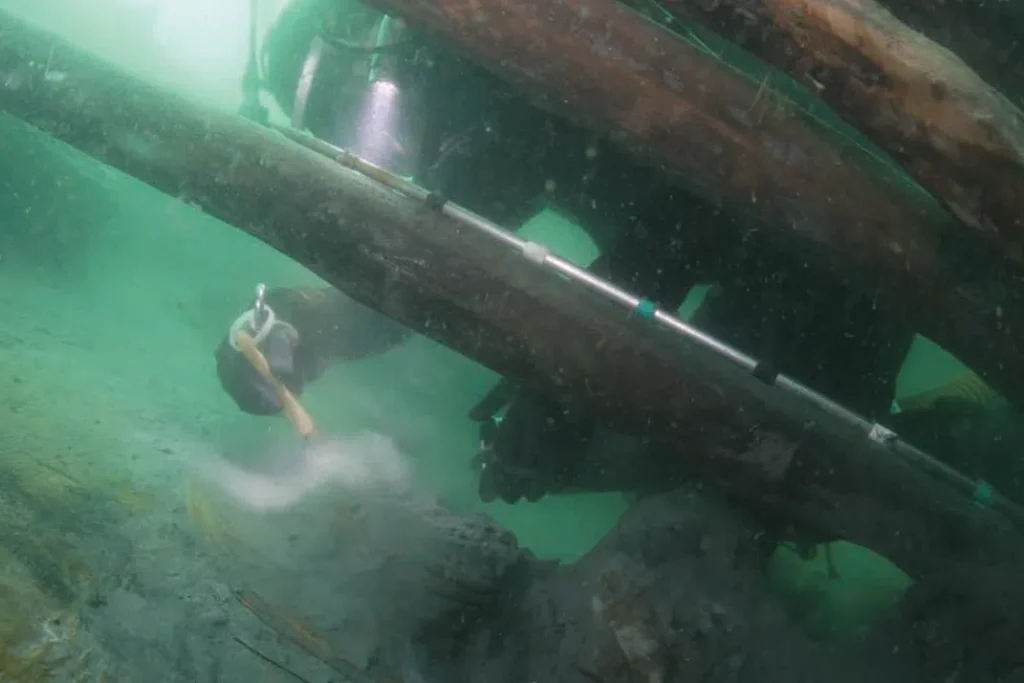
In a significant archaeological discovery, South Korean researchers have recovered a 600-year-old tax ship, known as Mado 4, which provides insight into the maritime operations of the Joseon dynasty (1392–1910). The vessel was raised from the seabed off the west coast in October 2022, following nearly a decade of conservation efforts.
Mado 4 is the only fully excavated Joseon-era ship and offers tangible evidence of the kingdom’s complex maritime tax network.
Initially discovered in 2015 near Taean, South Chungcheong province, Mado 4 rests at approximately 25 meters deep. The excavation site yielded over 120 artifacts, including wooden cargo tags denoting destinations, state rice containers, and government-produced porcelain.
These artifacts confirm that the ship was integral to a state-run transport system called “joun,” essential for moving grain and official goods from regional depots to Hanyang, now Seoul.
The ship is believed to have sunk around 1420 while navigating treacherous waters from Naju, a grain collection center. Its preservation under sand and silt has allowed researchers to observe key elements of Joseon-era engineering. Notably, Mado 4 features a twin-mast design, marking a departure from the single-mast ships prevalent prior, indicating advancements aimed at improving speed and maneuverability.
Moreover, the use of iron nails for repairs—the first confirmed instance of metal fasteners in Korean vessels—contrasts previous understanding that traditional ships relied solely on wooden joints.
Three ancient shipwrecks found on the coast Of Northern Israel
By Ainsley Brown - ATI
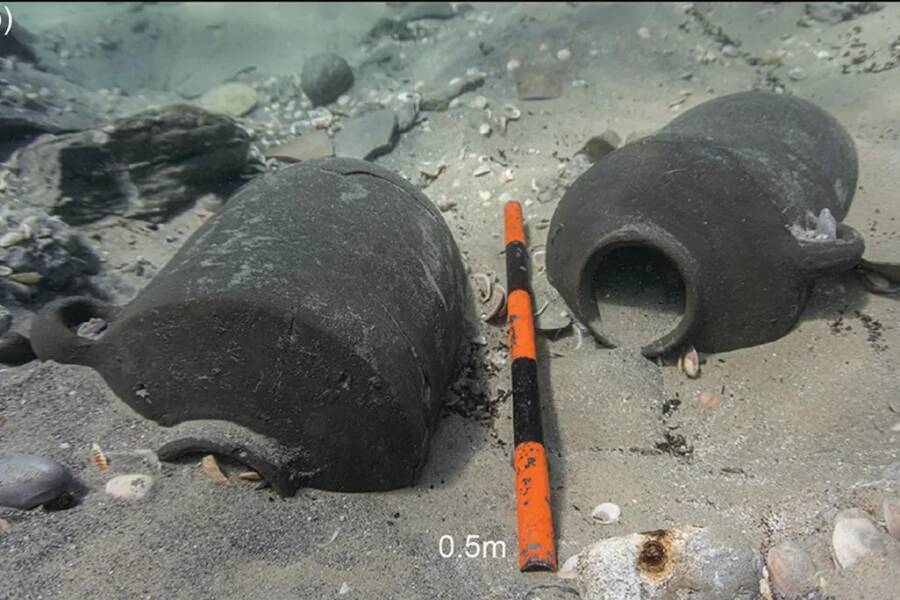
Divers at Tantura Lagoon have uncovered three shipwrecks, the oldest of which dates back 3,000 years — and they were filled with containers like bowls, jars, and amphorae as well as food like grapes and dates.
Archaeologists have discovered three Iron Age shipwrecks off the coast of Israel, and their cargo has reshaped experts’ understanding of ancient trade across the Mediterranean. The wrecks were found in Tantura Lagoon, also known as Dor Lagoon, near the ancient harbor city of Dor.
This is the first discovery of sunken cargo within a former port city in Israel and it provides deeper insight into Iron Age trade than pre-existing land-based evidence.
A new paper published in the journal Antiquity describes how the project, carried out by the University of California San Diego in conjunction with the University of Haifa, used both traditional methods of research alongside newer techniques. Archaeologists used 3D modeling, multispectral imaging, and digital mapping to examine the wrecks and surrounding waters throughout 2023 and 2024.
In all, the team was able to explore three shipwrecks laden with vast amounts of cargo at a sandbar near Dor.
Ancient Greek shipwreck found off Sicily

By Nisha Zahid - Greek Reporter
An ancient Greek shipwreck was uncovered just six meters below the surface off the coast of Santa Maria del Focallo, in the municipality of Ispica, Sicily.
The remarkably well-preserved vessel dates back to between the 6th and 5th centuries BCE and is considered one of the most significant finds in the Mediterranean in recent years. The shipwreck was first uncovered in 2024 during the fifth phase of underwater excavations, with further discoveries made in 2025 as part of the sixth campaign.
The excavation is led by the University of Udine’s Department of Humanities and Cultural Heritage, in partnership with the Sicilian Region’s Superintendency of the Sea.
The effort is part of the Kaukana Project, a long-term scientific initiative launched in 2017 by the late Sebastiano Tusa and Massimo Capulli.
The project focuses on reconstructing the historical and underwater landscape of Ragusa province by exploring coastal remains near the ancient cities of Ispica, Kaukana, and Kamarina.
During the five-week excavation conducted between May and June of 2025, archaeologists uncovered an unusually intact structure.
The team retrieved a mast—a component rarely found preserved in ancient wrecks—alongside black-figure pottery, a section of rope in excellent condition, and a small alabastron, or perfume vessel, inscribed with the Greek word “Ναῦ” (Nau), meaning “ship.”
Rare 16th-century shipwreck found in French waters
By Andrea Margolis - Fox News
Officials recently unveiled the deepest-recorded shipwreck in French waters, complete with a remarkably well-preserved cargo dating back 500 years.
The findings were announced by the French Department of Underwater and Submarine Archaeological Research (DRASSM) in a Facebook post on June 11. Officials said the ship was found by a French Navy unit during a military operation on March 4.
The shipwreck, which has been dubbed Camarat 4, was found off the coast of Ramatuelle, in southeastern France. It was found over one-and-a-half miles underwater.
"The shipwreck was discovered unexpectedly during an exploratory mission conducted as part of the ministerial strategy for mastering the seabed," said DRASSM's post, which was translated from French to English.
"This newly found wreck stretches 30 meters long and 7 meters wide, indicating a large navigation unit." Officials believe that the vessel dates back to the 16th century based on its cargo, which has remarkably survived the past five centuries.
Underwater pictures show a plethora of handmade ceramics near the wrecked ship. Historians believe the well-crafted artifacts originated from Liguria, Italy.
"The quality of the images obtained allows for detailed examination of this merchandise: around 200 visible polychrome faience [glazed ceramic ware] pitchers, with many more seemingly trapped under sediment," DRASSM said.
The pitchers also prominently feature the Christogram IHS, which symbolizes Jesus Christ, reflecting the enormous role that Christianity played in early modern Europe.
"These globular pitchers with pinched spouts and ribbon handles, typical of 16th-century Ligurian production, are adorned with the Christ monogram 'IHS' [and] various vegetal and geometric decorations," DRASSM added. "Several motifs have been identified."