HOT NEWS !
Stay informed on the old and most recent significant or spectacular
nautical news and shipwreck discoveries

-
Odyssey Marine drops on ruling that 1804 shipwreck booty belongs to Spain
- On 22/09/2011
- In Illegal Recoveries
By Thom Weidlich - Bloomberg
Odyssey Marine Exploration Inc. (OMEX) fell as much as 44 percent as an appeals court upheld a ruling that property it recovered from a sunken ship code-named “Black Swan” must be returned to Spain.
The U.S. Court of Appeals in Atlanta affirmed the lower- court ruling in a decision today.
“The district court did not err when it ordered Odyssey to release” the property to Spain, the appeals court said.
In December 2009, U.S. District Judge Steven D. Merryday in Tampa, Florida, backed Spain’s position on the treasure from the ship, whose full name is Nuestra Senora de las Mercedes, and dismissed the case that Odyssey Marine had brought. Merryday had said Odyssey could hold the property while it pursued its appeal.
Odyssey fell to $1.80 before closing at $2.16, down 33 percent, in Nasdaq Stock Market trading.
The company will ask the full appeals court to rehear the case, it said in a statement.
“While we were surprised by the ruling and are obviously not pleased with the opinion, there is no near-term economic impact on the company,” President Mark Gordon said in the statement.
Odyssey, which searches for sunken treasure, said in May 2007 it recovered more than 17 tons (15,422 kilograms) of silver coins from the ship, which went down in the Atlantic Ocean off the Strait of Gibraltar. -
Divers discover D-Day shipwreck off Portsmouth
- On 20/09/2011
- In Wreck Diving
By Oli Poole - Portsmouth
A group of divers has discovered a British D-Day shipwreck in the Solent.
Fourteen divers from the Southsea Sub Aqua Club located the British landing craft off the south-east coast of Portsmouth, in the middle of the main shipping lanes.
They believe it is the LCT 427 craft that was sunk after colliding with a fellow British craft on its return from delivering cargo to Sword Beach, Normandy, in June 1944. The club had to get special permission from the Queen’s Harbour Master in Portsmouth to dive in the area due to the high traffic.
Alison Mayor was part of the crew on the eight-day dive last month. She said: ‘It is such a tragic and sad story.
‘The crew had made the crossing to France, survived the engagement with the enemy and successfully delivered the cargo of tanks – only to be lost at the dead of night, four miles from home and in a collision with one of our own ships.
‘It’s a very moving experience when you swim around the wreck, particularly the area of the break.
-
Discovery of English shipwreck at the mouth of the Thames
- On 20/09/2011
- In Treasure Hunting / Recoveries
From Sail World
A mystery sunken sailing ship lying in 110 metres of water at the entrance to the Thames River is tipped to be a ship of the English Royal Africa Company, according to items retrieved from the vessel.This is the conclusion of the discoverer of the items, Odyssey Marine Exploration, a world leader in deep-ocean shipwreck exploration.
Discovered during the Atlas Project, believed to be the most extensive shipwreck search operation ever launched encompassing 5,000 square miles of ocean in 2005/6, the significant items in the wreck were :
An unmarked 17th-century tobacco pipe, Three glass bottle bases, A wooden folding rule, Manilla bracelets and... Elephant tusks.
An examination of these artifacts has established that the wreck is of a late 17th-century shipwreck that the company calls 35F. Close study of the artifacts by Odyssey’s archaeological team has led to the hypothesis that the wreck may represent the westernmost example of a West African trader and the only example of this date known off the UK.
If accurate, the evidence suggests site 35F would be the first English Royal Africa Company shipwreck identified worldwide.
Using advanced robotic technology, Odyssey conducted a pre-disturbance survey, including a photomosaic, and archaeologically recovered sample artifacts from the site. By studying the site’s formation and composition, and the recovered items, Odyssey was able to piece together likely history of this mysterious wreck.
Although the team cannot conclusively identify the shipwreck, the work conducted so far certainly indicates that the site is of historical significance:
The discovery of manilla bracelets (a highly valuable form of primitive currency) and elephant tusks undoubtedly links the ship to the triangular trade route between Africa, Europe and the Caribbean/Americas.
The wooden folding rule (an early version of the modern calculator and the earliest example to be found on a shipwreck) utilizes the English inch indicating the presence of a British carpenter on the ship.
Although the generic tobacco pipe discovered was not adorned with a maker’s mark, its style is consistent with pipes produced in England some time between 1660-1690, allowing the team to establish a date range and national origin of the wreck. -
Titanic necklace stolen from Denmark exhibition
- On 20/09/2011
- In Famous Wrecks

A necklace that belonged to a passenger on the Titanic has been stolen from an exhibition in Denmark.
The gold-plated necklace was part of a temporary display of artefacts from the ill-fated ocean liner at Copenhagen's Tivoli park.
Police are investigating and Tivoli has offered a reward of 1,000 euros (£870) for its recovery.
It is believed the necklace belonged to first-class US passenger Eleanor Widener, who survived the 1912 sinking.
More than 1,500 passengers and crew died when the Titanic foundered in the North Atlantic after striking an iceberg on its maiden voyage.
"The showcase has not been broken into and the alarm didn't go off," Tivoli spokesman Torben Planks said.
"It is pretty embarrassing," he added.
Exhibition owner Luis Ferreiro said the necklace was insured for 14,000 euros but was so well known he doubted it could be sold on.
"It was very important piece. The artefacts tell stories about the people aboard," he told the Associated Press.
The Widener family were among the richest families on board the Titanic.
The travelling exhibition includes china, ships' fittings and other items recovered from the famous shipwreck. -
A 104-year-old biscuit from Ernest Shackleton
- On 19/09/2011
- In Auction News

By Alasdair Wilkins - IO9
Ernest Shackleton earned his place in history as the leader of the ill-fated Endurance expedition, when he braved 920 miles of Antarctic waters to save his stranded crew. Now, for just $2500, you can commemorate Shackleton's heroic legacy...in biscuit form.
Below you can see a biscuit - or, as we uncouth Americans would more likely call it, cracker - from Shackleton's 1907 Nimrod expedition. Shackleton (who is second from the left in the photo up top) undertook three expeditions to the South Pole.Considering he died of a heart attack during the third expedition and the second expedition was abruptly cut short when the Endurance got trapped in pack ice - albeit with no loss of life, thanks to Shackleton's incredible journey to find help - the first expedition really has to be considered his most successful foray to the South Pole, if only by default
Indeed, while the Nimrod Expedition didn't feature the raw awesome of taking a lifeboat 920 miles over stormy freezing seas and then climbing through uncharted mountain terrain to find help and save his men, it still accomplished plenty.On this 1907 expedition, Shackleton made it to within 112 miles of the South Pole, by far the closest approach until Roald Amundsen and Robert Falcon Scott finally made it all the way there a few years later. The Nimrod expedition also carried out extensive scientific research and managed the first successful of Antartica's second highest volcano, Mount Erebus.
And the biscuit you can see on the left is a perfectly preserved relic of the Nimrod Expedition. Made by Huntley & Palmers, the foodstuff was meant to provide energy and protein. It was far from a delicacy - it likely didn't have much taste to it at all - but it was an effective, if imperfect means of keeping these early Antarctic explorers going.
Thanks to the cold, dry Antarctic climate, this particular biscuit was found perfectly preserved in the hut at Cape Royds, which served as Shackleton's base of operations during the Nimrod Expedition.
-
Uncovering shipwrecks: Students help discover 16th-century warship
- On 19/09/2011
- In Parks & Protected Sites
By Tina Eaton -Semissourian
They were off to a rough start. The July day broke rainy and cold. And the boat's battery had died overnight.
After a jump-start from an old van caused a lengthy delay, the boat's crew, including Southeast Missouri State University anthropology student Jennifer Rickard, was finally ready to go. Waves rocked the small boat as seven wet-suit clad divers loaded it with heavy oxygen tanks and equipment.
Rickard and the rest of the team finally took off from the coast of Menorca, a Spanish island in the Mediterranean Sea. It was not the ideal way to begin the divers' second-to-last day of underwater excavation. And it would get worse before it got better.
The divers made their way out to sea and began to survey a potential dig site. A rough patch of water caused the boat to lurch, sending a $400 piece of lighting equipment overboard."We're all just watching it in slow motion," said Rickard, a sophomore. After waiting over an hour for their instructor to resurface after retrieving the equipment, the group decided they must carry on.
"We had to proceed with the survey," she said. "We only had so much time and it was already cut short for our instructor after using an hour of oxygen."
They dove in.
Earlier research had indicated this was the place to be. Rickard's instructor waved them on to continue their search, and they swam over vast expanses of seaweed on the floor of the Mediterranean Sea. Then they spotted a telling anomaly."There was so much seaweed over such large areas," Rickard said. "To not see any in an area was a huge marker."
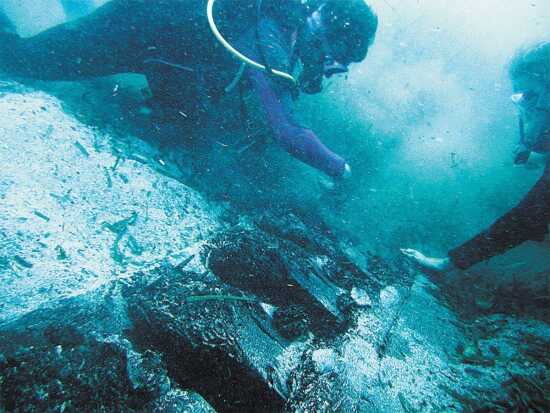
The divers dug hands and then arms into feet of dead seaweed until they felt something much harder than the vegetation. When they pulled their hands back, they noticed black markings on their gloves.
"I just started screaming into my regulator, which wastes oxygen really fast, but I was excited," Rickard said. "We were all really excited."
They had uncovered a small portion of a charred shipwreck, which initial tests have shown might date back to the 16th century, when many ancient battles for the control of Menorca's ports took place. -
Painting of lost Arctic vessel sold for $60,000 at auction
- On 15/09/2011
- In Auction News
By Randy Boswell - Vancouver Sun
Although the Canadian government failed to find the sunken HMS Terror during its high-profile search last month for the fabled Arctic shipwreck, an unidentified Canadian institution has secured an impressive consolation prize for the country: a historically significant and long-forgotten painting of the vessel that was auctioned this week in Britain.
A 175-year-old watercolour depiction of the ship, painted by the 19th-century artist and Arctic explorer George Back when he was commanding HMS Terror in 1836, sold at a Bonhams art auction on Tuesday to an unnamed Canadian museum or gallery for nearly $60,000 — more than double the expected price.
The picture shows the ship alongside an enormous iceberg in waters off Baffin Island, with one of Terror's lifeboats being rowed in the foreground close to a group of walruses.
Back's sketches and paintings of scenes observed during several 19th-century British expeditions to the Canadian Arctic are among the most important sets of visual documents of the country's early history.
The painting of the Terror emerged recently from a British family of Back's descendants, and experts were not previously aware of its existence.
A Bonhams spokesperson told Postmedia News that the painting was purchased for $58,000 by "a Canadian institution" at the firm's maritime art sale in London.
The painting had been expected to sell for between $15,000 and $25,000.
HMS Terror and its sister ship, HMS Erebus, have been in the news this summer because of a Parks Canada-led search for the wrecks of the ill-fated Franklin Expedition. -
Mystery boat discovered in Lake Monroe
- On 15/09/2011
- In Underwater Archeology
By Tom Knox - Daytona Beach News Journal
Archaeologist Jeff Moates had zero visibility as he dived into the brown water of Lake Monroe in search of a submerged shipwreck.
It was difficult to spot as he couldn't even see his hand an inch away from his face.
The picture was much clearer, though, on the 23-foot SeaCraft boat that Moates dived off last Wednesday. As he swam, extending his flippers to feel for where the boat should be, the crew on the boat followed his every movement.
"There he is -- fin and tank," commercial diver Todd Bosinski said of Moates. "Now he's swimming sideways."
Bosinski, owner of Blackwater Divers in DeLand, pointed to the outlined images of a long boat and a tiny man on his side imaging sonar device.
Bosinski and the team weren't seeking to recover gold from a wrecked Spanish galleon. He just wanted to find an interesting piece, perhaps something that could be in a museum. What they found wasn't museum-worthy, but interesting nonetheless: a boat believed to have plied these waters nearly a century ago.
Shipwreck research isn't Bosinski's day job. His 5-year-old company makes much of its money from inspecting bridges and storm drain pipes, or locating fraudulently abandoned boats for insurers.
His newest endeavor is finding sunken old-growth cypress logs. He's found 4,000 of them, although he can't yet excavate them until he gets the proper permits.Those logs are up to 10 times more valuable than conventional wood because of their rot-resistance and durability.
One of them that he's identified could be worth up to $100,000.
But last week, while his employees were dredging in Ocala, Bosinski spent the day on Lake Monroe in southwestern Volusia County.