HOT NEWS !
Stay informed on the old and most recent significant or spectacular
nautical news and shipwreck discoveries

-
Divers set sights on silver-laden WWII ship
- On 26/09/2011
- In Treasure Hunting / Recoveries

Photo OMEX
By William J. Broad - New York Times
In 1941, a Nazi torpedo tore a hole in a British merchant ship carrying a fortune in silver to England from India.The ship was part of a convoy headed for Liverpool, but it went down about 300 miles southwest of Ireland, disappearing in icy waters nearly three miles deep, deeper than the resting place of the Titanic.
Now, divers say they have found the wreck intact and they estimate its cargo at up to 240 tons of silver — a trove worth more than $200 million. They plan to recover it this spring.
The recovery, if successful, would be history’s deepest and largest retrieval of a precious cargo lost at sea and highlight the growing power of ocean technology, according to Odyssey Marine Exploration, the company that found the ship.It is working under contract to the British government and says it verified the ship’s identity this month.
“We were fortunate to find the shipwreck sitting upright, with the holds open and easily accessible,” said Greg Stemm, chief executive of Odyssey, which is based in Tampa, Fla. “This should enable to us to unload cargo through the hatches, as would happen with a ship alongside a cargo terminal.”
Mr. Stemm added that a growing number of seafaring nations view cargo recovery as a creative way to increase revenues.In such arrangements, private contractors put their own money at risk in costly expeditions and split any profits. Odyssey, for instance, is to get 80 percent of the silver’s value, and the British government 20 percent.
“It doesn’t cost taxpayers a dollar and accrues right to the bottom line,” Mr. Stemm said in an interview. “Governments are waking up to the potential.”
The ship carrying the valuable cargo was the S.S. Gairsoppa, a vessel of the British Indian Steam Navigation Company that was named for a spectacular waterfall near India’s western coast. In December 1940, it sailed from Calcutta laden with tea, iron and tons of silver.In Freetown, Sierra Leone, the ship joined a military convoy headed to the British Isles and the contested waters of the North Atlantic.
The merchant steamship, 412 feet long, had 83 crewmen and two gunners on board, according to Lloyd’s of London, which compiles information about cargo lost in war.
High winds and a heavy swell soon forced the Gairsoppa to slow. As the weather deteriorated, the captain judged that the wallowing ship had insufficient coal to make it to Liverpool and broke from the convoy for Galway, in western Ireland.
Then, a highly decorated German U-boat captain, Ernst Mengersen, moved in for the attack. It was Feb. 17, 1941. A single torpedo ripped through the Gairsoppa’s hull and exploded, causing the forward mast to topple and the antenna to snap, cutting off the ship from the world. The U-boat opened fire as the Gairsoppa sank.
All 85 men died save one — the second officer, who survived 13 days in a lifeboat.
In recent years, the famous lost cargo of silver began to beckon as technological strides resulted in new generations of sturdy robots, lights, cameras and claws that can withstand the crushing pressure of the deep. At least one company tried, and failed, to find the shipwreck.
In early 2010, Odyssey won an exclusive contract from Britain’s Department for Transport to salvage the cargo. This past summer, it hired a Russian ship and performed a preliminary survey in international waters, finding what it considered solid clues.
And this month, the company took its main ship, the Odyssey Explorer, to investigate the area. Its tethered robot took three and a half hours to descend 2.9 miles through dark waters to the muddy seabed. Then came a eureka moment, when the robot found a gaping hole where the torpedo struck 70 years ago.
The hulk of the Gairsoppa was covered in rivulets of rust known as rusticles, which look like brownish icicles. But still standing bright and shiny on the deck was a waist-high compass used by the helmsmen.There, small creatures with long tentacles had made themselves at home.
Odyssey says it confirmed the wreck’s identity from evidence including the number of holds, the anchor type, the scupper locations and red-and-black hull colors that matched the scheme used by the British Indian Steam Navigation Company. -
23 September 1779: “I have not yet begun to fight!”…
- On 25/09/2011
- In Famous Wrecks
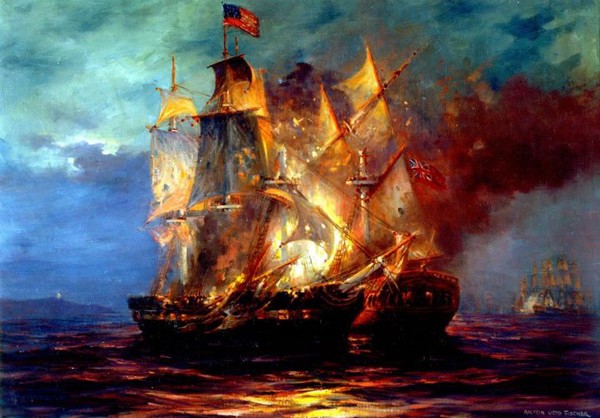
By Rob Almeida - gCaptain
On this day, 232 years ago, the 50-gun HMS Serapis engaged the Bonhomme Richard in the North Sea off Flamborough Head, England. Skippered by Captain John Paul Jones of the Continental Navy, the Bonhomme Richard was devastated inthe initial broadside between the two ships, losing much of her firepower and many of her gunners.Captain Richard Pearson, commander of the Serapis, called out to Jones, asking if he surrendered. Jones’ famous reply: “
I have not yet begun to fight !”
With the wind dying, and the decks of both ships strewn with the carnage of battle, the two ships became hitched together with grappling hooks. Sharpshooting sailors (Marines) in the rigging slowly picked off the the English sailors one-by-one.
Following a crippling broadside from the Continental Navy frigate Alliance, one that reportedly damaged the Bonhomme Richard as much or more so than the Serapis, Captain Pearson realized the futility in continuing the fight and tore down his colors, surrendering the Serapis.
-
Dive team searches for cannon another shot in Detroit River
- On 25/09/2011
- In Wreck Diving
By Elisha Anderson - Freep
The Detroit Police Department’s dive team plans to be back at it today – trying to locate an elusive cannon as part of a training exercise.
Divers dealt with poor visibility earlier this month when they tried to find the cannon dating back more than 200 years in the Detroit River. It’s expected to measure at least six feet in length and weigh 1,200 pounds.
“It was a little disappointing two weeks ago,” Detroit Police Sgt. Dean Rademaker said this morning.
He initially found the cannon covered in zebra mussels in July after spotting a silhouette on top of the sand. He dived for it two weeks ago and will dive again today.The cannon is located about 200 feet off the seawall near Cobo Center.
Visibility in the water two weeks ago was about 3-inches and under the water was dark, he said.
“Basically everything was being done by feel,’ Rademaker said.
Today visibility appears to be about 2-feet. The dive team plans to use GPS to get to the basic location, then will mark it off will a buoy and move the cannon closer to the seawall with a Detroit police boat.
-
Man to unveil underwater film of Wales’s famous shipwreck
- On 23/09/2011
- In Famous Wrecks

From Flintshire Chronicle
Never-seen-before underwater footage of Wales’s greatest shipwreck will be premiered next month – thanks to the work of a Flintshire couple.
The steam clipper Royal Charter, which was built in Sandycroft, was smashed against rocks off Moelfre, Anglesey, by the storm of the century – a Force 12 hurricane – with the loss of least 459 passengers and crew on October 26, 1859.
The ship was returning from Melbourne to Liverpool and laden with gold.
The film will be shown by diver Chris Holden, from Higher Kinnerton, who is treasurer of the Chester Branch of the British Sub-Aqua Club (BSAC).
Chris and his wife Lesley wrote of one of the definitive works on the tragedy – Life and Death on The Royal Charter.
He will show the video as part of a lecture on the 2,719-ton Royal Charter at the Chester Grosvenor Museum on October 25 – the eve of the 152nd anniversary of the tragedy.
Mary Tetley, chief executive of the British Sub-Aqua Club, said: “Chris and Lesley have done a phenomenal job in researching the story of the Royal Charter and the lecture will give us a new and fascinating insight into this maritime catastrophe.”
Along with unseen footage, the showing will be the first opportunity for many to see artefacts from the wreck.
Chris, who has dived the wreck since 1982, will also have at his talk Raymond Agius, a direct descendant of the heroic crewman Joseph Rogers (born Guze Ruggier in Malta), who – incredibly – managed to swim ashore with a rope helping to save lives.
Twenty-one passengers and 18 crew survived.
-
The mystery of Swissair Flight 111's diamond cargo
- On 23/09/2011
- In Airplane Stories

By Daniel Schwartz - CBC NewsAmong the mysteries about the crash of Swissair Flight 111 off the coast of Nova Scotia in 1998 is what happened to diamonds, rubies, emeralds and other gems that were supposed to be in the cargo hold.
Today they would be worth half a billion dollars.
Very little is publicly known about the gems. Three days before the crash, a popular exhibition,The Nature of Diamonds, closed at the American Museum of Natural History in New York. At least one piece from the exhibit was being shipped aboard the Swissair flight on Sept. 2.
Whoever had lent the item to the museum did not want any other information disclosed.
A total of one kilogram of diamonds and 4.8 kilograms of jewelry was being shipped on the plane. Jewelers regularly used the airline to transport gems.
The flight took off from JFK airport and then began to fly over the Atlantic Ocean, destined for Geneva, Switzerland, but a little less than an hour into the flight the crew noticed smoke and issued the international urgency signal "pan pan pan."
They were cleared to proceed to the airport in Halifax but crashed in the relatively shallow water off Peggys Cove, N.S. All 229 people aboard were killed.
98 per cent of plane recovered
The recovery effort, American Museum of Natural History in New York, retrieved 98 per cent of the aircraft and much of the 16 tons of cargo.
That effort included use of a suction-dredge vessel, which also retrieved rocks and other objects that had been at ocean bottom.
-
Letters about RMS Titanic sinking will cross the auction block in New York
- On 22/09/2011
- In Auction News

From Paul Fraser CollectiblesA historically significant, museum-quality archive of material pertaining to the doomed ocean liner the RMS Titanic will be offered on the first day of a three-day multi-estate sale planned for October 21-23 by Philip Weiss Auctions.
The event will be held in the firm's gallery facility in Oceanside, New York.
"It's rare when anything Titanic-related comes on the market, and when it does it's often a minor item," said Philip Weiss of Philip Weiss Auctions.
"But this is an incredible archive that came to us directly from a descendant of John and Nelle Pillsbury Snyder, who were rescued when the Titanic sank on the morning of April 15, 1912. This is sure to generate great interest."
Included in the archive is a letter written on Titanic stationery (and dated April 10, five days before the sinking); another letter, dated April 18, that talks about the confusion from news sources and the White Star Line (which built the Titanic) at the time of the sinking; and original photos taken from the rescue ship the Carpathia, showing lifeboats headed towards survivors.
Also included will be a group of possibly the only photos in existence of the steamship Californian, shown sailing toward the Carpathia in a belated rescue effort.
An inquiry at the time revealed the Californian was actually closer to the Titanic than the Carpathia, and even saw the rocket flares indicating a ship in distress, but for a variety of reasons it was slow to respond.
-
España gana a Odyssey también en el Tribunal de Apelación
- On 22/09/2011
- In Illegal Recoveries

Jesus Garcia Calero - ABC
El Tribunal de Apelación del Undécimo Circuito de Atlanta ha fallado hace tan solo unas horas rotundamente a favor de España en el juicio contra Odyssey Marine Exploration, dando la razón al Tribunal de distrito de Florida que juzgó el caso y emitió una sentencia ejemplarizante contra los cazatesoros en los primeros días del mes de junio de 2009.
Los responsables de Odyssey son derrotados en todos los puntos por la justicia americana que ha determinado que la fragata expoliada, un buque hundido en 1804 durante la batalla del Cabo de Santa María llamado «La Mercedes», es un buque de Estado y no un barco mercante, y también un cementerio de casi 300 marinos españoles que se hundieron con sus restos.
El general Diego de Alvear perdió en el naufragio a casi toda su familia, su esposa y dos hijos, después de que el fuego alcanzase la Santa Bárbara haciendo estallar la fragata «Mercedes» que, además, iba cargada de monedas de oro y plata. Los cazatesoros llenaron dos aviones con las monedas acuñadas en «El Callao» y las trasladaron en secreto desde el aeropuerto de Gibraltar con destino a su base en Tampa en mayo de 2007.
La polémica generada por este caso ha cambiado la conciencia sobre el patrimonio sumergido en España y ha cortado las alas a la influencia que Odyssey tenía en las altas instancias estadounidenses.
La decisiva ayuda de la US Navy a España, con informes técnicos, más la personación del Gobierno de Washington en favor de nuestra causa ha restado apoyos a los amigos del patrimonio ajeno. Entre los accionistas de Odyssey figuran senadores y miembros de la clase política de Washington que ahora ven afeada la conducta expoliadora. -
Odyssey to request En Banc hearing in "Black Swan" case
- On 22/09/2011
- In People or Company of Interest
From Yahoo Finance
Odyssey Marine Exploration, Inc., today announced that it will request an en banc hearing (a hearing before all the Eleventh Circuit Court of Appeals judges) in the "Black Swan" case and will point out that today's decision by a panel of only three judges from the Eleventh Circuit affirming the district court's dismissal of the case is contrary to other Eleventh Circuit opinions and rulings by the United States Supreme Court.
In today's opinion, the appellate court agreed with the lower court's finding that the U.S. federal court lacked jurisdiction over property recovered by Odyssey from the Atlantic Ocean in 2007.
The opinion concluded that the recovery was that of the sovereign immune shipwreck Nuestra Senora de las Mercedes, a Spanish vessel that perished in 1804, even though Spain's attorney admitted to the Eleventh Circuit panel that the majority of the coins aboard were not owned by Spain at the time of the sinking. Because no vessel was found or recovered at the site and identification was not certain, Odyssey code named the site "Black Swan."
Odyssey argued that even if the recovered cargo had originated from the Mercedes, that vessel was primarily on a commercial voyage when it sank, and therefore should not be considered as a "warship" having immunity from the jurisdiction of the court.
Judge Black, writing for the Eleventh Circuit, concluded that the Foreign Sovereign Immunities Act (FSIA) applied in the case because, "The shipwreck of the Mercedes is thus unquestionably the property of Spain." In an apparent contradiction however, the opinion also states, "We do not hold the recovered res is ultimately Spanish property."
Odyssey had also argued that sovereign immunity should not apply because Spain did not have possession of the recovered property, citing several cases requiring possession in similar admiralty cases, but the Court ruled that the FSIA does not require possession in order for a foreign country to claim immunity over its sunken warships.
The appellate court also affirmed the trial court's order which directed Odyssey to return the property to Spain, but according to the district court's ruling, this order is stayed until the appeals process is complete.