HOT NEWS !
Stay informed on the old and most recent significant or spectacular
nautical news and shipwreck discoveries

-
How to sink a Russian frigate
- On 07/09/2011
- In Wreck Diving
From Eugene Bonthuys - Compass Cayman
The sinking of the Kittiwake was all over the news recently. However, the trail had been blazed by another ship 15 years before, with the first arguably more unique than the second.
Although Little Cayman is world famous for its diving, Cayman Brac was, for once, in the shadow of its smaller sibling.In order to generate some more interest in diving the island, it was decided that a wreck sunk as an attraction for divers would be the ideal answer. A unique opportunity presented itself with the breakup of the Soviet Union, as a number of vessels were abandoned at naval bases in Cuba as the USSR pulled its military presence from the country.
The Cuban government had no use for the ships, so Cayman was presented with the opportunity to purchase a Russian military vessel, and for a little bit extra even have the Cuban government leave the deck guns on board.
After much negotiation and work, Patrol Vessel 356, a 330ft Brigadier Type II Class frigate, started its journey to Cayman Brac, a journey that it would never have dared attempt during the Cold War, and in September 1996, 15 years ago this month, she went to her final resting place on the seabed off Cayman Brac.
One of the people gathered to view the sinking of the vessel was author and underwater photographer Lawson Wood.
“The sinking was firstly highly charged with everyone driving their boats around, getting excited as the DoE, plus the Cuban tugboat tried to fill the ship with water, recalls Lawson.However, the excitement did not last, for as he recalls it was gradually replaced with boredom as the process dragged on.
“In reality, a fighting ship of this design is not expected to sink, even when under attack and filled with water! Eventually, of course she did go down amidst ships horns being sounded and shouting and cheering by all of the assembled boats and their guests.It was actually quite poignant and a little sad, to see this once great ship sink beneath the waves (with Jean-Michel Cousteau sitting in the crow’s nest !”
-
Expedition nets remains of 6 ships, fighter plane
- On 07/09/2011
- In Expeditions
From Erkki Sivonen - ERRIn the course of a joint Estonian-Swedish expedition this summer, maritime archeologists located the previously-unmapped remains of six ships in the West Estonian Archipelago and the Gulf of Riga.
Although already known to local fishermen and divers, by far the largest underwater object previously unmapped was the wreck of the German cargo steamer SS Meyersledge 15 meters below the surface near the island of Kihnu.
According to unconfirmed records, the 63-meter long steamer was sunk by the Soviet Air Force three miles off the coast of Kihnu on September 24, 1944.
"In the Suur Katel Bay [off the Saaremaa coast], we discovered remains of two ships that we are currently working to identify, and an Il-2 plane," Maili Roio, advisor at the Heritage Board and head of the underwater expedition.
The Il-2 was a Soviet ground-attack fighter used during World War II. Unfortunately, underwater visibility was extremely low at the time of the expedition, Roio said, therefore the archeologists could only retrieve sonar data rather than optical images.
-
Dives on Arctic wreck yield 19th century artifacts
- On 07/09/2011
- In Expeditions

Photo Brett Seymour
From Stephen Thorne - The StarArcheologists diving on a 19th century shipwreck have brought back a small supply of artifacts they hope will tell them more about the lost Franklin expedition.
With youthful enthusiasm, veteran staff from Parks Canada showed off ship’s fittings, copper hull plates, a British marine musket from 1842 and a pair of shoes plucked from the deck of HMS Investigator just eight metres beneath the freezing Arctic waters.
The former merchant ship made two voyages to the Arctic in search of Sir John Franklin’s storied expedition, but was abandoned in 1853 after becoming stuck in the once-impenetrable Arctic ice. The ship was found last year in Mercy Bay, off Banks Island in the Beaufort Sea.
“I’ve been doing this for over 20 years,” Marc-Andre Bernier, chief of underwater archaeology services, told a news conference Thursday. “This was probably the most phenomenal and exciting project — for all of us.
“To dive on that shipwreck that is literally frozen in time ... and having this phenomenal ship in front us standing proud on the bottom with artifacts on the deck was for us totally unprecedented.
“It was one of the highlights of our careers.”
A team of six divers, including one from the U.S. Parks Service, conducted more than 100 forays, aided by July’s midnight sun, under waters ranging in temperature from -2C to +2C.
What they found astounded even the most experienced among them.
Artifacts — including the shoes and a bent musket, its trigger guard altered to accommodate winter gloves — lay exposed on the ship’s decks and strewn on the sandy bottom.
Divers recovered 16 pieces, primarily to protect them from the ravages of time and ice, and to evaluate their overall condition.
-
Amateur diver finds 13th-century chest
- On 07/09/2011
- In Treasure Hunting / Recoveries
Recreational diver Andrei Ossiptshuk, diving in the Bay of Tallinn in August, came up with a merchant's chest dropped some eight centuries ago.
The chest lay among the rocks a little off the Tallinn waterfront at the depth of seven meters.
When opened, it yielded yellow brass scales, a set of tin weights, several leather knife sheaths, knife handles and some 13th-century coins.
According to Maili Roio, advisor at the Heritage Board, the find is unique and very well preserved. "I don't think there has been a find quite like this one".The objects probably belonged to a petty merchant in Tallinn, which by the 13th century had already become a major Baltic port and trade hub.
The Estonian History Museum has been tasked with the conservation of the rare antiques. -
Divers find artifacts from 1854 shipwreck in Northwest Passage
- On 05/09/2011
- In Expeditions

From Alaska Dispatch
A musket and other artifacts from HMS Investigator, the ship abandoned in the Canadian Arctic in 1854 during the hunt for Sir John Franklin's lost expedition, have been recovered by divers. The ship is credited with discovering the Northwest Passage.
Shoes, a musket, a copper sheet, and parts of the ship's rigging were among the items brought up over nine days this July from the wreck discovered last summer in Mercy Bay, off Banks Island in the Northwest Territories, in Canada's North. Divers were lucky enough to find the usually ice-covered bay largely open water during the expedition.
Archeologists photographed and mapped the ship using sonar and video to determine its state of preservation.
"Although the hull is basically survived up to the main deck, the main deck is a litter of timbers," Bernier said at a news conference.
The ship continues to be damaged by ice, he said, but there was a lot of sediment within the interior of the ship.
"This is basically the best conditions to preserve artifacts," he added.
The buried artifacts were left untouched, but about 16 lying outside and on the deck were recovered because they were exposed, and researchers feared they could become damaged before an expedition could return to the site.Bernier said the most exciting was the copper sheeting, which protected the ship's hull from marine organisms. That's because the copper can be chemically tested and compared to copper found at other sites to figure out whether those pieces originally came from HMS Investigator, or compared to the copper on other ships.
-
York expert to examine Lusitania finds
- On 03/09/2011
- In Famous Wrecks
From York Press
The expertise of a York conservator has been called upon by a team hired to examine new discoveries from a famous shipwreck.
Ian Panter, principal conservator at York Archaeological Trust, is heading to Ireland to work on items recovered from the underwater remains of the passenger ship RMS Lusitania, which sank off the Irish coast in 1915.
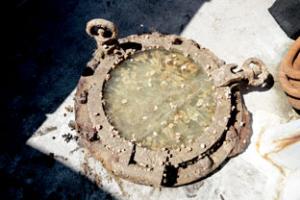
The latest finds – a telemotor, which was part of the ship’s steering mechanism, its telegraph and four portholes – were retrieved from the hull of the vessel last week in almost 330ft of water.
Mr Panter is also currently working on the Swash Channel wreck, the UK’s largest maritime archaeology project, from which a 400-year-old merman is currently on display at the DIG exhibition at York’s Hungate site, and has worked on two cast-iron cannons at the Tower of London recovered from the Elizabethan shipwreck off Alderney.
He said: “The Lusitania’s telegraph will, I hope, provide evidence of the very last command given to the engine room by its captain immediately after being hit by a torpedo. It could therefore shed more light on the events surrounding the so-called ‘second explosion’ which some people claim to have seen.” -
Wreck exposed by cyclone identified
- On 02/09/2011
- In Parks & Protected Sites
From Nine MSN
A shipwreck exposed when Cyclone Yasi hit north Queensland has been identified as the brigantine Belle, lost in 1880.
Months of detective work has confirmed the identify of the two-masted vessel, uncovered in Ramsay Bay, near Cardwell, after the monster cyclone hit in February.
The Belle was trying to recover cedar timber washed ashore from another wrecked vessel, the Merchant, when it sank.
"The identification is based on a match of records with the physical evidence - we are dealing with incomplete records and an incomplete wreck, so identification is based on probability," Environment Minister Vicky Darling said in a statement.
"But experts are satisfied that the Belle is the only likely contender out of the five vessels which are known to have been lost at Ramsay Bay."
Department of Environment Research Management's (DERM) principal heritage officer Paddy Waterson said historical records were obtained from England.
"The wreck was only partially exposed and the experts did not want to remove more sand unnecessarily in case it caused the remains to deteriorate more quickly," Mr Waterson said.
"Initial results were inconclusive so in June further investigations were conducted by archaeologists from DERM's Heritage Branch and the Museum of Tropical Queensland.
"The stern of the vessel had remained buried and it was important to examine that area to establish the length."
The Belle was built in 1865 in Canada and soon after made its way to Australia, where it operated out of Adelaide as a cargo ship. -
Caribbean pirate life: tobacco, ale … and fine pottery
- On 02/09/2011
- In General Maritime History
By Owen Jarus - Live Science
They smoked like the devil, drank straight from the bottle, annoyed the Spanish and had a fascination with fine pottery.
Oh, and they didn't use plates ... at least not ceramic ones.
Based in 18th-century Belize, they were real "Pirates of the Caribbean" and now new research by 21st-century archaeologists is telling us what their lives were like.Their findings, detailed in a chapter in a recently published book, suggest that while these pipe-smoking men acted as stereotypical pirates would — drinking, smoking and stealing — they also kept fancy, impractical porcelain in their camps. The fine dinnerware may have been a way to imbue the appearance of upper-class society.
From historical records scientists had known that by 1720 these Caribbean pirates occupied a settlement called the "Barcadares," a name derived from the Spanish word for "landing place." Located 15 miles (24 kilometers) up the Belize River, in territory controlled by the Spanish, the site was used as an illegal logwood-cutting operation.
The records indicate that a good portion of its occupants were pirates taking a pause from life at sea.
Their living conditions were rustic to say the least. There were no houses, and the men slept on raised platforms with a canvas over them to keep the mosquitoes out. They hunted and gathered a good deal of their food.
Capt. Nathaniel Uring, a merchant seaman who was shipwrecked and spent more than four months with the inhabitants, described them in the book The Voyages and Travels of Captain Nathaniel Uring (reprinted in 1928 by Cassell and Company) as a "rude drunken crew, some which have been pirates, and most of them sailors."
Their "chief delight is in drinking; and when they broach a quarter cask or a hogshead of Bottle Ale or Cyder, keeping at it sometimes a week together, drinking till they fall asleep; and as soon as they awake at it again, without stirring off the place."Eventually Captain Uring returned to Jamaica and, in 1726, published an account of his adventures.