HOT NEWS !
Stay informed on the old and most recent significant or spectacular
nautical news and shipwreck discoveries

-
Dives on Arctic wreck yield 19th century cache as Franklin search continues
- On 02/09/2011
- In Expeditions

By Stephen Thorne - The Winnipeg Free Press
Archeologists diving on a 19th century shipwreck have brought back a small cache of artifacts they hope will tell them more about the lost Franklin expedition.
With youthful enthusiasm, veteran staff from Parks Canada showed off ship's fittings, copper hull plates, a British marine musket from 1842 and a pair of shoes plucked from the deck of HMS Investigator just eight metres beneath the freezing Arctic waters.The former merchant ship made two voyages to the Arctic in search of Sir John Franklin's storied expedition, but was abandoned in 1853 after becoming stuck in the once-impenetrable Arctic ice. The ship was found last year in Mercy Bay, off Banks Island in the Beaufort Sea.
"I've been doing this for over 20 years," Marc-Andre Bernier, chief of underwater archeology services, told a news conference Thursday. "This was probably the most phenomenal and exciting project — for all of us.
"To dive on that shipwreck that is literally frozen in time ... and having this phenomenal ship in front us standing proud on the bottom with artifacts on the deck was for us totally unprecedented.
"It was one of the highlights of our careers."
A team of six divers, including one from the U.S. Parks Service, conducted more than 100 forays, aided by July's midnight sun, under waters ranging in temperature from -2C to +2C.
What they found astounded even the most experienced among them.
Artifacts — including the shoes and a bent musket, its trigger guard altered to accommodate winter gloves — lay exposed on the ship's decks and strewn on the sandy bottom.
Divers recovered 16 pieces, primarily to protect them from the ravages of time and ice, and to evaluate their overall condition.
The hull plates — one of which was lined with insulating felt — were particularly valuable archeologically, said Bernier. They will help identify pieces found elsewhere and perhaps point searchers toward Franklin's lost ships.
He said much of Investigator's interior is filled with sediment, likely preserving many more treasures of an age long past.
HMS Investigator was purchased and refitted by the British Admiralty in 1848, the same year the ship accompanied HMS Enterprise on James Clark Ross's expedition in a futile search for Franklin.
The vessel became trapped in the ice on the second trip and was abandoned three years later, on June 3, 1853. Investigator was inspected by crews of HMS Resolute a year later, still frozen in, and reported in fair condition despite having taken in water during the summer thaw. -
Treasure at site of 9/11 tragedy
- On 31/08/2011
- In Parks & Protected Sites

Photo Lucas Jackson
By Brian Handwerk - National Geographic
Archaeologists explore the newfound remains of an 18th-century ship's rear, or stern, at ground zero (map) in New York City last summer. With the tenth anniversary of the 9/11 terrorist attacks approaching, researchers found the ship's bow, or front, last month.
The unexpected piece of New York history turned up in the future parking garage of the new World Trade Center, which will eventually feature five new skyscrapers and the U.S. National September 11 Memorial & Museum.
Centuries ago, though-when Lower Manhattan's western shore was farther in-the site was an anchorage in the Hudson River.
"Right now we're standing by the theory that [the ship is] a Hudson River sloop, a merchant vessel," said archaeologist Elizabeth Meade of AKRF, an engineering firm contracted by the Port Authority of New York and New Jersey.
The World Trade Center ship "would have traveled up and down the river bringing cargo and people from the city to areas up north and might have gone as far south as the Caribbean."
Others have also suggested that the ship-which was likely deliberately sunk-may have done duty as a British troop carrier during the Revolutionary War. -
WW2 shipwrecks: monitors of climate change
- On 31/08/2011
- In Wreck Diving
By Tim Wall - Discovery News
A torpedo ripped through the port side of the passenger-freighter, City of Atlanta, and sent her to the bottom of the Outer Banks near Cape Hatteras. U-123 captain Reinhold Hardigan had found his fifth victim that night in the winter of 1942.Now, the wreck of the City of Atlanta is an artificial reefs and popular diving attraction.
During World War II, German U-boats and friendly minefields took a deadly toll of U.S. ships right off the North Carolina coast, near the famous civil war wreck, the Monitor. A National Oceanic and Atmospheric Administration (NOAA) study recently looked at the marine ecosystems supported by these WW2 era shipwrecks.They found that different wrecks supported different communities of fish and other species. They also placed temperature sensors to gather data which may corroborate evidence that the waters off North Carolina are warming and becoming home to more tropical species.
In June of 2010, NOAA researchers studied the wrecks of the Keshena, City of Atlanta, Dixie Arrow and EM Clark. They surveyed fish populations as well as other marine organisms, and determined that wrecks at different depths were home to different mixes of species. In general the mid-depth waters (20-40 meters) supported greater biodiversity.
While that was not surprising, the population survey established a baseline for watching changes in marine ecosystems as the waters warm up.North Carolina's marine communities are made up of a mixture of temperate and tropical species, due to the states' geographic location in a transition zone between north and south.
The Gulf Stream affects the southern portion of the state's waters around the wrecks of the Keshena and Dixie Arrow. Whereas the colder Labrador and Virginia currents affect the area north of Cape Hatteras, around the wreck of the City of Atlanta.
-
Blackbeard's Ship Confirmed off North Carolina
- On 31/08/2011
- In Underwater Archeology

Photo Robert R. Clark
By Willie Drye - National GeographicAfter 15 years of uncertainty, a shipwreck off the coast of North Carolina has been confirmed as that of the infamous 18th-century pirate Blackbeard, state officials say.
The Queen Anne's Revenge grounded on a sandbar near Beaufort in 1718, nine years after the town had been established. Blackbeard and his crew abandoned the ship and survived.
Until recently, the North Carolina Department of Cultural Resources emphasized that the wreck, discovered in 1995, was "thought to be" the Queen Anne's Revenge.
Now, after a comprehensive review of the evidence, those same officials are sure it's the ship sailed by one of history's fiercest and most colorful pirates.
"There was not one aha moment," said Claire Aubel, public relations coordinator for the North Carolina Maritime Museums. "There was a collection of moments and a deduction based on the evidence."
There were two main reasons for the team's certainty, Aubel said: the sheer size of the wreck and the many weapons that were found in the rubble.
No other ship as big as the Queen Anne's Revenge was known to have been in the area at the time, and a pirate ship would have been well armed, she said.
Blackbeard achieved his infamous immortality in only a few years, operating in the Caribbean Sea and off the coast of colonial America before being killed in a battle with British ships in North Carolina's Pamlico Sound in 1718. (Also see "Grim Life Cursed Real Pirates of Caribbean.")
Some historians have speculated that he deliberately ran the Queen Anne's Revenge aground so that he could keep the most valuable plunder for himself.
Such loot has helped archaeologists link the wreck to Blackbeard since excavations started in 1997. Among the major recovered artifacts are:
- Apothecary weights stamped with tiny fleurs-de-lis, royal symbols of 18th-century France. Queen Anne's Revenge was actually a former French ship, Le Concorde, captured by Blackbeard in 1717. He forced Le Concorde's surgeon to join the pirate crew, and a surgeon at that time likely would have had apothecary weights.
- A small amount of gold found among lead shot. Archaeologists think a French crewman might have hidden the gold in a barrel of shot to conceal it from Blackbeard's pirates.- A bell engraved with the date 1705.
-
Tales from sunkenships in Malaysian waters
- On 30/08/2011
- In Museum News
By Fadzli Ramli - Bernama
At a glance, nobody will be able to guess that Sharipah Lok Lok Sy Idrus is a researcher of ship wrecks, as well as an underwater treasure hunter.
Sharipah Lok Lok, who is the Assistant Curator of the Museum Department, has proven that her petite figure is no obstacle for her to conduct various types of salvaging work, including diving into the sea to retrieve items from sunken galleons, barges and man-of-wars.
"Small physical build is not a big challenge, but what is more important is my interest, and to me diving into the sea to see the treasures buried on the ocean floor is something exceptional," she said.
Sharipah Lok Lok spoke to reporters following a news conference held by the Director-General of the Museum Department Datuk Ibrahim Ismail in conjunction with the exhibition 'The Miracle of Shipwreck Treasures' being hosted here by the National Museum.
WANLI AND TANJUNG SIMPANG MENGAYAU
Sharipah Lok Lok made her first attempt at diving during the salvaging of 'Wanli', believed to have been attacked before going down in the waters off Dungun, Terengganu in 1630.
Wanli was found on Nov 1, 2003, 42 metres below the surface. However, among the challenges faced by Sharipah Lok Lok while diving was the high pressure at this depth.
This had forced Sharipah Lok Lok to stop halfway through her dive to stablise the pressure on her body and she could only stay two hours under the sea, compared with professional divers in the team who could remain under water for three hours.
She said what was retrieved from Wanli were broken and half-broken porcelain ceramics, similar to what had been recovered from other ship wrecks off the coast of Malaysia.
"This had revealed a picture of ceramics trading in Asia in the 17th century where merchants from Europe, including the Dutch, Portuguese and English, bought many ceramics from China," she said.
Sharipah Lok Lok said among the retrieved items were a mix of motifs including 'Kraak' and 'Transitional Wares' which had earlier been thought to have come from different times.
She said the motifs were crucial in determining the purpose of the porcelain ceramics, such as for weddings or religious ceremonies.
The sunken Tanjung Simpang Mengayau was the first vessel that Sharipah Lok Lok had experienced in research operations on sunken vessels. Tanjung Simpang Mengayau sunk after colliding with a reef some 700 metres from the Kudat coast in Sabah.
The vessel was laden with trade goods from China and thought to be from the Sung Dynasty era (960-1126) is believed to have sunk during that period.
"The wreck was 12.0 metres below the sea's surface. I did not make any dives, but was only carrying out research on the treasures retrieved from the ship," she said.
CERAMICS FROM THREE COUNTRIES
Meanwhile, during the news conference Ibrahim pointed out that the oldest wreck found in the South China Sea was 'Turiang,' believed to have gone down in 1370 and was found resting 42 metres under the sea.
He said the 26.0 metre-long ship, with its 7.5 metre-high mast, was made from wood and details indicated that the vessel was from China.
"It was found in May 1998 with ceramics cargo from China, Vietnam and Thailand. Among the recovered items were Turiang ceramics from China, a 'green-glazed' variety from Sisatchanalai, Thailand and under-glazed bowls from Vietnam," he said.
Another vessel with a consignment of ceramics that went down in 1830, some 2 nautical miles off the Desaru coast in Johor, was the 'Desaru'. It was discovered in 2001, some 20 metres under the sea.
Ibrahim said the 50 metre-long, 7 metre-wide ship is a junk from China and made from pine and cedar wood.
"No other junks were found earlier," he said, adding that the discovery shed new light on ship building methods in China during the 19th century.
He added that most of the blue-white porcelain discovered aboard the ship was believed to be bound for the Southeast Asian market. Among the items were tea and bowl sets, as well as plates with 'Lotus' markings.
The wreck of the vessel Singtai from China was found in April 2001 and has dispelled the theory that Sisatchanala was the only producer of 'under-glazed' ceramics.
"This was proven when the ship was found with 'under-glazed' Sisatchanalai and Sukhotai ceramics. The ship did not carry any celadon ceramics," he said.
The ship is believed to have sunk in 1550, some 12 nautical miles from Pulau Redang, Terengganu. It was discovered 53 metres beneath the sea surface. -
Showcase of treasures on display from 13 shipwrecks
- On 30/08/2011
- In Museum News
By Fadzli Ramli - Bernama
Seafarers from all over the world have sailed through the waters of Malay archipelago for centuries. Some of their vessels succumbed to inclement weather, leaks or attack and ended at the bottom of the sea.
Many came from China, the Middle East, as well as within the Malay archipelago.
"The ship wrecks are like time capsules, each with their own tales to tell," National Museum Director-General Datuk Ibrahim Ismail told Bernama after holding a news conference on the exhibition entitled 'The Miracle of Shipwreck Treasures,' at the National Museum here recently.
Ibrahim noted that the emergence of Melaka as a trading hub in the 15th and 16th centuries that attracted merchants from around the world.
"No surprise that some of the thousands of ships that crossed the seas to Melaka had sunk before reaching their destination. That is why the nation's waters are rich with the treasures from the ship wrecks," he said.
He added that efforts to search and recover ship wrecks in Malaysian territorial waters have been underway since the 1980s.
RISDAM, DIANA
The discovery of the sunken wreck of Risdam by a Singapore citizen on April 24, 1984 off the coast of Mersing in Johor ignited interest in ship wrecks around the country.
Risdam is believed to have sunk on Jan 1, 1727. The Dutch East Indies (VOC) vessel was 46 metres long, 15 metres wide, and 12 metres high.
Further, he said, the maritime archaeological work was carried out by the Johor museum authorities assisted by divers from the navy and the National Museum.
Among the items recovered were tin ingots, ivory, timber, and urns.
Another sunken ship, Diana, was discovered on Dec 21, 1993 by members of the Malaysian Historical Salvors (MHS) at the Melaka Straits. The government outsourced Diana's salvage operations to MHS.
"Most of the artifacts recovered from the wrecks were ceramics, some 11 tonnes of them that included plates, bowls, and tea sets. Some 24,000 white and blue China porcelain items were also recovered," he said.
Ibrahim indicated other items recovered from the wreck were herbs, such as green tea, ginseng, ginger, and rhubarb, as well as benzoin and glass beads.
SALVAGE WORK
The Malaysian Museum embarked on recovering ship wrecks in 1995 when its salvage team began to retrieve items from the sunken Dutch warship Nassau.
"Nassau sank some 5 kilometres off the Port Dickson coast, Negeri Sembilan. It was believed to have sunk on Aug 16 in the battle at Cape Rachado with Portuguese ships," he said. Cape Rachado is now known as Tanjung Tuan.
The salvage operation took place between August and December 1995 with the assistance from Transea Sdn Bhd, Mensun Bound, and Oxford University.
He said equipment like 'magnometer' and 'side scan sonar' were used to detect some 5,000 artifacts from the vessel that included muskets, anchors, bullets and ceramics.
The same year, another Chinese merchant ship, Nanyang that was believed to have gone down in 1380, was discovered in the waters near Pulau Pemanggil, Mersing, Johor. The wreck was found 54 metres under the sea.
"This ship exemplified a typical Chinese and Southeast Asia architecture and was 18 metres long and had a mast 5 metres high," Ibrahim pointed out.
He said the vessel's design gave some indication of the type of work ship builders were carrying out in Terengganu at the time. However, research on the wreck has yet to be carried out.
"400 ceramic items had been retrieved so far. Among the items recovered were pots, small bowls, earthen ware and huge urns with Sisatchanalai patterns," he said.
Sisatchanalai is an area in Thailand which was a centre for ceramics production in the 14th century.
-
Divers survey Scottish graveyard of first world war submarine disaster
- On 30/08/2011
- In Parks & Protected Sites
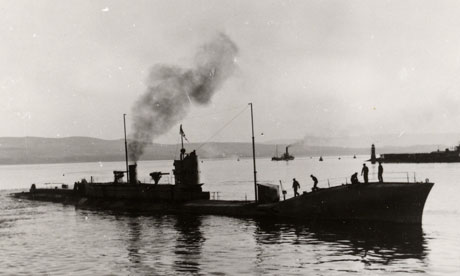
By Stephen Bates - The Guardian
Windfarm project to preserve wreckage from 'battle' of the Isle of May - navy's 1918 catastrophe that left 270 dead.An underwater war grave containing the victims of one of the worst British naval disasters of the first world war has been surveyed for the first time so it can be preserved in the middle of a windfarm.
The two K Class submarines were destroyed on 31 January 1918 during the so-called battle of the Isle of May, in which 270 lives were lost. The two submarines were sunk and three more damaged along with a surface cruiser.
But no enemy ships were involved in the sinkings, 20 miles off Fife Ness on Scotland's east coast. The deaths were all caused by a series of night-time collisions within the British fleet.
So embarrassing was the incident that even though one officer was court-martialed, the facts were not generally admitted for more than 60 years, until after the death of the last survivor.
Jim Rae, secretary of the Scottish branch of the Submariners Association, said: "It was an absolute bloody disaster from the beginning. The K Class submarines did not have a very impressive record. You can see why those who served in them were known as the suicide club."
The submarines proved far more lethal to their crews than to the enemy, so much so that the K was said to stand for Kalamity. Driven by oil-fired steam turbine engines, they were large and cumbersome, too slow to keep up with surface ships, hard to manoeuvre and stifling for their crews. Of the 18 that were built, none were lost in action but six were sunk in accidental collisions.
In January 1918, as British warships steamed north from Rosyth to join their fleet at Scapa Flow in the Orkneys, they were accompanied by two flotillas of the submarines. The first two subs found themselves bearing down on two minesweepers and changed course. The third, K14, veered to starboard to avoid colliding with them but performed a complete circle as its rudder jammed. -
Best preserved shipwreck found at Istanbul’s Yenikapi
- On 29/08/2011
- In Underwater Archeology

By Sevgi Korkut - Todays Zaman
In the course of the ongoing archeological excavations at the Yenikapı Marmaray construction site, the world’s best preserved shipwreck, a merchant vessel whose contents and wooden parts are in exceptionally good condition, was revealed.
The archaeologists believe that the ship is from the fourth or fifth century and that it sank in a storm. Surprisingly, most of the amphorae on the ship are in perfect condition.
The archeological excavation started in 2004 at the Yenikapı Marmaray construction site and reaches 8,500 years into the history of İstanbul. Skeletons, chapel remains, water wells and footprints, in addition to 35 shipwrecks, have been uncovered by archeologists so far.
A 15 to 16-meter-long, six-meter-wide shipwreck loaded with dozens of amphorae found last May brings new historical data to life.The amphorae are shaped and colored differently than previously found examples. It is assumed that the ship was completely buried in mud and that this oxygen-free atmosphere protected the vessel and its contents from breaking down or being damaged.
The ship was loaded with pickled fry, while almonds, walnuts, hazels, muskmelon seeds, olives, peaches and pine cones found on the shipwreck were also in good condition.
Archeologist Songül Çoban says they need two more months to completely uncover the shipwreck, which was found four-five meters below sea level, adding that they were working eight hours a day and that such a detailed excavation was demanding.
The shipwreck at Yenikapı is the only sample in near-perfect condition in terms of both wooden parts of the ship and its cargo in the world. When the shipwreck was first discovered, the mud above it was cleared away and the damaged top layer of amphorae was removed piece by piece, after which the team began removing the undamaged amphorae below them.After all of the objects are removed from the shipwreck, the hull of the ship will be given to İstanbul University.
Full story...