HOT NEWS !
Stay informed on the old and most recent significant or spectacular
nautical news and shipwreck discoveries

-
Franklin ships remain unfound
- On 27/08/2011
- In Expeditions
From CBC News
Archeologists in the Arctic hoping to find Sir John Franklin's long-lost ships neared the end of their latest search Friday with no shipwreck in sight.
It appears HMS Erebus and HMS Terror, two of the most sought-after wrecks in Canada, will remain undiscovered for now.
Parks Canada archeologists spent the last six days combing an area west of King William Island, where explorers seeking the Northwest Passage stopped or, in the case of Franklin, got stranded in ice.
Erebus and Terror vanished in the High Arctic more than 160 years ago, along with the famous British explorer and 128 crew.
This was the third year of a three-year-program to find Erebus and Terror, but searches for the two ships and remnants of Franklin's failed 1845 expedition began almost immediately after he disappeared.Marc-Andre Bernier, Parks Canada's chief of underwater archeology, says it is too soon to say whether the search program might be extended beyond this year.
Crews in two boats have been using sonar to map the ocean floor, he said. But a plan to use a new underwater robotic vehicle fell apart.
"We weren't able to deploy it," he said. "We're hoping if we continue next year, that's going to be available, but unfortunately for this year, we ran into some technical problems at the last minute, so that actually could not be used on this survey" -
Roman shipwreck full of wine jars found
- On 27/08/2011
- In Underwater Archeology

By Llazar Semini - StuffA US-Albanian archaeological mission claims to have found the well-preserved wreck of a Roman cargo ship off Albania's coast, complete with some 300 wine jars — all empty, alas.
The 30-metre long wreck dates to the 1st century BC and its cargo is believed to have been the produce of southern Albanian vineyards en route to western European markets, including France.
A statement from the Key West, Florida-based RPM Nautical Foundation said the find was made 50m deep near the port city of Vlora, 140 kilometres southwest of the capital, Tirana, early this month.
The foundation, in co-operation with Albanian archaeologists, has been surveying a swathe of Albania's previously unexplored coastal waters for the past five years. So far, experts have located 20 shipwrecks — including several relatively modern ones.
"Taking into consideration the date and also the depth — which is well suited for excavation — I would include it among the top 10 most scientifically interesting wrecks found in the Mediterranean," said Albanian archaeologist Adrian Anastasi, who participated in the project.
Officials said most of the jars, known by their Greek name of amphoras and used to transport wine and oil, were unbroken despite the shipwreck. However, the stoppers used to seal them had gone, allowing their contents to leak out into the saltwater.
Mission leader George Robb said the ship could have been part of a flourishing trade in local wine.
"Ancient Illyria, which includes present day Albania, was a major source of supply for the western Mediterranean, including present day France and Spain,' Robb said.
Team members retrieved one amphora for examination, before restoring it to the wreck. The site, whose precise location is being kept secret, will be left unexplored until the Albanian archaeological service is in a position to do so.
The monthlong mission ended last week and will be resumed next year. According to Albanian coordinator Auron Tare, it will eventually cover the whole Albanian coastline.
"These five years have shown how rich the Albanian underwater coastline is, and how interesting it could be for international tourists," he said.
-
Scientific advances may finally reveal Franklin’s lost ships
- On 26/08/2011
- In Expeditions

By Randy Boswell - Nunatsiaq NewsA Parks Canada-led team of researchers is trying — again — to unravel the ultimate Arctic mystery: the whereabouts of the lost ships of the ill-fated Franklin Expedition.
The experts are armed with everything from historical Inuit testimony and the scrawled writings of 19th-century explorers to state-of-the art seabed scanners and the latest computer simulations of ice movement through the Arctic Archipelago.
And while underwater archeologist Ryan Harris and his colleagues from a host of federal and Nunavut government agencies are optimistic that this could be the year for a worldshaking discovery, they know they’re not the first to harbour that hope.
Still, the veteran Parks Canada diver and marine historian is excited about fresh data being supplied by Canadian Ice Service scientists that should help the search team retrace what happened to the stranded Franklin ships more than a century and a half ago — and to help pinpoint where they might lie on the bottom of the Arctic Ocean.
“They’ve undertaken a historical ice climatology study to help us narrow our search area,” Harris said in a preexpedition interview. “It’s quite innovative.
It’s looking back at archived Radarsat ice imagery and trying to reconstruct patterns of ice formation, drift and breakup” in the waters known to have been sailed by Sir John Franklin when his ships — HMS Erebus and HMS Terror — fell prey to pack ice 165 years ago.The freeze-in led to the loss of the two vessels and, eventually, to the deaths of Franklin and all 128 men under his command.
“There were some very simple questions which we didn’t know the answer to, like what happens to the ice coming from Victoria Strait ?
Does it all go west of the Royal Geographical Society Islands or does it bifurcate ?” asks Harris, noting that a key pinch-point appears to lie where the Victoria Strait reaches the southerly Alexandra Strait near the southeast tip of Victoria Island.The ice “bottlenecks at the top of Alexandra Strait and that is the area where one of the vessels luckily made it through and the other got pinched and sunk.”
It appears that the ice data “reinforces our suspicion that there’s a big stoppage as it enters Alexandra Strait” and that “this is what imperilled the expedition in the first place.
-
Take the plunge: 4 incredible shipwreck dive sites
- On 25/08/2011
- In Wreck Diving

By Shira Levine - Fox News
Those who’ve sported SCUBA or snorkel gear and submerged beneath the surface of the sea have witnessed the fantastical underworld that lies below.Through the lens of a diving mask is a flooded universe where a symphony of plant life sways back and forth to the sub aqua beat, and gangs of fish nose around for something to eat.
To look out across a seascape is to delve into the dynamic and awe-inspiring; while at the same time observe something dark, scary and lonely.
While it's not eco-PC to dig man's underwater destruction, it is an otherworldly journey for the imagination to explore a ship or plane wreck via dive or snorkel. Marine life and their eco systems are surprisingly resilient.Submerged flora and fauna have no problem hopping onboard and moving into sunken ships once the waters have calmed.
UNESCO estimates that there are roughly three million shipwrecks worldwide and billions of dollars strewn across the ocean floor.Don’t get too excited. It costs about $4 million to send an underwater robot to hunt those treasures. Nevertheless, here are five wrecks to wreak exploratory havoc on in bodies of water all around the world.
MS Antilla
My first foray with sea wreckage was a close examination of the 400-foot long Antilla -- one of the largest wrecks in the Caribbean. Just off Aruba’s Arashi reef, the German freighter was initially used during World War II to provide provisions to submarines patrolling the Dutch Antilles.When Germany invaded Holland, Aruba joined forces with the Allies. Anchored in shallow waters, after being ordered to surrender in 24 hours, the German crew obliged, but the captain opted to scuttle the ship rather than let it fall under Allied control.
The Antilla sits at a shallow depth – peeking out of the surface and maxing out at a mere 60 feet. As a snorkeler, I was both dazzled and terrified by the ghostly presence of a ship that once was and now today is festooned with cheerful sponges, corals and a plethora of marine life that made the ship home.
SS Yongala
March marked the 100th anniversary of wreck located in the Great Barrier Reef Marine Park in Queensland, Australia.The Yongala hit the ocean floor in 1911 but was mysteriously undiscovered for more than 50 years despite all on board perishing. Considered one of the top wrecks in the world, the coral-encrusted ship attracts massive blue gropers and staggering schools of huge trevally, cobia, pinnate batfish and fingermark.
Not to mention bull sharks, marble rays and juvenile Humpback whales along with thousands of other sea creatures. The sea voyeurism continues when floating up closer to the surface where harmless sea snakes and turtles go about their business.
-
Scanners reveal a wreck on the bottom of lake Geneva
- On 25/08/2011
- In High Tech. Research/Salvage
From Physorg
The Russian submersibles involved in EPFL’s elemo project have discovered a new wreck on the bottom of the lake. Underwater archaeology is benefiting from scanners developed for scientific research.“It’s always a memorable moment when you find an unknown shipwreck. It’s not on the maps, and after having gone around it, I didn’t see any inscription on its hull,” explains Evgeny Chernyaev, who was piloting the submersible.
Diving off the shores of la Tour-de-Peilz, he was taking sediment samples.
The sonar indicated a large object off to one side. It was a sunken boat. The team was lucky; the portholes provide only a very limited range of vision and the sonar only sweeps 200m in front of the submersible, with an arc of 90°. The wreck is most likely an old barge used for hauling stone or gravel.
“The boat, about 30 meters long, could date from the end of the 19th or beginning of the 20th century. It must have sunk while navigating, because the anchor and other components were still on board, whereas boats that were sunk deliberately would have been stripped of all useful equipment,” explains Carinne Bertola, from the Musée du Léman in Nyon.Bertola, a specialist in shipwrecks, thinks that it was an old barge that transported materials extracted from quarries in the St. Gingolph area.
The pilot confirms this: “The state of the wreck leads me to think that it dates to the same time as that of the Rhône, which is not far away.”
At the bottom of the lake, where objects are covered in sediment and the visibility is bad, explorers can easily go right by a discovery. Fortunately, during this dive, Marie-Eve Randlett from EAWAG and Don Dansereau from the Australian Centre for Field Robotics were using a high-resolution scanner.This instrument helps them position the submersible correctly to take sediment samples at the desired depth, as well as make a precise map of the lake bottom.
-
Ship's story revealed in 435-year-old wreckage
- On 25/08/2011
- In Shipwrecks of the "New World"
By Carl Nolte - San Francisco Chronicle
Edward Von der Porten, a San Francisco nautical historian and archaeologist, has a sea story to tell - of disease and death and the shipwreck of a Spanish galleon full of the treasures of Asia.
He holds up a piece of delicate blue and white porcelain, part of a broken bowl. It shows a bird standing in a pond, a boat, a Chinese pagoda.
It is a piece more than 435 years old, salvaged from a bleak and remote beach in Baja California. It is part of the cargo of the galleon San Felipe, which sailed from Manila in the Philippines for the nearly unknown coast of California and the port of Acapulco, Mexico, in the summer of 1576.
The San Felipe was never seen again until the wreck was found not long ago, allowing its story to be told for the first time.
It is a centuries-old tragedy - a horrible last voyage that ended with the crew starving and racked with scurvy or some other dietary disease, so weak they could not sail the ship any longer. The San Felipe ran aground, everyone aboard dead or dying, "like a ghost ship," Von der Porten said.
The beach where the San Felipe ended up had no water, no food, no people. Even now, it is remote - "the middle of nowhere," Von der Porten said. -
Divers recover 'Lusitania' items
- On 24/08/2011
- In Expeditions
By Lorna Siggins - Irish Times
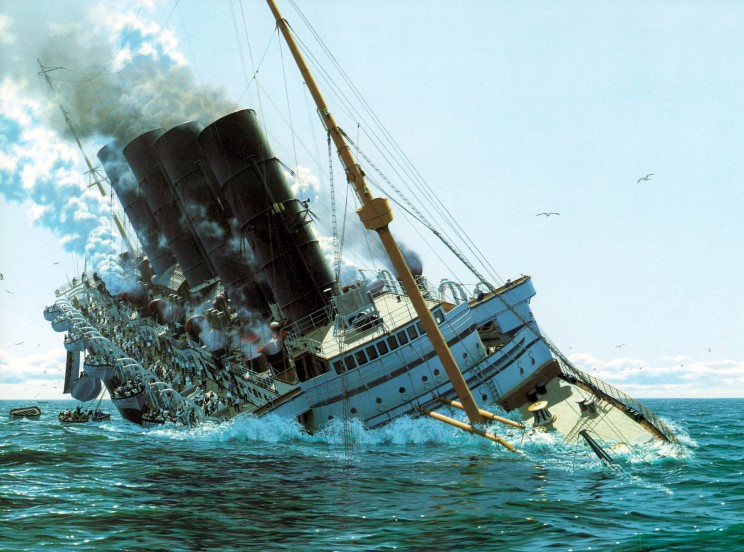
A diving expedition on the wreck of the Lusitania has recovered some key pieces of equipment, which were handed over to the receiver of wrecks last night.
A bronze telemotor, which was part of the ship’s steering mechanism, was among the items recovered from the vessel, which sank 11 miles off Kinsale Head, Co Cork, in 1915 after it was torpedoed by a German submarine.
The dive team, led by Eoin McGarry and sponsored by National Geographic, also recovered a telegraph, which controlled the speed and direction of the ship, and several portholes.
Receiver of wrecks and Customs and Excise officer for Cork Paddy O’Sullivan said he would be holding the items until such time as title was established.
Archaeologist Laurence Dunne, who was assigned under licence to supervise the diving expedition, said both the telemotor and telegraph would help to establish some of the facts surrounding the ship’s loss.
Mr Dunne told The Irish Times that the telegraph’s needle would show the direction in which the ship was heading after the last command was issued. -
Norway Seeks to Reclaim South Pole Explorer's Shipwreck
- On 23/08/2011
- In Expeditions
From Our Amazing Planet
A group of Norwegian investors wish to use balloons to raise the ship from its current resting place, load it onto a barge and send it across the Atlantic to be showcased in a museum.
"The incredibly strong-built oak ship has been helped by the Arctic cold and clean water to be kept in a reasonably good shape," said Jan Wanggaard, project manager for the Norwegian scheme, after a recent visit to the wreck, the AFP reported.The Maud, a 120-foot (36.5-meter) vessel named for Norway's queen at the time of Amundsen's explorations, was built to withstand frigid conditions. The ship left Norway in 1918 under Amundsen's command, with the aim of getting stuck in Arctic sea ice and floating through the Northwest Passage and across the North Pole.
Amundsen succeeded in the first of his goals — the ship spent years at a time locked in the ice. However, had he attempted the voyage in recent years, the explorer would have confronted very different conditions. Scientists have observed a steep drop-off in Arctic sea ice in recent decades.
Yet over the course of two expeditions, the first from 1918 to 1921, the second from 1922 to 1925, the ship never made it to the North Pole.
By 1930, the year the ship sank, Maud was serving as a warehouse and floating radio station in isolated Cambridge Bay, in what is now Canada's Nunavut province.Asker, a seaside Norwegian town, purchased the wreck from Canadian authorities for a single dollar in 1990, but their permit to move the vessel has now expired.