HOT NEWS !
Stay informed on the old and most recent significant or spectacular
nautical news and shipwreck discoveries

-
Archaelogists research 1619 shipwreck off Bermuda
- On 22/08/2011
- In Shipwrecks of the "New World"

By John Bordsen - Post Gazette
Piotr Bojakowski, 32, has been working in Bermuda for about a year as an archaeologist and conservator at the National Museum of Bermuda. We interviewed this native of Poland who has been researching the wreck of the Warwick, a 17th-century ship.
Q: What's the story on the wreck ?
A: In October 1619, the Warwick came to Bermuda with colonists and cargo; it was a stopping point for the English ship, which was bound for Jamestown in Virginia. The ship was here about a month, offloading some colonists and food and preparing to leave. But on Nov. 20, according to chronicles, a hurricane struck Bermuda.The Warwick's crew was prepped, but the moorings gave way and the ship crashed into the reefs and rocks surrounding the anchorage, one of the best inside Castle Harbour.
The ship was completely lost -- sunk with everything it still had on board. The governor of Bermuda, Capt. Nathaniel Butler, had been on board; he had a journal and wrote down events day after day. So we had very good data about the Warwick's location.
Q: You weren't sure where it was ?
A: This is one large bay. Everyone knew it was there ... but not exactly where the remains were.
Q: Over almost 400 years, there weren't "Look what I found!" discoveries ?
A: People started salvaging cargo and cannons right away. Butler came to the site a year later and recovered at least three cannon and barrels of beer.The following year, five more cannon and more provisions were recovered. The cannon went to the newly constructed Southampton port at the mouth of the harbor.
The ship belonged to the Virginia and Bermuda Company, so it was sort of protected.We know Butler issued a proclamation that everything looted had to be returned as the owners demanded. The only official salvage was by Butler.
-
Local shipwreck now eligible for National Register
- On 21/08/2011
- In Parks & Protected Sites

By Wes Helbling - Bastrop Daily Enterprise
A large steamboat that burned and sank in Morehouse Parish over a century ago has been recorded as an archaeological site with the state of Louisiana.
For decades the subject of local legends, the sunken boat is now designated as “Big Horn Steamboat Wreck,” Archaeological Site No. 16MO185.
The “MO” stands for Morehouse, and the “185” means this is the 185th archaeological site reported in the parish.
Dennis Jones with the state Division of Archaeology and marine archaeologist Allen Saltus Jr. with Archaeological Research Inc. conducted the first formal study of the wreck last month.
Field notes and subsequent historical research are included in the site record, which states the boat may have research potential as an example of a vessel that “was part of riverine commerce and transportation before the advent of railroads.”
Although the boat is in poor condition, further research could make it eligible for the National Register of Historic Places. Jones explains:
“Having the site listed and recommended as eligible for the National Register will mean that if there are any future projects on this part of Bayou Bartholomew -- by the U.S. Army Corps of Engineers, for example -- then this site would have to be taken into account and the project’s impact considered.”
In addition, he said, the site “is within a navigable waterway of Louisiana and is thereby legally protected as state property. Anyone looting or damaging archaeological sites on state property would be committing a crime.” -
Divers examine 19th century shipwreck
- On 20/08/2011
- In Underwater Archeology
From Viêt-Nam News
An inter-disciplinary team from different agencies in the central province of Thua Thien-Hue has begun to survey a shipwreck believed to date back to the early 19th century.
The survey is conducted to assess the feasibility of salvaging the ship and help authorities make a decision.
The shipwreck is located two metres underwater and 100m off Xuan Thien Ha Beach in Phu Vang District's Vinh Xuan Commune, said Phan Tien Dung, director of the Thua Thien-Hue Department for Culture, Sports and Tourism.
Dung said the survey will last for ten days and will be carried out with the support of divers, workers and special equipment from Hue City.
Based on the survey results, provincial authorities will decide whether or not the ship should be lifted from the site, Dung told Viet Nam News.
The 60m long, 10m wide steam-powered ship was discovered some 60-70 years ago and has been visited many times since by antique collectors and scrap merchants. Most of the ship is currently buried under sand.
In early 2011, Nguyen Cong Tinh, owner of a scrap shop in Hue city, was granted permission from Phu Vang District's military command to exploit the shipwreck further.
However, on May 29 this year, the provincial People's Committee issued a decision to revoke the permission and suspend exploration of the ship, said Tran Van De, chairman of the Vinh Xuan Commune People's Committee.
-
Roman shipwreck found off Albanian coast
- On 20/08/2011
- In Underwater Archeology
By Sean McLachlan - Gadling
An underwater archaeological survey has turned up a Roman shipwreck off the coast of Albania.
As the above video shows, the remains of the ship are now little more than a heap of amphorae, the characteristic pots the Romans used to transport wine.The team hasn't had a chance to excavate the site yet, so more finds may lie hidden beneath the bottom of the sea.
The archaeologists estimate that the ship was from the first or second century BC and was part of an extensive wine trade on the Adriatic Sea.
The ship was about 30 meters long and contained an estimated 300 or more amphorae. The excavation was funded by the RPM Nautical Foundation, which has discovered numerous shipwrecks in recent years.
Shipwrecks can tell us a lot about early technology and trade. Several museums are dedicated to them.
In Stockholm, Sweden, the Vasa Museum houses the well-preserved remains of a warship that sank in 1628.Despite its impressive appearance, it was badly designed and sank less than a nautical mile into its maiden voyage.
In Portsmouth, England, the Mary Rose Museum has a warship that sank in battle in 1545.
The Viking Ship Museum in Roskilde, Denmark, houses five Viking ships dating to about 1070. -
'New Vasa' shipwreck found on Baltic seabed
- On 20/08/2011
- In Underwater Archeology
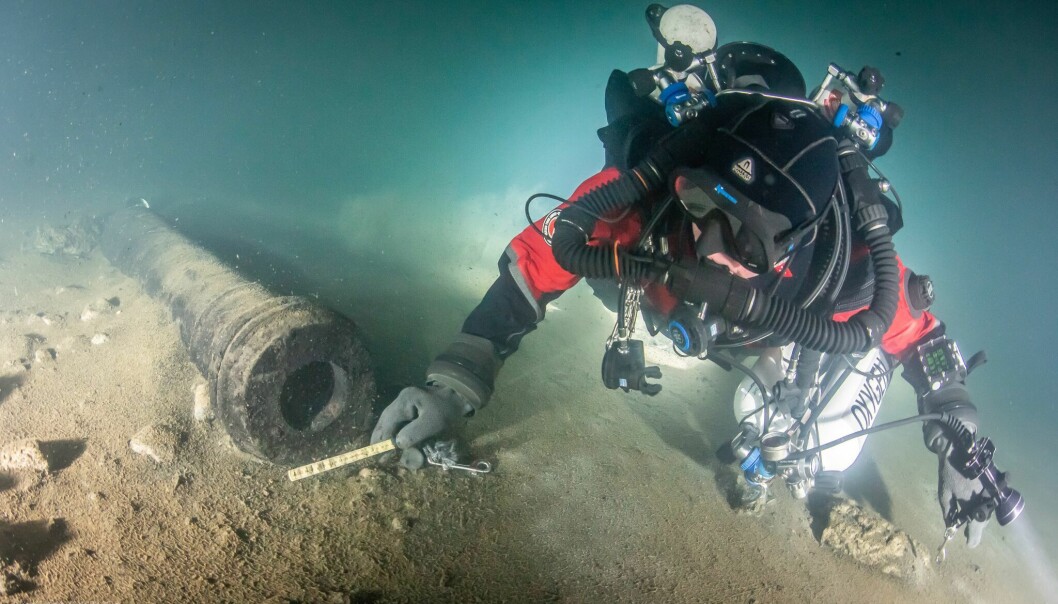
By Rebecca Martin - The Local
Swedish divers have uncovered what they believe to be the legendary Swedish warship Mars, lost in a sea battle with the Danish-Lübeckian navy in 1564, near the coast of the Baltic island of Öland.“The ship is lying port-side up and the site is virtually littered with cannons," said diver Richard Lundgren to The Local.
Mars was one of the largest ships of its time with 107 guns and a crew of 800 men, both out-sizing and outgunning the famous warship Vasa, which has been on show in Stockholm since it was lifted from city's harbour in the 1960s.
Divers have been searching for the legendary Mars for decades. And on Friday it was announced that it might have been found.
“We certainly don’t know of any other ships sinking near those coordinates,” said Andreas Olsson, head archaeologist at the Royal Swedish Maritime museum (Sjöhistoriska muséet).
The shipwreck was discovered at a depth of 75 metres, near the northern promontory of the Baltic island of Öland off of Sweden's east coast. The wreckage is reportedly solid oak and the seabed is strewn with bronze cannons.
The Mars was the largest ship in the Baltic in its heyday and was sunk, only a year after its maiden voyage, during a sea battle with the Danish-Lübeckian navy in 1564.
After two days of ferocious fighting, Mars was hit by cannon fire and went up in smoke. In the ensuing kerfuffle the vessel went down and has been resting untouched in its watery grave for 447 years.
According to Olsson, everything is pointing to it being Mars that the divers have come across. However, archaeologists can’t be completely sure until they have examined the shipwreck.
-
Sunken treasure sparks legal tussle
- On 20/08/2011
- In Treasure Hunting / Recoveries
By Tom Hals - Swissinfo
It was an eye-popping investment pitch no one else could match -- in return for $2 million (1 million pounds), Manhattan accountant Neil Ash was offering investors a stake in the one of the biggest sunken treasures ever, an underwater site teeming with emeralds.
The hitch: When Ash took backers to a Citibank vault to inspect gems that had quietly been recovered from the sea, they were gone.
That set in motion a complicated and colourful legal scramble to lay claim to a trove of emeralds worth up to $500 million, according to court documents.
It's a story marked by accusations of double-dealing, corporate mutiny and deceit. The cast includes an investor who once oversaw Citigroup's hedge fund business, a Democratic Party insider who has hosted the Obama family at his Hawaii getaway and an unlikely amateur treasure hunter.
The main legal dispute has played out quietly in Delaware's Chancery Court, where Jay Miscovich, a retired doctor who apparently found the emeralds, has battled against his investors who tried to seize control of the company that they say owns the treasure.A settlement was approved Friday, but if the treasure is as striking as court documents suggest, there are probably more legal fights to come.
"It's just amazing to me, it's nearly like a movie script," said Paul Horan, Key West's go-to attorney for treasure salvors, of the case. "You just scratch your head and ask what the hell is going on."
The main players in the drama are bound to silence by confidentiality agreements. Most sensitive details have been redacted from court documents. It's never even revealed where the sunken treasure is located, or thought to be located. The filings from each side that are public contradict eachother, and despite the settlement each side negates the other's accusations.
"CACHE" DISCOVERED
To the degree a story can be pieced together, it goes something like this.
In early 2010, Miscovich, an investor in sunken treasure excavations, claimed to have located a site and recovered a "cache" of precious stones.
To pay for the pricey recovery work, Miscovich turned for assistance to his brother Scott, a Hawaiian physician. Scott connected Jay with Dean Barr, the former Citigroup hedge fund executive, who in turn, brought in Ash the accountant. In the summer of 2010, the pair agreed to pony up roughly $2 million, according to the partnership agreement, although the two sides differ on how much of that they actually invested.
Almost immediately, things soured. The investors suspected the Miscoviches were scheming to keep the most highly prized gems for themselves -- a concern fuelled by the empty safe deposit box episode.
Their worst fears seemed to be confirmed when Ash, the accountant, was contacted by Gerry Edwards, a diver working on the recovery efforts in Florida. Recounting the conversation to Reuters, Edwards said he told Ash that boxes of emeralds were being stashed out of the investors' reach in Key West.
Soon after Edwards' call to Ash, the investors sued. They wanted a ruling that Jay Miscovich had breached his contract with the investors and that they could seize control of the partnership.
-
Diving into Jersey shipwreck history
- On 19/08/2011
- In Wreck Diving
By Kelly Nicholaides - North Jersey
Early maritime navigation challenges, weather conditions and greedy shippers pocketing insurance money have led to over 5,000 shipwrecks in New Jersey, according to Chet Nesley, a Professional Association of Diving Instructors master instructor.Nesley, who has logged over 4,000 dives in water ranging from 20-160 feet deep for shipwrecks, discussed maritime and shipwreck history, complete with a PowerPoint slideshow presentation, color photos and artifacts at the Meadowlands Environment Center in June.
"A shipwreck never gives up all its booty. There's always something to find," Nesley notes.
In maritime history, navigation tools and a seaworthy vessel were keys to preventing shipwrecks. A wooden ship depended on the wooden rods that held them together before nails existed.
"The wood swelled up in water, making it a tight fit. Sawdust filled in the spaces in between, so you had a watertight ship. The worst thing for a wooden ship is keeping it dry," Nesley says.
One such rod, a "treenail," is among Nesley's treasure troves from his shipwreck dives. But preserving the items is just as difficult as finding them.
"If you're not going to preserve it, don't bring it up," Nesley notes. "I had to soak this in freshwater for six months. I stuck it in my toilet tank."
How and why vessels had sunk is equally important as a ship's artifacts, he explains. "The challenges of early shippers was they had no GPS, no radar, no radio.The best charts were made by the British navy, who surveyed harbors and charted landmarks, all by hand. You had to have a good handle on math, trigonometry and algebra," Nesley says.
Getting lost was not uncommon.
"But as long as you could see the moon, the sun or the North Star, you had an idea where you were," Nesley explains.
Navigation was tricky. Vessels that got lost in a fog or made complex navigational errors include warships, passenger liners, freight, fishing and clamming boats. Even if shippers knew the latitude, longitude was not easy to find.
"You needed the time at prime meridian and local time," Nesley says.
"Dead reckoning" used the course, speed and time to figure out the position.
-
Diving trail puts Panhandle's sunken treasures on the map
- On 19/08/2011
- In Wreck Diving
By Kimberly Blair - PNJ
Pensacola has become a scuba diver's mecca, thanks to the Oriskany.
Divers travel here from all over the world to dive the aircraft carrier of the Korean and Vietnam war-era, sunk in 2006. As an artificial reef, it offers a challenging, deep-water dive 22 miles southeast of Pensacola Pass.
In fact, the sandy bottom of the Gulf of Mexico between Pensacola and Panama City is a watery grave for dozens of other ships-turned-reefs, with equally storied pasts and diving thrills.
A state Division of Historical Resources project is in the works to create a Panhandle Shipwreck Trail featuring the most interesting of these wrecks. Fifteen are under consideration.
"Our goal is to showcase the Panhandle as the diverse and exciting dive destination that it is," said underwater archaeologist Roger Smith, who is part of that division and is spearheading the project. "Pensacola has one of the earliest battleships, the Massachusetts. It's one of my favorite shipwrecks. It participated in the Spanish American War in the Gulf."
Smith was awarded a $60,000 National Oceanic Atmospheric Administration grant through Florida Department of Environmental Protection's coastal management program to pay for the project.
Expected to be launched by spring, the project calls for posting the history and diving details of each ship on an interactive website so people may "virtually dive" without ever getting their flippers wet.
Divers who come here will be able to sign up for a "trail passport" that challenges them to return to get their passport stamped with each completed dive.
Pensacola diver Bryan Clark believes the passport idea is clever.
"Most divers love a challenge," he said. "The shipwreck trail provides us with a goal that we can strive for while having fun diving and exploring Northwest Florida."