HOT NEWS !
Stay informed on the old and most recent significant or spectacular
nautical news and shipwreck discoveries

-
Family seeks closure from WWII off NC coast
- On 19/08/2011
- In Miscellaneous
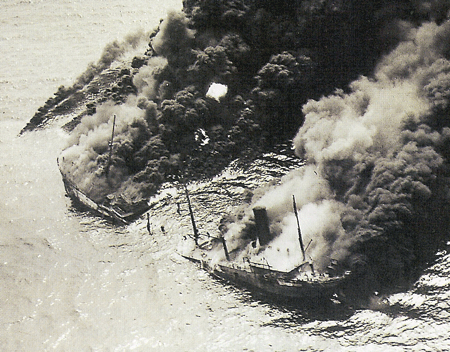
By Brock Vergakis - Muscatine Journal
Nearly 70 years after Capt. Anders Johanson was killed during World War II off the coast of North Carolina, his family is getting ready to finally pay their last respects.
Johanson was aboard an oil tanker making its way from Texas to New Jersey when a German U-boat fired three torpedoes at the Dixie Arrow on March 26, 1942, bursting thousands of barrels of oil aboard the ship into flames off of North Carolina's Outer Banks. His family will revisit the site of the wreckage Wednesday.
Survivors of the blast who were brought to Norfolk after being plucked from the sea told reporters at the time that Johanson survived long enough to order boats and life rafts launched _ which helped save 22 members of the 33-man-crew _ before being engulfed in searing flames as the ship sank. His body was never recovered.
More than half a century later, his family is still trying to come to terms with his death.
"He stopped in Jacksonville (Fla.) and asked for a destroyer escort and the destroyer came out and said, `Sorry brother, everything's OK. Don't worry about it," said Johanson's grandson, Dale Revels of Orlando, Fla., who along with his mother and uncle will be visiting the wreckage site for the first time as the guests of federal researchers examine World War II wrecks.
"It was basically a personality failure of the American Navy."
Johanson never received the public recognition that so many others who lost their lives in World War II did. There was no funeral for his wife and two young children to honor the Swedish immigrant, who was on his last cruise for the Merchant Marine before rejoining his family in Brooklyn, N.Y.
Johanson's family struggled in the chaos after his death. They were uprooted from New York and had to stay with family in Beaumont, Texas before a family death there left them with no home. They stayed at boarding home in New Orleans before eventually moving in with other family in Belleview, Fla., where questions for the newcomers were constant.
"When I was going through high school, I didn't have a father. During that time everybody seemed to have a mother and a father and people would ask me, `Where's your father?'" said Johanson's daughter, Jeanne Johanson Revels, now 83 and living in Port Orange, Fla.
"They had this big campaign about loose lips sink ships in 1942 during World War II. Those two men came to see my mother said we couldn't say anything about it. I guess it was classified information and you couldn't talk about it at all."
-
Sunken Treasure ?
- On 18/08/2011
- In Underwater Archeology

Photo Tane Casserley - NOAA
From National Geographic Daily News
Off Bermuda, archaeologist Jim Delgado examines fragments of a paint can found in the wreck of the paddle wheel steamer Mary Celestia, a Civil War-era blockade runner that sank 147 years ago.
After storms this past winter had swept silt from the wreck, a Bermudan government expedition discovered newly exposed artifacts, including fragrance bottles and unopened—but strong-smelling—wine.
On September 6, 1864, pilot John Virgin was at the helm as the Mary Celestia left the harbor at Southampton, Bermuda, which was then, as now, a British territory. The Civil War was in its third year, and the fast vessel—bound for Wilmington, North Carolina—was loaded with rifles, ammunition, and other supplies desperately needed by the Confederate States.Virgin raced the roughly 255-foot-long (68-meter-long) Mary Celestia toward the open Atlantic, only to hit rocks and reefs. Within minutes the Mary Celestia and its cargo were on the bottom of the ocean.
Salvagers quickly recovered the war supplies from the smashed ship, but the bow, or front, of the wreck was soon covered with silt and lay undisturbed, some 60 feet (18 meters) down, until the recent tempests. -
Captain Morgan finds marketing gold sponsoring salvage
- On 17/08/2011
- In Famous Wrecks
By Jennifer Sokolowsky - Brand Channel
Any old alcohol brand can sponsor a sports event or an arena, but Captain Morgan spiced rum has found a more unique opportunity: the underwater exploration of a ship thought to belong to Admiral Sir Henry Morgan – the rum brand’s notorious namesake – that sunk off the coast of Panama in 1671 along with four other ships.
The announcement that Morgan’s flagship, the Satisfaction, had been found by a team of divers and archaeologists led by Texas State University was made earlier this month, while Captain Morgan parent Diageo sent out its own press release announcing its sponsorship of the project.
But Captain Morgan offered a grant to the archaeologists last September, after the team recovered six iron cannons from a nearby site also believed to be from one of Morgan's ships and additional funding was needed to explore the surrounding sites.
Captain Morgan called the sponsorship opportunity “a natural fit” and did not miss the chance to drive its brand message home: “Captain Henry Morgan was a natural-born leader with a sense of adventure and an industrious spirit that the brand embraces today," said Tom Herbst, Brand Director, Captain Morgan USA.
Captain Morgan’s sponsorship of an underwater archaeological project is not the first such corporate venture– Sony and Intel sponsored Project Shiphunt earlier this year to allow a group of Michigan high school students to discover an historic sunken ship in The Great Lakes using Sony VAIO laptops – but it is garnering some powerful publicity, with most stories about the find prominently mentioning the rum and its sponsorship of the watery dig.
-
Judge: Salvage firm has title to Titanic artifacts
- On 17/08/2011
- In Famous Wrecks

By Larry O'Dell - NewsOK
A federal judge on Monday granted a company title to fine china, ship fittings and other artifacts worth about $110 million that it recovered from the Titanic in a half-dozen perilous expeditions to the famous shipwreck.U.S. District Judge Rebecca Beach Smith in Norfolk issued the order a little over a year after ruling that RMS Titanic was entitled to full compensation for the roughly 5,900 artifacts. In her August 2010 ruling, Smith postponed deciding whether to give RMS title to the artifacts or sell them and turn the proceeds over to the company.
Brian Wainger, an RMS attorney, did not immediately return voicemail messages.
Smith's ruling requires RMS to comply with "covenants and conditions" the company previously worked out with the federal government, including a prohibition against selling the collection.The conditions, which accompanied last year's ruling, also require RMS to make the artifacts available "to present and future generations for public display and exhibition, historical review, scientific and scholarly research, and educational purposes."
Premier Exhibitions Inc., the Atlanta-based parent company of RMS, has been displaying the Titanic artifacts in exhibitions around the world. The items include personal belongings of passengers, such as perfume from a maker who was traveling to New York to sell his samples.
According to the covenants, RMS is required to meet professional standards for preservation of the artifacts. RMS will be allowed to sell or otherwise dispose of individual items only if they are deemed of no cultural, historical or aesthetic value, or are in such poor physical condition that they cannot be restored.
The Titanic sank on its maiden voyage on April 15, 1912, killing more than 1,500 of the 2,228 passengers and crew. An international team led by oceanographer Robert Ballard located the wreckage in 1985 on the North Atlantic seabed, about 400 miles off Newfoundland, Canada. -
Sunken treasure found in the seas of Sicily
- On 14/08/2011
- In Underwater Archeology
By Rossella Lorenzi - Discovery News
Italian archaeologists have retrieved a sunken treasure of 3,422 ancient bronze coins in the small Sicilian island of Pantelleria, they announced today.
Discovered by chance during a survey to create an underwater archaeological itinerary,the coins have been dated between 264 and 241 BC.At that time, Pantelleria, which lies about 70 miles southwest of Sicily, in the middle of the Sicily Strait, became a bone of contention between the Romans and Carthaginians.
Rome captured the small Mediterranean island in the First Punic War in 255 BC, but lost it a year later.
In 217 BC, in the Second Punic War, Rome finally regained the island, and even celebrated the event with commemorative coins and a holiday.Lying at depth of about 68 feet, the coins most likely represent an episode of the Romans and Carthaginians struggle.
Amazingly, all 3,422 coins feature the same iconography.
On one side, they show Kore/Tanit, the ancient goddess of fertility, whom Carthaginians worshipped on the island around 550 BC.On the other, the coins display the head of a horse, surrounded by symbols such as stars, letters and a caduceus. A staff often surmounted by two wings and entwined with two snakes, the caduceus was the symbol of Hermes, the messenger of the gods in Greek mythology.
-
Local diver shares mysteries of the deep
- On 14/08/2011
- In People or Company of Interest
By Zach Levine - Howell Patch
Dan Lieb, of the New Jersey Historical Divers Association, presented a vast array of information on deep sea diving and shipwrecks to patrons of the Howell Public Library on Thursday evening.For most of Dan Lieb’s life, he has been fascinated with what is found under the surface of the ocean.
During his career as a member of the New Jersey Historical Divers Association (NJHDA), Lieb has helped locate 13 shipwrecks under the waters. He shared his vast knowledge of shipwrecks with patrons of the Howell Township Public Library on Thursday evening.
This event featured Lieb giving a slideshow presentation documenting the history of shipwrecks in the Garden State.
He began by asking the audience what famous shipwrecks they knew of, and he got back answers including Titanic, and Lusitania. He brought up a more famous local shipwreck, the Morro Castle, saying that he thought this shipwreck which took the lives of 137 individuals was much more fascinating than that of more well known shipwrecks like the Titanic.
“What happened with the Titanic was a mundane accident,” he said. “On the Morro Castle, you had scenes of corruption and murder, much more interesting events.”
Lieb then went into his presentation on shipwrecks, explaining that in the 1840’s, insurance companies did not want to offer monetary supprt to ships heading to New Jersey, since a great number of ships would end up getting shipwrecked. He explained these ships would crash through a myriad of causes, including storms, mechanical failures, collisions with other ships and even explosions.
“There have been about 7200 cases of shipwrecks off the coast of New Jersey,” he said, adding that number was just under the amount of ships that have crashed in all five of the Great Lakes combined. -
Crean recorrido virtual del buque “Laguna de Mandinga”
- On 14/08/2011
- In Parks & Protected Sites

Por Antonio Domínguez - La Gran Época
El Estado impulsa un proyecto que se adhiere a no negociar el patrimonio cultural de la arqueología subacuática con los llamados "buscadores de tesoros".Profesionales del Instituto Nacional de Antropología e Historia (INAH-Conaculta), de México, elaboraron un recorrido virtual subacuático de 360 grados, que está puesto en Internet, y que da cuenta de la labor de investigación, conservación y protección del buque “Laguna de Mandinga sumergido en la costa de Isla Cozumel, Quintana Roo, informó INAH el 4 de agosto.
Arqueólogos de la subdirección de Arqueología Subacuática (SAS) realizaron desde septiembre 2010, una exploración del buque de 20 toneladas “Laguna de Mandinga” hundido intencionalmente por la Armada, a 12 metros de profundidad en la costa de la Isla Cozumel.
El Buque “Laguna Mandinga” fue un navío de la Armada de México que patrulló por muchos años las costa del Mar Caribe, y que fue hundido con el objetivo de crear un arrecife artificial en torno a él, y así diversificar un área del Parque Nacional Arrecifes de Cozumel, destrozada un año antes, por los embates del huracán Wilma.
El personal del INAH, desarrolló un paseo virtual subacuático con una “inmersión en 3600 “, gracias a los materiales obtenidos durante la exploración junto con otros materiales previos del del Instituto.
El sitio subacuático de la Isla Cozumel en Quintana Roo es uno de los 300 sitios arqueológicos sumergidos en México, que forman parte de un inventario de bienes culturales del país.
La arqueología subacuática en México, entiende que el patrimonio cultural, es un legado y no tesoros negociables, lo que le ha valido el respeto de la comunidad internacional. -
A shipwreck, but not just any shipwreck
- On 14/08/2011
- In Wreck Diving
By Barbara F. Dyer - Knox Village Soup
As I picked up the phone that was ringing off the hook, the identification read Freeport. I haven’t ordered any Bean boots.Oh. It was Freeport, New York. An excited voice on the other end of the line said: ”Barbara, I just found a vessel built in Camden, Maine. So I Googled and it came up with your name and telephone number for marine information.”
Nothing is sacred anymore because of the Internet; however, I was pleased to get this call.
The shipwreck was the five-masted schooner, T. Charlton Henry, built in the H. M. Bean Yard in 1904.
He said that he hoped to find gold with it, but I told him that it would be black gold (coal), because it was built for the Coastwise Transportation Company, managed by Capt. John G. Crowley to carry coal for Washburn & Moen’s great manufacturing plant in Worcester, Mass., from Norfolk to Province for transshipment by rail to Worcester.
It was only 30 years before that a three-masted schooner was considered big. Then came some fours and finally Waldoboro built the first five-master, Governor Ames, followed by Camden with the John B. Prescott in 1899.
The article in the Camden Herald dated Nov. 28, 1904 tells it well, I quote verbatim:
“Beautiful Launch of the T. Charlton Henry, A Handsome Schooner, One of the Largest and Best Ever Built By Mr. Bean.
“Thursday’s weather was ideal for launching. The air was clear and mild and almost summer-like. The vessel went into the water at just 1:48, making one of the prettiest and most majestic launchings ever seen in this section. Some two or three thousand people viewed the spectacle, a small crowd compared with some of the Bean launchings.The great schooner seemed eager to make her leap for the water for several minutes before all the blocks were split out, in fact, when some of the men were working a third of the way down her keel, the vessel settled and began to move.
The men, warned by Mr. Bean, hastily crawled out, and down the ways she went piling up a monster wave under her stern and making a most graceful bow. The usual salute of cheers and whistles were given with a will.
“The christening of this schooner was a departure from the custom of flowers and doves, which has long been in vogue here and the T. Charlton Henry was christened by the wish of some larger owners in the way popular in many places, by breaking a bottle of champagne over her bow.The christening was done by Myrtle Bean, the little daughter of Mr. and Mrs. R. L. Bean. The champagne bottle was tied with red, white and blue ribbons on which were printed in gold letters the name of the schooner, the place and date and the name of the young lady.
These ribbons make a pretty souvenir of the event for the little christener.