HOT NEWS !
Stay informed on the old and most recent significant or spectacular
nautical news and shipwreck discoveries

-
Silver treasure, worth $18 Million, found in North Atlantic
- On 11/10/2011
- In Treasure Hunting / Recoveries

By William J. Broad - The New York Times
Sea explorers announced Monday the discovery of a new sunken treasure that they plan to retrieve from the bottom of the North Atlantic.Off Ireland in 1917, a German torpedo sank the British steamship Mantola, sending the vessel and its cargo of an estimated 20 tons of silver to the seabed more than a mile down. At today’s prices, the metal would be worth about $18 million.
Odyssey Marine Exploration, based in Tampa, Fla., said it had visually confirmed the identity of the Mantola with a tethered robot last month during an expedition and had been contracted by the British Department for Transport (a successor to the Ministry of War Transport) to retrieve the lost riches.
In recent years, strapped governments have started looking to lost cargoes as a way to raise money. They do so because the latest generation of robots, lights, cameras and claws can withstand the deep sea’s crushing pressures and have opened up a new world of shipwreck recovery.
“A lot of new and interesting opportunities are presenting themselves,” said Greg Stemm, the chief executive of Odyssey. The new finding, he added, is the company’s second discovery of a deep-ocean wreck for the British government this year.
In such arrangements, private companies put their own money at risk in costly expeditions and split any profits. In this case, Odyssey is to get 80 percent of the silver’s value and the British government 20 percent. It plans to attempt the recovery in the spring, along with that of its previous find.
Last month, Odyssey announced its discovery of the British steamship Gairsoppa off Ireland and estimated its cargo at up to 240 tons of silver — a trove worth more than $200 million. The Gairsoppa was torpedoed in 1941.
Both ships had been owned by the British Indian Steam Navigation Company, and both were found by Odyssey during expeditions in the past few months. Odyssey said that the Mantola’s sinking in 1917 had prompted the British government to pay out an insurance claim on about 600,000 troy ounces of silver, or more than 20 tons.
Mr. Stemm said the Mantola’s silver should make “a great target for testing some new technology” of deep-sea retrieval. -
Russia offers Azerbaijan to conduct underwater archaeological work
- On 09/10/2011
- In General Maritime History
The Russian Academy of Sciences (RAS) offers Azerbaijan to conduct joint underwater archaeological work in the Caspian Sea, Director of the Archaeology and Ethnography Institute of the Azerbaijani National Academy of Sciences (ANAS) Mais Rahimov told Trend.
She said Russia is very interested in carrying out underwater excavations in the Caspian Sea. It is expected that cooperation in conducting the excavations will be discussed by the leadership of RAS and ANAS President Mahmud Kerimov.
Discussions may be held during the RAS leadership's visit to Baku to attend the upcoming forum on humanities.
A lot of money is required for underwater archaeological excavations in the Caspian Sea, Rahimov said.
According to the Institute director, there are no experts in underwater archeology in Azerbaijan to conduct excavations. Therefore, Azerbaijan may send its employees to Russia to gain experience.
Do you have any feedback ? -
Isle of Wight. Clarendon shipwreck remembered
- On 09/10/2011
- In General Maritime History

By Dave Gilyeat - BBC News
The poor communities in an isolated part of the Isle of Wight once relished the chance to plunder the wrecks of unfortunate ships that crashed upon the shore.
But their fortunes changed following the sinking of the Clarendon in 1836 which saw a lighthouse built at St Catherine's Point.
All but three of the Clarendon's 27 passengers and crew perished within 10 minutes of it being wrecked at the coastal ravine called Blackgang Chine.
The 175th anniversary of the disaster is on 11 October, but maritime historian Stuart Haven said the Clarendon was "not as widely known as it should be".
Mr Haven, from the Royal Marines Museum in Southsea, said: "The incidence of a shipwreck is a combination of things - it's either a time capsule for modern archaeologists to study or it can be thought of as a moment of human drama where the passengers have their own story to tell.
"This is one of those great stories that's been forgotten over the course of the years."The Clarendon left the West Indies on 28 August 1836 with the captain, 16 crew and 10 passengers, including several children.
It was battered by gales in the Atlantic Ocean and by the time it entered the English Channel the storms had increased, forcing it towards Portsmouth.
Seeing the Clarendon's plight, an islander called John Wheeler and a group of local fishermen ran to Blackgang Chine to help.
Wheeler tied a rope around his waist and jumped into the sea as the ship hit rocks at the chine. Three crew members were subsequently rescued from the water.
Ken Phillips wrote in his 1988 book Shipwrecks of the Isle of Wight: "According to the survivors, those on board could see their would-be rescuers waiting, helpless to reach them against the fury of the storm. -
The mysteries of the underwater world
- On 09/10/2011
- In Underwater Archeology
By Cammy Clark - Miami Herald
The mysteries of the underwater world have intrigued Ian Koblick since he was a teenager diving into the unknown with homemade scuba gear and an air tank filled at a gas station.
His first underwater exploration yielded a lost boat motor in a California lake and a $10 reward. That started an eclectic marine career.He’s served as an aquanaut in the Tektite undersea research program off the Virgin Islands, searched for treasure from a sunken 1622 Spanish galleon with Mel Fisher and co-developed the Jules Undersea Lodge in Key Largo.
Now, through a nonprofit, Koblick, 72, helps operate multimillion-dollar marine expeditions that scour the bottom of the Mediterranean Sea for ancient shipwrecks.
“This is not treasure hunting; it’s archaeology,” he said recently from his office in Key Largo.
In 2003, he co-founded the Aurora Special Purposes Trust with fellow ocean explorer Craig Mullen, whose former company helped recover the space shuttle Challenger. The duo wanted to advance the understanding of ancient civilizations through marine cultural heritage.
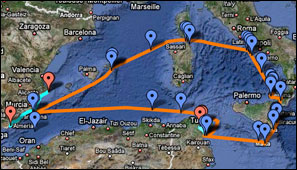
The operation has discovered 24 ancient shipwreck sites during highly technical surveys of ancient ports, harbors and trade routes in coastal waters of Italy, Malta, Croatia, Spain and France. Many have not been seen for 2,000 years or more.
“How much is out there? That’s the million-dollar question,” said Timmy Gambin, Aurora Trust’s archaeologist, in a phone interview from his home in Malta. “We’re just looking in water that’s 50 to 150 meters deep [about 150 to 450 feet], and we’ve come across so much that was previously unknown. It shows there is a lot out there.”
The expeditions also have uncovered World War II shipwrecks, more than a dozen World War II airplanes and unexploded military mines.
“We’re also mapping the underwater landscape of war,” Gambin said.
The Aurora Trust operates primarily from an 85-foot luxury research yacht equipped with the latest in diving technology, side-scan sonar, magnetometers, deep-sea robotic vehicles and sophisticated computer software.
-
Pavlopetri: A window on to Bronze Age suburban life
- On 09/10/2011
- In Underwater Archeology

By Dr Jon Henderson - BBC News
Semi-detached houses with gardens, clothes drying in the courtyards, walls and well-made streets - Pavlopetri epitomises the suburban way of life. Except that it's a Bronze Age port, submerged for millennia off the south-east coast of Greece.
This summer it became the first underwater city to be fully digitally mapped and recorded in three dimensions, and then brought back to life with computer graphics.
The result shows how much it has in common with port cities of today - Liverpool, London, New York, San Francisco, Tokyo or Shanghai - despite the fact that its heyday was 4,000 years ago.
Covering an area of about eight football pitches, Pavlopetri appears as a series of large areas of stones indicating building complexes, among which a network of walls can be traced.
It is a city of well-built roads lined by detached and semi-detached two-storey houses. There are larger apparently public buildings and evidence of a complex water management system involving channels and guttering.The city was divided into pleasant courtyards and open areas where people cultivated gardens, ground grain, dried clothes and chatted with their neighbours.
Dotted in between the buildings and sometimes built into the walls themselves there are stone-lined graves. These contrast with an organised cemetery just outside the city.
There is much about Pavlopetri that parallels our own towns and cities, and our own suburban way of life - people living side by side along planned-out streets. -
Titanic fascinates nearly 100 years later
- On 08/10/2011
- In Museum News
By Lucy Haines - Metro Edmonton
As the 100th anniversary of the sinking of the Titanic approaches, fascination with the famous shipwreck shows no signs of waning.
To that end, the Telus World of Science is hosting Titanic: The Artifact Exhibition, a re-creation of life aboard the fateful ship.
Starting Saturday through to February 2012, visitors will be drawn back in time upon entry, as each gets a replica boarding pass of an actual Titanic passenger.
Passengers then journey through the life of Titanic, from the ship’s construction, to life on board, to the sinking and artifact-rescue efforts.
Lowell Lytle, who acts as Titanic’s Capt. EJ Smith, will be on hand as the exhibit opens.
“Titanic brought the wealthiest and poorest of people together for one climactic moment,” he said.
“You couldn’t make that story up.”
Lytle is one of few who has been on a salvage expedition, calling it an exciting, fearful and ultimately lonely experience.
He even uncovered one of Titanic’s seven telegraphs, used to relay commands to the engine room.
Said to be unsinkable, the Titanic hit an iceberg off the coast of Newfoundland in April 1912. More than 1,500 people died while some 700 survived the disaster. -
Treasure wrecks in Spain
- On 07/10/2011
- In General Maritime History
By Annie Maples - Euro Weekly News
Around 3,000 wrecked ships lie off the coast of Spain, many still laden with gold, silver and gems.
“We always say there is more gold in the Gulf of Cadiz than the Bank of Spain,” said Juan Manuel Gracia, president of the Spanish Galleons Rescue Association.
At least 850 hulks lie beneath the Bay of Cadiz and salvage experts estimate that 180 of these contain treasure worth a total of €25 million.
“It’s as though we’ve lived with our backs to the sea,” explained Javier Noriego, director of Nera Subacuatica. “We have more wrecked ships than any other country in the world, but do less than anyone else to recover their riches,” agreed Gracia.
Both criticised lack of help on the part of the Spanish government in supporting exploration and salvage operations.They called for comprehensive protection of the entire Spanish coast to safeguard the national heritage, together with more backing and funding.
Spain’s sunken treasures also had to be protected against a further foe: unscrupulous professional treasure hunters.“Spain was their chief victim and principal target throughout the 20th century and they have preyed on immensely rich underwater sites,” Noriega said.
“They do their job,” said Juan Manuel Garcia in reference to Odyssey, the US salvagers recently ordered by an American court to return to Spain plundered treasure worth €400 million. “But they have been fooling us for years in the Gulf of Cadiz.”
“For years permits have been given to pseudo-scientific missions which are in fact looking for Spanish gold and silver,” agreed Javier Noriega.
Years of unchecked plundering could soon be over for the Gulf of Cadiz at least, now that the Culture and Defence ministries have embarked on their own mission to stop unauthorised ransacking of wrecks.
Navy minesweepers are currently charting the Gulf of Cadiz’s sunken treasure ships although the findings will remain classified information. -
Caso Odyssey: el expolio de un tesoro
- On 07/10/2011
- In Illegal Recoveries

Intereconomia
Enésimo recurso del Odyssey para no devolver al tesoro a España rechazado. A los cazatesoros solo les queda el Supremo. Lo cuenta en ALBA Pedro García Luaces.
El Undécimo Tribunal de Apelaciones de Atlanta (Estados Unidos) rechazó, el pasado día 21 de septiembre, el recurso interpuesto por la empresa Odyssey contra la sentencia de 2009 que resolvía a favor de los intereses españoles sobre la propiedad de las 594.000 monedas de oro y plata rescatadas del fondo marino.
A la empresa cazatesoros no le queda más salida que la elevación del caso al Supremo, un tribunal que no admite a trámite más que un pequeño porcentaje de los casos que recibe. Podría decirse que bien está lo que bien acaba, pero el periplo de Odyssey dejó un sinfín de decisiones controvertidas que pusieron de manifiesto la descoordinación entre Administraciones y una evidente pasividad en la gestión del suceso.Según su versión oficial, la empresa Odyssey Marine Exploration Inc. llegó a las costas españolas en busca del barco británico HMS Sussex, hundido en 1694 por un vendaval cuando cargaba un botín destinado a comprar el apoyo de la Casa de Saboya en el conflicto que mantenían los Habsburgo con la Francia de Luis XIV.
Entre 2000 y 2006, la empresa cazatesoros pudo hacer una completa cartografía submarina de la zona, campando a sus anchas por aguas de jurisdicción española sin contar con más permiso que una autorización del Ministerio de Asuntos Exteriores –sin competencia en la materia.
Odyssey había firmado un acuerdo con Reino Unido para repartirse la carga del Sussex, de ahí la mediación de este Gobierno con el Ministerio de Miguel Ángel Moratinos para que autorizase el trabajo de la empresa cazatesoros, aprovechando las relaciones iniciadas en el marco del Foro Tripartito.En mayo de 2007, la empresa Odyssey anuncia el hallazgo en aguas internacionales de un botín de 17 toneladas de oro y plata encontradas junto a un pecio al que se pone el nombre en clave de Cisne Negro.
El anuncio resulta ser contraproducente para los intereses de la empresa, ya que pone a las autoridades españolas sobre la pista del cargamento, pero Odyssey necesita hacerlo público para revalorizar sus acciones. La empresa se resiste a aportar más información sobre el lugar o el nombre del pecio del que extrajo la carga, por lo que proliferan las especulaciones sobre un expolio en toda regla, ya no sólo de un barco de guerra español, sino de un pecio hundido a menos de 12 millas de nuestra costa; es decir, en aguas de jurisdicción española.
Odyssey conocía la localización de La Mercedes y mantuvo dos operaciones secretas y simultáneas, una en el Mediterráneo y otra en el Atlántico.