HOT NEWS !
Stay informed on the old and most recent significant or spectacular
nautical news and shipwreck discoveries

-
Divers say they’ve found wreck of Oliver Hazard Perry’s ship off Westerly
- On 08/01/2011
- In Treasure Hunting / Recoveries
By Tom Mooney - Projo
A team of Connecticut scuba divers say they’ve discovered off the Westerly coast the wreck of a ship once commanded by Rhode Island naval war hero Oliver Hazard Perry, whose actions helped the United States defeat the British during the War of 1812.
It was after the naval victory at Lake Erie in September 1813 — during which Perry had one ship founder beneath him before transferring to another and continuing the battle — that his message to his commanders would become immortalized: “We have met the enemy and they are ours ...”
Now, divers Charles Buffum and Craig Harger say Perry would have never been at the Battle of Lake Erie had his schooner not sunk off the reefs of Watch Hill.
Buffum, the owner of a Pawcatuck brewery, declined to name the ship they’ve discovered until a planned announcement Friday afternoon in Westerly.But local marine archeologists, who have heard of the find, identified the vessel as the Revenge, a schooner that sank on Jan. 8, 1811 –– exactly 200 years ago Saturday.
Rhode Island marine archaeologist D.K. “Kathy” Abbass wrote a history of Rhode Island’s early navy for the Naval Historical Center in Washington, D.C., and is leading much of the underwater mapping of sunken ships in Rhode Island waters. She is familiar with the Revenge.
She says it’s a “long stretch” to say, as the divers have, that the vessel’s sinking “changed the course of U.S. history” merely because Perry ended up on Lake Erie two years later.
Further, because of how the Revenge sank –– and the likelihood that hundreds of other wooden vessels have fallen victim to the rocks and rip currents in the area known as The Race — she wonders if the divers have definitive proof they’ve found the Revenge. -
Waters off Port yield a national treasure
- On 07/01/2011
- In Parks & Protected Sites
 Photo Bill Schanen IV
By Bill Schanen IV - Ozaukee Press
The 142-year-old wreck of the Northerner, a 81-foot schooner discovered in 1975 by Port Washington residents five miles southeast of the city, has been listed on the National Register of Historic Places, the Wisconsin Historical Society announced last week.
One of only a few examples in Wisconsin of the small lakeshoring schooners that played a vital role in 19th century maritime commerce on the Great Lakes, the Northerner is inexorably linked to Port Washington.
The city, in fact, was the last port of call for the schooner, which on Saturday, Nov. 28, 1868, sailed into the harbor after the crew discovered it was taking on water.
Freed of its deck cargo, the Northerner continued its voyage south but made it only a few miles from Port Washington before sinking in about 130 feet of water. More than a century later, the Northerner was discovered by Rick Smith and Linda Nenn of Port Washington and Roger Chapman of Milwaukee, Smith said. Another Port Washington resident, Allen “Butch” Klopp, said he was the first person to dive on the wreck.Klopp has about 200 artifacts from the Northerner in his private collection. Among those artifacts are the ship’s rudder and tiller, which are in Klopp’s front yard on Division Street, a massive snatch block marked “SCHR. NORTHERNER,” a crock containing cheese and a rare set of intact running lights.
Smith has a smaller collection of artifacts from the Northerner that is on display at the Port Washington Light Station, a museum maintained by the Port Washington Historical Society.
The Northerner could also play a role in Port Washington’s future. The designation of the wreck as a national historical treasure could bolster the case for a National Oceanic and Atmospheric Administration (NOAA) shipwreck sanctuary headquarters near or in Port Washington.
NOAA is working to establish a 875-square-mile shipwreck sanctuary stretching from Port Washington to Two Rivers. The agency’s plan includes a headquarters to be located in one of the lakeshore communities within the sanctuary. Port Washington is in the running, and local officials have said the former coal dock would make an ideal location for the headquarters. -
Bells sound tales lost to the depths
- On 07/01/2011
- In Miscellaneous
By Raylene Bliss - Southern Courier
Shipwreck researcher John Sumner has photographed shipwreck bells along the eastern seaboard, including Maroubra and Bronte.
He said the port of Sydney hosted an enormous amount of shipping arrivals and departures, as well as some horrific losses of life, including when the Dunbar was wrecked in 1857 just south of South Head near the entrance to Port Jackson.
A total of 121 lives were lost with only one survivor, a crewman named James Johnson. A bell from the Dunbar was later bought at auction and installed in St John’s Church, Darlinghurst.
The Malabar, which was wrecked in Long Bay in 1931, was a very large ship, according to Mr Sumner. The suburb of Malabar was named after it.
Mr Sumner has spent more than two decades taking photos of bells from shipwrecks and at the top of his wanted list now are bells from the Runic, Currajong, Woniora, Hero, Adolphe, Munmorah, Mary Hamilton, Sphene, Jacques Del Mar and Merimbula.
-
Anchor provides deep and meaningful migration insight
- On 07/01/2011
- In Museum News
By Sally Pryor - Camberra Times
A massive salty relic of a bygone era a 1600kg anchor from a 19th century shipwreck will provide a poignant reminder of how times have changed when it is displayed in an upcoming National Museum exhibition.
The anchor, salvaged from the Nashwauk, which ran aground off South Australia on May 13, 1855, will be featured in the exhibition about the Irish in Australia, due to open on St Patrick's Day in March.
The ship had been carrying nearly 300 immigrants, 207 of whom were young Irish women who were travelling to Australia with government assistance to take up domestic work.
All survived the storm that forced them off the boat and on to shore, and many would go on to start new lives in South Australia.
Exhibition curator Richard Reid said yesterday the wrought-iron anchor, which will be displayed among hundreds of other items related to the long-term Irish presence in Australia, was a potent symbol of early assisted migration in Australia.
He said parts of the exhibition would serve to remind visitors that migration trends in Australia came about well before the post-war waves of Europeans which came to define multiculturalism in Australia. -
Want to find a wreck ?
- On 07/01/2011
- In Miscellaneous
 Photo Western Australian Museum
By Raylene Bliss - Southern Courier
The NSW Government is encouraging anyone with an interest in shipwrecks and underwater heritage to join the successful Wreck Spotters program on its 10th anniversary.
Planning Minister Tony Kelly said the Wreck Spotters program allowed volunteers to work alongside marine archaeologists in identifying, mapping and promoting shipwreck sites.
“Shipwrecks tell us so many stories of the state’s rich maritime history - and in doing so provide a fascinating insight into our past,” Mr Kelly said.
“Some 1800 historic wrecks are known to lie in NSW coastal and inland waters, but to date only around 175 have been located and recorded.
“That’s a lot of shipwrecks out there waiting to be discovered and this program has a key role in the ongoing search for these intriguing and unique heritage items.”
Anyone interested in joining the Wreck Spotters program should contact Heritage Branch maritime archaeologist Sarah Ward on 9873 8533 or visit maritime.heritage.nsw.gov.au -
Historian: Great Lakes take toll on ships
- On 07/01/2011
- In General Maritime History
By Katherine Sanderson - South Bend Tribune
The Great Lakes are in a terrible location, said Travis Childs, director of school programs for the Center for History in South Bend.
Cold blasts from the Arctic Circle meet tropical gusts from the Gulf of Mexico. It makes sailing in the latter months of the year especially dangerous.Childs talked about Great Lakes shipwrecks the day after the 35th anniversary of the sinking of the Edmund Fitzgerald in Lake Superior. His speech was given to the American Heritage Round Table at the downtown Mishawaka Library.
Most of the shipwrecks he talked about happened in October, November and December. And they go back to the first ship built to sail the Great Lakes.
The Griffon was built near Buffalo, N.Y., and in 1679 took explorer Robert LaSalle across Lake Erie, through Lake Huron, across the Straits of Mackinac to what would become Green Bay, Wis. There, LaSalle left the ship and continued his exploration through the Mississippi Valley, including a stop at what is now Riverview Cemetery in South Bend in December of that year.
The ship headed back east. "They never saw the Griffon again," Childs said.
There was no word after the Griffon left Green Bay, although the theory is that the ship made it through the Straits of Mackinac and sank in upper Lake Huron. No vessel has been found, however.
"It's the holy grail of trying to find shipwrecks," he said.
With no highways in those days, the Great Lakes were perfect for transportation, but not for every ship.
The Cyprus sailed for 24 days in September and October of 1907 before it sank in Lake Superior.
The L.R. Doty left Chicago in 1898 full of corn, towing the Olive Jeanette. They hit a gale and the tow line was severed leaving the crew of the Olive Jeanette to ride it out. The Olive Jeanette made it to Racine, Wis. The wreckage of the L.R. Doty was eventually found off Milwaukee.
Childs said that for a long time no one knew where the Doty sank, but this past May it was located in Lake Michigan in 300 feet of water. -
7,000-year-old timbers found beneath MI6 Thames headquarters
- On 07/01/2011
- In Miscellaneous
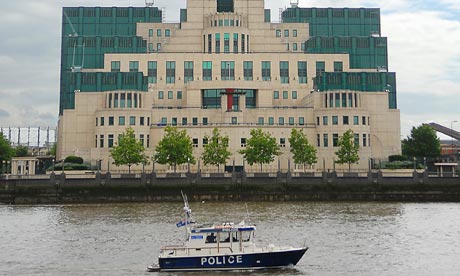 Photo Bertrand Langlois/AFP/Getty Images
By Maev Kennedy - Guardian
Archaeologists hail oldest wooden structure ever found on river, despite security services' armed response to researchers.When MI6 set up home on the banks of the Thames one secret escaped its watchful eyes. The oldest wooden structure ever found on the river, timbers almost 7,000 years old, have been discovered buried in the silt below the windows of the security services' ziggurat headquarters at Vauxhall, south London.
The archaeologists who uncovered the six hefty timber piles had to explain to the security services what they were up to when armed police turned up after they were spotted pottering about on a foggy day in the mud, armed only with tripods, cameras and measuring equipment – not, as one spectator had apparently reported, shoulder-mounted rocket launchers.
"They accepted there wasn't much damage we could do with a tripod," said Gustave Milne, the archaeologist who leads the Thames Discovery programme that has been surveying the entire prehistoric foreshore, uncovering centuries of ancient wharves, fish traps, jetties and ship timbers.
The timbers, partly scoured bare by erosion of the river bed, the largest up to a third of a metre in diameter, were discovered in work during exceptionally low tides last February, but carbon dating work – revealed in the new edition of London Archaeologist journal – has only recently been completed, proving that the trees were felled between 4790 BC and 4490 BC. -
Old American Indian canoe found
- On 05/01/2011
- In Underwater Archeology
By Whitney Ray - Capitol News Service
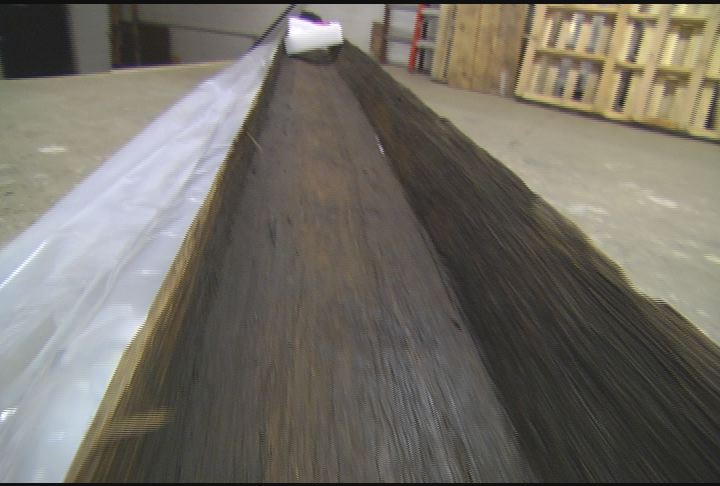
Florida archeologists are ecstatic about an American Indian artifact found buried in a lake bed.This 23 foot long canoe is believed to be between 5-hundred and 8-hundred years old. It was found in Lake Munson in Leon County last month when the water level was low.
Florida has about 350- ancient canoes, but State Historic Conservator James Levy says this is one of the best preserved specimens ever found.“This canoe is pretty rare. It’s a little longer than the average. Most are about 15 to 18 feet I think. But to find one with the sides still on it is extremely rare.
I think the reason for that is this one was lost in the middle of the lake. It sank in the mud. There’s a little less energy out there.
You don’t have the wave action and the sanding that take place along the shoreline and that’s probably why this one still has the sides and is in good condition,” said Levy.The canoe will be studied and displayed in the Florida Museum of Natural History.