HOT NEWS !
Stay informed on the old and most recent significant or spectacular
nautical news and shipwreck discoveries

-
Why Odyssey Marine is worth exploring
- On 13/01/2011
- In People or Company of Interest

From Seeking Alpha
Its easier to pass on Odyssey Marine (OMEX) than to understand the story. In the past 12 months the company has been kicked out of an index, redefined its business model, had a material development in its dispute with Spain, and is seen the entire shareholder base turnover. Based on this introduction I'm sure I've lost half my audience, but for those remaining, OMEX is worth exploring.
To keep it brief (it's worth reading a filing or two in order to really understand OMEX), here is a quick sum of the parts:
Black Swan -$7.50/share
A potential settlement following WikiLeaks could yield upwards of $1B based on the recent silver move. A settlement resulting in $500M to OMEX is worth $7.50/share based on the current share count. Any settlement value is a multiple of the company's current market cap. The silver is in the US and I doubt any is going back. Check out Treasure Quest for more.
Assets & IP - Managerial vs. Financial Accounting - $2.00+/share
Assigning fair value to Odyssey's assets and IP paints a drastically different picture of this company with respect to liquidation value.
PV of 10 $50M Targets - $2.00/share
Based on the identified high value target universe, we assign a recovery of 50% to only 10 of the 100+.
Dorado Resources - $1.75
This stake is worth more than half the current market cap of the company. The economics for deep sea mining work even with a 50% decline in metal prices. Based on a comparable valuation of Nautilus Minerals [NUS.TO], OMEX's interest is worth $1.75/share. -
A new way to date old ceramics
- On 12/01/2011
- In Conservation / Preservation
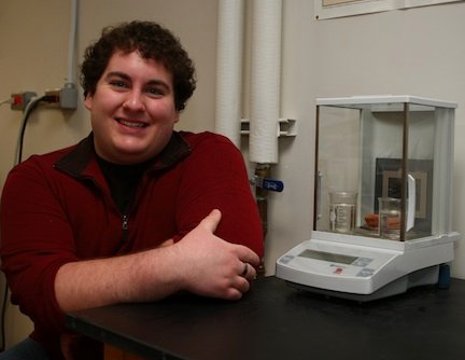
By Marcia Goodrich - Michigan Tech
If you are an archaeologist, determining when a pot was made is not just a matter of checking the bottom for a time stamp. Dating clay-based materials like ceramics recovered from archeological sites can be time consuming, not to mention complex and expensive.
Patrick Bowen, a senior majoring in materials science and engineering, is refining a new way of dating ceramic artifacts that could one day shave thousands of dollars off the cost of doing archaeological research.
Called rehydroxylation dating, the technique was recently developed by researchers at the University of Manchester and the University of Edinburgh. It takes advantage of ceramics’ predictable tendency to bond chemically with water over time.
“It’s simple,” says Bowen. First, dry the sample at 105 degrees Celcius. This removes any dampness that the ceramic might have absorbed.
Then, weigh the sample and put it in a furnace at 600 degrees Celsius. The chemically bonded water, in the form of hydroxyl groups (single atoms of hydrogen and oxygen bound together), forms water vapor and evaporates. “When you do that, you mimic what the sample was like when it was originally fired,” says Bowen.
Then weigh the sample again and leave it alone. Over the next several weeks, the ceramic will react with water in the air and gain weight. Plot the gain against a time constant, and the shape of the curve tells you the age of the ceramic. Theoretically.
But it ain’t necessarily so, Bowen discovered, working with his advisors, Jaroslaw Drelich, an associate professor of materials science and engineering, and Timothy Scarlett, an associate professor of archaeology and anthropology. “The dating process turns out to be more complicated than the literature suggests,” he says.
Using shards of pottery dating from 1854 to 1888, which Scarlett provided from an archaeological dig in Utah, Bowen tried out the original dating technique at different temperatures and got significantly different “ages” for the shards.
He then developed a new equation that addresses those temperature effects, as well as the fact that rehydroxylation is actually a two-step process: First, water vapor physically penetrates the pottery. Then, it bonds chemically to the pottery’s constituent minerals.
Bowen’s equation worked better, but not well enough to generate definitive dates. Humidity fluctuations affected the samples’ weights, skewing the results. Now the research team is using new methods to provide constant humidity and will run additional tests over the next few months on various types of ceramics of different ages.
They won’t only be using rare, antique pottery this time, however. “This year we are using broken pieces of brick from the Houghton Parking Deck; it’s easier to come by,” says Bowen.
“Somebody hit it with their car, and when I saw the pieces, I thought, ‘Oh! Sample!’” If all goes as planned, each of those samples dated by Bowen and fellow researcher Tyler Botbyl, a materials science and engineering junior, will turn out to be about forty years old.
The researchers believe their work has huge potential. “This will be a new, low-cost tool allowing archaeologists to derive dates from objects made over 10,000 years of human history,” said Scarlett. -
Coast a 'graveyard' of lost ships
- On 12/01/2011
- In Treasure Hunting / Recoveries
By Wallace McKelvey - Delmarva Now
For beachcombers, Delmarva's waterways are delivering constant reminders of a bygone era.The artifacts that have washed ashore from long-forgotten shipwrecks -- everything from button covers to Buddha statues -- hold both historical and mythic value to collectors like Bill Winkler of Ocean View.
"The history is more important than a piece of pottery or glass bottles," he said. "Literally tons, as in 2,000 pounds per ton plural, have been collected over the past 100 years."
Although not all the items can easily be traced to a particular wreck, given the daunting number of ships lost offshore since the days of the first 17th century settlers, Winkler said they all tell a story.
Now, at least part of the region's sunken history is being told through a map of the Shipwrecks of Delmarva commissioned by National Geographic.
Don Shomette, who's written volumes of literature about nautical history, was tasked with culling the 7,000 known shipwrecks to the 2,200 featured on the map. Based on predictive modeling, he said between 10,000-12,000 wrecks are believed to lie on or beneath the sea floor.
The region's waterways rival the Outer Banks of North Carolina as the "graveyard of lost ships," he said.
"It was an embarrassment of riches," he said. "There were so many important sites, and a number of them couldn't be included."
The process of selecting the sites to be included took more than a year itself, Shomette said.
He and cartographer Robert Pratt made the selections based on cultural and historical relevance, as well as diversity. Revolutionary War-era privateers exist alongside 1850s paddle steamers, Navy submarines and modern pleasure cruisers. -
Researchers propose Maluku deep-sea mission
- On 08/01/2011
- In Maritime News
By Fidelis E. Satriastanti - Jakarta Globe
Following a successful collaboration in the deep seas of North Sulawesi, Indonesian and United States marine scientists are considering a similar joint project in Maluku, an official said on Friday.
Last year, under a bilateral cooperation on marine sciences, the Indonesian Agency for the Assessment and Application of Technology (BPPT) and the United States National Oceanic and Atmospheric Administration (NOAA) conducted a 32-day, deep-sea research mission near the Sangihe and Talaud islands in North Sulawesi .
The survey, which was designed to explore the wealth of biodiversity in Indonesia’s oceans, involved at least 30 Indonesian scientists.
The team collected 79 marine species and discovered a deep-sea volcano using NOAA’s Remotely Operated Underwater Vehicle [ROV], a robot that has the ability to capture and send real-time images from a depth of 6,000 meters.
“After Sangihe and Talaud, the scientists recommended Halmahera [in Maluku] because it is considered a good area for research,” said Ridwan Djamaluddin, chairman for development of natural resources technology at BPPT.
“We are still assessing it,” he added. “We want to make sure the research is relevant.”
Ridwan said they were still trying to ascertain whether the 79 species found in North Sulawesi were new species, adding that he expected the work to be completed by March.
BPPT chief Marzan A. Iskanda said Indonesia could not have done the research by itself given the technology needed for deep-sea surveys. -
A boat, possibly Civil War-era, emerges on Sea Pines' shore
- On 08/01/2011
- In Parks & Protected Sites

By Tom Barton - Island Packet
Coastal waters uncovered a potential piece of Civil War-era history discovered last week by a visiting diplomat on a Hilton Head Island beach.
Sea Pines resident Sally Peterson was walking on the beach in Sea Pines with her brother, Peter Thomson, and his family, who were visiting for the holidays.Thomson is a Fiji diplomat and the South Pacific island nation's permanent representative to the United Nations.
During their walk, Thomson discovered what appears to be the ribs of an old wooden boat protruding from thick mud, like bones in a partially uncovered grave, on a shell beach opposite the 18th tee at Harbour Town Golf Links.
An eight- to 10-foot portion is exposed, including the holes for the wooden pegs that held the boat together and what Peterson believes are ballast stones in the hull's remains.
The rest of the boat is buried in mud. "It must have been preserved because of that," Peterson speculated.
"It became obvious from looking at it that it was an old boat," she added. "It looked like something that was being unearthed by the water. It was obviously something special."
Pictures of the wreck were shown to a local boat builder, who said the boat dates to the late 1800s to early 1900s, Peterson said. The boat builder declined to be identified.
Peterson said Indian pottery shards have been found along the beach, but she never expected to stumble across something as substantial as the remains of a boat.
"We're very interested to find out what it was about -- how big it is, how old it is and what it was used for," she said. "Finding out that information will be exciting. This was something special to come across in that situation. This was a wonderful find." -
Presumed Blackbeard booty on display at NC museum
- On 08/01/2011
- In Museum News
From The Sun News
New booty is going on display after it was collected from the shipwreck believed to be Blackbeard's pirate flagship.
The artifacts on display beginning Friday at the North Carolina Museum of History in Raleigh are fresh from the sea. They were recovered in this fall's expedition at the shipwreck site near Beaufort.
The wreck is believed to be that of Blackbeard's flagship, the Queen Anne's Revenge, which ran aground in Beaufort Inlet in 1718.
The artifacts going on display until Jan. 30 include part of a handblown blue-green window pane believed to have been in the captain's quarters.There's also a brass buckle that may have fastened a belt or weapons bandolier, and brass scale weights for weighing silver coins.
-
Odyssey wants government out of Black Swan case after WikiLeaks revelations !
- On 08/01/2011
- In Illegal Recoveries
By - Coin NewsLegal proceedings that date back over two years continue in the dispute over recovered sunken coin treasure as lawyers for the company in possession of the treasure filed a new motion in the matter.
Odyssey Marine Exploration, based in Tampa, Florida, directed its legal team to file a Motion to Strike the amicus brief filed by the United States in support of Spain in the "Black Swan" case currently pending before the Eleventh Circuit Court of Appeals. If the court opts to not strike the brief, Odyssey seeks to have the court direct the United States government to amend its statement of interest to more accurately reflect its true position on the matter.
The motion is in direct response to several U.S. State Department cables obtained and recently released by the website WikiLeaks which indicated that the U.S. State Department was willing to offer assistance to the country of Spain against Odyssey. In exchange, U.S. diplomats were asking for help in the return of a painting now in a Madrid museum, but believed to be confiscated from its rightful owners by the Nazis in the 1930′s.
"We have brought to the Court’s attention the evidence suggesting that the involvement of the U.S. Executive Branch in the ‘Black Swan‘ case goes beyond its interest in interpreting applicable laws," states Melinda MacConnel, Odyssey Vice President and General Counsel.
"The U.S. Government’s interest appears to have been related to a promise of support for Spain in exchange for assistance in obtaining this painting for a U.S. citizen. This calls into question whether there may have been any other offers of support in exchange for favors completely unrelated to this case. Any interest in the case of the U.S. beyond those stated in their filing should warrant striking the amicus brief or at the very least, require a full explanation of the motives behind their support of Spain."
-
US Navy ship sunk to create new diving attraction
- On 08/01/2011
- In Wreck Diving

From NewsLite
USS Kittiwake, a decommissioned US navy submarine rescue ship, has been intentionally sunk to create a scuba diving attraction.
Now lying on the ocean floor off the Cayman Islands, the 251-foot long, five-deck military ship, will become an artificial reef for divers to enjoy.
Officials say after acquiring the ship they cleaned it before flooding the rusty hull so it would sink upright and then punching holes into the hull and pumped in sea water.
This caused the Kittiwake to sink dramatically in a cascade of bubbles, but don't take our word for it.The ship is now sitting under 60ft of water just off the coast of Grand Cayman Island and is quickly becoming home to curious creatures including stingrays, barracuda and various schools of smaller fish.
It is hoped Kittiwake Cayman will soon become a destination for divers who will be able to snorkel overhead and see the main decks and topography of the ship or explore rooms of the wreck.
Read and see more...