HOT NEWS !
Stay informed on the old and most recent significant or spectacular
nautical news and shipwreck discoveries

-
Cache from shipwreck docking at N.C. museum of history
- On 05/01/2011
- In Museum News
Photo N.C. Department of Cultural Resources
From WNCT
A case exhibit of small artifacts from the wreck of what is believed to be Queen Anne’s Revenge (QAR), Blackbeard’s flagship, will be on display at the N.C. Museum of History in Raleigh from Jan. 7 through Jan. 30. The artifacts are fresh catch from the fall expedition at the shipwreck site near Beaufort.
The QAR ran aground in Beaufort Inlet in 1718, and the N.C. Department of Cultural Resources has led research at the site since 1997. The exhibit originated at the N.C. Maritime Museum in Beaufort, the official repository for the shipwreck artifacts, within the Division of State History Museums.
Among artifacts displayed is a part of a handblown blue-green window pane believed to have been in the captain’s quarters. A brass buckle that may have fastened a belt or a bandolier full of weapons will be exhibited. Brass scale weights for weighing reale silver coins will be on view; the reale weights were necessary because the smooth-edged coins could be filed or chiseled down (giving rise to the term “chiseler”), thus devaluing the coins.
A brass quillon block with gold gilding and a blade fragment from a small hunting sword will also be exhibited.The ornate scroll work and fancy handle design were unusual for pirate gear, so the sword may have been acquired on some adventure. It was recovered in 2007 and has been conserved and readied for display.
-
Madagascar - Island of lost treasures
- On 05/01/2011
- In Miscellaneous
 Photo Maurits
No-one knows how many ships lie on the seabed off the coast of Madagascar.
Archeologists, and treasure hunters, have searched the ocean floor around the country for many years, discovering a number of wrecks.
But until now, no-one has found the Degrave, a mythical ship that sank off the southern coast in 1703.Reporter Tim Healy goes to Madagascar to find out more.
-
Shipwreck off Ozaukee County gets historic designation
- On 04/01/2011
- In Parks & Protected Sites
By Meg Jones - The Journal Sentinel
An 1850s shipwreck in Lake Michigan near Ozaukee County has been listed on the National Register of Historic Places.
The 81-foot schooner Northerner sank in 130 feet of water about five miles southeast of Port Washington in 1868. The Northerner is a rare example of a sailing vessel that was vital to the economy and transportation of the Great Lakes before the development of roads and rail networks.
There are only a few archaeological examples of small lakeshoring schooners discovered in Wisconsin waters. Information gleaned from visits to the Northerner has broadened knowledge for maritime historians and underwater archaeologists of lakeshoring vessel construction, according to the Wisconsin Historical Society, which administers the national register program in Wisconsin. The society recently learned of the Northerner's designation.
Lakeshoring schooners like the Northerner were an important link for small communities, connecting them economically and culturally with regional markets.
The Northerner was built in 1850 and worked on Lake Ontario carrying goods to ports in America and Canada. The last five years of its operation were on Lake Michigan during the lumber industry boom. It sustained hull damage while it was being loaded with wood at a pier in Amsterdam, Wis. and sank while being towed to Milwaukee for repairs.
Scuba divers venturing to the wreck can see an intact hull and deck and carved bowsprit as well as lumber stacked in the Northerner's hold.
The National Register of Historic Places is the official national list of historic properties and is maintained by the National Park Service. -
Wooden shipwreck exposed on ocean beach
- On 04/01/2011
- In Parks & Protected Sites
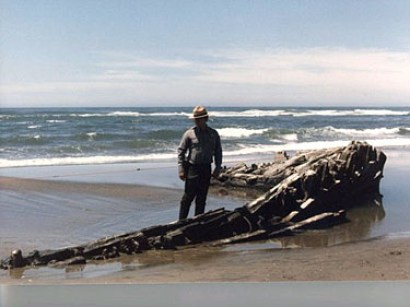
The King Phillip has made one of its rare appearances after the recent deluge of rain and wind.A clipper ship that was wrecked on the beach in the late 1800s, the King Phillip pokes its head above the sand every now and then before disappearing back beneath the surface.
Its last appearance was as recent as November, but it's been known to vanish for decades. Since it's on federally protected land, it's a crime to damage the historic remains. But historians are free to come by for a close inspection.
Currently, both the bow and stern are visible at low tide.
It was rough weather that originally sunk the ship. It dropped anchor off the coast, but the waves eventually cast it up onto the beach.After it ran aground, a notoriously shameless publication known as the "Chronicle" issued rumors that the captain had been drunk. His crew promptly refuted the gossip. It was a rare show of solidarity: previous crews on the ship had mutinied.
"With the parting of the cable, the ship roils at the mercy of a pitiless, heavy sea," went one newspaper account. "On the Cliff House veranda, on the beach, in the Park, anxious watchers, hoping for some relief.Tossing, pitching, rolling, tugging at her anchors, she holds on for hours in the fearful surf."
After it beached, the ship was stripped of valuables, then most of it was demolished with explosions. But bits and pieces still remain, nearly a century and a half later. -
Divers may have found ship built in Everett in 1894
- On 04/01/2011
- In Wreck Diving
By Debra Smith - Herald
The morning of Oct. 11, 1923 dawned dark and dangerous for the SS City of Everett.
Overnight, a ferocious squall overtook the ship in deep waters miles off the Florida coast in the Gulf of Mexico. The crew of 26 men was headed to New Orleans with a cargo hold full of rich Cuban molasses.
The first U.S. steamship to circle the globe and chug through the Suez Canal was to meet a bad end. Churning seas and high winds battered the ship, which launched from an Everett shipyard in 1894.
The first mayday was broadcast at 7:30 a.m.
“Am lowering boats. Will sink soon. Latitude 24.30 north, longitude 86 west.”
Four words were sent before 8 a.m.: “Going down stern first.”
One last SOS was sent, then the City of Everett was gone.
Rescue ships arrived at the coordinates to find nothing but the timeless sea.
Months later a bottle washed up on a Miami beach with a note stuffed inside.
“S.S. Everett. This is the last of us. To dear friends who find this, good-bye for ever and ever.”
Everett had sprung to life in 1890. A group of wealthy East Coast investors scrambled to build a manufacturing empire of factories, shops and stick-framed houses.
A newfangled steamship design grabbed the imagination of Everett's founders, who learned of a cigar-shaped cargo fleet making money on the Great Lakes.
It was decided that one of Everett's main industries would be the production of steel-hulled ships that would revolutionize marine transport.The Everett fleet would deliver wheat, iron ore, coal and lumber throughout the Pacific. They'd even steam goods to Atlantic ports by way of a canal that other visionaries of the time wanted to slice across Nicaragua.
Designed by Alexander McDougall, a scrappy Scottish-born ship captain and inventor, the steel ships would carry significant loads while cutting efficiently through waves and wind.Unlike the wooden cargo ships of the time, McDougall created a ship with a flat bottom, a curved deck that shed water and a bow and stern that ended in tapered points. A wheelhouse was positioned toward the stern.
-
Could you invest and find real sunken treasure ?
- On 03/01/2011
- In Miscellaneous

By Jonathan Maitland - This Is Money
The odds of finding booty on shipwrecks may be minimal, but such schemes - or 'search and recovery investment opportunities' - are becoming more popular...
It's not often your financial adviser makes you smile - they are not natural entertainers as a rule - but mine had me chuckling recently.We were discussing 'exotic' investments when he suggested putting money into a scheme that recovers treasure-filled shipwrecks.
I replied that investing in modern-day piracy was a bit like asking Bernie Madoff to look after your pension.
But the joke then appeared to be on me when he said that another client, an accountant from St Albans, Hertfordshire, had put £100,000 into the scheme last year - and was about to reap a windfall of £1.4m.
A centuries-old vessel containing a huge haul of valuable coins had been discovered at the bottom of the Atlantic and he was looking forward to telling his client the good (and bad) news. 'Congratulations, you are now a millionaire. And you have a large tax bill'.
The odds of finding booty on shipwrecks may be minimal, but such schemes - or 'search and recovery investment opportunities' as they are prosaically called - are becoming more popular.
There are now at least half a dozen salvage companies trawling international waters for treasure - and your money.These schemes claim that many thousands of merchant ships, often laden with fantastically valuable cargo, have gone to the bottom over the past 500 years.
-
Gunboat discovery comes after years of sightings, botched efforts
- On 30/12/2010
- In Underwater Archeology
By Craig Brandhorst - Free Times
As South Carolina’s deputy state archaeologist for underwater, USC’s Chris Amer has helped discover, map and excavate more than a few shipwrecks over the years, including the Civil War submarine H.L. Hunley and a slew of other vessels along the East Coast and elsewhere.Now, Amer and his colleagues are in the news again following the recent discovery of a Civil War vessel in the muddy waters of the Pee Dee River.
The Confederate gunboat CSS Pee Dee, which Amer and State Archeologist Jonathan Leader discovered near Marion in November — 18 months after discovering two of the boat’s three enormous cannons at the bottom of the river — was one of 22 similar gunboats built at inland naval yards across the South.
Since discovering the Pee Dee’s cannons, Amer and his colleagues have brought up seven artillery shells and plan to bring up several more.They are also making plans to raise the two cannons they’ve already found — a 9-inch Dahlgren and a 6.4-inch Brooke Rifled Cannon — sometime next summer.
If they can find the third gun, also a Brooke cannon, they will raise that as well. All of the artifacts will be housed in the Florence County Museum.
“They’re building a huge new facility there,” Amer says. “There will be a whole exhibition about the Civil War, and specifically about the Mars Bluff Naval Yard and the shipwreck.”
As warships go, the CSS Pee Dee had a fairly humble military career — in fact, it never reached the open sea, as by the time of its completion the Union army had already captured Georgetown. It has nonetheless enjoyed a storied afterlife, marked by sightings, disruptions and attempts to salvage pieces of it for posterity and/or profit.
Launched at Mars Bluff in January of 1865, the 150-foot gunboat participated in exactly one skirmish three months later, about 40 miles upstream, near Cheraw.There, it provided cover for the Confederate troops of General William Hardee as they retreated from the advancing troops of General William T. Sherman. Subsequently, the gunboat was returned to Mars Bluff, where it was torched, possibly blown up and irretrievably sunk by its own crew so it would not be captured.
In the ensuing century-and-a-half, the river level periodically changed and the CSS Pee Dee reappeared several times.Amer says that an ensign in the U.S. Navy spotted the boat shortly after the Civil War, and in 1906 the U.S. Army Corps of Engineers pushed its wreckage onto a sandbar while dredging the river.
Nearly two decades after that, the United Sons of the Confederacy managed to remove the boat’s propellers, which wound up on display at the Florence County Museum.
In 1954, however, much of what remained of the CSS Pee Dee was lost to history after a group of local businessmen also spotted the wreckage. Amer says the men brought in a bulldozer to make a road to the riverside then attempted to drag the boat ashore for display at a roadside attraction called Confederateland.
“Of course, this vessel had been burned and pushed ashore by the Corps of Engineers and possibly blown up, so it wasn’t very integral, and when they tried to pull it up it just broke into pieces,” Amer explains.
“So what they did is grab whatever they could — a 30-foot piece of the stern that was intact, a boiler and the two engines, the propeller shafts, anything else they could put their hands on.Then they put them on display across the highway and charged two bits for people to see them. Over time, things disintegrated, and that was that.
I suspect the wood just dried up into powder. It was pretty much the end for those pieces.”
-
Legal notice orders war wreck to be preserved ‘at all costs’
- On 27/12/2010
- In Parks & Protected Sites
By Christian Peregin - Times of Malta
A one-of-a-kind sunken wreck from World War II lying near Manoel Island has been scheduled as a site of archaeological importance to be preserved “at all costs”.
The wreck is an X127 Waterlighter used as a submarine supply barge during World War II and sunk by enemy fire while still lashed to its moorings beneath the arched colonnades of the Lazzaretto.
It was among 200 originally designed for the Gallipoli campaign in 1915 by Walter Pollock and Son of Faversham in Kent and is the only one in the world that has been preserved intact.
The site in Lazzaretto Creek is touted as ideal for diving and a number of divers have campaigned for it to be protected. They were worried it would be spoiled by the yacht marina planned as part of Midi’s Mediterranean marina village project on Manoel Island.
Last year, Midi CEO Ben Muscat had been reluctant to give a guarantee to protect it, saying: “We will try to work around it as much as we can. The breakwater won’t touch the wreck but at the end of the day it is still going to be smack in the middle of a marina.” He did not anticipate any works taking place close to the site but could only pledge to save the site “to the extent that we can”.
However, the wreck has now been protected through a legal notice that has just been published. This gives it a Class B certification which means it is “very important to be preserved at all costs”.Adequate measures must be taken to preclude any damage from immediate development, a spokesman for the planning authority said.
When the government had released plans for the yacht marina last year, it did not give any indication of how the wreck would be protected. When contacted, the Infrastructure Ministry had said there was no mention of it during the consultation process.
Diver ,, who campaigned for the wreck to be protected, welcomed the announcement. “At last, our voices have been heard. It would be interesting to know, though, what enforcement systems will such scheduling bring into force.”
