HOT NEWS !
Stay informed on the old and most recent significant or spectacular
nautical news and shipwreck discoveries

-
Secret Oregon Coast shipwreck shows up after 35-year absence
- On 25/12/2010
- In Parks & Protected Sites
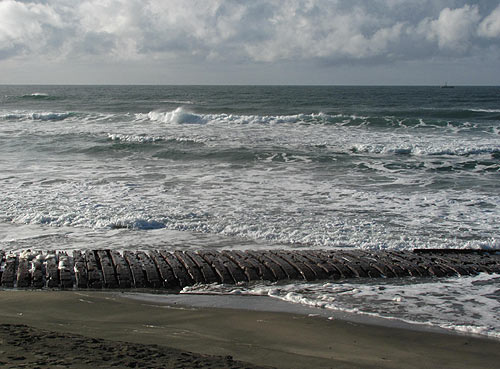
From Beach Connection
An old and forgotten resident of Rockaway Beach, on the north Oregon coast, is showing up again. She's a little over 100 years old to be exact, and she hasn’t been seen for the better part of 35 years.The wreck of the Emily G. Reed has been unearthed by recent winter wave action, which has cut a wedge out of the sandy slope towards the waves as much as four or five feet deep.
It’s a treasure hunters dream of sorts, with around 100 feet of the ribcage-like structure now visible – the most in decades.
The Reed hit the mouth of the Nehalem River in 1908, back when there was no jetty. Apparently, the Reed was looking for the Tillamook Rock Lighthouse to guide its way, and for some reason made a wrong turn and grounded itself.
“It snapped in half,” said Don Best, a longtime Rockaway Beach resident, historian and photographer. “Pieces were scattered all over. There’s still a piece in Nedonna Creek."This portion is the largest chunk still around, though it had been thoroughly raided pretty quickly, like anything else left of it. Some of the raiders included Best’s family, back in the early pioneer days of the area.
The Emily Reed has been a secretive, shy shipwreck, hiding beneath the sand for most of its time on these shores. After this part came to rest here, it was visible most of the time until the 40’s and 50’s, when its visibility became less and less.
Then it just disappeared, until three years ago.“That was the first time it was visible in around 35 years,” Best said.
The Reed was built in New England by the Reed family, which created a small fleet of ships bearing the name. “There was a Mary Reed; there were a bunch of different ships with that name Reed,” Best said.
It was bound for Portland, carrying a load of coal from New Castle, South Wales in stormy and foggy weather. It had been at sea 102 days and ran aground on Valentine’s Day, February 14.
From there, accounts vary. Seven or eight crewmembers apparently lost their lives after getting swept out to sea. The captain, his wife and some others clung to a chunk of the wreck and supposedly made it ashore.
Another account has a group of them in a lifeboat that was carried back out to sea, and never made it back until they got to the central Washington coast. One died along the way after drinking sea water. -
Spanish galleon at Children's Museum in Jensen Beach opens to public
- On 25/12/2010
- In Museum News
 Photo Grayson Hoffman
By Kim Hughes - TC Palm
Although the newest exhibit at the Children's Museum of the Treasure Coast — a replica of a Spanish galleon named the "Marti Frances" — has only been open since Monday, so far it's getting a big thumbs-up from kids and parents alike.
The 62-foot ship is a full-size replica of a 1600s Spanish galleon and features two stories and 15 interactive, hands-on exhibits. Named after two of its biggest beneficiaries, Marti Huizenga, wife of businessman H. Wayne Huizenga, and the Frances Langford Foundation, created by the late singer/actress, the ship cost approximately $600,000. Work on the project began in early November.
The upper deck was closed Thursday as installers from Sparks Exhibits in Orlando fine-tuned some of the stations. Still, there was still plenty to do.
John Handlen of Jensen Beach visited the exhibit with his daughter, Haley, 6. Frequent museum visitors, they came to check out the newest offering after Handlen's sister told him it had opened this week.
"It's pretty impressive. I didn't know it was going to be this big," he said.Haley, a kindergartner at First Baptist Christian School in Stuart, enjoyed the "What's Cooking?" station that allows guests to pretend to cook in the ship's galley.
-
Maritime Museum restores a vibrant heritage
- On 25/12/2010
- In Museum News
By Lisa Crawwford Watson - Monterey Herald
History may be in the making. But its intrigue lies in the telling or, even better, in the showing.In a dramatic effort to bring history to life, Monterey History and Art Association has unveiled the first phase of an expansive, multistage renovation of the Monterey History Maritime Museum at Custom House Plaza in Monterey.
Since its inception in 1931, MHAA has endeavored to both preserve and portray the colorful, controversial and compelling heritage of Monterey.
For nearly 80 years, the organization has worked with the City of Monterey, California Department of Parks and Recreation, National Trust for Historic Preservation and other agencies to create continuity between the past and present.
Most recently, the organization presented the new lobby of the Maritime Museum, redesigned to bring the seafaring adventures of the 1700s, 1800s and early 1900s to life.
The portal to the museum now features eight large-scale models of historic tall ships, and more than 30 boat lanterns from early eras plus, on permanent loan from the U.S. Navy, the bell from the USS Monterey aircraft carrier, which launched in 1943 and played a significant role in the Pacific Theater during World War II.
Each ship replica is accompanied by information that creates the context of her maritime heritage.
"This is the beginning of a whole transformation of the Maritime Museum," said MHAA Executive Director Pam Crowe-Weisberg, who was appointed in 2009. "We have many wonderful collections here, and we really want to present them in a way that attracts a cross-generational audience. Change takes time, but it is time to do something different, to think outside the box."
To this end, Crowe-Weisberg hired architects Jennifer Siegal, founder and principal of Office of Mobile Design, a Los Angeles-based firm dedicated to the design of "responsible, sustainable, precision-built structures," and Libby Barnes, who specializes in green residential and commercial design.
-
The tales and treasures of the world’s lost cities
- On 25/12/2010
- In Miscellaneous

By GFExplorer - Sabotage Times
Hidden under the world's oceans, these lost cities have inspired tall tales and expensive expeditions alike. Let us take you through these antiquated wonderlands whilst keeping your feet firmly on dry land.Heracleion, Egypt
Discovered in 2000 by French archaeologist Franck Goddio, Heracleion was the main sea port of the Pharaohs before Alexander the Great founded Alexandria around 331 BC. Washed into the ocean around 1000 years ago, probably by a tsunami, archaeologists have found a city almost untouched by time, full of colossal statues, hieroglyphic tablets and an extraordinary store of gold coins and jewellery from the time of Cleopatra, the last Egyptian queen.
Choquequirao, Peru
Machu Picchu’s lesser known sibling city in South Peru, Choquequirao is two days trek into the spurs of the Salkantay Mountain Range in the Cusco region above the valley of river Río Apurímac. The complex is 1,800 hectares, of which 30-40% is excavated and may well have been the last place of resistance by the Inca people after the Spanish siege of Cusco in 1535.
Fuxian Lake, China
Hidden for millennia underwater in China’s second deepest lake, this 1.7 square mile (2.7 square km) site, found by diver Geng Wei in 2005, may be the ancient city of Yuyuan dating back to the Qin and Han dynasties of 2000 years ago. Chinese reports describe two large pyramids similar to those found at Mayan sites in South America and a coliseum. Although Chinese documents make no reference to the city, local legend described how building silhouettes were visible under the lake from the nearby mountains on clear days.
Yonaguni Jima, Japan
Known as the Japanese Atlantis, these ruins lie in shallow waters just off Yonaguni Jima and seem to be the remains of an advanced Asian culture washed into the sea by an earthquake 2000 years ago. Discovered by divers in 1985, excavation continues in the area producing never seen before artefacts, including a huge, underwater Sphinx.
Archaeologists have found a city almost untouched by time, full of colossal statues, hieroglyphic tablets and an extraordinary store of gold coins and jewellery from the time of Cleopatra.
Sunken City, Cuba
In May 2001 a Canadian company mapping the ocean bottom of Cuba’s international waters discovered an unexpected archaeological treasure trove when they picked up sonar readings which suggested huge, megalithic ruins 2,200 feet (671 metres) below the surface of the ocean. Immediately jumped upon by the popular press as a possible site for Atlantis, National Geographic magazine reported the story in 2002, however further study of the site has not yet been forthcoming. -
Knoxville's shipwreck ?
- On 24/12/2010
- In General Maritime History
By Jack Neely - Metropulse
Last Saturday at 3 p.m., a small group of interested people convened in a banquet room at Calhoun’s on the River, ostensibly to discuss the First Creek Tennessee River Shipwreck Project.
It takes some swagger to schedule anything on the last Saturday afternoon before Christmas, when friends and relatives are starting to blow through town and the stores are full of frantic shoppers. But Jim McNutt is a laid-back kind of guy.
He’s enjoying a pint of beer and the company of a small group of curious people: a rescue diver, a prominent attorney who happens to live nearby, and some friends and relatives.Billed as an “informal meeting,” it was certainly that. McNutt gave no presentation, but on the occasions when one of the guests expressed curiosity about the shipwreck, he gestured toward a table.
“It’s all over there,” he said. On the table was a plastic bag with a sawn-off piece of weathered wood with a rusty 10-inch spike in it and some rough sketches of what he was talking about.
What he’s talking about is something many of us have noticed on the shore. Planted in the sandy beach between the Volunteer Princess excursion vessel and the mouth of First Creek, there are rectangles of symmetrical wooden beams, looking a little worse for wear, and usually underwater except in wintertime.
Metro Pulse ran a column about it a couple of years ago, based on the assumption that it was all the foundation of buildings, wharves, or warehouses that had once stood there.
McNutt is convinced the wood is the remains of nautical vessels. He first encountered the ruins around 1977, when, before waterfront restaurants, few ever ventured to the riverbank. Now the proprietor of a business called Marine Geographic, McNutt has convincing experience. He says he has done salvage work in the Virgin Islands, Honduras, Aruba, and even Cuba, sometimes hunting for 18th-century Spanish and English wrecks.
He’s worked on old riverboat sites on Florida rivers. He wrote a book, Quest for Shipwrecks, about his adventures. (It’s out of print, but he had a couple of copies on his table.)He’s also recently worked on practical salvage operations in this area, like recovering a Caterpillar earth mover that fell into the water near the mouth of Third Creek.
“I do a lot of underwater work,” says the gravelly voiced troubleshooter. “I love it.”
“There are boats wrecked all the way up and down here,” he says. He talks about one near Island Home, and another on the Holston, a marble boat that is clearly visible. -
Wrecks of the World II program expanded, June 6-7
- On 24/12/2010
- In Festivals, Conferences, Lectures
From Marine Link
The American Salvage Association (ASA) and the North American Marine Environmental Protection Association (NAMEPA) will co-sponsor a conference, “Wrecks of the World: Hidden Risks of the Deep (WOW) II” on Monday, June 6 and Tuesday, June 7, 2011 at the Maritime Institute of Technology and Graduate Studies (MITAGS) in the Washington, DC area (Linthicum Heights, MD) USA.
The conference will explore the myriad issues (pollution threat, impact modeling, risk assessment, oil removal and remediation, implications to the environment, legal, insurance and funding issues, next steps) related to the more than 8,500 sunken vessels in the world, many of them World War II-era.
The program has been expanded to include discussion of the pollution threat posed not just by ship wrecks but also by the tens of thousands of abandoned oil wells that litter coast and offshore waters around the world.
The problem of potentially-polluting wrecks has long been discussed and recent incidents around the world have caused government agencies and responsible parties to look proactively at preventing catastrophic oil and other chemical releases from long submerged shipwrecks.
These wrecks may contain as much as 20 million tons of oil and other hazardous materials. Sporadic or continuous leakages or potential sudden massive spillages from these wrecks pose a continual risk across the globe.
With the work that has recently occurred in the U.S. including remediation of the Beaumont off the Texas coast and the Princess Kathleen on the Alaskan coast, anticipated work on the Montebello off of California and on the Coimbra off of New York among others, as well as oil recovery from the wrecks of the Asian Forest and the Black Rose off the coast of India, not to mention the oil removal projects being considered by the Canadian, Korean and Norwegian governments, among others, wreck oil removal has come to the forefront of marine environmental concerns. -
Restoration efforts on Civil War steam engine progressing
- On 24/12/2010
- In Conservation / Preservation
By Mark St. John Erickson - Newport News Daily Press
The warship Monitor was rescued from the Atlantic in 2001 after spending nearly 139 years underwater. Only now is the vessel regaining some of its original character.When archaeologists and Navy divers recovered the warship Monitor's steam engine from the Atlantic in 2001, the pioneering Civil War propulsion unit was enshrouded in a thick layer of marine concretion.
Sand, mud and corrosion combined with minerals in the deep waters off Cape Hatteras, N.C., to cloak every feature of Swedish American inventor John Ericsson's ingenious machine, and they continued to envelop the 30-ton artifact after nine years of desalination treatment.
This month, however, conservators at the Mariners' Museum here and its USS Monitor Center drained the 35,000-gallon solution in which the massive engine was submerged and began removing the 2- to 3-inch-thick layer of concretion with hammers, chisels and other hand tools.
Working slowly and carefully to avoid harming the engine's original surface, they stripped off more than two tons of encrustation in their first week of work, gradually revealing the details of a naval milestone that had not been seen since the historic Union ironclad sank in a storm in December 1862.
"This is a technological marvel. It was cutting-edge in its day. But what's really neat is revealing all the wheels, oil cups, valves and other parts that the Monitor's crew used to operate the engine," said conservation project manager Dave Krop.
"If you consider that it spent nearly 139 years underwater, it's in outstanding shape — though some of the wrought iron has seen better days.And there are some copper alloy parts that look brand-new when they're first uncovered — like they just came off the shelf."
Smaller, more compact, yet just as capable as other steam engines of its day, the Monitor's vibrating side-lever engine was the ideal match for Ericsson's revolutionary warship.
Its long, low, horizontal cylinder enabled the engineer to place it below the vessel's waterline as well as behind a thick armor belt — and that well-protected position virtually eliminated the vulnerability associated with the much larger and more easily targeted engines of the day, most of which towered above the deck of a ship.
Ericsson was so confident in his engine's capabilities that he ignored orders to equip the vessel with masts and rigging.
And it astounded Union and Confederate observers with the way it performed in its historic clash with the rebel warship Virginia — also known as the Merrimac — in the March 8, 1862, Battle of Hampton Roads. -
USC archaeologists locate wreck of Confederate gunboat
- On 23/12/2010
- In Underwater Archeology
 University of South Carolina
From Live 5 News
A University of South Carolina archaeologist has found the wreck of C.S.S. Peedee, a Confederate gunboat that was destroyed by Confederate forces so it would not be captured by Union forces, in the Pee Dee River.
The discovery comes 18 months after underwater archaeologist Chris Amer confirmed the presence of two of three cannon from the gunboat in the river: a Confederate Brooke rifled cannon and a Union Dahlgren smooth-bore, 9-inch shell cannon near the Confederate Mars Bluff Navy Yard.
"This isn't a boat resting neatly on the river bottom," Amer said. "The remains are as messy as the history that put it there. Together, the wreck and cannon tell a story about the little known but very important role that inland Confederate naval yards played in the Civil War.Hidden along interior rivers, the naval yards let Confederate forces build and protect gunboats and support vessels."
Amer said that after an unsuccessful three-week search in July to determine whether the elusive third cannon was hidden under the Dahlgren or under a handful of artillery shells on the river's bottom, he returned in September to follow up on clues about the Peedee's location.
The clues included some data from downstream that he gathered in 2009 and a personal account by a man who claimed that he witnessed a salvage operation of the Peedee in 1954.
"Michael Hartley, an archaeologist in North Carolina, said he was 12 years old when he watched a group of men salvage a boiler and parts of C.S.S Peedee at Mars Bluff," said Amer. "He said the water was low and that he made a detailed map of its location."
Hartley, once on staff at USC's South Carolina Institute of Archaeology and Anthropology (SCIAA), gave Amer a file that he had created on C.S.S. Peedee.
"I was able to go right to the spot," said Amer. "Hartley's account matched up with magnetic readings that I took of a 25,000-square-foot area."
In November, Amer used sonar to search for the debris and found evidence of the wreck: ripples on the sand where sediment had built up over debris, magnetic "hits" in straight lines depicting the iron bolts along bedding timbers and a tree stuck on something substantial on the river's bottom, possibly ship timbers.
"It's in pieces and buried, although I'm not sure just how deep," Amer said.
The condition of the wreck doesn't surprise him. After all, he said, the Confederate commanders set the 170-foot gunboat ablaze and blew it up in 1865 so it wouldn't fall into the hands of Gen. William T. Sherman's northward advancing Union troops.
He said in the early 1900s, the U.S. Army Corps of Engineers further damaged the wreck while clearing the river channel for boat traffic.
Disruptions to the wreck occurred in 1925, Amer said, when propellers were salvaged, and again in 1954, when Hartley witnessed the salvaging of two engines, a boiler, propeller shafts and a 30-foot section of the stern.