HOT NEWS !
Stay informed on the old and most recent significant or spectacular
nautical news and shipwreck discoveries

-
S.O.S. sounded for 'perfect storm' rescue ship
- On 16/08/2012
- In Maritime News
By Anthony R. Wood - Philly
The ship survived Iwo Jima, drug wars, the Mariel boat-lift, and one of the most-horrific North Atlantic storms of the 20th Century.
But at age 69, the fabled Zuni/Tamaroa is confronting a more formidable adversary - the sedentary life.
While moored at a marine yard near Norfolk, Va., in late May a major leak flooded the engines, and a forward bulkhead partially collapsed, according to Harry Jaeger, who is leading the battle to save the ship.
Jaeger runs the Zuni Maritime Foundation, which dreams of restoring the ship - named the Zuni during its naval career, and the Tamaroa, or Tam, when the Coast Guard took it over - as a museum and educational vessel.
The foundation is trying to raise $500,000 for the rescue operation, but it might take more than double that amount, said Tim Mullane, owner of American Marine Group, which has provided a temporary haven for the vessel.
Jaeger said the current owner, listed as Zuni/Tamaroa L.L.C., of Wilmington, plans to sell the steel ship to Mullane, who in turn would sell it for scrap metal.
Mullane said that he was in no hurry to take ownership and that he wants to give the foundation a chance to raise the rescue money. He added, however, that the operation would be a daunting one.
-
Costa Concordia salvage suffers delays
- On 15/08/2012
- In Maritime News
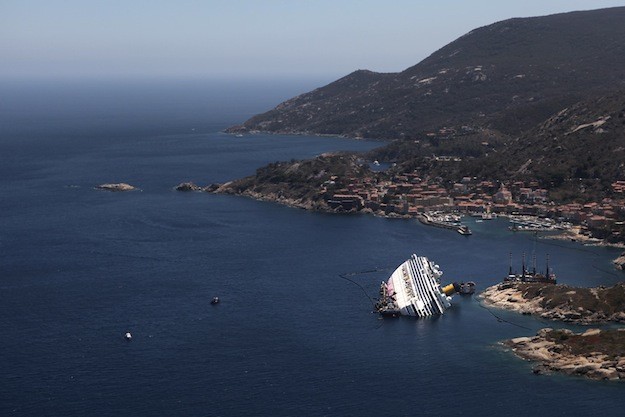
gCaptainThe wreck removal of the infamous Costa Concordia is going to take longer than expected, officials in Italy announced this week.
On Monday the Department of Civil Protection, which is the Italian government office overseeing the removal process, met with the salvage team who presented new detailed engineering design plans for the vessel’s removal, along with a new estimated timetable for job’s execution.
The new timeframe includes estimates that the Costa Concordia will be upright and floating by the end of spring 2013, ahead of Giglio’s next tourist season but months behind the original timeframe announced when the work began.
As gCaptain reported in April, the historic contract to remove the 114,500-ton cruise ship was awarded to a consortium involving U.S.-based Titan Salvage and Italy’s Micoperi after the pair submitted a winning proposal based on a set of strict parameters and guidelines that took into account heavy environmental concerns and Giglio’s tourism-based economy.
In May, the team revealed its salvage plan during a Rome press event with the estimate that the job will be fully completed within one year.
Wreck removal work began in June with a timetable that included uprighting the ship and delivery to an Italian port by the end of January 2013.
-
Waverley paddle steamer is a national treasure
- On 15/08/2012
- In Maritime News

By Cat Harvey - Daily RecordEver since I was little. I’ve loved going on boats. CalMac are like high-tech fighter jets to me. While planes, trains and automobiles make me travel sick, choppy seas are just a wild adventure to be overcome.
There’s something hypnotic about staring into the horizon or watching the wake of a ship.
Through work I was asked to report on not one but two sea adventures in as many days and I’ve returned ship-shape and ready to share.
My first voyage was on the Waverley, the last sea-going paddle steamer in the world. She is a charity and lovingly cared for by professionals and a team of volunteers in the preservation society.
This boat is a national treasure. You can sit on deck and watch the Clyde coastline.
Downstairs you can marvel at the immaculately cared-for pistons pounding away, or if you’re like my pals, you can head to the dancing where you’ll find a band in full swing with a packed floor by 10.30am.
It truly is the best day out in Scotland.
My love of the Waverley is not a secret.
Only a year ago I shared the tale of my new best mates, the Possil Fossils, a group of pensioners with cheeky banter and more zest than a crate of lemons.
This year, along with some feisty golden oldies, there was a hen do all dressed as pirates and a group of pals from Dunoon, who got on board dressed as the entire cast of the Wizard of Oz.
-
SS Central America ingot sells for $891,250 at World's Fair
- On 14/08/2012
- In Auction News
From Paul Fraser Collectibles
A Harris Marchand & Co gold ingot recovered from the wreckage of the SS Central America has sold with strong results, topping the Rarities Night at the 2012 ANA World's Fair of Money on August 9.The ingot was described as an American numismatic treasure by the auction house, as a unique example weighing 174.04 ounces of extraordinarily fine gold.
Attributed to the Marysville, California office of Harris and Marchand (whose main office was in Sacramento), it sold for $891,250 as top lot in the sale.
It originates from the SS Central America, a sidewheel steamer wrecked during a hurricane off the southern part of Virginia in 1857.
The ship was carrying over $100m in coins and ingots from the California Gold Rush, which was only recovered in the 1980s and made available following an intense legal battle in 1996.
Of the 500 ingots recovered from the ship, the most valuable is an 80 pound example that sold for $8m in 2001 to become the world's most valuable piece of currency.
-
Slave ship artefacts found at Lynyard Cay
- On 13/08/2012
- In Underwater Archeology

From Heritage Daily
On craggy rocks and in silent gullies at Lynyard Cay in the Abacos lay the fragments of an American-owned slave ship, the 129-ton, 88-foot schooner, the Peter Mowell.Luckily, 390 of the 400 of its human cargo were able to clamber safely ashore – they were quite young: 96 men between 20 and 36 years, 37 women between 20 and 30 years, and 256 children between 6 and 20 years.
Thanks to the ever-changing winds of fate, though, they were not to be sold as slaves like the estimated 12-million Africans forced across the Atlantic over the course of the three-and-a-half century slave-trade era.
Rather, rescued by Ridley Pinder and other wreckers from Cherokee Sound, they joined some of the last of the 37,000 African-born immigrants who had been rescued in The Bahamas, whose descendants most likely make their homes there today.
But what is left of the ship intrigued archaeologist Michael Pateman from the Antiquities, Monuments & Museum Corporation of The Bahamas, a Nassau-based, non-profit, quasi-government agency, and archaeologist Corey Malcom from the Key West, Fl.-based Mel Fisher Maritime Heritage Society and more importantly – because the information gleaned will add to The Bahamas’ rich cultural history – what happened to its human cargo, crew and wreckers ?
Where are their descendants now and what stories do they have to tell ?
So, on the 152nd anniversary of its wreck, July 25, 1860, and partnering with William Mathers, of the Florida-based marine archaeological organization, Atlantic Sea Resources, they set out to see for themselves.
Using coordinates recorded by the governor of The Bahamas at the time (Bayley) to the Duke of Newcastle, they returned to the site and were able to spot piles of ballast stones that were scattered along the shoreline as its hull was ripped apart on the reefs, along with encrusted copper nails and spikes that had become concretized together over a century and a half.
-
South Pacific wreck may be full of pirate treasure
- On 11/08/2012
- In Treasure Hunting / Recoveries

By Kathy Marks - The IndependentThe wreck of a 19th-century pirate ship believed to contain a hoard of treasure may finally have been found off Tonga, according to officials on the South Pacific island.
The Port-au-Prince, a British privateer which had seized treasure from French and Spanish vessels, sailed into Tongan waters in 1806 in search of whales.
However, it was seized by the local chief, Finau Ulukalala II, whose warriors massacred most of the crew, including the captain, William Thompson, and then scuttled it, so Tongan legend goes.
Although the chief salvaged cannons and iron – then of great value in Tonga – from the ship, the rest of the treasure was supposedly left intact.
Sandra Fifita, a local tourism official, said the Port-au-Prince's hold was believed to contain "a considerable amount of copper, silver and gold … along with a number of silver candlesticks, incense pans, crucifixes and chalices".
-
Discovering the Westmoreland Treasure Ship
- On 11/08/2012
- In Treasure Hunting / Recoveries

By Elizabeth Edwards - My NorthNorthern Michigan: Over 150 years after she went down, shipwreck hunter Ross Richardson found Lake Michigan’s legendary treasure ship, the Westmoreland. Now What ?
On Father’s Day 2010 Ross Richardson indulged his obsessive search for a shipwreck he refers to almost exclusively (and with a hint of passion in his voice) as She.
As evening set in after a family outing, he put his 1984 20-foot Bayliner Trophy hardtop into Lake Michigan in Glen Arbor and ran it 16 miles through darkening waters until he’d rounded the glowing face of Empire bluffs.
Offshore from the mouth of Benzie County’s Otter Creek and under a star-spattered sky, Richardson maneuvered his boat through the now black waters in a perfect mile-grid pattern.
All the while, he studied the screen of his Hummingbird side-scan sonar, alert for any marks on the screen that could signal traces of the propeller steamer the Westmoreland—a ship perhaps not seen since she sank in a snowstorm in 1854.
A ship that legend has it went down with a winter’s pay for the entire garrison stationed at Fort Mackinac—gold pieces that would be worth millions today.
A ship whose whereabouts is one of Lake Michigan’s great unsolved mysteries.
That short list also includes the whereabouts of the 17th-century Le Griffon—the first European sailing ship on the Great Lakes, and the Northwest Airlines Flight 2501 that disappeared in 1950 with 58 people onboard.
All three wrecks have been doggedly pursued since they were lost, and sometimes hunters become so obsessive their names become intertwined with the wreck’s narrative.
To wit, Le Griffon and Robert Libert, who believes he found LaSalle’s ship off the coast of Charlevoix in 2001 after searching 30 years, and then brashly involved the French government in his tangle with the state of Michigan over salvage rights.
Then there’s adventure novelist Clive Cussler—the mind behind his novels’ hero, suave, craggily handsome Dirk Pitt—who uses the organization he founded and funds, National Underwater Marine Agency (NUMA), to mount annual searches for Flight 2501.
-
Cable ship erupts in flames off Namibian coast
- On 11/08/2012
- In Maritime News
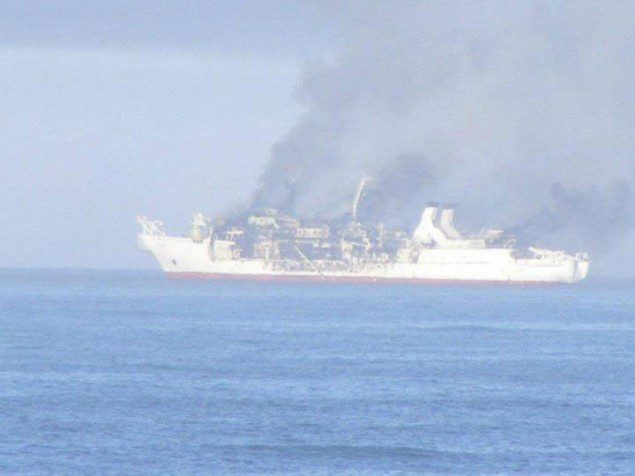
From gCaptainA cable laying ship returning from a repair job off the coast of Namibia erupted in flames and smoke earlier this week, forcing all 56 crew members to abandon ship and leave the still burning vessel adrift just offshore in the southern Atlantic Ocean.
The vessel, the 135 meter long Chamarel belonging to the French telecommunications company France Telecom-Orange, caught fire on August 8th following a repair operation on the Sat3-Safe cable extending from South Africa to Europe.
Reports indicate that the fire started on the bridge and quickly spreading to other sections of the vessel.
In a statement, France Telecom says that despite the crew’s efforts to control the blaze, the decision was made to abandon the ship at around 8 p.m. local time and all 56 crew members were safely recovered by a Namibian fishing vessel without injury or incident.
The crew is currently located at the Namibian port, Walvis Bay and will be repatriated in the coming days, the statement added.
France Telecom says that the cause of the fire has not yet been established and a full investigation will be launched as soon as the vessel has been recovered.
The company also added that the incident has no immediate impact on submarine cables in the area, which will continue to function normally.