HOT NEWS !
Stay informed on the old and most recent significant or spectacular
nautical news and shipwreck discoveries

-
Jensen firefighter finds anchor treasure at Dollman Beach
- On 19/08/2012
- In Parks & Protected Sites
By Cynthia Washam - The Palm beach post
The ocean is a shrewd storyteller, whispering secrets of her past just often enough to hold everyone's interest.
This month, she threw out a nugget to an unsuspecting Jensen Beach firefighter out for day with his family at Dollman Beach. "We all had masks and we're checking out the rocks at the beach," 50-year-old Bennett Richardson said. "
I saw what I believed to be part of an anchor sticking out of the sand. I was excited because this is the Treasure Coast and it's not called that for nothing."
The Treasure Coast moniker comes from the fleet of Spanish galleons that wrecked against rocks and reefs in a 1715 hurricane, spilling an estimated $900 million worth of gold bars, coins and jewels from Sebastian to Fort Pierce.
Although treasure hunters have uncovered millions in sunken artifacts, they know millions more are still waiting to be found. On Sunday, three weeks after Richardson spotted the crusty chunk of iron poking out of the sand, he returned to the St. Lucie County beach.
This time he called Chris Perry, a fellow surfer and former professional photographer. He also enlisted the help of a couple strangers at the beach.
While Perry took pictures, the three men pushed the seven-foot-long anchor up from the sand.
"You'd need about 20 people to get it out," Richardson said. "We all just gave up because it was too heavy."
Lucky for him, because he could have been arrested if he'd taken the anchor out of the water. State law allows only licensed salvagers to remove historic artifacts from the ocean.
-
One man’s quest to recover artifacts from Lake Ontario shipwreck
- On 19/08/2012
- In Parks & Protected Sites

By Carola Vyhnak - The StarShe was in trouble from the start. Rotting and full of leaks, His Majesty’s Ship Speedy was in no shape to sail Lake Ontario, much less carry the who’s who of Upper Canada from York to Newcastle, 150 kilometres away.
But over the captain’s protests, the 80-foot warship was forced to make the trek east for an important murder trial in October of 1804.
Battling a sudden, vicious storm, she struck rock lurking beneath the waves and sank, taking everyone on board to an icy death.
Two centuries later and 22 years after finding her remains off Presqu’ile Point in Brighton, 90 minutes east of Toronto, wreck hunter Ed Burtt believes it’s high time the artifacts were recovered so everyone can appreciate a little-known part of Canada’s heritage.
“This is the most historically significant archeological site that changed the history of Canada,” says the 72-year-old Belleville diver.
Worried about the wreckage rotting on the lake bottom, he’s anxious to haul up relics that include a ship’s bell with an “S” still visible. But that can’t happen until a government-approved site is found to exhibit the items.
It was Oct. 7, 1804 and the trial of Ogetonicut, a native charged in the murder of a white man, was about to start in the tiny colony of Newcastle. A successful trial there would pave the way for the establishment of a district town.
HMS Speedy had been languishing in York harbour for months, taking on so much water she had to be bailed out daily. Hastily built with green timber by the British government in anticipation of a war with U.S. colonies, the seven-year-old schooner was pressed into ferry service.
-
Famed SS Terra Nova shipwreck discovered off Greenland
- On 18/08/2012
- In Famous Wrecks
From Maritime Executive
U.S. researchers have discovered the wreck site of the SS Terra Nova – the ship that Captain Robert Scott sailed on to his ill-fated Antarctic expedition 100 years ago.
It was located off Greenland.
In 1910, Capt. Scott and his crew set off aboard the Terra Nova in hopes of becoming the first expedition to reach the South Pole.
Upon arrival at the South Pole in January 1912, Scott and his crew realized they had been beat by a Norwegian team led by Roald Amundsen. The polar team led by Scott never made it home; their bodies were found by a search party eight months later, according to a BBC News report.
The historic vessel, on the other hand, lived on and ended up sinking in 1943 while making a supply delivery to Arctic base stations after being damaged by ice. Its crew was rescued by U.S. Coast Guard cutter, Southwind.
Back in current times, the wreck has been discovered by a Schmidt Ocean Institute team during echo-sounding equipment testing on the R/V Falkor. An unidentified object was noted during sonar mapping of the sea bed.
An underwater camera package was dropped into the waters below the research vessel to film the presumed wreck. Right across the top of the target, it showed the remains of a wooden wreck lying on the seabed, as well as a funnel next to the ship.
The features of the wreck closely matched historical photos of the Terra Nova, leading to the identification.
-
Hunt for enemy submarines
- On 17/08/2012
- In High Tech. Research/Salvage
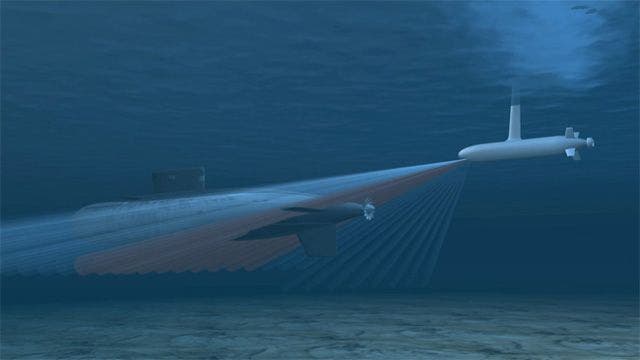
By Allison Barrie - Fox NewsUnderwater satellites, mini-robot sub trackers and an open invitation to join the hunt for submarines in dangerous waters – all US projects underway to defeat the growing threat of enemy submarines.
Submarines may sound like a bit of an old school Hunt for Red October style threat, but Anti-Submarine Warfare planning is still vital.
Diesel-electric submarines are a growing threat for four primary reasons.
They can be built a relatively low cost in comparison to traditional platforms and have therefore proliferated in numbers- arguably in numbers that exceed our maritime platforms.
Additionally, the lethality of these diesel electric subs has also grown while their acoustic signatures are lower making them harder to detect.
DARPA’s Distributed Agile Submarine Hunting or DASH program will detect and locate submarines over vast areas in both deep and shallow water.
DASH is a sort of an underwater version of a satellite capable of operating at extreme depths in open ocean. Known as “subullites,” these are being developed for deployment on deep sea enemy sub stake outs.
The underwater satellites will be mobile, quiet and unmanned.
Just like a satellite in the sky, it will have a large field of view- but in this case of the water overhead so that it can scan upwards and from great depths detect the quiet diesel electric subs.
To hunt submarines in the more shallow continental shelf waters, state of the art mobile sensors will hunt from above rather than from below the threat. For this area, non-acoustic sensing will be deployed.
-
Collector asks for whom the Empress of Ireland bell shall toll
- On 17/08/2012
- In Famous Wrecks
From Montreal CTV News
Philippe Beaudry is getting frustrated that his deal for his collection of items from the doomed Empress of Ireland still hasn't closed.
The vessel sank in May, 1914 after it collided with a Norwegian ship near Rimouski, making it the largest maritime accident in Canadian history, as 1,012 passengers and crew died in the disaster.
The horrific incident has long been Beaudry's great passion and has inspired him to spend 16 years collecting the world's largest Empress of Ireland collection, valued at over $3 million.
The ship's bell is all that remains in his possession, after he agreed to sell the rest of the items to the Museum of Civilization in Gatineau in December, following a grueling five-year negotiation.
"I cannot keep a treasure that has to be seen by the public," said Beaudry.
The deal was to be finalized April 12, 2012 but the federal review board responsible for approving the agreement has postponed its decision until June.
-
Shipwreck Found in Seneca Lake
- On 17/08/2012
- In Parks & Protected Sites
From Rochester Your News Now
You'd never know it was there from the shores of Seneca Lake: the treasure, and ruins, which lie beneath."Would have been nice, if someone had seen it, could have done a sketch,” said Jim Kennard.
Kennard has more than just sketches of the wreckage of "The Onondaga." He's seen it. Through sonar images, anyway.
"I've been searching for shipwrecks since the mid 70s. So, a long time."
Kennard and a partner located the old steamer while searching for sunken wrecks in the lake. They actually made the discovery two years ago, but confirming it took time.
"Because of the depth the image was really kind of fuzzy, and we didn't have the capability to get close to it."
The Onondaga was built in 1860; one of the largest steamers on the Finger Lakes.
It was used to ferry soldiers to the south end of Seneca Lake during the Civil War, and later converted into a passenger steamer. By 1898, the boat had been docked. One of its final uses was housing quarantined smallpox victims.
"After that, the townspeople in Geneva decided let's make a big deal out of this."
So to send the boat to a watery grave, the Onondaga was loaded with 500 pounds of dynamite, 300 pounds of blasting powder and a barrel of gasoline.
"So it was quite a spectacle."
-
Exhibit features shipwreck found in Hawaiian Islands
- On 17/08/2012
- In Museum News

By Wendy Osher - Maui NowA new exhibit featuring a shipwreck found in the northwestern Hawaiian islands opens in Massachusetts tomorrow.
The Lost on a Reef exhibit features displays and research information on the Two Brothers vessel, which wrecked on a stormy night in the French Frigate Shoals on February 11, 1823.
The Two Brothers is recognized as the first discovery of a wrecked whaling ship from Nantucket. The ship was also captained by Captain George Pollard Jr., who previously commanded the ill-fated Essex, the story of which inspired the storyline for Herman Melville’s epic tale, Moby Dick.
Archaeologist Kelly Gleason, the Maritime Heritage Coordinator for Papahānaumokuākea Marine National Monument, will introduce the exhibit during the opening festivities.
Gleason will describe the discovery of the 19th century wreck site, and the research that ensued which led to the positive identification of the vessel.
The exhibit, on display at the Nantucket Historical Association’s Whaling Museum, highlights the maritime heritage of the Papahānaumokuākea Marine National Monument, and presents findings and artifacts from NOAA research missions.
Full story... -
French shipwreck to be rebuilt after freeze drying process
- On 16/08/2012
- In Conservation / Preservation

From The TelegraphBy placing the ship – La Belle – in a constant environment of up to 60 degrees below zero, more than 300 years of moisture will be safely removed from hundreds of European oak and pine timbers and planks.
The freeze-dryer, located at the old Bryan Air Force base several miles northwest of College Station, is 40 feet long and 8 feet wide – the biggest such machine on the continent devoted to archaeology.
Researchers will then rebuild the 54 ½-foot vessel, which will become the centrepiece of the Bob Bullock Texas State History Museum in Austin.
From a historical perspective, it's "an icon of a small event that dramatically changed the course of Texas history," said Jim Bruseth, who led the Texas Historical Commission effort to recover the remains.
The ship was built in 1684 and sank two years later in a storm on Matagorda Bay, about midway between Galveston and Corpus Christi. Captained by Rene-Robert Cavelier Sieur de La Salle, he hoped to colonise Texas for France.
"When La Belle sank, that doomed La Salle's colony and opened up the door for Spain to come in and occupy Texas," Mr Bruseth said. "People can see firsthand how history can turn on a dime."
Researchers have determined that unlike earlier vessels, the frames on La Belle were marked specifically by the French craftsmen so the wood comprising the hull could follow the complex curve of the ship.
After a more than decade-long hunt, Texas Historical Commission archaeologists found it in 1995 in 12 feet of murky water. Then began the tedious recovery that involved constructing a dam around the site.