HOT NEWS !
Stay informed on the old and most recent significant or spectacular
nautical news and shipwreck discoveries

-
Treasure salvage licence hopes are 'wrecked'
- On 24/05/2014
- In Miscellaneous

By Natario McKenzie - Tribune 242
A senior government official yesterday seemingly ‘wrecked’ salvagers’ hopes for speedy licence approvals, revealing that a moratorium remained in effect and suggesting their motives did not necessarily align with the Bahamas’ national interests.Dr Keith Tinker, the Antiquities, Monuments and Museum Corporation’s (AMMC) director, told Tribune Business that a moratorium on wreck searches and salvage leases in the Bahamas remains in effect for now, as the necessary protocols to prevent “the rape” of historic sites still need to be put in place.
While a growing list of frustrated wreck salvagers have in recent times questioned why the Government has dragged its feet in acting on their license applications, Dr Tinker said: “The moratorium is still in effect. As far as we have been advised, it has not been lifted.
I know that the process of consideration by the Bahamas government is ongoing as to if they are going to lift it, and when they are going to lift it. That’s as much information as we are aware of. That’s the sum total of it.”
Dr Tinker’s comments, though, are at odds with the position taken in today’s Tribune Business (see Page 2B) by one of the 18 salvagers with an outstanding licence application before the Government.
Apart from stating that the moratorium had been lifted, the salvager said he had been waiting since April 2012 for his licence approval, which was supposed to come within 90 days.
“The salvage business is a very expensive undertaking, requiring large financial assets, boats, equipment and manpower, and none of these can just sit around for indefinite periods of time,” the salvager wrote.
-
Looking down the barrel of history
- On 21/05/2014
- In Museum News

By Ted Shorack - The Daily Astorian
After five years of painstaking restoration work, two cannons from a 19th century American ship that surveyed the region are now ready to be displayed at the Columbia River Maritime Museum.
Museum staff used a forklift Tuesday to hoist the 1,300-pound iron cannons and carefully place them in replica wooden carriages and original mounting pieces.
Although the ship was broken apart on the Columbia River bar 168 years ago, the cannons still technically belong to the U.S. Navy.
The museum partnered with the Navy and the state of Oregon to restore and display them.
“To us it’s so much more than just a maritime story,” said Dave Pearson, deputy director of the museum. “This was the dawn of the Oregon territory. This is something that I think has a bigger story to tell.”
The two cannons, known more specifically as carronades, were discovered in 2008 during Presidents Day weekend.
Mike Petrone of Tualatin and his daughter Miranda, who was 12 years old at the time, discovered the first cannon while walking along the beach in Arch Cape. Two days later the second one was found by Sharisse Repp of Tualatin.
Staff with the Nehalem Bay State Park and others had to use a backhoe for the first cannon and dig trenches alongside it before pulling it out.
Both were displayed in tubs at the park as officials tried to determine their origin.
-
'Byzantine iPad' found in ancient shipwreck
- On 20/05/2014
- In Underwater Archeology
By Rossella Lorenzi - News Discovery
Turkish archaeologists excavating a harbor site on the European side of the Bosphorus have unearthed a 1,200-year-old wooden object which they claim is the ancient equivalent of a tablet computer. The device was a notebook and tool — in one.
The Byzantine invention was found within the remains of one of the 37 ships unearthed in the Yenikapi area of Istanbul, a site which has been at the center of excavations for the past 10 years.
Also known as Theodosius Port, it was built in the late 4th century during the reign of the Byzantine Emperor Theodosius I and become the city's most important commercial port.
Probably belonging to the ship's captain, the wooden object, whose cover is finely carved with decorations, is the size of a modern seven-inch tablet, but it's much thicker.
It consists of a set of five overlaid rectangular panels carved with frames and covered with wax. Notes could be taken on those panels, as shown by writing in Greek which is still visible on the wax.
A primitive "app" is hidden on the bottom panel: a sliding lid revealing a hidden plate with carved spaces.
"When you draw the sliding part, there are small weights used as an assay balance," Ufuk Kocabaş, director of Istanbul University’s department of marine archeology and the Yenikapi Shipwrecks Project, told Hurriyet Daily News.
-
Divers stage emergency excavation of historic Thames shipwreck
- On 16/05/2014
- In Conservation / Preservation
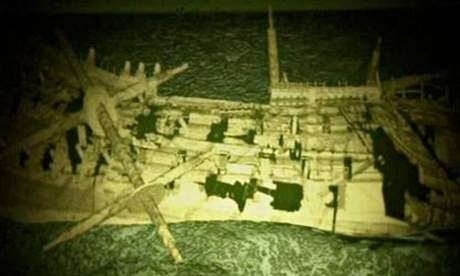
By Dalya Alberge - The GuardianArchaeologists will embark on an emergency excavation of one of Britain's most important shipwrecks on Sunday after discovering it is deteriorating at alarming speed because of the warmer waters caused by climate change.
The once-mighty 17th-century vessel, named the London, has lain in the muddy silt of the Thames estuary off the Essex coast near Southend-on-Sea for 350 years.
Built in 1656, she was in a convoy that transported Charles II from the Netherlands to restore him to his throne after Oliver Cromwell's death in 1658. One of the most illustrious ships of her day, her remains are now a time capsule of the 17th century.
English Heritage, the government advisory body, has commissioned Cotswold Archaeology to carry out a major excavation.
Mark Dunkley, a marine archaeologist at English Heritage, told the Guardian: "It's rare for wooden shipwrecks of this age and older to survive to this extent."
The hundreds of surviving wrecks are mostly later iron and steel ships.
Asked why the wreck is deteriorating now after 350 years, he said: "Through human-induced climate change, warmer water is moving northwards. That's allowing the migration of warm-water invasive species."
He spoke of the need for action to stop warm-water ship-boring organisms eating away at timber and organic artefacts and prevent loose objects being dispersed.
-
Christopher Columbus’s Santa Maria looted ?
- On 16/05/2014
- In Underwater Archeology

From Associated PressAn explorer who believes he’s found the wreckage of Christopher Columbus’s flagship, the Santa Maria, off the coast of Haiti said Wednesday that the vessel has been looted and needs to be excavated immediately.
“I think this is an emergency situation,” explorer Barry Clifford said. “I think the ship needs to be excavated as quick as possible and then conserved and then displayed to the world.”
Clifford was at the Explorers Club in New York to show photos and video of what he said was a pile of ballast stones from the wreckage.
“I think the evidence is overwhelming that this ship is most probably the Santa Maria,” he said.
If the wreckage Clifford has found is the Santa Maria, it would be the oldest known European shipwreck in the so-called New World.
But scientists say it’s far too early to make any such declaration.
-
Men guilty of stealing artefacts from sea
- On 16/05/2014
- In Illegal Recoveries

David Knight, 52, of Castle Road, Sandgate, and Edward Huzzey, 55, of Granville Parade, Sandgate, admitted to a total of 19 offences between them.
Bronze cannon and propellers from German submarines were among items taken from wrecks off the Kent coast.
The men appeared before Southampton Magistrates' Court where sentencing was adjourned to 2 July.
The Maritime and Coastguard Agency (MCA) said the offences were contrary to section 236 and section 237 of the Merchant Shipping Act 1995.
The shipwrecks targeted included German submarines from World War One and an unknown 200-year-old wreck carrying English East India Company cargo.
-
The wreck of Christopher Columbus’s flagship the Santa Maria
- On 13/05/2014
- In Underwater Archeology

By David Keys - The Independent
More than five centuries after Christopher Columbus’s flagship, the Santa Maria, was wrecked in the Caribbean, archaeological investigators think they may have discovered the vessel’s long-lost remains – lying at the bottom of the sea off the north coast of Haiti.It’s likely to be one of the world’s most important underwater archaeological discoveries.
“All the geographical, underwater topography and archaeological evidence strongly suggests that this wreck is Columbus’ famous flagship, the Santa Maria,” said the leader of a recent reconnaissance expedition to the site, one of America’s top underwater archaeological investigators, Barry Clifford.
“The Haitian government has been extremely helpful – and we now need to continue working with them to carry out a detailed archaeological excavation of the wreck,” he said.
So far, Mr Clifford’s team has carried out purely non-invasive survey work at the site – measuring and photographing it.
Tentatively identifying the wreck as the Santa Maria has been made possible by quite separate discoveries made by other archaeologists in 2003 suggesting the probable location of Columbus’ fort relatively nearby.
Armed with this new information about the location of the fort, Clifford was able to use data in Christopher Columbus’ diary to work out where the wreck should be.
-
Retrieving the other coins from the Odyssey shipwreck
- On 08/05/2014
- In Scams, Thefts
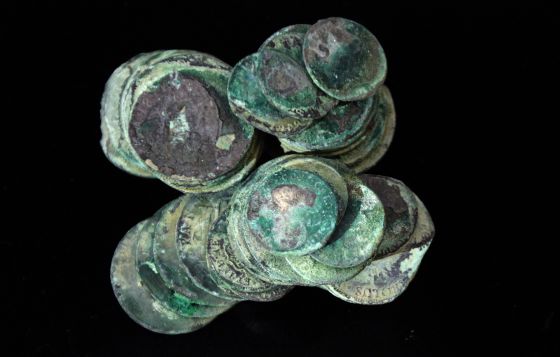
From Tereixa Constenla - El PaisThe last court battle over the Odyssey case was, comparatively, a minor skirmish, and it went mostly unnoticed.
Last October, the US-based treasure hunter paid the Spanish state $1 million (€717,000), according to the annual report that Odyssey Marine Exploration filed with the Securities and Exchange Commission in Wall Street.
In September 2001, after a protracted international legal battle, a US appeals court ruled that Odyssey had to return the 594,000 silver and gold coins it took in 2007 from a 19th-century Spanish shipwreck because the property is protected, among other things, by a 1902 US treaty that Washington signed with Madrid.
Once the case of the Nuestra Señora de las Mercedes was resolved, Spain claimed $3.2 million (€2.3 million) in legal expenses from Odyssey.
In September 2013, the Florida court ordered the treasure hunter to pay a third of that ($1.07 million, or €767,000). The Culture Minister on Tuesday confirmed that the money had been transferred to the Spanish treasury.
The case drew a huge amount of attention to the need to protect Spain’s underwater heritage.
“It served to create public awareness,” said Jesús García Calero, editor-in-chief at Abc newspaper and coordinator of a recent Madrid symposium on underwater archeology.
But not everyone was so optimistic. The writer Arturo Pérez-Reverte, author of the Alatriste series and one of the guest speakers, said that the Mercedes victory was an isolated case.
“It could happen again tomorrow.
The minister cannot go and get his picture taken underwater next to the sunken ship, and there are no votes to be won from it. Until a Spanish child knows who Jorge Juan or Blas de Lezo were, nothing will change,” complained Pérez-Reverte, who was very critical of “the notable lack of culture among our political class.”
But the Defense and Culture ministries are preparing to familiarize Spaniards with the story of La Mercedes, a frigate that was sunk by an English ship on October 5, 1804 off the Portuguese coast of the Algarve, and forgotten about until two centuries later, when the Odyssey US marine exploration company found the wreck and extracted its valuable load of gold and silver coins.