HOT NEWS !
Stay informed on the old and most recent significant or spectacular
nautical news and shipwreck discoveries

-
Explorers find 1952 US plane wreck in Lake Ontario
- On 17/07/2014
- In Airplane Stories
From Independent Records
The wreck of a U.S. Air Force twin-engine plane that crashed into eastern Lake Ontario more than 60 years ago has been found in deep water off Oswego, a team of underwater explorers said Tuesday.
The Beach Aircraft C-45 flew for miles on its own after its three-man crew and two civilian passengers bailed out when one of the engines failed during a flight over central New York in 1952.
The aircraft flew on automatic pilot for more than an hour before it crashed into the lake several miles northwest of Oswego, on the lake's southern shore 35 miles north of Syracuse.
A trio of explorers from the Rochester area said they located the nearly intact plane in more than 150 feet of water while searching for historic shipwrecks on the lake's eastern end on June 27.
One of the searchers, Jim Kennard, said the C-45 was on a routine flight on Sept. 11, 1952, from Bedford, Massachusetts, to Griffiss Air Force Base in Rome, New York, when the left engine began failing about 50 miles from its destination.
As the plane started to lose altitude, the pilot believed it would soon crash and ordered the other two Air Force officers on board and the two civilians to parachute from the aircraft at 2,500 feet.
-
Divers uncover historical treasure trove in waters off Sai Kung
- On 14/07/2014
- In Underwater Archeology

By Danny Mok - South China Morning PostA group of local divers are on an underwater mission to find historical treasures they believe may have been resting on the sea bed off Sai Kung for centuries.
The seven members of the Hong Kong Underwater Heritage Group will complete their 13-day expedition today, retracing their 2010 search in the same area off High Island Reservoir, which turned up some promising finds.
"We identified 313 artefacts [in 2010], mostly porcelain, in a small area of 30 metres by 30 metres," said group member Marco Li Li-hen, 42.
"Twenty-two of them were intact blue-and-white porcelain bowls and plates.
"That surprised us. Why were there so many artefacts there?"
The group of divers are mentored by Dr Bill Jeffery, an Australian maritime archaeologist who lives in Hong Kong. Jeffery said the artefacts could date back to the Ming (1368-1644) or early Qing (1644-1912) dynasties, and could have ended up on the ocean floor after a shipwreck.
"Trading was going on in this general area, but how much was going on and are there other shipwrecks there? Quite possibly," Jeffery said, adding that it was too early to say what else might be found at the site.
"We need to do the excavation, then to get ceramic experts to look at what we have found to see the significance of the materials."
The group is hoping to find the source of the artefacts found in 2010.
Cheng Kai-ming, former chairman of the Archaeological Society, said it was an unusual undertaking for a group of amateurs.
"It's certainly rare to see [people] like them using their spare time for underwater archaeology … which is much riskier than on dry land, especially working with shipwrecks."
Both Cheng and Jeffery are keeping their expectations low about the likelihood of finding anything significant but that has not dampened their enthusiasm.
-
Cursed, 450-year-old shipwreck to be explored
- On 13/07/2014
- In Underwater Archeology

Researchers have begun exploring the wreckage of the Mars, a Swedish war ship that sank during a naval battle in 1564.
Johan Rönnby, professor of maritime archeology at Södertörn University in Sweden, was recently awarded a grant from the National Geographic Society for his project, "The Maritime Battlefield of Mars (1964)."
How were the Vikings such remarkable mariners ? Scientists have found the answer buried deep in a 16th-century shipwreck.
"It's a unique ship," Rönnby said. "Maybe the biggest in the world during this time. And when it exploded, because it actually exploded during the fight, it went down to the bottom ... so we are diving on the wreck, but we are also diving on the sunken battlefield."
The ship sank during a bloody battle against a fleet from Denmark and the German city of Lübeck. Mars was rumored to have been cursed because many of its 130 cannons were made from melted church bells.
Rönnby says due to the brackish water and conditions of the Baltic Sea, the ship is remarkably well-preserved.
"The cold and darker water of the Baltic Sea preserves wreck in a fantastic way, and that's really the reason we have Mars on the bottom like this," Rönnby said.
-
Doubt on Christopher Columbus account of Santa Maria shipwreck
- On 08/06/2014
- In Shipwrecks of the "New World"

By Harriet Alexander - The TelegrapAn 'X' marked the spot on the explorer's map – and the crowd grew wide-eyed in amazement at what they were told lies beneath.
The 500-year-old diaries corroborated the find, said Barry Clifford, a marine archaeologist, standing at the front of the wood-panelled Explorer's Club in New York.
The ballast found under the waves matched the profile of the ship, believed to have run aground half a millennia ago. The government of Haiti, the country on the map, was excited by the news.
Mr Clifford thought he had found his treasure: the wreck of Christopher Columbus's ship, a prize 500-years in the searching.
"I think the evidence is overwhelming that this ship is most probably the Santa Maria," he said last month.
But after the triumphant announcement, Mr Clifford's find is now being called into question.
A Portuguese-American historian, Manuel Rosas, has said that the discovery of the shipwreck is impossible – because the ship never sank.
His theory, based on over two decades of research, is that the ship did not sink, as is widely believed, but was hauled onto the Haitian shore, used to house the sailors Columbus left behind on his return voyage, and eventually years later burnt as firewood.
He says that Columbus deliberately misled the world with his journals, because he was acting as a spy for the Portuguese king, rather than reporting to his Spanish paymasters.
"He was the James Bond of his day," said Mr Rosas, speaking to The Telegraph from his home in New York. "It's unbelievable that he has managed to pull the wool over everybody's eyes for five centuries.
"But the important thing to remember is that the whole mission was to trick the Spanish – and tell the Portuguese what was really going on. In this he succeeded.
"Anyone who looks for a shipwreck off Haiti won't find the Santa Maria – because it never sank."
-
Spain’s hard-won shipwreck coins finally go on public display
- On 03/06/2014
- In Museum News
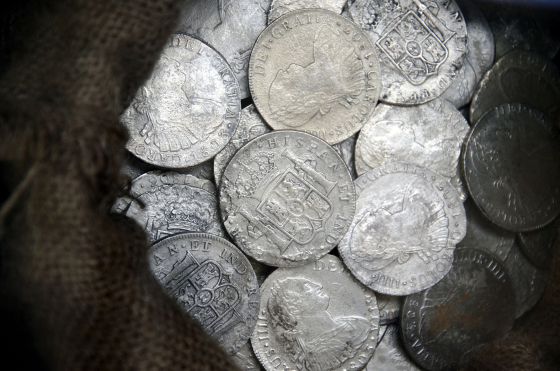
By Miguel Tébar - El PaisFive years after being scooped up from the seabed off the coast of Cadiz by US deep-sea treasure-hunting company Odyssey, and following lengthy legal wrangling over their ownership, around 8,000 coins from a much larger haul that was aboard a Spanish frigate sunk by the British in 1804 have gone on display at ARQUA, the National Sub-Aquatic Archeology Museum, in Cartagena.
The Spanish government sees its success in reclaiming the coins as a major victory against companies such as Odyssey, which scour the world’s oceans in search of sunken booty.
The case sets a legal precedent, providing Spain with the mechanisms and procedures to protect hundreds of its vessels lying on the seabed around the world sunk in centuries past.
“This is an unprecedented international triumph against plundering and the illegal traffic in cultural heritage,” José María Lassalle, Spain’s secretary of state for culture, told assembled dignitaries on May 29 at the opening of a permanent exhibition about the vessel, Nuestra Señora de las Mercedes, which will focus on Spain’s fight to recover almost 600,000 coins worth an estimated half-a-billion dollars that Odyssey found aboard.
Iván Negueruela, ARQUA’s director, gave journalists a guided tour of the exhibition, which aside from explaining the historical background to the treasure haul, also highlights what he calls the dangers of underwater “piracy.”
The exhibition is divided into four parts: “New Routes and Inter-Oceanic Trade”; “Naval Construction”; “Nuestra Señora de las Mercedes”; and “A Legacy to be Protected ?”.
-
‘Pirates of the Caribbean’ Tall Ship Sinks Off Saint Lucia
- On 29/05/2014
- In Maritime News
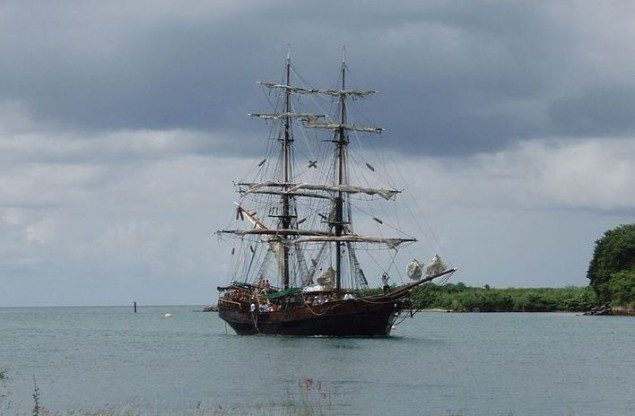
An iconic two-masted, square-rigged tall ship famously featured in the Pirates of the Caribbean movies has sunk off Saint Lucia.
According to reports, the Brig Unicorn sank early Saturday morning as it sailed from Saint Lucia to Saint Vincent & the Grenadines for dry docking, a short journey of about 18 miles.
St. Lucia Times reports that the ship sank within a matter of minutes of first taking on water. So far there is no official determination as to the cause of her sinking.
All 10 crew members including the captain abandoned ship and were rescued by the St. Vincent & the Grenadines coast guard some time later. No injuries were reported.
In an interview with the St. Lucia Times, a spokesman for the St. Vincent & the Grenadines coast guard said the ship had already sunk upon their arrival at the scene.
The 138-foot long Brig Unicorn was built in the late 1940’s in Finland. The ship was featured in at least three of the Pirates of the Caribbean movies (although not as the Black Pearl), as well as in the 1970’s TV series Roots.
The ship has been in St. Lucia since 1980, serving mostly recently as a bar and restaurant in Rodney Bay Marina.
The vessel will likely not be salvaged.
-
Tests for China's first archaeological exploration ship
- On 26/05/2014
- In Maritime News
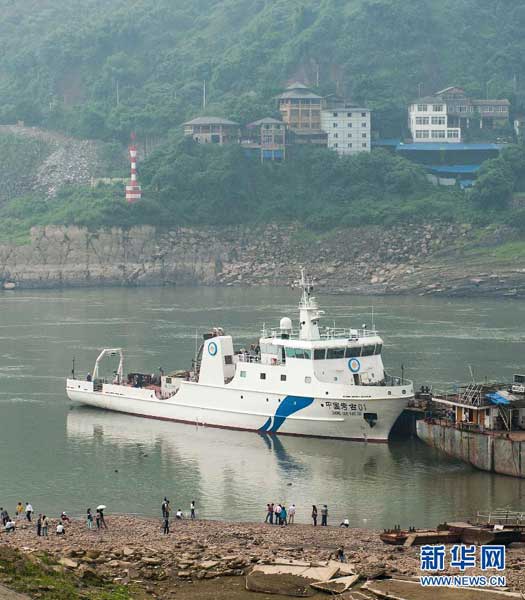
China's first underwater archaeological exploration vessel has begun testing in southwest China's Chongqing Municipality.The ship, owned by China's cultural heritage team, is berthed at the private port of Changhang Dongfeng Shipbuilding Corporation. The hull of the ship is white, emblazoned with "Chinese Archeology" both in Chinese and English.
The 500-tonne, 56-meter vessel has a maximum displacement of 960 tonnes, and can carry a crew of 30, according to an official with the Chongqing culture and heritage commission.
Underwater archaeology in China has made great strides since the 1980s and a number of professional institutions and teams work in the field. The lack of properly equipped vessels ships has long been a problem.
This ship, designed by the 701 Research Institute of the China Shipbuilding Industry Corporation, will continue testing in Shanghai before sailing out to the Xisha Islands in the South China Sea to begin archaeology work.
-
Is treasure hunting the world's worst investment ?
- On 24/05/2014
- In Treasure Hunting / Recoveries
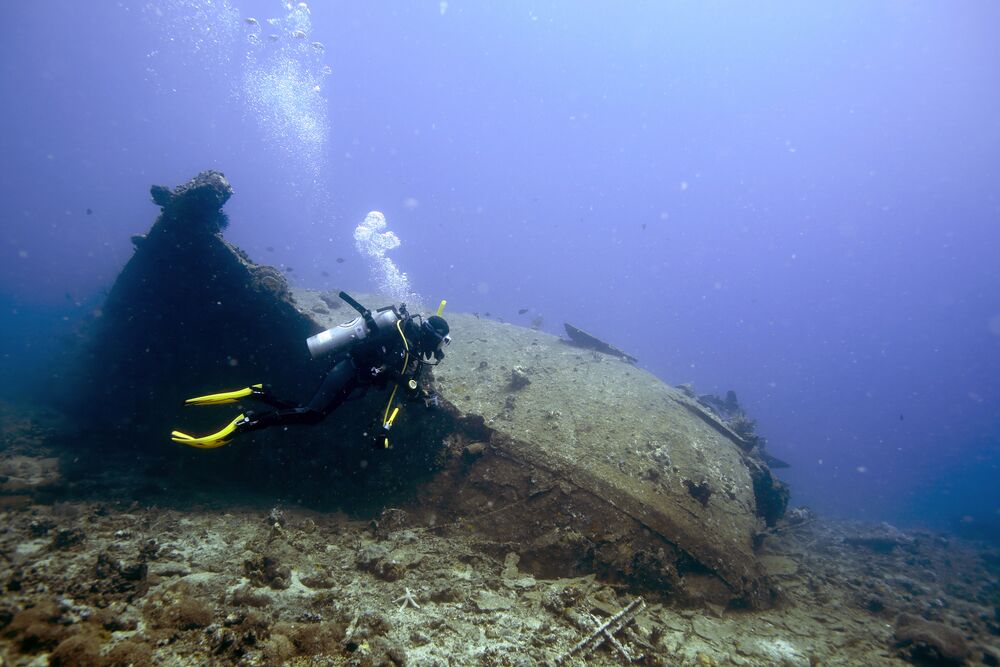
By Peter B. Campbell & Rodrigo Pacheco-Ruiz - BloombergDreams of undersea riches make treasure hunting a seductive investment. As professional underwater archaeologists, we don’t normally comment on the commercial salvage of historical shipwrecks.
But in this case, our expert opinion is: Don’t waste your money.
The fact is, no major treasure-hunting venture has ever been profitable for investors, according to a series of academic studies. And from an archaeological point of view, there are compelling scientific and legal reasons that investments in treasure hunting won’t pay off.
Treasure hunting has recently been in the news. On Monday, Tampa, Florida-based Odyssey Marine Exploration Inc. said that it had recovered gold from the sunken ship SS Central America, with estimates that there may be as much as $86 million in precious metal at the wreck site off the coast of South Carolina.
Investors are typically drawn to salvage ventures by these kinds of estimates. However, analysis of eventual sales of the recovered artifacts shows the projections are always inflated and never realized.
When Mel Fisher found the wreck of the Atocha, a 17th-century Spanish galleon that sank off the Florida Keys, he estimated that the cargo was worth $400 million.
Sales of recovered artifacts suggest a value of $13 million to $24 million, or no more than 6 percent of the original estimate. Over the years, Odyssey has projected a total of $3 billion for its various projects, but to date it has recovered only 2 percent of that amount.
High operating expenses ultimately make treasure hunting unprofitable. Of the six largest salvage projects, all but the Atocha definitively lost money despite multimillion-dollar cargoes, according to a 2013 report.
(It is debatable whether the Atocha venture was actually profitable and the data haven't been disclosed.)
Shares of the eight public treasure-hunting companies trade at pennies, except for Odyssey.
The news media often touts billion-dollar figures when a new wreck is found. Records of what was actually on the ships often directly contradict the inflated estimates.