HOT NEWS !
Stay informed on the old and most recent significant or spectacular
nautical news and shipwreck discoveries

Back-up sonar gets Centaur hunters back on track
From Brisbane Times
Shipwreck hunters are using a back-up sonar to search for the sunken hospital ship Centaur after a mishap on Friday. Search director David Mearns said the 'disturbing' loss of the SM30 sonar towfish has forced them to use reserve equipment.
They resumed their search for the Centaur with an AMS60 sonar which produces higher resolution images.
"In simple terms we will be able to "see" the targets better with the AMS60 and thus have a better idea whether the targets are man-made or geology," he has written on his blog.
"So while the loss of the SM30 was very unfortunate the AMS60 is the best option for this next phase of the search."
Mr Mearns said searchers had been able to eliminate possible `targets' and were focussing on an already identified target with similarities to the Centaur.
"The target has the right approximate shape and size for the wreck of Centaur and importantly we could now see an acoustic shadow behind the target whereas in the original image there was none," he wrote.
First look inside England's new Titanic museum
By Peter Law - The Daily Echo
The final plans for Southampton's £15m Sea City Museum can today be exclusively unveiled. The museum, which will reshape the city's Civic Centre forever, is expected to attract 150,000 visitors a year.
The Daily Echo can reveal a dramatic cruise-liner inspired extension which will be the largest museum display area in Hampshire.
Known as "The Pavilion", Southampton City Council hopes it will bring international blockbuster exhibitions to the city for the first time.
The old magistrates' courts will be transformed into two permanent exhibitions, titled "Southampton's Titanic Story" and "Gateway to the World".
Southampton's Titanic story will be told through the eyes of the crew and community to which they belonged.
"We have taken time to research other commemorative displays and museums to understand how we could take a tragic subject matter and make it engaging, informative and respectful," Caroline Keppel-Palmer, from museum designers Urban Salon, said.
"Our focus is to focus on the human stories surrounding the disaster, rather than the event itself and we also focus on Southampton in 1912 and life in the merchant navy at the turn of the century."
Egypt lifts huge 'Cleopatra temple' block from sea

From BBC News
A huge granite block thought to have once formed part of a temple pillar in a sunken palace of Cleopatra has been raised from the sea at Alexandria.
The nine-tonne stone, said to be from a temple to the goddess Isis, was lifted by crane out of the waters which have covered the palace for centuries.
It was cut from a slab of red granite quarried in Aswan, some 1,100km (700 miles) to the south, officials say. There are plans to exhibit it in a new museum devoted to the sunken city. Earthquakes are thought to have toppled the city in the 4th Century.
"This is one of the most important archaeological finds in Alexandria, among the 400 items recovered by the Greek archaeological team that has been engaged in underwater research since 1998," Egyptian Culture Minister Faruq Hosni said at the scene.

From The Economist
A shipwreck is a catastrophe for those involved, but for historians and archaeologists of future generations it is an opportunity.
Wrecks offer glimpses not only of the nautical technology of the past but also of its economy, trade, culture and, sometimes, its warfare.
Until recently, though, most of the 3m ships estimated to be lying on the seabed have been out of reach. Underwater archaeology has mainly been the preserve of scuba divers.
That has limited the endeavor to waters less than 50 meters deep, excluding 98% of the sea floor from inspection.
Even allowing for the tendency of trading vessels to be coasters rather than ocean-going ships, that limits the number of wrecks available for discovery and examination.
Moreover, shallow-water shipwrecks are often damaged. Storms reach down to affect them. Seaweeds and corals, which need light to grow, colonize them.
Freelance divers, seeking salvage rather than knowledge, despoil them. Archaeologists do sometimes team up with people who have access to miniature submarines (some manned, some unmanned) to explore deeper waters.
But such expeditions are expensive—a million dollars a pop is not untypical—and archaeology is not a well-resourced profession. Often, these expeditions are privately financed, speculative ventures which amount to little more than treasure-hunting.
Modern robotics, however, is changing this. A new generation of cheap, free-swimming, automatic underwater vehicles (AUVs) is being developed. Past minisubs have needed a lot of backup and, if unmanned, have had to be guided by signals passing down tethers.
Their mother-ships have thus had to be fitted out specially, which is one reason for the expense. An AUV, by contrast, can be dropped into the ocean and left to fend for itself. A wider range of vessels can thus support it.
Read more...
What lies beneath: nazi wreck off Fujairah
By Derek Baldwin - Xpress
Deep-sea mission off Fujairah shores reveals stunning new details behind mystery sinking of World War II nazi submarine.
The Gulf of Oman's pithy-black deeps have finally surrendered secrets of the mystery sinking of Nazi submarine U-533 during the Second World War.
Several years after the discovery of the U-boat on the seabed 108 meters below by Dubai shipwreck hunter and diver William Leeman, a new deep-sea mission in October to the U-boat's final resting place has confirmed a fatal blast hole was ripped into her rear port side, dooming the twin-screwed 76.8-meter-long vessel and 52 crew members to a watery grave.
Capitalizing on clear waters and armed with electric underwater scooters and high-powered spotlights, Leeman and his team of recreational divers discovered the two-meter gash near her propellers, confirming reports by RAF (Royal Air Force) Squadron 244 that a British light bomber aircraft had scored a direct strike on the submarine on October 16, 1943.
"This is where she was hit by a depth charge by a British Blenheim that struck from the air," said Leeman, 52, an electrical engineer.
"During our last dive, we could see the jagged edges of the hole where she was blown up. That was the moment of truth - the ship then sank to the bottom in a forward motion marking the epic death of 52 German mariners."
Explorers discover 1862 shipwreck in L. Ontario
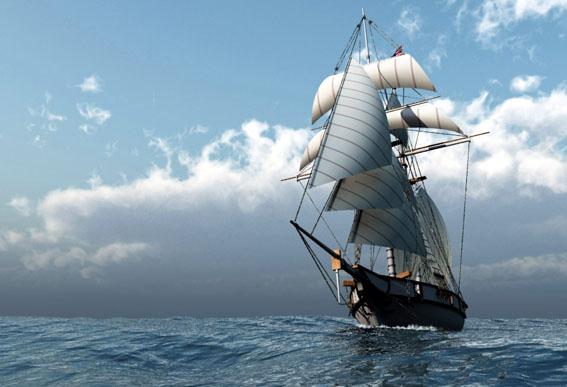
By Virginia Kropf - The Daily News
Rochester shipwreck explorers Jim Kennard and Dan Scoville have announced the discovery of yet another sunken ship in southern Lake Ontario, off of Oak Orchard Harbor.
A 19th century schooner sunk in 1862, the C. Reeve, was discovered by the men in late summer after a search effort which took them more than five years.
Finding the ship was a lucky discovery, the men said Tuesday. The initial discovery was not made by the conventional search methods used by the team to discover many of Lake Ontario's shipwrecks, they said.
The Reeve is a two-masted gaff rigged schooner built in 1853 in Buffalo by the firm of J.B. and N. Jones.
In July of 1858, the schooner made a trans-Atlantic crossing, sailing from Detroit to Liverpool, England, with a cargo of black walnut lumber. In October, she returned with a full load of crockery.
The Reeve is the 14th discovery for Kennard and Scoville between Lake Ontario and the Finger Lakes. Kennard said they have already discovered a few more shipwrecks in Lake Ontario, which they have not yet announced.
In an e-mail Monday afternoon, Kennard said as they were eating, a light wind was pushing the boat along when Scoville looked at the depth recorder and could see they were going over something that was several feet off the bottom.
Since one of the masts of the Reeve is still standing, the recorder jumped up, momentarily showing something 75 feet off the bottom.
Promising start to Centaur hunt
By Tuck Thompson - Courier Mail
Shipwreck hunters have found a "promising" image about the size of the sunken Australian hospital ship Centaur just two day into their deep-water search.
But they have admitted the seabed east of Moreton Island is so rough they may never find the ship, torpedoed by a Japanese submarine in 1943.
Expedition leader David L Mearns said sonar being towed by the Seahorse Spirit needed to be reexamined.
"The target was very close to directly beneath the sonar towfish where it doesn't perform as well," he said. "Nevertheless the target was about the right shape and size of the Centaur so we definitely have something to look forward."
But searchers also expressed frustration that much of the search area is severe, impenetrable terrain.
"This section of Australia's continental margin is geologically very dynamic with steep canyons carved into the continental slope," Mr Mearns said.
"We have found our search box to be dissected by three large submarine canyons whose walls rise 600 metres or more to exposed rocky cliff tops. The impact of all this geology is that it makes our job of picking out a relatively small shipwreck like the Centaur amongst all the rocks extremely difficult."
Coral gives up link to maritime saga

By Manuel Mitternacht - Smh
The legendary wreck of a British cargo ship that sank while sailing in convoy with Matthew Flinders 200 years ago has been discovered off the Australian coast.
Maritime archaeologists have made the claim after last week discovering a ship's cannon embedded in a reef in the Coral Sea off North Queensland.
It is thought to belong to the Cato, which sank in the area after running aground in 1803 en route to India.
Expedition leader Kieran Hosty, of the National Maritime Museum, said it was significant to Australia's maritime history.
''Very few colonial trading vessels have been found in Australian waters; this is just one of a handful,'' he said.
Five expeditions had visited the coral outcrop, known as Wreck Reef, in the past 45 years but failed to find where the Cato went down.