HOT NEWS !
Stay informed on the old and most recent significant or spectacular
nautical news and shipwreck discoveries

A long-sunken 11-foot-long cannon

From Texas A&M University - Institute of Nautical Archaeology
A long-sunken 11-foot-long cannon weighing almost 10,000 pounds made its public debut Thursday at the Texas A&M University Conservation Research Lab, part of the Institute of Nautical Archaeology.
The cannon was raised at sundown Nov. 22 from the USS Westfield, which was lifted from its watery resting place in the Texas City Channel, where it had been submerged for 146 years.
The recovery is part of a $71 million U.S. Army Corps of Engineers project to deepen the Texas City Channel along the Texas coast to keep waterways open for navigation.
The Civil War Union gunboat ship USS Westfield, originally built as a Staten Island ferry, was intentionally destroyed by Union forces to prevent capture after it grounded in the channel during the 1863 Battle of Galveston.

Search begins for the wreckage of the Centaur hospital ship

By Sophie Tedmanson - Times Online
A UK-based shipwreck hunter is set to embark on a search for the wreckage of one of Australia’s biggest maritime disasters off the coast of Queensland this weekend.
The Australian hospital ship the Centaur was torpedoed by a Japanese submarine off the coast of Queensland on May 14, 1943. Of the 332 non-combatants on board, only 64 survived the attack, and were forced to spend another 35 hours clinging to life rafts in the water while being circled by sharks until they were found by rescuers.
David Mearns, the director of the Blue Water Recoveries in West Sussex, will lead the search on board The Seahorse Spirit, a 72-metre multi-purpose vessel which has been fitted with 65 tonnes of specialised sonar equipment.
Mr Mearns said the crew of scientists and experts hope to head out to sea by Sunday on the $AU4 million (£2.2 million) mission, which is being jointly funded by the Australian and Queensland governments.
The wreck of the Centaur, which was built in Scotland by the British Blue Funnel Line shipping company, has never been found. A ship thought to be the Centaur was discovered in the same area in 1995, however the wreck was later deemed to be too small to be the hospital ship.
Mr Mearns said the crew will cover a search area of 4,000 sq miles in the Pacific Ocean off Cape Moreton by initially using a deep tow sonar which will scan the sea sideways.
He said the budget will only finance the operation for approximately 35 days at sea and the search could be hampered by the underwater terrain, but the team was confident of finding the 3,200-tonne, steel shipwreck.
Previously undiscovered ancient city found on Caribbean sea floor

By Jes Alexander - Herald de Paris
Researchers have revealed the first images from the Caribbean sea floor of what they believe are the archaeological remains of an ancient civilization.
Guarding the location’s coordinates carefully, the project’s leader, who wishes to remain anonymous at this time, says the city could be thousands of years old; possibly even pre-dating the ancient Egyptian pyramids, at Giza.
The site was found using advanced satellite imagery, and is not in any way associated with the alleged site found by Russian explorers near Cuba in 2001, at a depth of 2300 feet.
“To be seen on satellite, our site is much shallower.” The team is currently seeking funding to mount an expedition to confirm and explore what appears to be a vast underwater city.
“You have to be careful working with satellite images in such a location,” the project’s principle researcher said, “The digital matrix sometimes misinterprets its data, and shows ruins as solid masses.
The thing is, we’ve found structure - what appears to be a tall, narrow pyramid; large platform structures with small buildings on them; we’ve even found standing parallel post and beam construction in the rubble of what appears to be a fallen building.
You can’t have post and beam without human involvement.”
Seychellois man tormented by treasure hunt

By Jean-Marc Mojon - Telegraph
Cruise-Wilkins has spent much of his life, as did his father before him, dynamiting granite boulders, exploring caves and pumping water to find the treasure that Olivier Levasseur is thought to have buried somewhere near his house in Bel Ombre, in the north of the Seychelles' main island of Mahe.
Standing near a rock just yards from his beach-front home where the ebbing turquoise sea laps at a keyhole-shaped marking his father found, the 51-year-old ponders his strategy.
"We've used all kinds of machines and expensive equipment, ground-penetrating radars, but I think we need to go back to the old method. We need to get into this guy's mind," he says with a haunted gaze.
Levasseur was known as La Buse, which is French for buzzard, although whether the moniker was for the speed at which he flung himself on his prey or for his aquiline nose is unknown. He was driven from the Caribbean with scores of other buccaneers and corsairs in the early 18th century.
Thames mudlark tells history pupils to get their hands dirty
By Ellen Widdup - London Evening Standard
An amateur archaeologist is hoping to take children as young as five down to the mud banks of the Thames to search for buried treasure.
Steve Brooker, a "mudlark" who has helped find more than 13,000 objects of historical significance by the river, wants to encourage primary and secondary school classes to join him for a dig.
The 47-year-old has plans to start a history museum which would house some of his artefacts and provide a base for groups to explore the banks.
"This would not be like any other museum where kids get bored after five minutes," he said. "They could become involved in history, touch it, smell it, even change it."
He said he could give each class of 30 children who came to dig with him a guarantee that at least one would find something of major interest.
"The banks are teeming with surprises - from Elizabethan coins, buttons and pins to even older bits of pottery, bones and spears.
"The only rule will be that finds are handed over to the Museum of London to be recorded. The child's name will appear on that recording."
Scouring the depths of history

From the Sydney Morning Herald
Susan Gough Henly peers into vessels submerged beneath North America's most historic body of water.
Standing on the deck of Philadelphia II, a replica of one of Benedict Arnold's 1776 gunboats, I listen to Eric, a guide fitted out in period costume. He is describing what it might have been like living and fighting alongside dozens of citizen soldiers aboard this 16-metre square-rig ship.
"Just up the lake, the British were building war boats at the rate of knots," Eric says. "It was too dangerous to stay on land because of unfriendly Native American tribes.
"So you can imagine what the conditions must have been like with 44 men in this space for weeks at a time."
Pearl Harbor mini-submarine mystery solved ?
By Thomas H. Maugh II
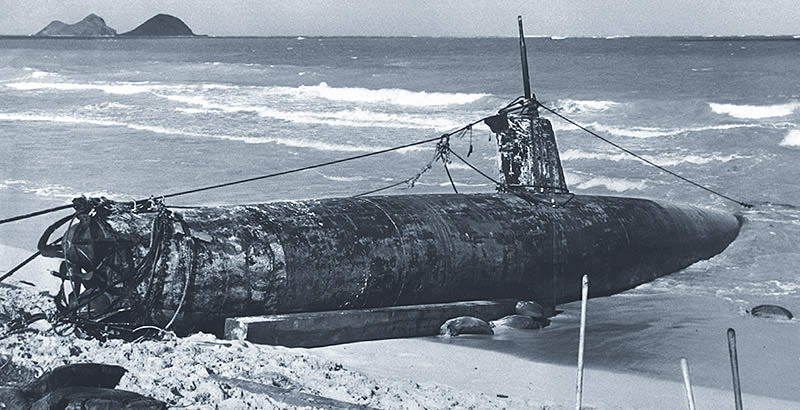
The remains of a Japanese mini-submarine that participated in the Dec. 7, 1941, attack on Pearl Harbor have been discovered, researchers are to report today, offering strong evidence that the sub fired its torpedoes at Battleship Row.
That could settle a long-standing argument among historians.
Five mini-subs were to participate in the strike, but four were scuttled, destroyed or run aground without being a factor in the attack.
The fate of the fifth has remained a mystery. But a variety of new evidence suggests that the fifth fired its two 800-pound torpedoes, most likely at the battleships West Virginia and Oklahoma, capsizing the latter.
A day later, researchers think, the mini-sub's crew scuttled it in nearby West Loch.
The loch was also the site of a 1944 disaster in which six tank landing ships preparing for the secret invasion of Saipan were destroyed in an ammunition explosion that killed 200 sailors and wounded hundreds more.
Divers find trash, treasure in area waters
By Denise Perry Donavin - Southbend Tribune
Don McAlhany has a unique way of spending New Year's Eve: scuba diving under ice in Lake Michigan or the St. Joseph River.
This year will mark his 31st in scuba gear, as he joins members of the local Michigan Underwater Divers (M.U.D.). McAlhany is the president of M.U.D. — an organization of local scuba divers who explore the rivers and lakes of southwest Michigan.
M. U. D., an appropriate acronym, explains the diver, since mud is the venue the divers face most often.
Local lakes and rivers are not the clear blue of the Caribbean that many divers envision. And in that mud, the divers have found plenty of trash and treasures — from anchors and engines to cash registers and coins, McAlhany said.