HOT NEWS !
Stay informed on the old and most recent significant or spectacular
nautical news and shipwreck discoveries

Diving into sunken-treasure investing

By Shelly K. Schwartz - CNBC
Gold coins, gems and historic artifacts that were lost at sea have captured the imagination of treasure hunters for centuries.
“As a child, everyone dreams of finding treasure,” says Dr. E. Lee Spence, an underwater archeologist who discovered several historically significant shipwrecks, including the Civil War blockade-runner, Georgiana and the Confederate submarine Hunley. “There’s romance and drama.
But as an adult most people aren’t going to spend their lives trying to find it.”
For a minimal investment, though, you can find your own piece of sunken treasure without getting wet. And if you play your cards right, it might even produce a profit.
“I believe this area is currently undervalued as the prevailing wisdom now amongst archaeologists is to leave shipwreck porcelain in situ (buried), rather than remove it post excavation,” says Costas Paraskevaides, director of artancient.com, an online marketplace for historic artifacts, including items legally excavated from shipwrecks.
A number of countries, he notes, including Cambodia, have actually “enshrined this policy” in the UNESCO (United Nations Educational, Scientific and Cultural Organization) Convention on the Protection of Underwater Cultural Heritage in 2001, “with more likely to follow, including Vietnam.”
“My own view is that with a reduction in legal salvage operations, those legitimate pieces on the market are bound to appreciate,” says Paraskevaides.
“Of course, the UNESCO 2001 convention would not cover shipwrecks found in international waters, but the big Chinese wrecks, which are of most interest to collectors as they contain porcelain, are mostly found in the territorial waters of Cambodia, Vietnam and Malaysia.”
Yi Cao hopes he’s is right. The Beijing native who now lives in Arlington, Va. purchased a 300 year-old shipwreck salvaged plate earlier this year for nearly $400. It was recovered from the Ca Mau wreck off Vietnam.
“It’s from the Qing Dynasty and it’s been fairly well-preserved by the water,” says Cao, who plans to purchase additional salvaged plates in the future.
“This is just a hobby of mine and I do not plan to sell it anytime soon, but I believe the price will appreciate when collectors discover that they are of high quality and there are not as man of them available for sale as they imagine.”
Seems everybody's on the hunt for the USS Bonhomme Richard

By Annys Shin - Washington Post
Captain Ahab had Moby Dick. Bob Neyland's white whale is the Bonhomme Richard.
For decades, thrillseekers, archeologists and professional treasure hunters have searched for the wreckage of the USS Bonhomme Richard, a Continental Navy ship captained by John Paul Jones during the Revolutionary War that sank on Sept. 25, 1779, off the coast of Yorkshire, England, in the choppy waters of the North Sea.
But the ship is legally the property of the U.S. Navy, which is responsible for preserving whatever may be left of it. A big part of that job falls to Neyland, chief archaeologist for the Navy's Underwater Archeology Branch, based at the Washington Navy Yard.
The tiny unit is responsible for identifying and preserving sunken and historically important Navy vessels from colonial-era warships to World War II fighter planes.
Created in 1996, the branch has had as many as eight employees, but budget cuts have sliced that to four, including Neyland. After salaries, the branch operates on a budget of about $37,000.
Neyland augments that by teaming up with other Navy offices, nonprofit groups, federal agencies and state governments.
With their help, he has been able to join three expeditions in the past four years to look for the Bonhomme Richard.
He would like to be part of the crew that finds the ship, but he has a lot of competition. Treasure hunting has become mass infotainment, thanks to TV shows such as "Deep Sea Detectives" on the History Channel and "Treasure Quest" on the Discovery Channel.
Shipwreck hunters include independent archaeologists, descendants of shipwreck victims and private salvagers seeking to cash in on what they find.
That burgeoning interest in sunken treasure has an upside: a steady stream of discoveries.
In 1995, a nonprofit group backed by adventure novelist Clive Cussler found the wreck of the H.L. Hunley, a Confederate Civil War submarine, off the coast of Charleston, S.C. (An earlier explorer claims to have identified its resting place in 1970).
In 2000, the Navy helped raise the Hunley, which contained the remains of its eight-man crew.
The sub, propelled with a hand crank, was designed to pick off Union ships blockading the port of Charleston.
The Hunley sank in 1864. The raised vessel and its contents, now in South Carolina, are estimated to be worth as much as $40 million.
95-year-old ammunition pulled from sea
From bernews
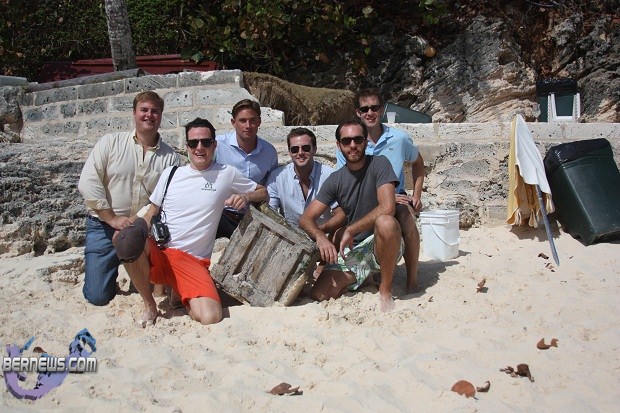
A group of visitors pulled a chest from the ocean, which after a delayed time that saw the Police Bomb Squad clear the area, was determined to be ammunition from a ship that wrecked off Bermuda in 1915.
The guests had flown into Bermuda to celebrate a wedding, with the majority coming in from New York and staying at the Coral Beach Club. The finders were Walker Brock, John Macaskill, Brendan Johnston, Andrew Gooss, Thatcher Martin, Will Rabbe and Chris Sturgess.
The group informed us that one of them was already well known around the hotel prior to the chest discovery, due to a drunken incident which resulted in him being found in the morning fast asleep on the hotel grass.
Yesterday they spotted the box lying in the ocean floor; approximately 11 feet deep and 50-100 feet from shore. Upon discussion they decided to attempt to pull it up, and waited till high tide today to make the job easier.
A number of them combined starting at approximately 11am today, and with the use of a volleyball net they managed to drag the box off the sand and place it on a boogey board.
They said the board was somewhat sinking under the weight, but they managed to safely get the box ashore. The entire procedure took around an hour, resulting in the box coming ashore at around 12pm today.
Victory at Yorktown won on the water

By Amanda Kerr
In September 1781 a naval battle between the British and French at the mouth of the Chesapeake Bay set up the eventual victory for the Siege of Yorktown.
British ships were coming down from New York to anchor for the winter. Gen. George Washington, who had arrived at Yorktown with his troops, feared being trapped by the British by land and sea. He pleaded with the French to send help.
Rear Adm. Francois Joseph Paul Comte de Grasse brought his fleet from the Caribbean and succeeded in blocking the British. Adm. Thomas Graves’ fleet was so badly damaged that it had to sail back to New York for repairs, leaving Gen. Lord Charles Cornwallis to fend for himself in Yorktown.
“That’s what set the stage for the Siege at Yorktown,” archaeologist John Broadwater said in an interview in advance of Yorktown Day next week. “That made it possible for the land siege.”
A month after the Battle of the Capes, other ships figured prominently along the coast of Yorktown.
Broadwater, who has studied, surveyed and excavated the Cornwallis ships in the York River, will discuss the maritime significance during a presentation this weekend at the Yorktown Victory Center. This summer Broadwater surveyed a newly discovered ship along the town shoreline, near the Betsy.
The presentation coincides with the 229th anniversary of the siege, celebrated annually on Oct. 19.
Cornwallis had an interior fleet of more than 50 ships to support his troops in town.
Broadwater explained that in the days before the siege, Cornwallis tried to break the French blockade in the Chesapeake Bay by using fire ships, rigged to burn and shoot out flames in an effort to damage other boats.
But the French were able to cut their anchors loose before any of their boats were damaged by the flaming ships.
Broadwater said that once Cornwallis realized he was vulnerable to an amphibious assault, he scuttled 10-12 ships to block the shoreline at Yorktown.
In some ships crews bored a hole near the bow. In the Betsy, a merchant ship Broadwater excavated in the 1980s, a piece of planking below the water line had been chopped out.
“I guess whatever they could do to sink the ship in a hurry,” Broadwater surmised.
Project researchers offer update on QAR expedition

By Jannette Pippin - Enc Today
A large concretion-covered artifact pulled this week from the shipwreck site of the presumed Queen Anne’s Revenge is the latest piece of evidence of the life of Blackbeard the pirate.
A six-week dive expedition is underway to recover artifacts from the wreck believed to be Blackbeard’s flagship, and N.C. Maritime Museums Director Joseph Schwarzer said each artifact raised by underwater archaeologists verifies what was once only legend.
“Because of their efforts we’re given a group of tangible facts about Queen Anne’s Revenge and about Blackbeard,” he said.
During a news conference held Friday to provide an update on the dive expedition, Maritime Museum officials announced plans for a major QAR exhibit to open at the Beaufort facility in June 2011.
“In the near future you’ll see major shifting taking place at the museum,” said N.C. Maritime Museums Exhibit Curator Mike Carraway.
The Maritime Museum is the official repository for QAR artifacts; and as the items come out of the conservation process, the goal is to present them and the history of Blackbeard and the QAR to the public.
Long-term plans call for the opening of a QAR exhibit at the museum’s Gallants Channel annex in 2018, the 300th anniversary of the sinking of the Queen Anne’s Revenge.
“This truly is a national treasure that belongs to North Carolina,” Schwarzer said.
But after 300 years on the ocean floor, the QAR artifacts don’t emerge from the water looking shiny and new.
The largest artifact to be raised during this dive was brought in for display before being moved to the QAR conservation lab in Greenville.
By Jennifer Johnson - The Examiner
"This is a very exciting find," recounted Bruce Lockett, director of the Texas Archaeology Study Association (TASA) and president of the Vidor Historical Society, referring to a wreck site discovered by the group months ago.
"We've been searching for this site for quite awhile, and I think we may have finally found what we have been looking for."
Lockett told The Examiner in August of this most recent find, but now the TASA team has pictures of artifacts located around the wreck site, items which lead the group to think they have indeed uncovered the object they have spent years searching to find.
Lockett said he and his group have been searching for the sunken Angelina steamboat, believed discarded along the Neches riverbed only a few years after it was commissioned in 1844.
"It made 12 trips, and on the last trip coming back it was lost in transit," he said. Information logged by Lockett and TASA maintain an account of the vessel.
"This (August) expedition was searching for the steamboat Angelina, which sank in the same area in 1849," Lockett wrote in a log of the find sent to the Texas Historical Commission.
"The expedition's purpose was to photograph and designate possible sites for exploration review to find the steamboat.
It is believed the vesel in completely intact with boiler and engine still onboard along with many historical artifacts from the period."
Lockett said a boiler/engine combo recovered from an 1800s wreck site is unheard of to this date, but anticipates that streak to change when TASA is able to explore the site, which is located south of Evadale.
While the actual wreck site is under more than 100 years of debris and river sand built up over the past century, team members have collected multiple artifacts for review.
And, according to seasoned excavator Lockett, the finds have been consistent with what they expected to locate at the Angelina wreck site.
Among some of the objects uncovered at the location were carbon batteries, 10-inch nails, angle irons and rivets, and unidentified artifacts thought to be either whiskey barrels or cotton bales.
The only thing that stand between the group and what they believe is the long, lost Angelina is permission to excavate the site.
Lockett said they have been waiting to receive word from the Texas Historical Commission to commence with the dig since August, but he anticipates making a road trip to the state office to seek permission if he doesn't hear back from the state agency before the first of November.
"We are waiting on permission to dig the trench, but from what we are seeing, I feel we have found the Angelina," Lockett said.
"We have found many reasons to believe the most recent discovery will be the Angelina, but right now, we have to get all the facts checked with the proper authorities."
Marine Exploration: treasure-laden Solo Dios Gloria

From Market Watch
Marine Exploration, Inc. and its Joint Venture Partner Hispaniola Ventures, LLC, announces their treasure hunting ship RV Hispaniola has recently left port returning to the site of the shipwrecked Spanish galleon Solo Dios Gloria.
One of the world's greatest divers, Burt D. Webber Jr., leads the crew as it seeks the sunken trove of gold, silver and jewels rumored to be on the Solo Dios Gloria. Shareholders and investors can expect the Company to issue near term updates and results from the ongoing salvage operations.
An early 18th Century Spanish galleon, the Solo Dios Gloria sank off the north coast of the
Dominican Republic. In late December 2009, the Dominican Republic confirmed Marine Exploration's discovery of artifacts from the ship.
The 300-plus items included silver coins, jewels, gold jewelry with pearls, a solid gold ring with diamonds, two hand-held bronze cannons, numerous pistols and cannons, guild pewter plates, navigation compasses, plumb lines for measuring depth, a pistol, sword sheaths, ornaments, plates, silverware, sword handles, a device to measure the ship's speed, bronze candlesticks, and a previously discovered bell from 1693 with the phrase 'Soli Deo Gloria'.
Mark Goldberg, CEO, Marine Exploration states, "The quest continues. Renowned treasure hunter Burt Webber knows well the Dominican Republic waters and has cutting-edge technology aboard the RV Hispaniola. We believe Burt and crew are at the right place at the right time."
Shipwreck site of St Paul may have been located
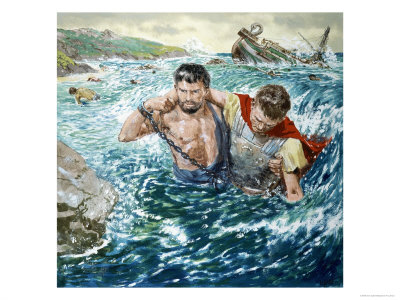
Wordsmith Media, Inc. have announced an agreement with Lou Reda Productions to produce a two-hour special on the Shipwreck of St Paul, based on the research of author and explorer Robert Cornuke.
The two companies finalized the details of a contract for the production and possible airing of a network series.
“I have been excited about this documentary for some time which will vividly display the findings of our research in Malta where we believe we have located the exact spot where the vessel carrying St Paul and some 270 people shipwrecked in the 1st century,” Cornuke noted.
As a former CSI investigator, Cornuke recreated in great detail the shipwreck account described in Acts chapters 27-28 of the Bible.
Scott L. Reda, Managing Director of Lou Reda Productions, stated, “We are happy to partner with Wordsmith Media on this very important and groundbreaking documentary which we believe will have a tremendous impact on a large international television audience.”
Lou Reda Productions is internationally recognized as one of America’s outstanding documentary filmmakers producing more than four hundred cable and network programs with numerous awards and recognitions including, The People’s Choice Award – Favourite New Mini-Series 1983 for The Blue and The Gray for CBS.
Reda has had 5 Emmy nominations, a Peabody Award and in 2009 produced the Emmy Award winning series WWII In HD for The History Channel.
Wordsmith Media, Inc. is a brand-driven company specializing in non-fiction, historical and cultural media, operating a global content network throughout the US and Europe for television broadcasting, DVDs, books, e-books, enhanced e-books and more traditional magazines.
Certain information contained in these materials is “forward-looking” information, such as projections, estimates, pro formas, or statements of intentions, expectations or plans.
All forward-looking information is subject to known and unknown risks and uncertainties, many of which are outside of the control of the company. Consequently, actual results may, and probably will, differ materially from the results contemplated in such forward-looking information.