HOT NEWS !
Stay informed on the old and most recent significant or spectacular
nautical news and shipwreck discoveries

Indonesia says China interested in shipwreck treasure

From AFP
China has shown strong interest in buying a massive haul of shipwreck treasures found off Indonesia after a final auction Thursday in Jakarta failed to attract a single bidder, a senior official said.
Like the two previous auctions held by the Maritime Affairs Ministry earlier this year, no investors paid the hefty 16-million-dollar deposit required to bid.
The auction committee's secretary at the ministry, Aris Kabul, said the Chinese government was interested in the haul salvaged in 2004 off Cirebon, West Java.
"We held talks with the Chinese government and our plan is to keep these treasures in museums in China and Indonesia," Kabul told AFP.
"I think it will the best solution so that this rich treasure will be preserved properly by museum experts," he said adding that both countries had not reached any agreement yet as details were still being discussed.
The collection comprises some 271,000 pieces including rubies, pearls, gold jewellery, Fatimid rock-crystal, Persian glassware and exquisite Chinese imperial porcelain dating back to the late 10th century.
Belgian treasure hunter Luc Heymans who conducted the salvage operation said it was one of the biggest shipwreck treasures ever found in Asian waters.
"The Chinese are very interested as this treasure is unique and there are no similar collections in any museums in China," he told AFP.
He said the investors involved in the salvage operation hoped for a quick solution so they could get their profits.
"We have taken huge financial risks in the operation and it's logical for us to get our money back soon," he added.
According to him, the operation cost about 10 million dollars.
£76,000 for a gold coin celebrating a great British victory
From Paul Fraser Collectibles
Dating from Queen Anne's reign, the piece was struck from captured French & Spanish bullion
Just over a week ago, Baldwin's assisted St James's Auctions in their coin sale with some very successful results, especially in British gold coins.
It was surprising that Baldwin's had taken the time to be involved, as they had just carried out a two day auction consisting of the last section of The Michael Hall collection of medals and a more standard Ancient, English & World Coins, Commemorative Medals & Orders, Decorations & Medals sale.
Between them, the two sales offered 2,324 lots. Three stand-out lots were:
A gold triple unite coin from the reign of Charles I from the Oxford Mint, 1644. Regular readers may remember that there was a Charles I triple unite coin in the St James auction too which also performed well (the basic design is the same, but there are clear differences to the careful eye).
The coin, displaying a crowned and armoured half-length portrait of the King, left-facing, holding an upright sword in his right hand and a laurel branch in his left has an attractive red tone and achieved £62,000 against a £50,000 estimate.
A remember that Russian coin collecting is in rude health came in the form of a gold 37½-Roubles coin from the doomed reign of the last Tsar, Nicholas II.
With light hairlines and marks, but otherwise extremely fine and rare, the piece was pushed up by excited bidders to double its £25,000 estimate, selling for £50,000 exactly.
However the top lot was a 1703 gold 5 Sovereign piece from the reign of Queen Anne, specifically from the famed Vigo run.
These were coined from gold captured by Admiral Sir George Rooke from a Franco-Spanish bullion fleet sheltering at Vigo Bay on 12 October 1702.
Search for John Paul Jones' ship continues

By Earl Kelly - hometownannapolis.com
A research team including a Naval Academy professor and four midshipmen recently identified more than 70 features on the North Sea floor that could be part of John Paul Jones' famous Revolutionary War ship, Bonhomme Richard.
Professor Peter Guth and the four mids discussed their findings at a meeting of the Naval Academy Oceanography Club yesterday. They said that while last month's expedition did not provide conclusive evidence of Jones' ship, it did reveal what may turn out to be parts of Bonhomme Richard buried under the sea floor.
The next step in the search for the ship will be for the Navy, possibly using divers and collecting higher resolution pictures, to conduct another mission looking at specific targets, Guth said.
"That's going to happen, we just don't know when," he said. "We are confident we have some nice targets, but it is going to need a lot more work before we can say that it is John Paul Jones' ship."
Guth said the two-week-long expedition last month identified 920 sites. Of these, 76 scored a grade of A, about half of which scored a rating of "unique A."
Another 100 or so findings were given a B, Guth said.
Last month's exploration was the fifth attempt to locate Bonhomme Richard, which sank following a point-blank battle with HMS Serapis on Sept. 23, 1779.
Jones won the battle and captured Serapis, but Bonhomme Richard sank about 36 hours after fighting stopped.
Records do not indicate where the ship went down, but historians and scientists have narrowed the search area to 900 square miles off the northeastern coast of England.
On the most recent trip - aboard the USNS Henson, a 329-foot survey ship - researchers focused on a 70-square-mile area where the water was about 200 feet deep. The Henson traveled in a back-and-forth pattern, as if mowing a lawn.
To cover as much area as possible, researchers used low-resolution sonar to scan a swath about 100 yards wide. When the images revealed something noteworthy, the ship would pass over the area again, this time scanning at high resolution an area only about 15 feet wide.
 Jay Cronan
From Northern Star
Heavy seas have prevented any light been being shed on the mystery shipwreck that appeared at Ballina last month.
Tim Smith, deputy director of the Heritage Branch of the NSW Department of Planning, which runs the State’s shipwreck program, said a maritime archaeologist had been recruited to inspect the site at Lighthouse Beach recently.
“Unfortunately, unfavourable sea conditions meant that he could not undertake any survey fieldwork,” he said. “We will have to wait for another window of opportunity.
“There have also been reports of another wreck sighting that we’re keen to check out.”
Mr Smith suspects the first wreck spotted near the north wall is the ill-fated SS Tomki that met its demise on the northern side of the Richmond River entrance, before the current wall was built, on September 14, 1907, while being towed to sea by a tug. There was no loss of life with all passengers and crew rescued.
However, Clem McMahon, from the Ballina Naval Museum, disagrees. He suspects the Tomki is the second wreck, spotted further north along the beach; and the wreck nearer the wall is another, unknown ship.
“With these heavy seas it’s Murphy’s Law out there at the moment,” he said.
The NSW Department of Planning’s Heritage Branch has recorded about 87 wrecked vessels in or around the treacherous Richmond River entrance since the 19th Century.
Shipwrecks are protected under both the NSW Heritage Act and the Commonwealth Historic Shipwrecks Act, which stipulate penalties up to $1.1 million for any disturbance to a site, although divers and beach-goers are free to view any wrecks.
What makes a 300-year-old pocket watch tick ?
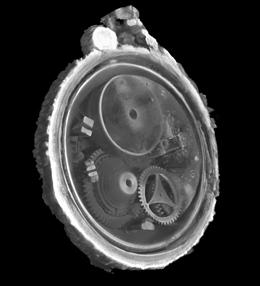 Trustees of NMS
By Jo Marchant - Nature.com
State-of-the-art X-ray scans have revealed the internal mechanisms of a corroded, barnacle-covered pocket watch recovered from a seventeenth-century wreck.
The watch looks little more than a lump of rock from the outside, but the scans show that the mechanism inside is beautifully preserved, from delicate cogwheels and Egyptian-style pillars to the maker's inscription.
Researchers from the National Museums Scotland in Edinburgh used the images to construct a three-dimensional virtual reconstruction of the watch's lost workings.
They hope to use the technique to probe the internal structure of other archaeological artefacts, especially those salvaged from underwater sites.
The watch and three-dimensional reconstruction are now on display in the Treasured exhibition of the National Museum of Scotland until 2011.
The watch was found on a wreck believed to be the Swan — a small warship that sank off the west coast of Scotland during the English Civil War. She formed part of Oliver Cromwell's forces that attacked the Royalist stronghold of Duart Castle in Mull, UK, but succumbed to a violent gale on 13 September 1653.
A naval diver discovered the wreck in the 1970s, and it was excavated in the 1990s. Salvaged artefacts including the pocket watch, a hoard of silver coins, cast iron guns and an ornate sword hilt were taken to the National Museum of Scotland.
Shipwreck featured in Yorktown Day presentation
From the Virginia Gazette
Renowned underwater archaeologist, John Broadwater, will discuss his findings from a survey this summer of a newly discovered shipwreck in the York River at the Yorktown Victory Center this weekend.
The presentation coincides with Yorktown Day weekend which commemorates the 1781 Siege of Yorktown, a battle that effectively ended the Revolutionary War.
The presentation "Yorktown Shipwrecks: 2010 Archaeology and Past Surveys" is sponsored by the Virginia Department of Historic Resources and will features Broadwater's findings from a survey of a shipwreck conducted in August.
The boat was initially discovered by a sonar test in 2008 and is located near the Betsy, a Revolutionary War era ship that was among several scuttled by British General Charles Cornwallis in an effort to block the French Navy.
Broadwater has previously said that although there were no conclusive findings indicating the new ship was part of the scuttled fleet, he suspects that it is.
Nine other ships that have been confirmed as part of the sunken fleet have been mapped in the York River, with seven on the Yorktown side of the river and two on the Gloucester side. Broadwater was among several archaeologists to excavate the Betsy in the 1980s.
The entire area is on the National Register of Historic Places.
HMS Victory cannon 'rare example', says expert

From BBC News
The 41 bronze cannon discovered with the HMS Victory shipwreck in the English Channel are "extremely rare examples", an expert has said.
The ship, the predecessor to Lord Nelson's Victory, sank in a storm on 5 October 1744 with all hands. Charles Trollop, a historical expert, said the ship was built at a "seminal moment in the history of gun founding".
The fate of the ship and the remains of the more than 1,000 crew are the subject of a UK public consultation.
Mr Trollop made the comments after examining the two cannon brought to the surface by Odyssey Marine Exploration, the company that found the wreck in May 2008, to establish the identity of the shipwreck.
He said: "As a result of the normal practice of melting brass guns down for re-use, very few cannon from this pivotal era survive for study.
"[Admiral Sir John] Balchin's Victory is thus a highly unique site in the history of naval ordnance: the only wreck site of a First Rate Royal Navy warship with an intact collection of cannon known in the world."
Mr Trollop said changes in the top naval personnel, naval tactics and the move from casting in brass to iron made the snapshot of history uniquely important.
His research found the Victory was the last British naval vessel fitted with a full complement of purpose-made brass cannon.
The finding of the ship 100km away from Les Casquets rocks meant the blame for the ship's loss could not necessarily be due to an error by the crew or its commander, Admiral Sir John Balchin.
Historical treasure on harbour's floor

By Henry Budd - The Daily Telegraph
Sydney Harbour may be the city's sparkling centre piece but its sandy bottom reveals its darker side. The city's coast and harbour have claimed more than 140 ships and hundreds of lives since the First Fleet arrived in 1788.
While many of the vessels have long since succumbed to the relentless toll of the ocean, several major shipwrecks are still visible to divers.
Sydney Harbour was considered one of the world's safest shipping harbours until the cargo ship Edward Lombe broke apart during a storm and was driven on to Middle Head in 1834, killing 12.
Nearly 180 years on, the ship's anchors can still be seen sitting on the bottom of the harbour.
Divers can still find pieces of coal west of North Head after the cargo ship Centurion sank in 1887 carrying 400 tonnes of the fuel. Parts of the steamers SS Centennial and Royal Shepherd, which sank in 1889 and 1890 respectively, can also be spotted by divers.
But the most intact wreck on the Harbour floor - the iron-hulled TSS Currajong - which sank in March 1910 off Bradleys Head, rests in a shipping channel and can't be reached without permission from Sydney Ports Authority.