HOT NEWS !
Stay informed on the old and most recent significant or spectacular
nautical news and shipwreck discoveries

Work begins on £36m Mary Rose museum
From Yorkshire Evening Post
Work begins today on a new £36 million museum which will bring the hull of the Mary Rose and thousands of its artefacts together under the same roof for the first time since they were brought up from the seabed almost 30 years ago.
The project at Portsmouth Historic Dockyard in Hampshire has been described as "the most ambitious heritage construction project seen in Europe this decade".
The new building housing the Mary Rose's fully-conserved hull and its 19,000 artefacts. It will replace the current temporary museum located 300 metres away, which has space to display only 5% of the Tudor items recovered with the wreck.
During the construction of the new museum, the Mary Rose will be out of view to the public. When the museum opens in 2012, the preserving chemical sprays that have kept the hull shrouded in mist will be gone.
The ship will be on display during the final phase of conservation, controlled air drying, until 2016 when the 34-year project to preserve the timbers will be complete. Construction of the museum begins today on the 28th anniversary of the raising of the Mary Rose off the seabed of the Solent just outside Portsmouth Harbour.
The event was watched by a worldwide television audience of more than 60 million people.
Lewes shipwreck site a window into 1770s economy
By Molly Murray - The News Journal
The wine: imported from South Africa; the porcelain from China, the bottled water from Germany. More evidence of a global economy ? You bet, said historian and archaeologist Charles Fithian. But we're not talking 21st century, here.
This global economy was vibrant in the 1770s and researchers have found clear evidence of it at the bottom of the sea with a Lewes shipwreck, discovered by accident during a U.S. Army Corps of Engineers beach replenishment project in 2004.
"History repeats itself," said Faye Stocum, a state archaeologist who is working on the project.
As it turns out, the Roosevelt Inlet Shipwreck is a significant historical resource for researchers and historians who want to learn more about British mercantilism in the colonies, what types of commodities colonists in places like Philadelphia and Delaware were buying and what went wrong with this fragile economic system that eventually led to the Revolutionary War.
It is the first British merchant ship from the time period that archaeologists have been able to explore and study.
The remains of the ship still rest just off the beach in about 15 feet of water near Roosevelt Inlet. But thousands of artifacts - many of them glass and pottery shards - were pumped to dry land along with sand borrowed to restore the beaches. Six years later, artifacts are still washing onto the beach.
The wreck site was listed on the National Register of Historic Places in Nov. 2006.
Archaeologists with Southeastern Archaeological Research Inc., the Florida consulting company that was hired by the state, suggest that only a small part of the hull remains intact. They estimate than some 40,000 artifacts were recovered - much of it material that ended up on the beach or washed in later.
The state's consultant completed a historic review of the wreck site during the spring and was reluctant to pinpoint the identity of the vessel. The consultant points to 31 possibilities from the hundreds of vessels that sank in Delaware Bay in the 18th and early 19th centuries.
They suggest the ship may have been Dutch -- based upon the large number of Dutch-made tobacco pipes that were recovered and the thought that the ship may date from the Revolutionary War at a time when trade with England would have been limited. The consultants suggest that Dutch tobacco pipes were not common in the Mid-Atlantic except during the Revolution and immediately following it.
Ship researchers get stuck into tar and pitch
By Robin Turner - Western Mail
Welsh researchers examining a historic Newport ship are to look in detail at how expert 15th century ship-builders kept vessels watertight.
European funding will allow research on the exceptionally effective tars and pitches used to seal and repair the hulls of ships more than 500 years ago.
The remains of the medieval vessel were found on the west bank of the River Usk, which runs through Newport’s city centre, during the building of the Riverfront Arts Centre.
The ship was originally about 80ft long and its watertight structure made it quite capable of continental voyages.
Artefacts found in the ship suggest it was trading with Portugal in the 15th century. There are also theories that the ship might have been built there. Tree-age dating has given a likely felling date of 1465 and 1466 for some of the timbers used in both its construction and its repair.
Maritime archaeologist Nigel Nayling has overseen the research and conservation of the ship since its discovery in 2002. He is now overseeing the European funded research into tars and pitches used in the ship which involves scientists from Cardiff University, the British Museum and the University of Wales Trinity Saint David.
Mr Nayling, of the University of Wales Trinity Saint David said: “Tars and pitches are black sticky substances produced by heating wood.
“They have an ancient history of use as all-purpose waterproofing agents and adhesives. In medieval times their role in ship building and maintenance led them to acquire vital strat- egic and political importance for the developing European seafaring economies and naval fleets.”
The project, funded by the Marie Curie Intra-European Fellowship scheme, will bring French expert Dr Pauline Burger to the UK for two years. She will use analytical chemistry techniques and experimental modelling to work out what kinds of tar were used on the ship, how they were made and where they came from.
She will compare the tars and pitches on the Newport ship with those from other shipwrecks and from the collections of the British Museum where tars and pitches occur on objects as varied as ancient Greek amphorae, Egyptian sarcophagi and Iron Age harness fittings.
Divers discover long lost wreck HMS Snaefell

By Sarah Scott - Chronicle Live
Deep beneath the waves she has lain lost for 70 years, her carcass gathering rust long after she braved the bombs of Dunkirk. But today the remarkable story of HMS Snaefell can finally be told after a group of divers located her, off the North East coast.
The paddle steamer, which saw service as a minesweeper in both the First and Second World Wars, was bombed and sank in 1941, and all trace was lost.
That is until Allan Lopez of North Shields, skipper of the Spellbinder II, came across the forgotten wreck.
He said: “We kept it a secret for a bit. We have been opening up a lot of new wrecks and have found quite a lot over the last few years.
“HMS Snaefell was one of the last boats away with survivors from Dunkirk. The wreck was supposed to be somewhere off Whitley Bay.”
Brent Hudson, 40, of County Durham, was among the team of eight divers from the Silent Running Dive Team to come across the wreckage eight miles off the coast of Sunderland.
“Paddle steamers are very rare ships. When one of the divers reported he had seen paddles we did not believe him.
“When we went down a second time we could clearly see them and we knew this was something special,” he said.
New images may yield Viking ships
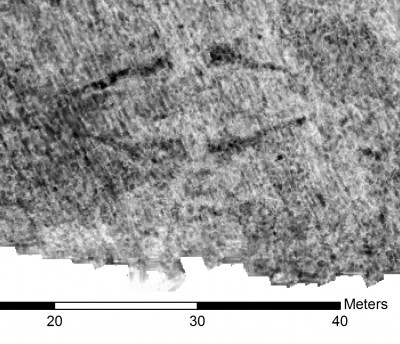 LBI ArchPro / NIKU
From News in English
Archaeologists think they have found two more Viking ships buried in Vestfold County south of Oslo. The biggest may be 25 metres long, larger than any found so far.
Road construction near the old Viking trading center at Kaupang has led to the discovery of two large ship silhouettes on ground radar pictures.
The pictures have been made possible through a venture involving the Norwegian Institute for Cultural Heritage Research (Norsk institutt for kulturminneforskning, NIKU) and the Ludwig Boltzmann Institute for Archeological Prospection and Virtual Archeology.
They portray some “exciting” images with the help of high tech methods including satellites, laser scanning, magnetometers and georadar, according to NIKU officials.
The methods can avoid or minimize destructive excavations by allowing archaeologists to register what the Norwegians call kulturminner (cultural antiquities) under the surface with a high degree of precision.
The images of Viking ships, along with several burial mounds, could be the biggest discoveries of their kind for more than a century, and some call them potentially “sensational” while officials urge restraint.
Even though the data so far is startling, the head of the Directorate for Cultural Heritage in Norway, Jørn Holme, told Norwegian Broadcasting (NRK) that people should not expect too much at this stage.
Spanish Navy ships looking for sunken treasure
Daniel Woolls - The Canadian Press
Spanish Navy vessels looking for sunken treasure off the country's coast have found around 100 possible shipwrecks in the first fruit of a drive to protect Spain's historical heritage from private salvagers seeking gold and other booty.
Two minesweepers and other vessels located the sites in Atlantic waters off the southwestern city of Cadiz as part of a campaign that began Sept. 8 and is due to last two months, the Culture Ministry said Tuesday.
Spain wants to avoid a repeat of a saga that began in 2007 when Tampa, Florida-based Odyssey Marine Exploration found a sunken Spanish galleon and salvaged from it an estimated $500 million in silver coins and other artifacts.
That ship, the Nuestra Senora de las Mercedes, was sunk by the British navy southwest of Portugal in 1804 while sailing back from South America with more than 200 people on board. A U.S. court ruled last year the loot belongs to Spain but the company has appealed and still has the treasure, holding it in the United States.
Spanish Navy officials were not immediately available to comment on which if any of the new possible shipwrecks might be valuable or when marine archeologists might determine this.
So far, 15 of the sites have been analyzed and the only thing of value that has turned up is an 18th-century anchor, the newspaper El Pais reported Wednesday.
It quoted Navy Admiral Daniel Gonzalez-Aller, the director of the search effort, as saying most of the sites examined so far will be ruled out as worthless and include remains of seaside human settlements and possibly even junk like washing machines.
Spain's defence and culture ministers, Carme Chacon and Angeles Gonzalez-Sinde, boarded one of the minesweepers taking part in the search Tuesday and insisted they are very serious about protecting vestiges of Spain's past.
"Where some see loot, we see our history. Where some look for gold, we find our heritage. Where others would seek to pillage, our calling is to conserve," Chacon said in a speech aboard the ship.
The Culture Ministry estimates there are more than 3,000 sites in Spanish coastal waters with shipwrecks, remains of airplanes, submarines or human settlements, but most of them are remains of ships. Of that total, it says as many as 800 could be in waters off Cadiz.
Future stages of the search campaign will target other areas of Spain's coast, with the ultimate goal of developing a map of where on the seabed shipwrecks lie.
Shipwreck may yield secrets of antiquity

By Clara Moskowitz - MSNBC/LiveScience
The examination of a Mediterranean shipwreck from the 4th century B.C. could shed light on ancient sea routes and trade, researchers say.
The remains of a merchant vessel, full of amphoras that probably had been filled with wine, were discovered in 2006 on the seafloor south of the island of Cyprus. A team has been excavating the site, diving and dredging up important pieces, since then.
The wreck was first discovered in 2006 by fishermen. One of the ship's anchors was also uncovered.
The particularly well-preserved remains, especially the amphoras, which were oval, narrow-necked vases, reveal many clues about the ship's story, the research team says in a new paper.
"We know by having studied a lot of these ceramic containers — we have created catalogs with different shapes — we know where they come from and where they date," said Stella Demesticha, a professor of maritime archaeology at the University of Cyprus, who is leading the shipwreck research team.
The amphoras found at this site, she said, are very typical of those made on the Greek island of Chios in the Aegean Sea.
"We know the red wine from Chios was praised," Demesticha told LiveScience. "It was very good quality, very expensive."
A large collection of olive pits was also discovered at the shipwreck site. The scientists don't know whether the olives were packed as a source of food for sailors or were a commodity to be sold.
Edmund Fitzgerald artifacts on auction block
By Peter Passi - Duluth News Tribune
Collectors of Great Lakes maritime artifacts may want to set their sights on an auction house in Duluth’s Lincoln Park neighborhood this afternoon.
Several items from lakers, including some that appear to be from the ill-fated Edmund Fitzgerald, will go on the block today at Col. Brent Loberg’s Sellers Auction, 2103½ W. Third St. Loberg is quick to note that he’s not a colonel in the military sense, but wears the title in the tradition of accredited auctioneers across the nation.
The weekly multifaceted auction begins at 4:30 p.m. and probably will last about four hours. Loberg estimates he’ll get to the shipping paraphernalia about 6:30 p.m.
The auction features four paddles apparently from a life raft belonging to the Edmund Fitzgerald; an embroidered ship blanket that purportedly belonged to a cook who had to sit out the oreboat’s final voyage because of a fortuitous illness; as well as several clips and photos documenting the vessel’s tragic demise Nov. 10, 1975.
Loberg said the items came to him by way of the family of a man who worked at Fraser Shipyards in Superior, where the Edmund Fitzgerald was refitted during the 1960s. The family asked Loberg not to release their identity.