HOT NEWS !
Stay informed on the old and most recent significant or spectacular
nautical news and shipwreck discoveries

-
Low Mississippi river exposes shipwreck near Cape Girardeau
- On 09/10/2012
- In Parks & Protected Sites
By Erin Ragan - Southeast Missourian
Calling all available archaeologists.
Low water on the Mississippi River has revealed a mystery on the banks near Cape Girardeau -- and two local educators along with a longtime shipwreck salvage diver are looking for help to solve it and preserve what they say is "a piece of our river heritage."
Amy Grammer and her husband, Russell, leaders of the local private school Prodigy Leadership Academy, were exploring the river's edge on a search for driftwood, pieces of pottery and pebbles for student projects on a September afternoon when something out of the ordinary caught Amy Grammer's eye.
"I almost walked right past it," she said. She didn't realize what she was seeing until she noticed a row of wooden tongue-in-groove planks and several joists protruding from the mud.
Low water after months of drought had exposed a section of a ship's stern. Knowing their find was something special, the Grammers immediately called on Randy Barnhouse, a longtime friend, retired teacher and salvage diver from Cape Girardeau.
Just one week before the discovery, Barnhouse visited the school to talk to students about shipwreck exploration.
For around 30 years, he has made repeated trips to Florida and the Caribbean for treasure salvage diving expeditions.
Barnhouse visits the wreck often to conduct measurements and document observations of the ship.
Its location, per request of its discoverers, needs to be kept a secret so that the site can remain undisturbed. Around 30 feet of the ship's length is visible in addition to the stern.
A large iron cleat shows near the riverbank and a hatch is blocked by a large section of cement and other debris. The ship's age is unknown. Barnhouse said he believes the ship may have been built when shipbuilders were switching from wood to metal.
The ship's hull appears to be made from iron, but a wooden casing surrounds it. Decking is also wooden.
-
Mazotos wreck could shed light on ancient shipbuilding
- On 06/10/2012
- In Underwater Archeology
From Cyprus Mail
Latest underwater excavations on the 2,350-year-old Mazotos shipwreck have established that the keel, and at least 15 metres of the ancient vessel’s planking has been preserved, the Antiquities Department said yesterday.
“This is of prime importance, as it places this wreck among the very few in the Mediterranean that can provide information on shipbuilding during the Classical period,” an announcement said.
It also said that during this year’s excavations archaeologists were also able to shed some new light on trade in antiquity, another important domain of maritime archaeology.
“Together with the Chian wine amphorae, the ship’s main cargo, a secondary type was also transported on the Mazotos ship: wine jugs, which were stowed among the amphorae found in the aft part of the hold.
Furthermore, small fine ware pottery was recovered from the stern cabin, which was also partly excavated,” the department said.
It added that the vessels must have belonged to the crew or the passengers. One of them bears two inscribed letters, most probably the initials of someone’s name, it said.
The Mazotos shipwreck, some 14 nautical miles southwest of Larnaca, is possibly the largest ancient commercial shipwreck located in open Cypriot waters.
It sank in 350 BC en route from the Greek island of Chios carrying around 1,000 urns filled with wine said to have been the most expensive Greek wine of the Classical period.
Today the wreck is buried 45 metres below sea level and is the oldest shipwreck found off the coast of the island to date. The Kyrenia II shipwreck, found 50 years ago, dates back to 300 BC.
Underwater excavations on the wreck began in November 2007 after the ship was discovered by divers a year earlier.
-
Naval aviator returns to underwater site of 1974 crash
- On 05/10/2012
- In Airplane Stories

By Jim Barnett - CNNBob Besal went on a fishing trip this month off the coast of St. Augustine, Florida.
The 62-year-old retired rear admiral, who earned two Distinguished Flying Cross awards and spent a lifetime on the water and above it, didn't catch any fish, but he did return with some memorable souvenirs.
Twenty miles from shore and 80 feet under the Atlantic, parts of Besal's past were brought to the surface.
Nearly 38 years ago, the naval aviator made a critical decision that almost cost him his life and ultimately defined it.
Besal and three other pilots were simulating bombing runs on a training mission when his Vought A-7 Corsair clipped the plane next to him. Besal ejected at a speed close to 350 mph.
"It's not one of those things you brag about, honestly," laughed Besal. "I didn't cover myself in glory on December 2, 1974. So it's one of those things if people asked I would tell them, but I didn't try to advertise it as such."
Pilot who survived midair collision decades ago learns wreckage found
The wreckage of Besal's plane was found last month by a team of divers from TISIRI (Think It Sink It Reef It), a Jacksonsville-based marine conservation company that specializes, among other things, in building artificial reefs.
A data plate picked up off the ocean floor was traced back to Besal, who now teaches aviation maintenance technology in Charleston, South Carolina.
Joe Kistel, executive director of TISIRI, asked Besal if he would like to return to the wreckage site, an invitation Besal eagerly accepted.
Just after dawn on a recent Saturday morning, Besal joined a crew for a 90-minute ride to the wreckage site.
Little did he know that the decades-old ruins had become part of a productive ecosystem.
-
Button found on St. Augustine shipwreck
- On 04/10/2012
- In Underwater Archeology


By Dan Scalan - JacksonvilleA corroded uniform button found in the mud off the St. Augustine Beach pier could be the “smoking gun” that leads to identifying a mystery shipwreck.
And the copper coin with a face of what could be Britain’s King George found by a Lighthouse Archaeological Maritime Program volunteer just adds to evidence that the wreck could be part of a British Revolutionary War fleet that fled Charleston in 1782.
The corroded button bears the number 74. That means it came off a 74th Regiment British Army uniform of Cambell’s Highlanders, assembled in Scotland in 1777 to fight rebels in North America.
When the British fled the American army’s advance into Charleston, half of the fleet headed into the St. Johns River in Jacksonville and the rest went to St. Augustine.
There, 16 of them wrecked on Dec. 31, including the escort ship Rattlesnake, said Chuck Meide, archaeology director at the St. Augustine Lighthouse and Museum program.
“This is a smoking gun,” Meide said. “This confirms the ship we are digging on was in the evacuation of Charleston.”
The Lighthouse Archaeological Maritime Program seeks and preserves the underwater history off the nation’s oldest city. Begun in 1996, it has targeted more than 50 possible wrecks.
One was the British sloop Industry, which sank in 1764 just south of the current lighthouse. Divers recovered numerous artifacts including a cannon and tools that never made it to St. Augustine’s then-British outpost.
-
Shipwrecked painting returns to Scilly
- On 03/10/2012
- In Museum News

By Andy - Scilly TodayA painting that was salvaged from a nineteenth century shipwreck has been returned to Scilly.
The picture of the Eric Rickmers, the same ship that was wrecked on that foggy October night in 1899, was yesterday presented to the Isles of Scilly Museum by Derek Kemp, the grandson of the Bryher resident who found it.
79-year old Derek, who is related to the Jenkins family of Bryher, says his grandfather pulled the painting from the water after the wreck. It’s thought to have been owned by one of the ship’s officers and painted in Bangkok.
Derek said the painting went to the mainland with his father when he moved to Kent looking for work. He said he wants it to hang in the Museum in Scilly along with other artefacts from the Eric Rickmers.
The German-registered, three-masted barque was on her maiden voyage from Bangkok to Bremen, carrying a cargo of rice when she hit Scilly Rock in thick fog off Bryher. All her crew managed to get to shore safely.
Museum curator, Amanda Martin, said the wreck is well known for the amount of valuable canvas that was salvaged, at some personal danger, by the residents of Bryher.
She says the bell from the ship was installed in the tower at the old Carn Thomas school site.
-
Praise for Kiwi divers involved in Rena clean up
- On 02/10/2012
- In Dangerous Places for Shipping
By Grayson Ottaway - News Talk ZB
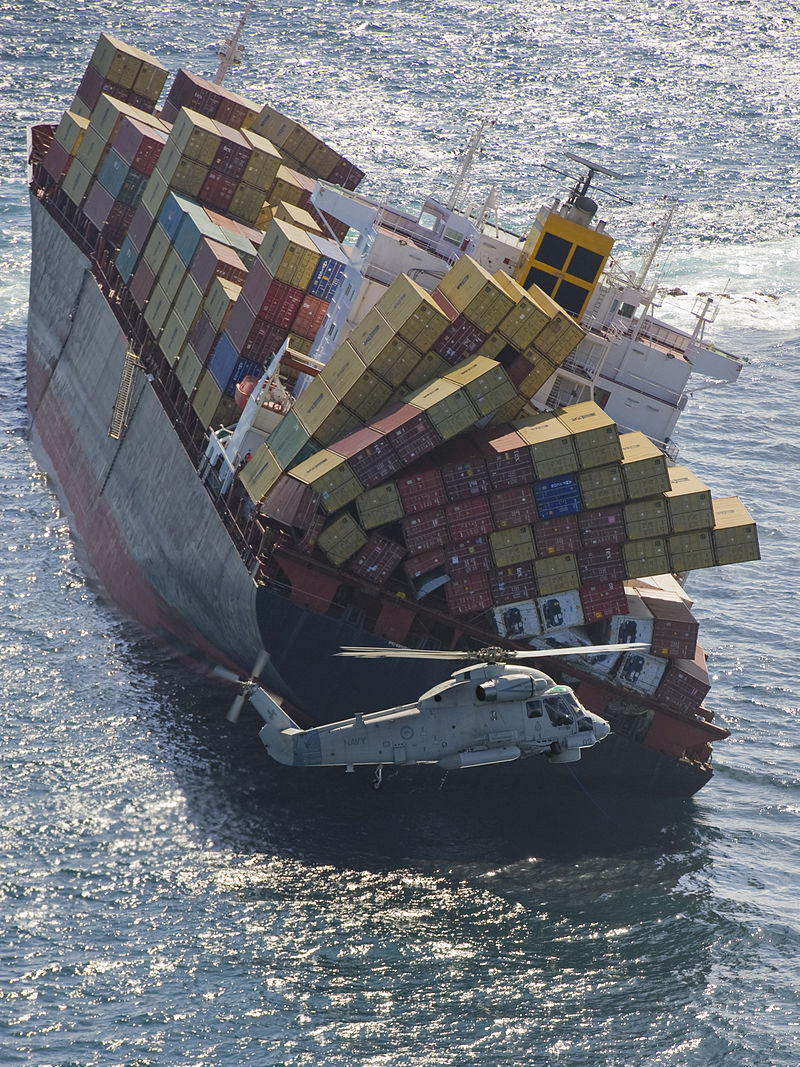
There's praise for Kiwi divers involved in the Rena clean up by an international salvage and recovery firm.
In seven days, the divers have manually loaded 81 tonnes of debris from around the wreck of Rena into cages, that are then hoisted up to the surface.
Braemar Howells operations manager Mike Richards says the men have been working in difficult conditions at depths down to 30 metres, often in strong currents.
-
Huong River divers find treasure trove of antiquities
- On 02/10/2012
- In Treasure Hunting / Recoveries

Over three decades ago, a scrap merchant got an "amazingly" high price for a ceramic item he found on the bed of the Huong (Perfume) River in the former imperial city of Hue.
Since then, several divers joined the business of searching for antiques on the riverbed, and many precious items have been found.
Nguyen Van Can and Pham Van Thuan are among these antique seekers, and both of them have over 20 years of experience on the job.
They say the Huong River is over 100km long but the antiques are to be found on a 20km stretch in the lower reaches that run from Long Tho Hill to the Thuan An Estuary.
Different sections of this stretch hold different groups of antiques, they say.
Ancient stones and weapons have been found in front of the well-known Thien Mu Pagoda while the next section – from Kim Long Village to the area in front of the Hue Citadel – has released old bowls and dishes, jewellery and coins.
From the Phu Xuan Bridge to a tributary of the Dong Ba River branch, a section holds a lot of military equipment and weapons from the former US-backed Sai Gon regime.
The section to the south of Hen (Oyster) Islet keeps a lot of mushroom-shaped lime-pots of the former Champa civilisation, while another that runs from the Bai Dau area to the Sinh Crossroads has a lot of Vietnamese Chu Dau, Chinese and Champa ceramic wares of different types.
Researcher Ho Tan Phan, who has a big collection of antiques lifted from the bed of the Huong river, says the "allocation" of different kinds of antiques to different sections of the river is testimony to a "very special" cultural phenomenon in Hue.
He says many more studies need to be carried out to discover and clarify many cultural and historical aspects of the ancient city of Hue in particular and of Viet Nam in general. -
Daniel Frank Sedwick Treasure and World Coin Auction #12
- On 02/10/2012
- In Auction News
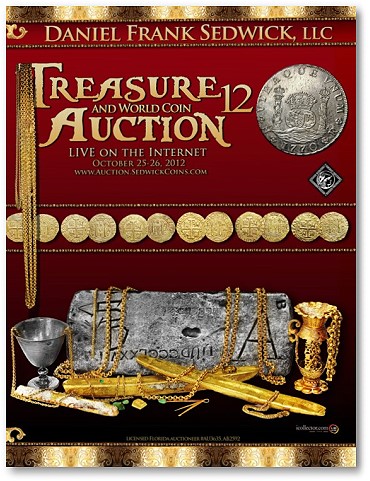
By Daniel Frank Sedwick - coin WeekWith a pre-auction low estimate of over $1.5 million, this is our highest-value auction to date.
As you browse the 1884 lots, you will see trophy after trophy (MANY “finest knowns”) interspersed with solid material in gold and silver coins and ingots, plus all kinds of artifacts.
The catalog starts with a bang, featuring a collection of 24 Lima, Peru, 8 escudos among the 85 total gold cobs, most of them from shipwrecks and many in Mint State grade, with lots of rare dates (be sure to read our article enumerating all the dates and varieties known).
The World Gold Coins section after that features significant selections from Brazil, including an 1827 Pedro I 6400 reis in AU-55 grade (lot 114), plus an MS-63 dobrão (20,000 reis) of 1726-M (lot 102).
All of the Spanish colonies and Latin American republics are well represented, one highlight being a very rare Popayán, Colombia, 10 pesos of 1870 in AU condition (lot 160).
The highest value items, however, are in the Shipwreck Ingots and Shipwreck Artifacts sections: the former includes the largest gold bar (over 2.5kg) we have ever offered from the Atocha (1622) (lot 294), and the latter features several gold chains and an ornate gold vase from the 1715 Fleet (lot 1797) that we believe was meant for anointing the new Queen of Spain !