HOT NEWS !
Stay informed on the old and most recent significant or spectacular
nautical news and shipwreck discoveries

-
Issyk Kul: The 2012 expedition wraps up
- On 17/10/2012
- In Expeditions
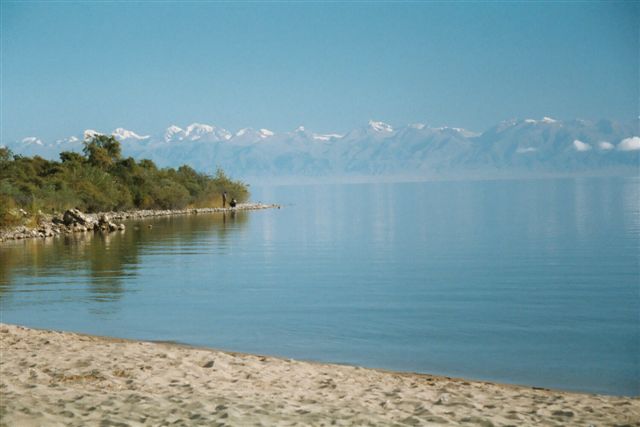
By Kristin Romey - National Geographic
After our tour around Issyk Kul, our international team was looking at the final stretch of survey before the end of the season.
Almost any archaeologist will tell you that some of the most interesting stuff gets found right about the time you have to leave, and this season was no different: with just a few days to go we found some of the most significant building features we saw all season.>Under the gun, we mapped and sampled the area just in time.
Why the rush to leave ? The weather on the lake seems to take a real turn for the worse in early October, when a fierce west wind called the Ulan picks up.
Like every natural phenomena associated with Issyk Kul, there dramatic story behind it:
Long ago, two warriors mythical warriors named Ulan and Santash competed for the attentions of a beautiful woman named Cholpon. Unable to make up her mind, Cholpon instead ripped out her heart.
The hill where she died was named Cholpon-Ata (now the popular resort town), and the Kyrgyz mourned her death by filling the valley below with their tears, creating Issyk Kul.
-
In search of Kublai Khan's fleet
- On 17/10/2012
- In Underwater Archeology

By Geoff Maslen - The Age
Down to a sunless sea…
So wrote the opium-addicted 18th-century English poet Samuel Taylor Coleridge after a dream about the great Mongol ruler Kublai Khan.
A grandson of Genghis Khan, Kublai's realm stretched from the Pacific Ocean to the Black Sea, covering a fifth of the known world.
In 1279, he became the first non-Chinese emperor, establishing the Yuan Dynasty and ruling over China, present-day Mongolia, Korea and other Asian regions.
But his ambition to occupy more lands led to one of his worst defeats when he sent his warships to invade Vietnam in 1288.
Now, 725 years later, Australian archaeologists are helping excavate the site where the mighty Kublai Khan's invasion fleet of 400 was destroyed by the Vietnamese.
They had lured the Mongols up the Bach Dang River just as the tide was starting to ebb. The Vietnam army had driven hundreds of sharpened wooden stakes into the bed of the river that were invisible at high tide; when the tide turned and began to ebb, the entire fleet was holed and sunk, captured or burnt by fire arrows.
"The Bach Dang battlefield research project came about after Jun Kimura, one of my PhD students now at Murdoch University, was asked to go to Vietnam in 2008," says Dr Mark Staniforth, a senior researcher in archaeology at Monash University.
"I had been looking for an opportunity to do some research there on the site where Kublai Khan's fleet was defeated and went with him initially to help record a couple of wooden ship's anchors found in the Red River.
That gave me the chance to spend a few days in Bach Dang looking at the site and where we discovered the Vietnamese had been working since the 1950s.
They were doing a good job but suffered a few problems — mainly not having much in the way of equipment or money."
-
Queen Anne’s Revenge Community Day at N.C. Maritime Museum
- On 17/10/2012
- In Museum News

From Beach Carolina
As part of “National Archaeology Day” the N.C. Maritime Museum in Beaufort will host a number of fun-filled activities related to the Queen Anne’s Revenge (QAR) project on Saturday, Oct. 20, 10 a.m.-2 p.m.
With a focus on artifacts recovered from the wreck of Blackbeard’s flagship, conservators will explain how the items are freed from the cement-like casings called concretions after nearly 300 years in the ocean.
Free family fun, educational entertainment, and 18th century tools last touched by pirates will provide a unique experience for all audiences on Community Day. Games, crafts, weapon demonstrations, and a chance to talk with members of the research team also are part of the day’s activities.
In June 1718, the Queen Anne’s Revenge ran aground in Beaufort Inlet.
The shipwreck was located in 1996 by Intersal, Inc. of Florida by Operations Director Mike Daniel through research provided by Intersal President Phil Masters.
Since 1997 the N.C. Department of Cultural Resources’ Underwater Archaeology Branch has led research at the wreck site.
The fall dive expedition will conclude later this month and updates are available at on the project’s website.
-
Calculating evaporation from the ocean
- On 12/10/2012
- In Marine Sciences
By Lonny Lippsett - Oceanus
Imagine you turn on the tap in the morning and water pummels out and spills over your sink.
Later you go out to your garden, but water trickles feebly out of the hose.
The water pump in your house is definitely not working the way it used to. Scientists say something like that is probably happening in our planetary home.
Climate change is gunning the motor of Earth’s water pump, driving more rainfall to already wet areas and less to drier regions.
To get a handle on how things will change, it would sure help if we could get a handle on how the motor is driving more moisture to the atmosphere.
But figuring out how and why water molecules move between air and ocean, at present at least, is a formidable challenge for scientists.
“It’s the boundary between two turbulent fluids, the ocean and atmosphere; each is it’s own thing, basically chaotic and hard to calculate,” said Carol Anne Clayson, an oceanographer at Woods Hole Oceanographic Institution.
“Then the two are coupled: If something changes the sea surface temperature, for example, the atmosphere responds to it, and every atmospheric response changes the sea surface temperature,” she said.
“We don’t have the computational power to simulate in a model all the physics that goes on—even if the interface between them were flat and never-changing.”
Which it is most definitely isn’t. The air-sea interface “is typically the most turbulent part of the ocean,” Clayson said.
A dizzying mix of interrelated factors—waves, winds, water temperature and salinity, bubbles and spray, solar radiation, and others—each add a layer of complexity that occurs over wide ranges of time (seconds to seasons) and space (millimeters to miles).
-
Celebrities saved millions using tax breaks from shipwreck
- On 09/10/2012
- In Treasure Hunting / Recoveries
By Alexi Mostrous - The Times
Celebrities and some of Britain’s most senior businessmen invested more than £110 million into marine treasure hunts, which allowed them to avoid tax on millions of pounds, The Times has learnt.
Bear Grylls, the TV adventurer and Chief Scout, David Harding, the City’s highest earner, and Stephen and Julie Pankhurst, the co-founders of website Friends Reunited, are among 129 people who invested in 18 shipwreck salvage companies offering tax breaks now under investigations by HM Revenue & Customs...
-
Tomb raider’s treasure stays missing, but fortunes are being made
- On 09/10/2012
- In Treasure Hunting / Recoveries
By Alexi Mostrous - The Times
When General Louis Palma di Cesnola, the 19th century tomb raider, loaded his favourite vessel with 62 boxes of treasure, he could hardly imagine its contents would become the focus of a modern-day tax dispute.
On June 20, 1872, the 130ft Enigma caught fire, sinking with di Cesnola’s entire cargo of 4,000 stolen Phoenician relics.
The general suspected foul-play but could do nothing.
The ship is still on the seabed, somewhere off the coast of Cyprus.
Since 2010, Robert Fraser Marine, a branch of a private London bank, once, part owned by Robert Maxwell has spent millions of pounds searching for sunken treasures...
Full article... -
Italian archaeologists find 2 sunken Roman ships off Turkey
- On 09/10/2012
- In Underwater Archeology
Two ancient Roman shipwrecks, complete with their cargo, have been discovered by Italian archaeologists off the coast of Turkey near the the ancient Roman city of Elaiussa Sebaste.The ships, one dating from the Roman Imperial period and the other from about the sixth century AD, have been found with cargoes of amphorae and marble, say researchers from the Italian Archaeological Mission of Rome's University La Sapienza.
Both ships were discovered near Elaiussa Sebaste, on the Aegean coast of Turkey near Mersin, according to a statement issued by the Italian embassy in Ankara.
Officials say the discoveries - led by Italian archaeologist Eugenia Equini Schneider - confirm the important role Elaiussa Sebaste played within the main sea routes between Syria, Egypt, and the Anatolian peninsula from the days of Augustus until the early Byzantine period.
Elaiussa, meaning olive, was founded in the 2nd century BC on a tiny island attached to the mainland by a narrow isthmus in the Mediterranean Sea. Schneider has been leading the excavations since 1995.
-
The Baltic Sea is a treasure chamber of shipwrecks
- On 09/10/2012
- In World War Wrecks

From Helsingin Sanomat
Experts excited at find of the torpedoed Russian World War I armoured cruiser Pallada.
Finland’s National Board of Antiquities considers the find by a Finnish diving group of the Russian World War I armoured cruiser Pallada in the Gulf of Finland to be of real significance.
“For example its war grave status makes it an important discovery. Furthermore, warships are unique sources of information”, says National Board of Antiquities marine archaeologist Minna Leino.
The Pallada sank with all hands in the autumn of 1914. It was the pride of the Russian Baltic Sea Fleet.
It was almost brand new and its crew were a top class outfit, chosen for the purpose.
When the ship went down, she took with her around 600 officers and men, for whom the Gulf of Finland became their watery grave.
Now the Pallada lies outside of the Finnish coastal town of Hanko in two pieces at a depth of 60 metres.
The divers, who found the wreck already in the summer of 2000, spent 12 years examining it before going public with the find and telling Helsingin Sanomat about it this past summer.
For a diver, finding a wreck almost the size of the car and passenger ferry Estonia, which famously went down in Finnish territorial waters in 1994 killing more than 800 passengers and crew, is an immense experience.
“The Pallada is the largest warship wreck in the Gulf of Finland. It was the Russian fleet’s greatest loss in the Baltic Sea in the First World War”, explains Jouni Polkko, one of the first men to dive to the wreck.
“The sinking of the Pallada was an important turning point in the history of naval warfare. It marked the end of the era of armoured cruisers and the beginning of the era of submarines.”
The Pallada was taken out by a single torpedo fired from a German submersible. The ship was hit in the magazine, exploded, and broke in two, disappearing under in a matter of minutes.
Wartime censorship rules meant that little was written of her fate at the time, and over the decades she has become a legendary object of attention for divers and naval historians, but otherwise forgotten, in spite of the horrific loss of life.