HOT NEWS !
Stay informed on the old and most recent significant or spectacular
nautical news and shipwreck discoveries

-
Lake search for Nazi gold
- On 22/02/2013
- In Treasure Hunting / Recoveries

By Tony Paterson - New Zealand Herald
An Israeli journalist has launched a search for nearly half-a-tonne of Jewish-owned gold and platinum believed to have been stolen by the nazis and dumped in a remote lake north of Berlin during the last days of World War II.
Yaron Svoray, who is also an anti-Nazi campaigner, has begun a new attempt to find the stolen gold using sophisticated sonar equipment, following a number of previous failed bids.
"It's about the people the treasure belongs to. It is time that they obtained a little justice," Svoray said.
The lost gold and platinum is thought to be encased in 18 crates lying at the bottom of eastern Germany's Stolpsee Lake.
In 1981, the Stasi - the Communist secret police - used army dredging barges to scour the 12m-deep lake but found nothing.
Svoray's previous efforts to track down property stolen by the Nazis resulted in the recovery of 40 uncut Jewish-owned diamonds decades after the end of the war.
The 59-year-old has also written a book entitled In Hitler's Shadow, which was later turned into a film.
German authorities in the state of Brandenburg said they were assisting him in the Stolpsee search.
According to some reports, the crates contain 350kg of gold and 100kg of platinum in bars which were stolen from prisoners at the Ravensbruck concentration camp near the Stolpsee.
Another version holds that the precious metals were seized during the Kristallnacht pogrom in which countless Jewish businesses were ransacked by the Nazis in November 1938.
-
Replica of 16th-century Basque galleon wreck
- On 20/02/2013
- In Miscellaneous
From the Windsor Star
It’s the oldest shipwreck ever found in Canada and one of the most important in the world: a 16th-century Basque whaling galleon that lies at the bottom of Labrador’s Red Bay, a sunken relic from the Age of Discovery that symbolizes the early spread of European civilization — and commerce — to the New World.
Now, the 450-year-old San Juan, a jumble of thick beams and broken barrels lying in shallow waters off the site of a 1560s-era whaling station in the Strait of Belle Isle, is to be resurrected by a team of Spanish maritime heritage experts planning to construct a full-scale, seaworthy replica of the original 16-metre, three-masted vessel.
Parks Canada underwater archeologists, who discovered the 250-tonne San Juan in 1978 after following documented clues about a lost galleon traced by federal archivist Selma Barkham, will meet this week with Spanish officials to begin sharing decades of amassed research on the ship’s design and construction, Postmedia News has learned.
Then, to mark the Basque city of San Sebastian’s year as Europe’s “cultural capital” in 2016, Spain expects to christen its floating tribute to the whaling crews that — for several decades during the 16th century — transported millions of barrels of whale oil to Europe from the future Canada, a treasure every bit as valuable at the time as the gold taken by Spanish conquistadors from more southerly parts of the Americas.
“Right from the start, we thought this was a really, really great idea,” said Marc-André Bernier, Parks Canada’s chief of underwater archeology. “For archeologists, this is basically the ultimate final product.
You’re taking all of the research from a site that’s been excavated, then you take it to the maximum in experimental archeology,” physically recreating “what is lost.”
For Robert Grenier, Bernier’s predecessor as Canada’s top marine archeologist and the leader of the Red Bay discoveries more than three decades ago, the planned construction of a San Juan replica is “like a dream.”
-
Blizzard of 2013 unearths shipwreck of 1894
- On 14/02/2013

By Angeljean Chiaramida - Newbury Port NewsOn April 13, 1894, local residents rose to find the schooner Jennie M. Carter smashed on the sands of Salisbury Beach, its crew gone while its cat remained curled up on the captain’s chair.
Sunk as the result of one of the worst storms of the 19th century, the broken bones of the 130-foot, three-masted vessel are now more visible, further exposed through the sand after the sea ravaged Salisbury’s shoreline during the weekend blizzard.
“You can usually see it when there’s a low, low tide, but after this storm it would be more visible,” said Cassie Adams, the hostess at Salisbury Beach’s Seaglass Restaurant.
“The beach lost a lot of sand in this storm.”
Playing on Salisbury Beach as a child, Adams hadn’t been aware that the wooden stubble peeking up in the sand during very low tides was a 139-year-old sunken ship.
Forming a remote oval in the shape of a ship, its remains look like wooden stubble sticking up in the sand, she said, its inner realm filled with what looks like driftwood.
“I never knew it was a shipwreck until someone told me about it,” Adams said. “Our patrons at the restaurant comment on it when it’s visible.”
Other local history buffs in Salisbury know of the famed shipwreck and its lore, according to Salisbury Historical Society secretary Beverly Gulazian.
When the Jennie Carter went down due to foul weather, she was carrying granite, Gulazian said, and after the ship was lost, its cargo was salvaged.
-
Extracting stranded U.S. minesweeper may take 2 months
- On 13/02/2013
- In Maritime News
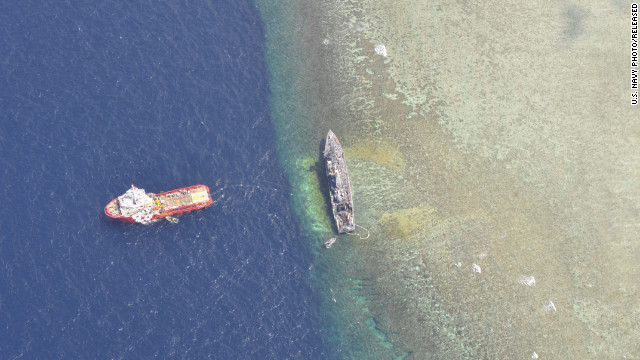
By Jason Hanna - CNNRemoving a stranded U.S. minesweeper from an environmentally delicate reef off the Philippines may take until April, the state-run Philippines News Agency reported Wednesday, citing the Philippines Coast Guard.
The U.S. Navy is preparing to extract the USS Guardian from the Tubbataha Reef, a Philippine national park and UNESCO World Heritage site where the 224-foot-long ship ran aground on January 17.
The Navy plans to cut the 1,312-ton minesweeper into pieces and then, with the help of two contracted crane ships, lift the pieces and carry them away.
Philippines Coast Guard Rear Adm. Rodolfo Isorena said Wednesday that he hopes the salvaging will begin soon so that further damage to the reef will be limited, the Philippines News Agency said.
One of the crane ships has arrived in the area, about 80 miles east-southeast of Palawan Island in the Sulu Sea, and the other is on its way, the news agency reported.
The ship is estimated to have damaged about 4,000 square meters (about 43,000 square feet) of the reef, the news agency said. Various U.S. officials, including Navy Vice Adm. Scott Swift last month, have apologized to the Philippines for the incident, which the U.S. Navy and the Philippines Coast Guard are investigating.
Philippine officials said last month that the country would seek compensation for reef damage.
The U.S. ambassador to the Philippines, Harry Thomas Jr., assured the Philippines on Monday that the United States "will provide appropriate compensation for damage to the reef caused by the ship."
The reef is home to a vast array of sea, air and land creatures, as well as sizable lagoons and two coral islands.
About 500 species of fish and 350 species of coral can be found there, as can whales, dolphins, sharks, turtles and breeding seabirds, according to UNESCO.
-
A tale of two brothers who took diving to new depths
- On 13/02/2013
- In Treasure Hunting / Recoveries
From This Is Kent
It begins: "If it had not fallen to the lot of Whitstable to be celebrated for its oysters and its company of free dredgers, it might have claimed a word of notice for producing that rarest of all workmen, the sea diver."Dickens, who had reputedly stayed at the King's Head pub in Island Wall and conversed in depth with the divers, went on to describe the work they carried out, some of it in gruesome detail.
In subsequent research I was often referred to a local story about brothers Charles and John Deane visiting a farm in Seasalter when the barn, housing horses, caught alight.
A fire engine arrived, but the firefighters could not get through the smoke.
Charles, wearing a fireman's helmet on his head and with a pipe from the now empty water-pump feeding air into it, was able to get through the smoke and free the horses.
A tale from the past that might have some basis, but it is a fact that in 1823 Charles Deane patented a smoke helmet and air pump for firefighters.
He and his brother tried to sell this to the insurance companies that owned most of the country's fire engines, but with little success.
The Deanes worked with locals who were involved in salvaging using a diving bell and became convinced that this helmet with a suit could be developed for use under water. They spent much of 1827 and 1828 on the suit until they had a successful prototype ready in 1829.
Gradually, together with help from local seamen, the Deanes developed new salvaging techniques and made a name for themselves in successful salvage operations. Their big break came in 1834.
The Deanes and their team discovered and salvaged the Enterprise, a slave ship that had foundered near Copeland Island, off Ireland, in 1803 with £200,000 of silver dollars, the proceeds from the sale of slaves in America.
-
World’s longest Viking shipwreck to be exhibited in Denmark
- On 13/02/2013
- In Museum News

The National Museum in Copenhagen is set to unveil a major special exhibition called VIKING, highlighted by the display of the largest Viking shipwreck ever found.
The exhibition will be the largest on Vikings in 20 years, and will be cover the themes of war, expansion, power, aristocracy, rituals and beliefs, as well as cultural contacts and trade.
The 37-metre-long warship, which was found in Roskilde, could carry up to 100 warriors and is thought be have been part of the royal fleet of King Cnut the Great, who conquered England in 1016 and Norway in 1028.
In excess of 25 percent of the ship has been preserved and will be exhibited in a specially-constructed steel skeleton that will show the ship in its full size.
-
Southern Surveyor locates resting place of WW2 shipwreck
- On 06/02/2013

From The Maritime ExecutiveOne of NSW’s wartime mysteries has at last been solved with the discovery of the wreckage of the MV Limerick off Ballina on the NSW far north coast, Heritage Minister Robyn Parker announced.
Ms Parker said that while a lot is known about the sinking of the MV Limerick in 1943, it has taken almost 70 years and the opportunistic use of Australia’s Marine National Facility research vessel, Southern Surveyor, to identify the ship’s final location.
“Limerick was one of the largest vessels sunk by Japanese submarines off Australia’s east coast during their offensive submarine patrols through 1942 and 1943,” Ms Parker said.
“Local fishermen using modern depth sonars identified a large shipwreck in about 100 metres of water some 18 kilometres off the coast late last year.
“Following their discovery, NSW Water Police assisted the NSW Office of Environment and Heritage (OEH) in an initial survey of the deep site with a side scan sonar but due to bad weather they were unable to conclusively identify the shipwreck as being Limerick.”
OEH then approached Australia’s Marine National Facility (AMNF), which operates Australia’s ocean-going research vessel, the 66-metre Southern Surveyor.
Owned and operated by the CSIRO and funded by the Commonwealth, AMNF is a research facility which is available to all Australian scientists and their international collaborators.
“The team at AMNF were contacted by OEH and coincidentally a research voyage was already scheduled to operate in the suspected wreck area. OEH approached the lead scientist on board to see if they could assist in locating the wreck,” Ms Parker said.
-
Sunken Spanish treasure found off Florida Keys enlivens auction
- On 04/02/2013
- In Auction News

By Katy Mantyk - The Epoch Times
Two Spanish ships, loaded with the belongings of nobility returning to Spain with the armada in 1622 never made it past the Florida Keys.
It is believed that at least one of the ships was sunk by a storm.
Fast forward nearly 400 years. The sunken ship was found by a team of divers hunting for shipwrecks. Only in their dreams could they imagine what they found inside the ship when they swam upon the hull.
A Colombian emerald set in gold, dating back to the Renaissance period, was recovered from the shipwrecked Spanish galleon, Nuestra Señora de Atocha.
It will be among the fascinating, history-rich offerings at Sotheby’s sale of Masterworks on Friday Feb. 1 in New York during Old Masters Week. The treasure is estimated to sell for between $150,000 and $250,000.
The ship Atocha was commissioned by the Casa de Contractación, a Spanish government agency which attempted to regulate Spanish exploration and colonization efforts, and was named for Our Lady of Atocha, whose shrine in Madrid was regularly visited by Spanish kings.
The ship was constructed in Cuba and, after ill-fated attempts to depart the shipyard due to needed repairs, she finally crossed the Atlantic and arrived in Spain late in 1620.
Next, in Cartagena, Colombia and Portobelo, Panama, the galleon was loaded with the belongings of the noble families and other passengers making the return journey to Spain with the armada.
The fleet set sail for Spain with goods and passengers on September 4, 1622 in the midst of hurricane season.
Both the Atocha and the Santa Margarita only sailed as far as the Florida Keys before they hit a squall and sank along the reefs.