HOT NEWS !
Stay informed on the old and most recent significant or spectacular
nautical news and shipwreck discoveries

-
What lies at the bottom of Lake Michigan
- On 01/03/2013

By Julia Thiel - Chicago Reader12TH STREET BEACH WRECK, YEAR UNKNOWN
Just south of the Adler Planetarium, an unidentified shipwreck is embedded in the sand. Underwater Archaeological Society of Chicago president John Bell says that it's probably the closest wreck to shore in the area; you can actually walk to it.
Shoreline erosion caused by the construction of the planetarium in 1925 exposed the hull of the schooner, which is an estimated 140 feet long.
The stern end of the ship has been paved over, but Bell says that "on a good day, you can see the ribs."
LADY ELGIN, 1860
The deadliest shipwreck in the Great Lakes until the Eastland disaster—and still the worst open-water disaster on Lake Michigan—was the sinking of this 252-foot passenger steamer.
In an early-morning storm a schooner rammed the side of the larger steamship at full speed, ripping a hole it in.
The schooner suffered some damage but made it back to Chicago, while the Lady Elgin quickly broke in half and sank.
Many of the passengers floated toward the coastline on pieces of the deck, only to be drowned in the surf near shore. Of the nearly 400 passengers aboard, more than 300 died.
The remains of the ship were discovered in 1989 by shipwreck hunter Harry Zych, who immediately claimed ownership of them.
Nearly 20 years of searching was followed by a decade of litigation, and though shipwrecks are usually the property of the state, Zych eventually won the legal battle.
He's found artifacts including pre-Civil War muskets and swords, china plates and spoons engraved with the words "Lady Elgin," a three-foot-long steam whistle, and a chandelier.
-
Hollandia shipwrecked 'pirate coin' stolen
- On 01/03/2013
- In Scams, Thefts

From BBC News
A distinctive Spanish silver coin, recovered from the shipwreck of the Hollandia which sank in 1743, has been stolen from a house in Hertfordshire.The eight reales coin, minted in 1741 and hung from a chain, was taken in a burglary at a house at Braughing, near Ware, on Friday, said police.
A spokesman from the British Museum said the coins, known as pillar dollars, were "historically important".
Police have appealed for anyone with information to contact them.
The coin, minted in Mexico, sunk to the seabed when the Hollandia, carrying a cargo of silver from Amsterdam to the Far East, sank during her maiden voyage off the coast of the Isle of Scilly.
Tom Hockenhull, curator of modern money at the British Museum, said: "Historically these coins are quite important as they were some of the first trade coins - the model for the US dollar essentially.
-
Australian Billionaire: “Titanic II” Will NOT Be Unsinkable
- On 28/02/2013

By Jonathan Allen - gCaptain/Reuters
Australian mining entrepreneur Clive Palmer on Tuesday unveiled blueprints for Titanic II, a modern replica of the doomed ocean liner, although he stopped short of calling the vessel unsinkable.
The ship will largely recreate the design and decor of the fabled original, with some modifications to keep it in line with current safety rules and shipbuilding practices, and the addition of some modern comforts such as air conditioning, Palmer said at a press conference in New York.
The three passenger classes, however, will be prevented from mingling, as in 1912, Palmer said.
“I’m not too superstitious,” Palmer said when asked whether recreating a ship best known for sinking was tempting fate.
White Star Line, the operator of the original ship, had said the Titanic was designed to be unsinkable.
Some 1,500 people died on Titanic’s maiden voyage in 1912 from Southampton to New York after the ship collided with an iceberg in the North Atlantic.
Palmer, who created the company Blue Star Line last year, declined to make a similar boast.
“Anything will sink if you put a hole in it,” Palmer said.
“I think it would be very cavalier to say it.”
Unlike the original, Titanic II will have more than enough space in its lifeboats for every person on board and will have additional escape staircases.
Markku Kanerva, sales director at Deltamarin, the Finnish company designing the ship, said it would be the “safest cruise ship in the world.”
Palmer declined to answer questions about the project’s cost.
Although the Titanic was the world’s largest ship in her time, she would be smaller than many of today’s modern cruise ships.
-
Oil threat from shipwrecks
- On 27/02/2013
- In Miscellaneous
By Chad Oliver - NBC2
An NBC2 Investigation examined the fragile future of deep sea shipwrecks which some have called "ticking time bombs."
They are relics of the past but posing potential problems for the future.
One ship in particular sits 75 miles from Southwest Florida and is now on the dederal government's radar. It's an oil cargo ship named the Joseph M. Cudahy, which could cause a mess for the environment and for tourism.
Records show the Cudahy had nearly 80,000 barrels of oil on board when a German U-boat blasted it with a torpedo during World War II.
Even though the ship sank in 1942, divers say oil still leaks into the water.
In 2010, Congress allocated $1-million for the National Oceanic Atmospheric Administration (NOAA) to form a database of shipwrecks and assess their threat.
It's called "Remediation of Underwater Legacy Environmental Threats – referred to as "RULET."
We were was given advance results of the assessment ahead of the national report coming out later this month.
Out of 20,000 ship wrecks off the coast of the U.S., NOAA determined about one hundred pose a substantial pollution threat.
Fewer, only six, are considered high priority for a most-probable discharge of oil. One of those ships is the Cudahy.
It's a ship Michael Barnette, from the Association of Underwater Explorers, knows well.
"One of the easiest ways to find the wreck when you're in the vicinity, especially on a calm day - you'll see a slick on the water," said Barnette. "You actually smell it before you get there."
Barnette is a respected diver who has written three books on Florida shipwrecks. He is a marine biologist who spends his free-time exploring underwater.
"There are still plenty of wrecks to be found," added Barnette.
The St. Pete native has identified or helped identify more than 50 shipwrecks worldwide, including the Cudyhy six years ago.
He said what makes diving intriguing is "piecing together in your mind what happened."
-
Pieces of eight from West Cornwall shipwreck sold at auction
- On 26/02/2013
- In Auction News
From Falmouth Packet
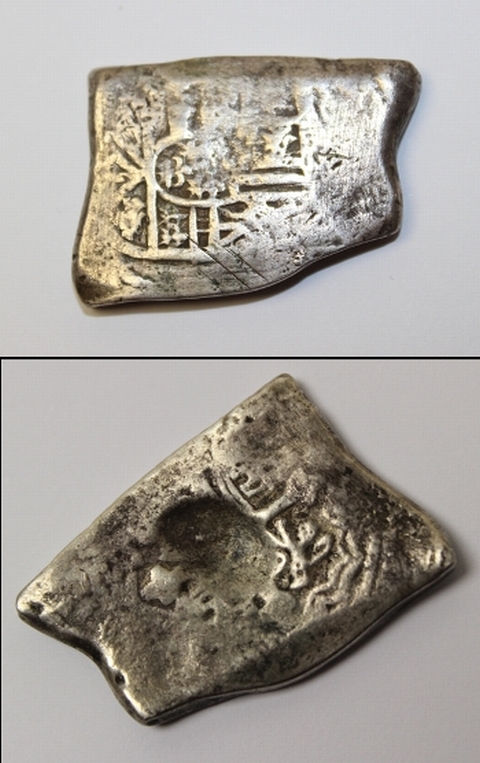
Coins recovered from a West Cornwall shipwreck that still inspire visions of pirates and buried treasure have sold at auction.
The 17th Century Cob and piece of eight were recovered from the wreck of HMS Association, lost at sea in 1707.
Sold by Hanson's Auctioneers in Derbyshire the coins were found after the ship, which launched from Portsmouth Dockyard in 1697 and fought at capture of Gibraltar, was dredged up 300 years later in 1967.
One was a 17th century ‘COB,’ a Spanish currency.
Unusually shaped, this coin details the history of Spain, as this currency was cut crudely into shapes of an accurate weight, in preparation for its melting down and using in jewellery.
Also uncovered from the wreck was an example of the infamous pieces of eight. As the world’s first global currency these were used across the vast Spanish Empire.
-
World’s first underwater nuclear explosion
- On 24/02/2013
- In Dangerous Places for Shipping
By Michael Zhang - Peta Pixel
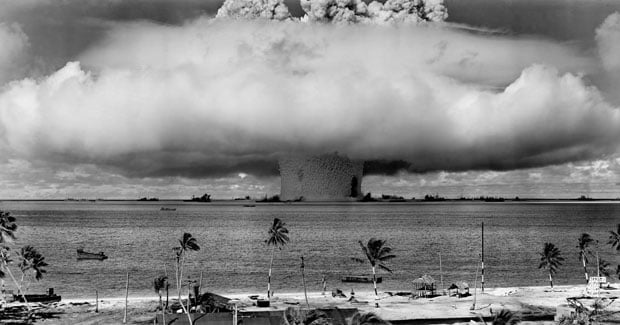
In in 1946, the United States conducted a series of nuclear weapon tests at Bikini Atoll in what’s known as Operation Crossroads.
A total of two bombs were detonated to test the effects nuclear blasts had on naval warships.
The second, named Baker, was the world’s first nuke to be detonated underwater.
Due to the unique properties of underwater explosions, the Baker test produced a number of unique photographs that the world had never seen before.
Read and see more...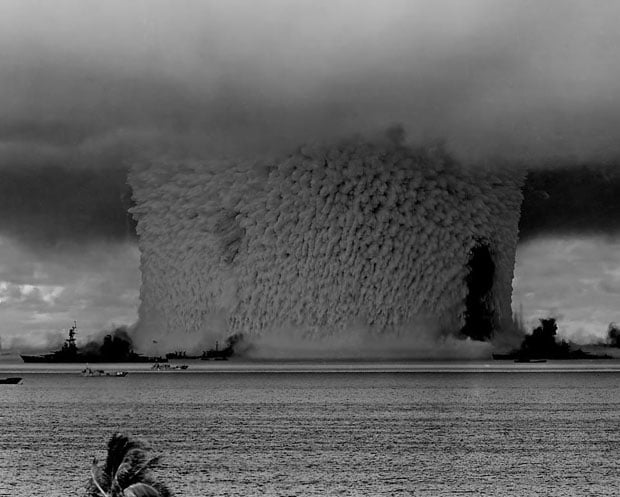
-
Seafarer obtains dig and identify on Lantana site
- On 23/02/2013
From The Sacramento BeeSeafarer Exploration Corporation announced today that they have completed phase I on a shipwreck site located near Lantana Beach, FL and are moving into Phase II, a dig and identify permit which allows Seafarer to dig and determine various artifacts to help identify the ship.
The final phase of excavation will be Phase III, full salvage.
Seafarer received a permit from the State of Florida for a shipwreck site located off of Lantana Beach, Florida in 2012.
The site has recently been surveyed using a Geometrics 882 Cesium Vapor Magnetometer and this survey work showed compelling evidence that a large part of the ship lies buried in a relatively compacted area.
Having completed phase I of the mapping survey and underwater video, Seafarer is preparing to begin digging and identifying the wreck.
Items found and documented on this site in past explorations by third parties suggest the wreck could be a French or Spanish ship from the late 1600s. It will require more work to determine with accuracy.
Kyle Kennedy, Seafarer's CEO, stated "While we have dig sites currently under permit, the Lantana Beach site represents one of our more intriguing ventures.
In many cases historic shipwrecks are spread out over wide areas which can cause exploration and recovery to be very time consuming and expensive but this particular site looks very compact. We are very excited by what we discovered in Phase I and are eagerly anticipating Phase II which will begin immediately after obtaining our Department of Environmental Protection and US Army Corps of Engineers permits."
Seafarer also announced a new collaboration with Dr. John de Bry, a paleographer specializing in sixteenth- through eighteenth-century French, Spanish and English manuscripts who also serves as the Director of the Center for Historical Archaeology in Melbourne, FL.
Dr. de Bry has also participated in a number of field excavation projects in the United States, the Caribbean, South America and the Philippines and will provide technical expertise on Seafarer's many excavation projects.
"We are moving forward on various fronts," Kennedy continued.
-
Underwater discovery offers glimpse of 1850s trains
- On 23/02/2013
- In Parks & Protected Sites

By Edward Colimore - PhillyThe emerald-colored waters off Long Branch, N.J., were "gloomy and spooky" as Dan Lieb swam toward the two hulking silhouettes, sitting upright and side by side about 90 feet down.
The objects were heavily encrusted with marine life, but Lieb recognized the unmistakable lines, the wheels and boilers of identical locomotives, 160 years after they fell or were cast overboard.
"It looked like they were steaming across the bottom in a race," said Lieb, 56, of Neptune, Monmouth County. "You could imagine them on tracks at a station with steam coming out of the valves, and people and luggage on the platform."
Five miles off the Jersey Shore, their presence is a mystery perplexing researchers. How did two pre-Civil War locomotives wind up there ? Did they slip off a sailing ship during a storm ? Were they purposely dropped into the deep ?
Lieb, a technical illustrator, diver, and member of the Philadelphia Chapter of the Explorers Club, will describe the progress of the investigation at the club's meeting - open to members and guests - at 6 p.m. Tuesday at the Academy of Natural Sciences in Philadelphia. The event will be open to the public. Admission is $10.
He is the director of the Sunken Locomotives Project for the New Jersey Museum of Transportation, a nonprofit educational organization that took legal possession of the engines - through a federal proceeding - about nine years ago.
Research into the submerged locomotives also is being conducted by the New Jersey Historical Divers Association, said Lieb, president of the group.