HOT NEWS !
Stay informed on the old and most recent significant or spectacular
nautical news and shipwreck discoveries

-
Team explores 19th century Parthenon marble shipwreck in Greece
- On 09/08/2011
- In Underwater Archeology

A team of underwater explorers in Greece examined the shipwreck of the Mentor, which sunk in 1802 as it transported marbles from the Parthenon to London.
The sculptures, part of the Parthenon collection taken and sent to England by Lord Elgin, were recovered after the ship sunk and no additional pieces were found in last month’s or in three previous explorations, the Athens-based Culture and Tourism Ministry said in an e-mailed statement today.
Three ancient coins, two silver and a bronze, were found on the wreck as well as two pistols and navigation tools used by the 10-member crew, according to the e-mail. French sea explorer Jacques-Yves Cousteau investigated the vessel with a team in 1975, the ministry said.
The Mentor, which lies near the island of Kythira in the Mediterranean sea, was explored from July 6 to July 15 and the team was funded by Kytherian Research Group, an Australian foundation, according to the e-mail.
Lord Elgin dismantled part of the Parthenon frieze at the beginning of the 19th century to ship back to Britain. Greece renewed its campaign to retrieve the marbles, housed in the British Museum, with the opening of the New Acropolis Museum in June 2009. -
Expert to take Titanic wreck photos
- On 08/08/2011
- In Famous Wrecks
From Tyrone Times
The man who discovered the wreck of the Titanic is to return to its final resting place to capture fresh images of the ship for a new £100 million visitor attraction in Belfast.
Dr Robert Ballard will journey two-and-a-half miles to the bottom of the Atlantic Ocean next month to film the mangled stern section, which broke off from the rest of the liner as she sank on her maiden voyage in 1912.
His footage will enable Belfast's Titanic Signature Project, which is under construction in the same docklands where the ship was built, to show visitors the first complete image of the wreck which Dr Ballard discovered in 1985.
Details of the underwater venture emerged as the team building the project - which will be the world's largest Titanic attraction - briefly opened its doors to show off progress to date.
Live streamed pictures of all future submarine trips to the wreck will also be broadcast in the centre from April next year when it opens just ahead of the 100th anniversary of the sinking.Project manager Noel Molloy said the underwater map was only one unique feature of many set to be housed in the eye-catching white-panelled building, which is modelled on the Titanic's bow.
-
Norway, Nunavut clash over shipwreck
- On 08/08/2011
- In Parks & Protected Sites

By Tristin Hopper - National Post
Rather than see it preserved in a Norwegian museum, a committee in Cambridge Bay, Nunavut would rather see the Maud end its days on the bottom of the Arctic Ocean.
Maud Returns Home, a salvage group backed by Norwegian investors, is planning a multi-million dollar expedition to restore the Maud, a 1918 polar exploration vessel once commanded by legendary Norwegian explorer Roald Amundsen.
The group aims to raise the wreck with special balloons, mount it on a barge and tow it through the Northwest Passage back to Norway, where it would be preserved in a museum outside Oslo.
“This initiative will be a last opportunity to bring the remains of this once proud polar ship back home and give it a respectable place to rest in the years to come,” reads the project’s website.
Meanwhile, Keep the Baymaud in Canada, a committee of 20 Cambridge Bay residents, is aiming to block the Norwegian’s efforts and keep the 95-year-old ship underwater. The shipwreck is one of the community’s few tourist attractions, say committee members, and locals earn money by motoring visiting cruise ship passengers to the wreck site.
“While we don’t deny the importance of the Maud to Norway, one also cannot deny the fact that she is a Canadian archaeological site that has been there since 1930 and should not be removed,” reads a petition circulated by the group.
Amundsen had already conquered the South Pole and the Northwest Passage when, in 1918, he set his sights on the North Pole.
Pulling out from Oslo on the newly-christened Maud, Amundsen plan was to deliberately strand the vessel on a chunk of pack ice, where he believed ocean currents would soon carry the ship to the pole.
The 46-year-old explorer was soon plagued by accidents on the expedition. He broke his arm in a fall from the ship, was lightly mauled by a polar bear and nearly died of carbon monoxide poisoning.
The ship, meanwhile, was not drifting anywhere near the North Pole. By 1924, strapped for cash, the expedition was forced to sell the Maud to the Hudson’s Bay Company. -
Armada wreck discovered off Donegal
- On 06/08/2011
- In Underwater Archeology
Belfast Telegraph
The wreckage of a sunken vessel believed to be from the Spanish Armada has been discovered off the Donegal coast.
Underwater archaeologists are to explore the historic wreck, located in shallow waters in Rutland Harbour, near Burtonport.
Evidence uncovered during a dive survey revealed the vessel was likely to be a 16th-century ship, possibly part of the 1588 Spanish Armada.
Heritage minister Jimmy Deenihan has granted 50,000 euro for the excavation by the underwater archaeology unit from his department's National Monuments Service.
He said the discovery was a major find of significance not only to Ireland but also to the international archaeological, historical and maritime communities.
"If, in fact, it proves to be an Armada vessel, it could constitute one of the most intact of these wrecks discovered to date," he said.
"It could provide huge insight into life on board and the reality of the military and naval resources available to the Armada campaign." -
Watch live: first glimpse of newfound shipwreck
- On 05/08/2011
- In Underwater Archeology
From Our Amazing Planet
Scientists using a remotely operated vehicle in waters off Turkey stumbled upon an unknown shipwreck yesterday (Aug. 3).Today the world could watch the live stream from a camera aboard the underwater robot as the team investigated the wreckage for the first time.
The team aboard the research vessel Nautilus, on an expedition in the Black Sea, happened upon the sunken ship while on the way to investigate another shipwreck, known as the Sinop B.
The team has dubbed the newfound shipwreck the Sinop E. The ship lies in about 305 feet (105 meters) of water, and based on the amphorae — ceramic storage vessels — strewn near its broken timbers on the ocean floor, the team suspects it dates to a time before the Sinop B, a wreck from sometime within the 5th to 7th centuries.
Two red dots sometimes appear on the camera view — these are lasers shot from the remotely operated vehicle to take measurements. The dots are approximately 4 inches (10 centimeters) apart, a measure that can give viewers a sense of scale of the artifacts caught on film.
The expedition is a project of oceanographer Robert Ballard, best known for his discovery of the wreck of the Titanic, and it aims to investigate everything from shipwrecks to underwater volcanoes and weird sea life around the planet for several months this summer.
Throughout the season, a satellite dish on the ship will transmit live video and other data from the expedition 24 hours a day, 7 days a week. -
Second piece of historic ship discovered at WTC site
- On 05/08/2011
- In Underwater Archeology
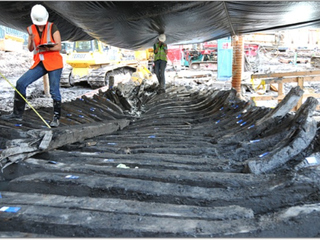
By Olivia Scheck - DNAinfoArchaeologists helping to excavate the World Trade Center site have uncovered a second piece of the more than 200-year-old ship that was discovered there last summer.
The find, made last Friday, came as workers began digging up the east side of the construction area, which once housed the World Trade Center complex.
"We were expecting there to be something there," said Michael Pappalardo, an archaeologist with engineering consultancy firm AKRF who was on hand for the unearthing. "But it was definitely exciting."
"Now no more of these remains are on the site," he added, explaining that the rest of the relevant area had already been excavated.
Archaeologists first noticed remnants of the ship — curved pieces of wood buried 25 feet below street level — last July and spent two weeks excavating the artifact, which turned out to be a 32-foot-long section of the boat's hull.
The piece that was found last Friday belongs to the very front of the ship, providing crucial clues as to its size, shape and, therefore, use, according to Pappalardo.
"It does give us a much better sense of the boat's original dimensions," the archaeologist, who now estimates that the ship was 50 feet long at its base and 60 feet long on the deck, explained.
Scientists from AKRF spent two days removing the newest piece, which measures roughly 6 feet long, 3 to 5 feet wide and approximately 1 foot tall.
It was still being stored at a facility in New York as of Thursday morning, but it will soon be reunited with the rest of the ship's remains at Texas A&M's Center for Maritime Archaeology and Conservation, Pappalardo said.
The artifacts will be saved there under stable conditions until the Port Authority decides what to do with them, according to Pappalardo. The authority might decide to undergo the lengthy process of preserving all of the remains — perhaps to be reconstructed later — or they might just decide to preserve some of the artifacts, the archaeologist explained. -
Divers search for hidden golden bars off O.C. coast
- On 05/08/2011
- In Miscellaneous
By Kathy Ochiai - Newport Beach Patch
In the film Pirates of the Caribbean: Curse of the Black Pearl, Orlando Bloom's character Will Turner states, "I'm not obsessed with treasure." Scuba divers off the coast of Laguna Beach might feel the same way as they spend days looking for "golden bars" placed by the Sport Chalet sporting goods chain as part of their annual treasure hunt.
Six of these bars have been hidden in various locations. The "golden bars" are actually T-bar weights painted gold, but they represent Sport Chalet gift cards worth $1,000, $3,000 or $5,000.
Three bars were placed off the coast of Southern California, and two have been found. Two other found bars were placed in Northern California and Arizona.
This leaves one bar unfound as of the posting of this article (Aug. 3). Which is why yesterday on Wednesday divers were stacked up like planes over LAX off the coast of Laguna Beach. They were searching for the remaining Sport Chalet "treasure bar."
Laguna Sea Dwellers Sherri Cubillos and Russ Follmer brought their friend and "rogue diver" Daniel O'Hara out to give the treasure hunt a try.
"We’re just going for our regular dive, but we know about the gold bar and we know that there’s one left because someone found the one at Shelly," Cubillos said, referring to the three-foot statue imbedded in the sand in about 30 feet of water off Shaw's Cove. -
Britain gripped by rush for nazi gold
- On 03/08/2011
- In Treasure Hunting / Recoveries

Underwater treasures can charm the hearts and capture the minds of even the most practical people in the world.A team of British businessmen seems, too, to have fallen under the spell of hidden nazi gold.
The businessmen managed to find the directions to the treasures in a secret SS letter stored in the nazi archives in Koblenz, British media report.
The document says the gold was sunk in Berlin’s Stolpsee Lake by the end of World War II as ordered by Luftwaffe Commander Hermann Göring. Whom the 18 boxes belonged to is unknown.
The British treasure-hunters have found a witness to the sinking.
“There were 20 to 30 men wearing death camp uniforms; they stored the heavy boxes on boats,” Eckard Litz told The Sun. “The boats took to the middle of the lake where the boxes were thrown into the water.Then the boats were refilled – about six times. After all the boxes were sunk, the Nazi’s shot all the men.”
Back in 1981, East Germany’s Defense Minister Erich Mielke ordered to search for the gold in the lake, but nothing was found. Local residents say the lake is filled with garbage, which could seriously complicate the search operation.
"I am not surprised they have not found anything as the lake is 1,040 acres in size. They didn't have the technology to properly examine the lake,” priest Erich Koehler told the Sun.“But there are enough local people still around to know that the gold is there – and the bodies of the poor souls forced to dump it into the water."
The British businessmen, however, are will not give up that easy: they are planning to rent a submarine.