HOT NEWS !
Stay informed on the old and most recent significant or spectacular
nautical news and shipwreck discoveries

-
A vessel of Indian culture
- On 03/08/2011
- In Parks & Protected Sites

By Stuart Ferguson - Online WSJ
In the spring of 2000 Steve Everett and his environmental-science students from Eastside High School here were examining the isolated north shore of the 5,800-acre Newnans Lake, six miles east of town, looking for signs of a former logging camp.
But what at first seemed to be logs lying on the exposed bed of the drought-stricken lake turned out to be dugout canoes, their bows and sterns emerging from the mud.
Once state archaeologists were called in, 101 canoes or partial canoes were found and studied, their positions mapped and samples of their wood radiocarbon dated. Dugouts were found buried on top of one another, while more were discovered spread out farther down the shore.
Three-quarters of the canoes examined were constructed from Southern hard pine; other woods used were cypress and conifers. Lab tests showed the vessels dated from 500 to 5,000 years ago; their lengths ranged from 15 to 31 feet. It was the single largest cache of prehistoric watercraft ever discovered.In a telephone interview, Mr. Everett said some of his students worked into the miserable, humid Florida summer, aiding the professional archaeologists as they learned what they could before the rising lake submerged the boats.
And there, now under about five feet of water, the canoes remain—too fragile to remove from their protective environment. Earlier exposures of the lakebed over millennia had weakened the wood's structure, meaning anything removed without subsequent years of expensive restoration would turn to dust.
Some of the archaeologists were from the University of Florida, and the school's Florida Museum of Natural History wanted to share the information acquired from the dig, showing not just how canoes were used in the past, but how they still play a vital role among present-day Indians.
"Dugout Canoes: Paddling Through the Americas" makes clear these wooden vessels were—and are—the pickup trucks of Native America. Their owners piled their families, food and items for trade into dugouts to carry them across a lake or far across the sea. -
Shipwreck believed to be from Captain Morgan fleet
- On 03/08/2011
- In Underwater Archeology

By McLean Robbins - Gadling
Archaeologists have discovered the wreckage of a 17th century ship they believe to be from the famed Captain Henry Morgan's fleet, lost off the coast of Panama in 1671.
The shipwreck was found on the Lajas Reef at the mouth of the Chagres River. The wreck is believed to be one of the boats lost as Morgan stormed Panama City in an attempt to take the Castillo de San Lorenzo, a Spanish fort on the cliff overlooking the entrance to the Chagres River, the only water passageway between the Caribbean and the capital city.
Although his men ultimately prevailed, Morgan lost five ships to the rough seas and shallow reef surrounding the fort.
In the 17th century, Morgan sailed as a privateer on behalf of England, defending the Crown's interests and pioneering expeditions to the 'New World.' Today, Morgan is perhaps best known as the inspiration for the famed Captain Morgan's rum.The team uncovered roughly 52x22 feet of the starboard side of a wooden ship's hull and a series of unopened cargo boxes and chests encrusted in coral. The artifacts were buried deep beneath a thick layer of sand and mud.
Ballast stones and iron concretions (the hull's 'ribs') were also found. The ship was found with the help of a magnetometer survey, an underwater archaeological technique used to locate anomalies in the magnetic field below the surface of the water. The funding for the expedition was provided by Captain Morgan rum.
"For us, the real treasure is the shipwrecks themselves, which can give us the ability to accurately tell the story of a legendary historical figure like Captain Henry Morgan," said Frederick "Fritz" H. Hanselmann, underwater archaeologist and Research Faculty with the River Systems Institute and the Center for Archaeological Studies at Texas State University.
"Discoveries of this nature allow us to study these artifacts and teach others what life was like for these famous privateers more than three hundred years ago."
Due to the shallow waters and close proximity to the coast, treasure hunters have stolen many of the artifacts of monetary value, like gold coins, from the surrounding areas.
In an attempt to help save the historic site from looting, the dive team is working closely with the Panamanian government to study and carefully preserve artifacts, which are an integral part of Panama's history and heritage. -
Shipwreck blocks corps levee repair in California
- On 03/08/2011
- In Underwater Archeology
By Todd Plain - Dvids Hub
Pieces from a sunken ship at a planned levee-erosion repair site along the Sacramento River are nearly stable enough to become a permanent piece of history.
The pieces are the products of six data-recovering dives conducted from Sept. 28 to Oct. 7, 2009, directed by the U.S. Army Corps of Engineers Sacramento District, and part of an intensive underwater investigation of the historic Clarksburg Ferry, which operated along the Sacramento River between Yolo and Sacramento Counties until it sank in 1928.
“It just so happens that this ferry is resting in an area where we need to place a bunch of rock to stabilize the levee,” said Sacramento District archaeologist Nikki Polson. “Because the ferry meets certain criteria, it’s eligible for the National Register of Historic Places.”
The levee repair site is part of the corps’ and the Central Valley Flood Protection Board’s Sacramento River Bank Protection Project, an ongoing, joint effort to strengthen levees along the Sacramento River.
In a lawful intent to balance historical preservation concerns with the needs of federal undertakings, the Section 106 process of the National Historic Preservation Act ensures the Sacramento District will attempt to identify and resolve potential conflicts between their Sacramento River Bank Protection Project activities, public interest and historic preservation.
-
Sailors from two centuries ago to be remembered
- On 03/08/2011
- In General Maritime History
By Mark McNeil - The spec
With the 200th anniversary of the War of 1812 fast approaching, a special commemoration of the loss of 53 American sailors on the Scourge and Hamilton is being arranged for Aug. 7.
The hour-long ceremony will take place at The Hamilton and Scourge Naval Memorial Garden at Confederation Park to acknowledge the sailors who died in what was the largest loss of life suffered by the United States Navy in that war.
The warships sunk to the bottom of Lake Ontario in the early morning hours of Aug. 8, 1813 when they were struck by a sudden squall that took down the ships in a matter of minutes or even seconds.
Michael McAllister, Coordinator of the Hamilton Military Museum, says there have been commemorations sporadically over the years, but with the 200th anniversary of the War of 1812 coming up next year, organizers have decided to host services each year until 2014.
This year’s ceremony will include a chaplain from the American Legion of Veterans.
McAllister says the memorial garden at Confederation Park was built to remember the American sailors and raise public awareness of the tragedy, even though the site is a considerable distance from where the sinkings actually took place.The closest community on the shore is Port Dalhousie.
-
Ming dynasty porcelain found in China's 'Bermuda Triangle'
- On 03/08/2011
- In Underwater Archeology

A large number of blue and white porcelain objects were found in the mysterious "Chinese Bermuda Triangle" waters of the Poyang Lake Laoyemiao after a month-long cultural relic exploration in this area, according to Jiangxi's Institute of Archaeology.
The porcelain, which probably dates back to the mid-to-late Ming dynasty, together with some copy celadon of Longquan kilns were mainly exports of Jindezhen, said Xiao Fabiao, leader of the exploration group. He revealed that debris also signals the location of the sunken ship.
Known as "China's Bermuda Triangle," this 24-kilometer stretch of Laoyemiao waters located in Duchang County of Jiangxi province are long and narrow waters connecting the Gan River and Poyang Lake, China's biggest fresh water lake.Famous for rushing waters and powerful waves, the waters are a dangerous area where shipwrecks frequently take place.
-
An American warship attacks Libyan pirates… circa 1801
- On 02/08/2011
- In General Maritime History
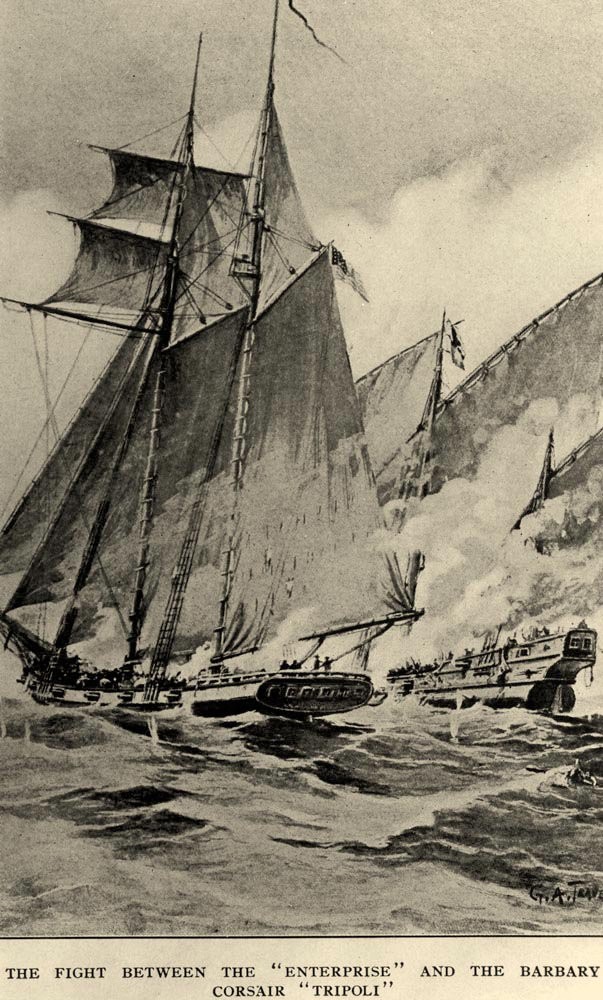
Exactly 210 years ago today, during the First Barbary War, the schooner Enterprise, commanded by Lieutenant Andrew Sterett, encountered the Barbary corsair Tripoli west of Malta and prepared for engagement.
After a three-hour battle and false surrenders by Tripoli’s commander, Admiral Rais Mahomet Rous, Enterprise broadsided the vessel. Admitting defeat, Rous surrendered and threw the Tripolitan flag into water.
Text extracted from Dudley Knox‘s “A History of the United States Navy,” page. 62. Sterrett reported that, “The carnage on onboard the Tripolitan was dreadful, she having twenty men killed and thirty wounded…Her mizzen-mast went over the side…
We had not a man wounded and sustained no material damage in our hull or rigging.”
-
Divers to examine safety of sunken WWII ships off Treasure Coast
- On 02/08/2011
- In Maritime News

By Eliot Kleinberg - Palm Beach Post
Frank Leonard Terry and a colleague had just gone to the stern of the W.D. Anderson for coffee on the night of Feb. 22, 1942, when a torpedo slammed into the engine room of the 500-foot, 10,277-ton freighter, filled with oil and headed north, 12 miles north of Jupiter.
"The ship stood, in a fraction of a second, from forward to astern in flames,' U-boat commander Fritz Poske wrote.
As Terry went over a rail and into the water, a second torpedo hit. Covered in oil, he bobbed for hours in water so cold he thought sharks had bitten off his legs. He was surprised when rescuers told him they were still there. He was the only survivor.
"It was my first trip to Florida. I didn't like the experience," Terry said in a 1992 interview for a Palm Beach Post section marking 50 years since World War II came to Florida.
Between February and May 1942, U-boats sank 24 ships off Florida, 16 of them from Cape Canaveral to Boca Raton.
In all, from Maine to Texas and from California to Alaska, U-boats sank about 400, killing about 5,000 seamen. Sinking with them: oil, paint, cotton, sugar; airplanes, tanks and trucks. Now, six decades later, the National Oceanic and Atmospheric Administration wants to know whether any of that foul cargo still leaches into the water.
Starting as early as next spring, the Coast Guard will be looking during regular patrols. Salvors will dive to any wrecks believed to be a significant threat; money for that comes from a spill fund financed by the oil industry. -
Is this a UFO on the bottom of the ocean ?
- On 02/08/2011
- In Miscellaneous
From Gizmodo
Swedish sea treasure hunters have found something extraordinary: A 60-foot disc sunk in the bottom of the ocean, with what appears to be 985-foot-long impact tracks leading to it.
The team leader never found anything like it: You see a lot of weird stuff in this job but during my 18 years as a professional I have never seen anything like this. The shape is completely round… a circle.Those are the words of Peter Lindberg, commander of the Ocean Explorer. He and his team found the strange disc on June 19 2011, at 285 feet below the surface of the Botnia Gulf, which is located somewhere between Finland and Sweden in the Baltic.
The Ocean Explorer is not a team of crazy UFO hunters, but a company that finds sunken ships and retrieve their contents for profit.In 1997 they found the ship Jönköping, which was loaded by 2.500 bottles of an amazing champagne: Heidsieck&Co Monopole 1907 "Gout Americain" dedicated to the Russian Imperial Fleet. They sold those bottles for $13,000 a pop.
Linberg is not claiming this is a UFO but the appearance of the sonar image is leading some people to believe it's a crashed object either made by humans or—dun dun DUN—aliens. I look at the images and all I can think about is "someone get Chewie and Han's bodies out of there."