HOT NEWS !
Stay informed on the old and most recent significant or spectacular
nautical news and shipwreck discoveries

-
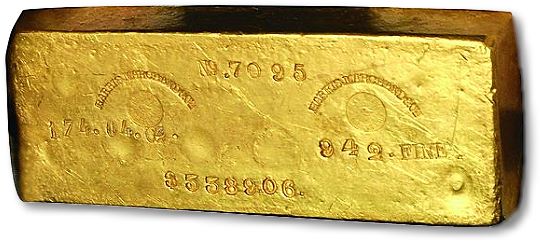
Unique Harris & Marchand Bar from S.S. Central America
- On 11/08/2011
- In Auction News
By Stacks Bowers
The finding of treasure is everyone’s dream. However, treasure is elusive. Of the many thousands of ships that have been lost in the world’s lakes, rivers, and oceans, those few that have been recovered nearly all have lacked rare coins of significance.The most important treasure ever found was that of the S.S. Central America.
Lost in the Atlantic on September 12, 1857, the ship went down with several hundred passengers and a king’s ransom in United States gold coins and ingots from the Gold Rush, in an era in which gold was valued at $20.67 per ounce. No greater or more important American numismatic treasure will ever be found, as no greater treasure was ever lost !In the 1980s the wreck of the S.S. Central America was located in 7,200 feet of water off the coast of North Carolina and recovered by the Columbus-America Discovery Group. Most national treasures cannot be owned.
There is only one Star Spangled Banner, and it is in the Smithsonian Institution. There is only one Declaration of Independence, and it is in the National Archives.
While many historical artifacts, accessories, ship components, and other items recovered from the S.S. Central America have been preserved for study by institutions and others, over 5,000 freshly minted 1857-S double eagles, over 500 gold ingots from Gold Rush assayers, and other coins were made available for public purchase by collectors, investors and museums from around the world beginning in 1999. A national treasure to be shared!
One very important example, a unique Harris & Marchand bar attributed to Marysville, California, with a special double stamping of the “all seeing eye” hallmark, was initially purchased by a knowledgeable collector as “first pick” from the entire treasure.The Harris & Marchand ingots remain among the rarest recovered, with only 37 known in total and ONLY ONE from the Marysville office, making this giant gold brick a significant and important rarity. This impressive ingot has been in private hands since that time.
-
Premier treasure-hunting: Putin dives into “Russian Atlantis”
- On 11/08/2011
- In Treasure Hunting / Recoveries
Known for his keen interest in exotic adventures, Vladimir Putin has tried himself as a sea treasure hunter.
While visiting an excavation of an ancient city in south Russia, the prime minister could not resist the temptation to take part in some research to shed light on the fate of the historic site.
The PM put on a diving suit and dived deep into the Taman Bay where, to everyone’s utter surprise, he managed to find two ancient amphorae dating back to the 6th century AD.Putin said he had seen at a depth of about two meters – the sea was still and the water transparent.
The chief archeologist explained to Putin that amphorae often broke when the ancient ships were loaded or unloaded, so the sailors just threw them into the sea.
The city of Phanagoria, founded about 2,550 years ago, is Russia’s biggest ancient settlement. For unknown reasons, it was abandoned in the late 9th century AD – this is why archeologists call it the “Russian Atlantis.”
The PM suggested that the excavation should become an underwater museum – the attraction, he believes, will gather crowds from all over the world.
Putin also told journalists that the Taman dive was his third-ever attempt at scuba diving. He added that swimming in a diving suit is much more interesting than in a submarine.Back in 2009, the PM dived into the Baikal Lake on a Mir-1 – a special submersible.
-
Salme yields evidence of oldest sailing ship in Baltic sea
- On 11/08/2011
- In Parks & Protected Sites

By Sigrid Maasen - Estonian Public Broadcasting
The ancient ship burial site in Salme on the island of Saaremaa still has some surprises in store.
The archeological excavations in Salme, soon to be completed, have yielded evidence that the ship that had been buried with 35 warriors and nobles had a keel, which in turn leads to the conclusion that it used sails.This represents the earliest known use of sails on a vessel in the Baltic Sea region, reported ETV.
"One piece of new information that we have been anticipating since winter was still to be found - namely, confirmation of whether it was a sailing ship or not. Now we have evidence that it used sails," said archeologist Jüri Peets of Tallinn University.
Peets called this discovery the cherry on top of the cake that was the nearly two-year-long archeological dig. "It is thought that sails were first introduced in the North Sea and Baltic Sea region at about 700 A.D., which is the conventional date.Our ship dates from the year 750. The ship from the year 700 was from the North Sea region, near Norway. However, here in the Baltic Sea region, this is without a doubt the oldest sailing ship that has been found," said Peets.
-
19th-century shipwreck artifact treasure trove
- On 11/08/2011
- In Underwater Archeology

By Randy Boswell - Winnipeg Free Press
A series of dives last month to the rediscovered Arctic Ocean wreck of HMS Investigator has revealed glimpses of what Parks Canada archeologists believe to be an unprecedented "treasure" of historical artifacts preserved in silt below the deck of the sunken 19th-century British ship, Postmedia News has learned.
The July expedition to the vessel's resting place in Mercy Bay, a frigid patch of water off the shore of Banks Island in the Northwest Territories, saw divers collect a handful of evocative relics -- including a sailor's shoe and a largely intact rifle -- that lay "in plain sight" and were at risk of disappearing in the seabed sludge.
But their key finding was confirming the likelihood that "thousands" of other objects -- scientific specimens, crewmen's personal belongings, architectural fixtures, a stash of vintage booze in the ship's "spirits room" -- have remained entombed and protected in the Royal Navy vessel since it became trapped in ice, was abandoned and then sank during a failed search for the lost Franklin Expedition in the early 1850s.
"We were blessed with really exceptional weather and very, very co-operative ice conditions," Ryan Harris, a Parks Canada underwater archeologist, told Postmedia News.
"There's a very high level of siltation inside the hold and that actually bodes quite well for preservation of what will probably amount to thousands upon thousands -- or hundreds of thousands -- of artifacts that are likely inside the vessel."
He said the ship itself is in remarkably good condition and described the "surreal" experience of seeing a ship so rich in history coming into view with each dive.
The Investigator, captained by Irish-born Robert McClure, had left a British port in 1850 to join what had become a desperate search for the lost ships and missing 129 men from Sir John Franklin's ill-fated Arctic expedition, HMS Erebus and HMS Terror.
McClure entered the Arctic from the Pacific but was forced to leave the ship when it became locked in ice at Mercy Bay in 1853.He ordered the creation of a cache of supplies on the nearby shore of Banks Island, then led his men on a sledge journey across the sea ice to their rescue by another British ship at Melville Island.
The crew's eastward route back to Britain marked the first recorded transit of the Northwest Passage -- a combined voyage by ship and sledge that won McClure everlasting fame despite his failure to find Franklin and the loss of the Investigator, which sank in 1854. -
Donegal wreck may have Spanish Armada link
- On 10/08/2011
- In Underwater Archeology
Lorna Siggins - Irish Times
Two shipwrecks discovered off the Donegal coastline may be linked to the late 16th-century Spanish Armada and a separate late 18th-century French armada, despatched to assist Irish rebellion efforts.
However, identification of the two wrecks outside Burtonport harbour may take some time, Connie Kelleher of the Department of Arts, Heritage and the Gaeltacht’s underwater archaeology unit, said yesterday.
The two shipwrecks, one of which is definitely a warship, are lying 200m apart in just four metres of water off Rutland Island close to Burtonport.
Lead shot balls were retrieved during dives in which Ms Kelleher participated yesterday morning. Pottery has also been recovered from within the hull of the possible Spanish Armada ship, which is filled with sediment.
A full excavation of material is under way, as part of a long-term management plan for the location.
Minister for Arts, Heritage and the Gaeltacht Jimmy Deenihan has awarded €50,000 for the work, and the Geological Survey of Ireland’s vessel Keary, named after late geologist Raymond Keary, is providing a support platform for the dive team.
Many of the wrecks already located lie off the north and west coasts, off Inishowen in Co Donegal; Co Sligo; Clare Island, Co Mayo; Co Galway; and Co Clare; and the Blasket Sound in Kerry.
Five of the hulls, or remains of same, have been located off Donegal, and the three wrecks off Streedagh strand in Sligo were the subject of a protracted court action.
The two wrecks now under investigation were originally pinpointed by Donegal divers, including Liam Miller, Oscar Duffy and Michael Early in 2008-2009.At this stage, identification is uncertain, but Ms Kelleher believes they may be “enormously significant”.
The later wreck, possibly French, could be linked to Napper Tandy’s revolutionary efforts.Tandy (1740-1803), who worked with Wolfe Tone in founding the United Irishmen, accepted a French government offer of a corvette, the Anacreon, and sailed from Dunkirk with United Irishmen and arms, arriving on Arranmore island, close to Burtonport, in September 1798.
-
Finnish shipwreck from 1924 found in France
- On 10/08/2011
- In Wreck Diving
French divers have discovered the sailing ship Port Caledonia, which sank with all its crew 87 years ago.The ship was found at the bottom of the Bay of Biscay. The home harbour of the four-mast vessel was the town of Uusikaupunki in southwest Finland.
Port Caledonia sailed to its fate from the port of Mejillones in Chile on August 4, 1924, carrying 4,000 tonnes of saltpetre.It was meant to arrive in France’s La Pallice harbour on December 2, but tragedy struck before the vessel could reach port.
Hit by a storm, the ship broke mast after mast and then finally crashed into rocks.
Many eyewitness accounts remain of the dramatic sinking, as the sailors fought for their lives for many hours. Because of the raging storm, all attempts to rescue them failed. The last sailor disappeared from view nearly ten hours after the alarm sounded.
All 25 crew members and captain Alfred Karlsson died that day.
The captain was from the municipality of Vårdö in the semi-autonomous maritime province of Åland. Eight of the sailors were Finns, while the others hailed from Germany, England, Sweden, Denmark and Norway.
The French newspaper Sud-Ouest was the first to report the news on its web page.
-
Works to preserve artifacts from sunken blockade runners
- On 09/08/2011
- In Conservation / Preservation
By Ben Steelman - Star News Online
Their career began 150 years ago and lasted just a few seasons, but for a while they made Wilmington, in the words of Civil War writer Clint Johnson, “the most important city in the Confederacy.”They were the blockade runners, merchant ships that sped past Union warships in the dark to bring much-wanted supplies into Southern ports.
After the U.S. Navy and ground forces effectively sealed off Charleston, S.C., in 1863, that meant Wilmington.
Arms, ammunition, medicine and much-needed supplies slipped into the Port City, usually under the protective guns of Fort Fisher. These were then loaded onto the Wilmington & Weldon Railroad for shipment north to Richmond.
Now, state archaeologists are beginning to take a new look at the blockade runners and their cargoes. They hope to launch a campaign to conserve artifacts recovered from the waters off Cape Fear.
The wrecks of 21 blockade runners lie in shallow waters off the coast in what is one of the few maritime National Register historic districts.
“There’s probably twice as many still out there,” said Mark Wilde-Ramsing, an assistant state archeologist who heads North Carolina’s Underwater Archaeology Branch at Fort Fisher. On April 27, 1861 – nearly a month before North Carolina officially seceded from the Union – President Lincoln extended the naval blockade of the Confederacy to the Tar Heel coast.
Declaring a blockade and enforcing it, however, are two different things. In early 1861, the U.S. Navy had just 42 warships, many still deployed in foreign ports, hardly enough to cover the 4,000-mile-long Confederate coast.
The first blockader, the USS Roanoke, didn’t take up station off Cape Fear until July 12, 1861.
-
Submarine exploration of Admiralty Inlet shipwreck only the beginning
- On 09/08/2011
- In High Tech. Research/Salvage
By Charlie Bermant - Peninsula Daily News
The exploration of the wreckage of the SS Governor in Admiralty Inlet is not only of historical significance but also sets the tone for future oceanic research, says the spokesman for the exploration dive team.
“Our mission was to create a three-dimensional scan of some portions of the wreck,” Joel Perry, vice president of expeditions for OceanGate, told more than 200 people at the Northwest Maritime Center last week.
OceanGate sent a manned yellow submarine, the Antipodes, on several dives in late June to the 90-year-old wreck 240 feet beneath the surface of Admiralty Inlet.
“Conditions were favorable and we were successful in scanning the portions that we wanted,” Perry said.
The next stop for the team is off the coast of Monterey, Calif., where it will attempt examination of the SS Montebello, an oil tanker that was torpedoed on Christmas Day in 1941 by a Japanese submarine and sank within 25 minutes off the coast south of Monterey.
The 38-member crew survived, but 73,000 barrels of crude oil may yet be aboard the vessel.
OceanGate will survey the wreck to assess the potential environmental threat to the nearby Monterey Bay National Marine Sanctuary and report its findings to the National Oceanic and Atmospheric Administration.
“Our exploration of the Governor couldn’t have gone any better,” Perry said.
“It was the ideal place for a practice run before our work with the Montebello.”
A capacity crowd Thursday night listened to Perry and Jefferson County Library Associate Director Meredith Wagner to find out more about the history and exploration of the ship that sank off Point Wilson at about midnight April 1, 1921.
Eight of the 240 people aboard the Governor did not survive.
The 417-foot passenger steamship was heading from Vancouver, British Columbia, on its way to Seattle when it was rammed by the SS West Hartland, which was leaving Port Townsend, heading for Bombay, India.
Captain Harry Marden of the Governor mistook the red light on the port side of the West Hartland for the bright red light at the end of the Fort Flagler dock and could not stop in time to avoid the collision, Wagner said.
The bow of the West Hartland hit the starboard side of the Governor. The Hartland’s captain, John Alwen, intentionally kept the bow wedged into the Governor, allowing time for most of the liner’s passengers to abandon ship.
