HOT NEWS !
Stay informed on the old and most recent significant or spectacular
nautical news and shipwreck discoveries

-
« La Nymphe » repose ici depuis 223 ans
- On 02/03/2017
- In Underwater Archeology

De Ouest France
Dans les premiers jours de 1794, la frégate à la tête d’une petite armada républicaine chargée de reprendre l’île de Noirmoutier aux Vendéens, atteinte par une batterie côtière, s’échoue.Dépecée en partie puis longtemps oubliée, son linceul de sable est localisé en 2014. Michel Vrignaud a plongé avec les découvreurs. Il est en conférence ce soir à La Ferrière.
En juin 2014, deux plongeurs passionnés localisent un tumulus de cailloux et de sable dont la forme pourrait être celle d’une coque : 47 m de long et de 5 à 10 m de large.
En août, Michel Vrignaud de l’association vendéenne de vidéo et d’archéologie sous-marine (AVVAS) plonge avec les découvreurs. Il reste 50 minutes, à filmer et brasser les premières hypothèses sur l’histoire de l’épave. Un moment inoubliable pour cet érudit de l’épopée vendéenne.
Touchée au grand hunier et percée à plusieurs reprises par les boulets vendéens, la frégate aux 26 canons se brise doucement devant le Bois de la Chaise.
La première nuit se passe à sauver l’équipage et sortir la poudre. L’île est reprise, les Vendéens capitulent contre parole de vie sauve, on connaît la fin tragique des insurgés, exécutés par lots au sortir de l’église.
-
Wartime shipwreck comes up for sale
- On 24/02/2017
- In World War Wrecks

By Janet Hall - Northumberland Gazette
If you’re looking for a gift for the man who has everything, how about the remains of a ship sunk by a U-boat during the Second World War ?The wreck of the Athelduke, a 8,966-ton British diesel motor tanker which lies at the bottom of the North Sea near the Farne Islands, has come up for sale.
The tanker was built in 1929 by R Gordon and Company of Port Glasgow, Scotland. Owned by the United Molasses Company of London, she operated out of the port of Liverpool.
Requisitioned by the Admiralty during the Second World War to augment the ships of the Royal Fleet Auxiliary, she was part of convoy FS-1784 transporting 12,600 tons of molasses from Port Everglades, Florida, via Loch Ewe to Salt End, Hull, when, at 5.32pm on April 16, 1945, she was torpedoed and sunk by U-1274.
A survivor’s report confirmed that Athelduke was hit by two torpedoes. The first struck the vessel on the port side of the cross bunker tank and the second on the port side of the near cargo tank.
The bunker caught fire and she started to sink, although she took 12 hours to sink completely. Seeing the danger, Captain Joseph Errett ordered his crew to abandon ship, which they did by way of two boats.
The master, 41 crew members and four gunners were picked up by the British merchantman SS King Neptune and were landed in Grimsby the following day.
-
Shipwreck hunters pursue 'Holy Grails'
- On 24/02/2017
- In People or Company of Interest
By Tom Banse - NW News Network
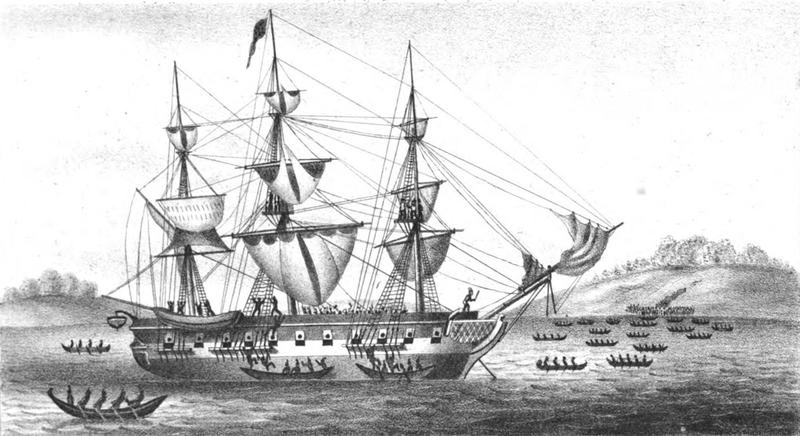
Shipwrecks along the Pacific Northwest coast number in the thousands. A handful have become the long-running obsessions of a cadre of shipwreck buffs.Arguably, the greatest mystery among many in the region to chew on is: where is the Tonquin ?
Scuba diver Tom Beasley of Vancouver, Canada, has been involved in the search for her since 1982. "The Tonquin is one of holy grails of undiscovered shipwrecks in the Pacific Northwest,” he said.
“For me, the Tonquin is the top of that list." The merchant ship was owned by New York millionaire John Jacob Astor. In 1811, the Tonquin carried the fur traders who set up Fort Astoria, the first permanent American settlement on the Pacific Coast.
The Tonquin then sailed on to Vancouver Island where the captain insulted a native chief. That set off a battle in which most of the crew was killed. A survivor retreated to the ship's powder magazine and blew everything up to avoid capture.
Beasley said this likely happened near present-day Tofino or in a bay northwest of Port Hardy, British Columbia. "There is a lot more searching that needs to be done,” Beasley said.
“These are dynamic bodies of water. In the Tofino area, the prime location is probably an area that has dynamic sand. If the wreck is there, it could be covered one day and uncovered two years later." "I like it because it is a fascinating period of cultures coming together and first meeting.
And the conflict and interaction of those cultures," Beasley said. "It's a fascinating, little-known story that should be known more, mystery and adventure."
Beasley serves on the board of the Underwater Archeological Society of British Columbia when he is not earning his living as an employment attorney.
After decades of searching, a rusty anchor recovered from the sandy bottom near Tofino in 2003 is the most intriguing clue found so far.
Beasley described the anchor as oddly encrusted with blue-green trade beads, which dated to the fur trading era when the Tonquin sank. But no markings conclusively link the anchor to the lost barque.
-
WW1 shipwreck off Folkestone
- On 24/02/2017
- In Parks & Protected Sites
From BBC News
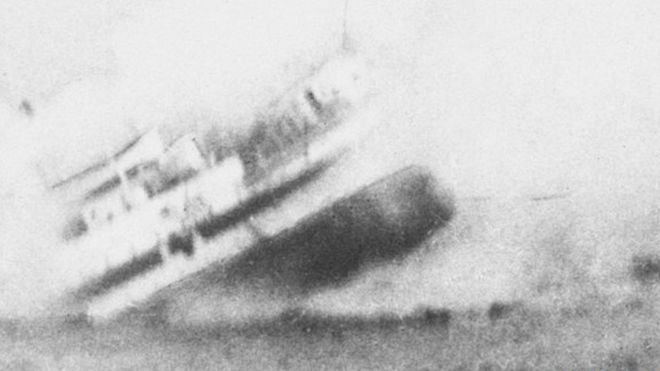
The remains of a First World War hospital ship that sank in the English Channel more than 100 years ago has been given legal protection.About 160 people died when HMS Anglia struck a German mine close to the Kent coast on 17 November 1915. The ship was carrying soldiers, some severely injured in the Battle of Loos, back from France to England.
Many of the casualties were soldiers with amputated limbs as well as medical staff who perished trying to save them.
Campaigners have long-called for the ship to be protected - to safeguard the remains and honour those who died.
It has now been included in a new list of wrecks covered by the Protection of Military Remains Act. Historian Dr Peter Marsden said it was "wonderful to have succeeded at long last" but he was highly critical of the Ministry of Defence (MoD).
"This huge story lying on the sea bed needs protection.
It shouldn't take years and years to get it done," he said. "It's not just protection of the objects that might be taken by divers, it's the recognition by the government that these are the people who died in service to their country."
An MoD spokesman said: "The Ministry of Defence ensures that all wrecks, including HMHS Anglia, are protected under the Act if they meet the correct criteria."
-
Save WWII shipwreck HMAS Perth from salvagers
- On 11/02/2017
- In World War Wrecks

By Jewel Topsfield - WA Today
Australia and Indonesia will conduct a joint dive of the World War II shipwreck HMAS Perth off the coast of Java next month amid fears the vessel, which is believed to hold the remains of 40 to 60 men, is being destroyed by illegal salvagers.Efforts to protect the wreck comes as three Japanese ships that sunk off the coast of Borneo during the 1944 Pacific War by US forces have reportedly been torn apart for scrap.
The research dive on HMAS Perth will be the first detailed survey of the wreck since 2014, following the shock discovery the previous year that the cruiser and other WWII wrecks in the vicinity had been looted for scrap metal.
A sonar survey of the HMAS Perth carried out by the Australian National Maritime Museum and the Indonesian National Research Centre of Archaeology in December was inconclusive as poor weather conditions impacted on the quality of the images taken.
The museum's director, Kevin Sumption said the dive would confirm the condition of the wreck, if it had been recently interfered with by salvagers, its corrosion and its historical and archeological significance.
"We are very aware that there are concerns in the community and we are doing everything we can, working in close partnership with our Indonesian partners, to secure formal protection of the site," Mr Sumption said.
-
Une épave de sous-marin allemand
- On 11/02/2017
- In World War Wrecks

De Mer et Marine
L'U-864 a été coulé le 9 février 1945 par un sous-marin britannique à deux milles de l'île norvégienne de Fedje, non loin de Bergen.Le U-Boot allemand venait d'appareiller avec à son bord 67 tonnes de mercure liquide à destination du Japon.
Depuis 2003 et la découverte, à 160 mètres de fond, de l'épave sectionnée en deux parties, l'administration maritime norvégienne faisait face à un dilemne : le métal toxique à bord s'était déjà répandu sur une surface de 30.000 m2; fallait-il risquer d'en propager davantage en relevant l'épave ?
Et si on la laissait dans le fond, comment faire pour empêcher le mercure de se répandre à chaque tempête? La partie avant, reposant sur le bord d'un fossé sous-marin, était la plus problématique.
L'administration norvégienne a donc choisi d'utiliser une technique d'enrochement, très répandue à l'offshore pour notamment protéger les câbles sous-marins.
Elle a, pour celà, fait appel au spécialiste néerlandais du dragage et des opérations offshore Van Oord.
Les ingénieurs ont élaboré une solution originale: isoler le sol marin contaminé et recouvrir l'épave, le tout en respectant les contraintes de l'administration norvégienne, qui avait fixé à 220 ml (soit un verre) la quantité de mercure qui pouvait être rejetée durant l'ensemble des travaux.
-
Show of shipwrecked treasures raises scientists’ ire
- On 07/02/2017
- In Museum News
By Tracy Watson - Nature
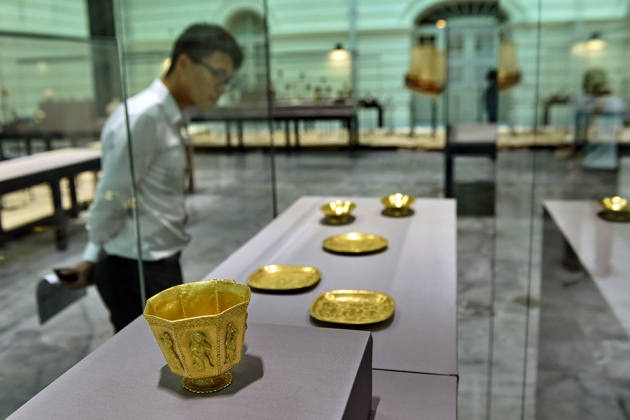
A museum show of sumptuous treasures from a ninth-century shipwreck is being denounced by researchers, who say that commercial salvage of the artefacts irreversibly damaged the wreck’s scientific value.
On 6 February, the Advisory Council on Underwater Archaeology sent a letter of opposition to the Asia Society, the non-profit group that is mounting the show of Chinese Tang-dynasty porcelains, gold vessels and other objects from the wreck at its New York City museum. Critics fear that the exhibition, slated to open on 7 March, will encourage exploitation of wrecks by for-profit firms.
Museums that show salvaged treasures don’t intend to promote treasure-hunting, “but that’s the effect it has”, says Marco Meniketti, an archaeologist at San José State University in California who leads the advisory council.
Artefacts from the Belitung wreck, named after the Indonesian island close to the ship’s final resting spot, were scheduled to go on display at the Smithsonian Institution's Sackler Gallery in Washington DC in 2012.
The institution cancelled the exhibition in December 2011 after vocal opposition from Smithsonian scientists and others. But the problems presented by exhibiting the spoils of commercial salvage remain, says maritime archaeologist Filipe Castro at Texas A&M University in College Station.
That type of excavation “silences all the questions that a vessel like that could answer”, he says, reeling off a list of data that should have been collected at the Belitung site.
In a statement, the Asia Society said that “American audiences should have an opportunity to see this material because of its significance”. In recognition of “the sensitivities” around the exhibition, the society is co-sponsoring a public symposium about the ethics of archaeology and commercial salvage.
And the head of Seabed Explorations, the company that salvaged the wreck, defended his team’s work. “Without Seabed Explorations there wouldn’t be any data existing at all about the Belitung shipwreck,” says Tilman Walterfang.
-
1,800-year-old shipwreck found
- On 02/02/2017
- In Underwater Archeology

By Molly Fosco - Seeker
An 1,800-year-old Roman shipwreck was discovered off the coast of Spain's Balearic Islands.Spanish archaeologists found the ship about 230 feet (70 meters) underwater, reported El Pais. According to the Balearics Institute for the Study of Marine Archeology (IBEAM), most of the 1,000 - 2,000 Ancient Roman jars onboard are still in their original position from the time of the ship's sinking.
The jars, known as amphorae, have remained untouched for nearly two millennia. The amphorae are made of clay and were likely carrying garum, a pungent, fermented fish sauce that was considered a delicacy in Roman society, IBEAM's scientific director explained.
Factories in Spain and Portugal once mass produced garum because it was such a widely used condiment, much as ketchup is today.
This is one of the few intact shipwrecks that has ever been discovered in the western Mediterranean.
"As far as we know, this is the first time that a completely unaltered wreck has been found in Spanish waters," Javier Rodríguez, one of the marine archaeologists who participated in the exploration, told El Pais.
The fact that the ship was found in national park waters was a key factor in its preservation. The Balearic Islands foster hundreds of animal species and plant life and was declared Cabrera Archipelago Maritime-Terrestrial National Park in 1991.