HOT NEWS !
Stay informed on the old and most recent significant or spectacular
nautical news and shipwreck discoveries

-
HMS Hermes items allegedly taken from ship
- On 31/01/2017
- In Illegal Recoveries
By Sarah Ann Harris - Huffington Post
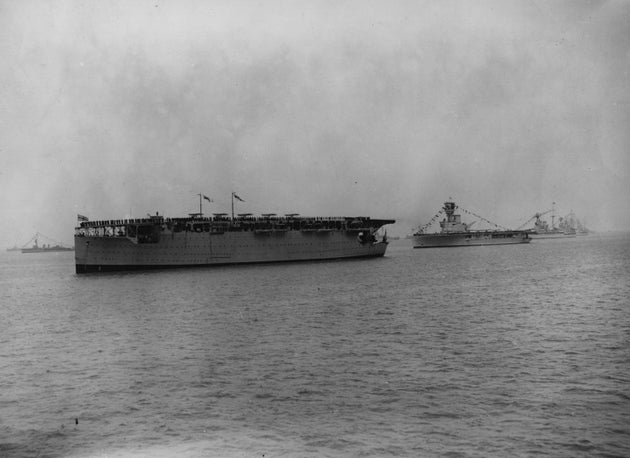
Two men have been charged in connection with the alleged removal of items from a sunken Royal Navy warship in the English Channel.John Blight and Nigel Ingram are accused of failing to declare items to the Receiver of Wreck from HMS Hermes, a protected cruiser built in the late 19th century and converted into an aircraft ferry and depot ship ready for the outbreak of the First World War, the Press Association reported.
It was sunk by a German submarine in the Dover Strait in October 1914 with the loss of 44 lives.
A Kent Police spokesman said: “Officers from Kent Police’s rural task force launched an investigation in August 2015 after being informed that a number of historical artefacts had been reported missing from the wreck.”
Blight, 57, of Winchelsea, East Sussex, has been charged with three counts of dishonestly failing to disclose items of wreck to the Receiver of Wreck with intent to make a gain. Ingram, 56, of Teynham, Kent, has been charged with the same three counts in addition to being in possession of £16,000 worth of criminal property.
-
Lady Luck and Shipwreck Park Pompano
- On 31/01/2017
- In Parks & Protected Sites

By Charles Davis - Deeperblue
Shipwreck Park Pompano is the latest twist to the area known as the “Wreck Diving Capital of the World”. Greater Fort Lauderdale has been claiming that title for decades and with over 100 wrecks off a 26-mile coastline, it is difficult to challenge the claim.The Greater Fort Lauderdale area is an informal area roughly the same as Broward Country Florida and includes the cities of Fort Lauderdale, Pompano Beach and Hollywood which are all on the coast.
The Shipwreck Park is a private/public charitable not for profit organization funded by the City of Pompano Beach and the Isle Casino Racing Pompano Park.
The purpose of the organization is the ongoing expansion of the artificial reef system with additional sunken ships and rotating underwater art installations. The first project of Shipwreck Park was the purchase of the 324-foot long tanker Newton Creek, with its preparation and placement on the sea bottom.
The Newton Creek is now called the “Lady Luck” and sits upright in 120 feet of water just one mile off shore.
The ship was bought at a public auction from the City of New York. The Newton Creek was a sludge carrier. The City of New York operates a number of sewage treatment plants, however, not all of the plants can reduce the sewage to a level that it can be used for the creation of fertilizer.
The Newton Creek would collect the sludge from waste treatment plants and transport it to the Newton Creek Waste Treatment Plant. The plant would further treat the sludge and sell it to fertilizer manufacturers.
-
Treasure hunters target Hull ship HMS Kingston
- On 30/01/2017
- In Treasure Hunting / Recoveries

From Hull Daily Mail
An Argentinian treasure hunter is hoping to strike a £1 billion gold haul by bringing a 300-year old Hull-built ship to the surface.The HMS Kingston was built in Hull in 1697 but now lies at the bottom of the Atlantic Ocean, off the Uruguayan coast where it was sunk in 1763. But Ruben Collado hopes to resurrect the ship, which was renamed the Lord Clive, believing it to hold £1 billion in gold bullion on board.
Next month he will be begin his exploration of the ship renamed after Clive of India.
Collado told The Times: 'The imperial vessel could contain €1,200m in gold coins. 'And that is without considering goods such as rum, opium and silk stored in lead pipes.
'The important thing is to get these ships because they will give us the true magnitude of the story, This is the history of Latin America and the Spanish.'
The 64-gun vessel, which was built in Hull, sailed to South America for the East India Company to bring funds and personnel for British military campaigns. But the ship was sunk by cannon fire during the Seven Year's War in an attempt to retake Colonia del Sacramento, a former colony of British ally Portugal, after it was seized by the Spanish.
-
Four 19th-century shipwrecks found off Australian coast
- On 29/01/2017
- In Underwater Archeology

From Stuff
Four 19th-century shipwrecks have been discovered off Queensland's coast, but experts say identifying them will not be easy.
Archaeologists from the Australian National Maritime Museum uncovered the vessels at Kenn Reef, more than 500km off central Queensland. More than a dozen iron anchors, several copper-alloy fasteners and at least six cannons were found at depths up to 10m.
Dr James Hunter said it was an amazing feeling to set eyes on what remained of the ships more than 150 years after they went down, although identifying them would be no easy feat.
"This will take months of careful examination of the archaeological discoveries against historical records, including ship's logs and accounts of shipwrecks in newspapers from the period," he said.
-
Furneaux Islands' shipwreck 'graveyard'
- On 29/01/2017
- In Museum News

By Rosemary Grant - Radio Australia
Tasmania's rich maritime history can be seen in the wrecks dotted around almost every treacherous stretch of the coastline, but the Furneaux Group of islands in Bass Strait is especially notorious for leaving vessels in ruin.
The wreck of the trader the Sydney Cove in 1797 put the area on the map — even before British navigator Matthew Flinders charted the islands in 1798.
From then on the local sealing and mutton bird industries boomed, and ships were regularly trading in the area. The Furneaux Maritime History Association now wants to establish a permanent artefact display near the coast at Lady Barron.
Sixth generation local Gerald Willis grew up fascinated by the shoals and wrecks and is part of the group keen to see more of the area's history on display.
"My father was born on Puncheon Head, which is Cape Barren Island, lived there until he was three, [then] came to Lady Barron," he said. "Mum's father was a Welshman but her mother, through her side goes back through six generations [of] early settlers on the islands.
The shipwrecks around the island have always intrigued Mr Willis.
"There's countless wrecks, we've got the shoals to the south-east of Flinders Island called the Pot Boil, which is an area where the sea bottom is sandy, very hard sand, the channels shift and you really need local knowledge to get through them," he said.
"They've been a problem for seafarers for a long time."
Over the years lighthouses were peppered around the islands to aid the safe passage of ships sailing between Europe, South America and the east coast cities of Sydney and Newcastle.
But they could not save the iron barque, Farsund, which was headed to Sydney from La Plata, Argentina, early last century.
"There are still signs of the Farsund, a wreck that went aground in 1912, that's on Cape Barren Island," Mr Willis said.
"It's still there, it's falling to pieces, the stern is falling off, 20 metres or so of the rear has fallen and just gone into the sand, and wiggled its way down towards the centre of the Earth.
"It's a dangerous sort of ship to walk on because there's so much rust — it's just falling to pieces.
-
Sunken treasure from the "Hoi An Hoard"
- On 22/01/2017
- In Auction News

From Art Daily
Turner Auctions + Appraisals will present an online sale on February 12 from the renowned “Hoi An Hoard” – historic treasures of 15th- and 16th-century Vietnamese ceramics that were recovered from a trading ship that sank over 500 years ago in a typhoon in the Dragon Sea.Excavated from the deep with extreme difficulty under death-defying conditions in the late 1990s, the shipwreck’s collection of porcelain artifacts is considered by many experts to be the most significant find in Vietnamese art.
The auction features over 160 lots, almost all with multiple items. Among the offerings are vases large and small, boxes, wine flasks, bowls, tea and wine cups, serving plates, platters and more.
Some items are decorated with blue and white designs, enamel or white glaze; some are undecorated; and some include marine encrustations from over five centuries buried at sea.
An auction highlight is a small, one-of-a-kind box in the form of a crab, decorated with green enamel that has degraded over the years due to underwater exposure at the bottom of the sea.
The works for sale from the Hoi An Hoard are sure to tempt today's treasure hunters.
These 500-year-old ceramics – probably created in the mid-1400s, before Johannes Gutenberg printed his first bible and Leonardo da Vinci was born – infrequently come up for auction.
Focused on individual buyers, this auction presents a rare opportunity to obtain art objects with a unique historical, cultural and archaeological provenance – and at prices that enable most people to participate.
The story of the Hoi An Hoard – from the collection itself, which is the only known cache of Vietnamese ceramics, to the extraordinary underwater archaeological excavation, which involved smuggling, typhoons and hazardous diving operations – is an amazing tale.
-
Scuba diver honoured for dedicated shipwreck research
- On 21/01/2017
- In People or Company of Interest
By Davis Wells - The Herald
Scuba diver Allen Murray has spent the best part of two decades dedicated to researching and exploring historic shipwrecks, perhaps most notably bringing to life a mystery that has puzzled researchers and defence experts for a hundred years.The seasoned diver, aged 60 from Plymouth, and who has been an active and leading member of a several diving clubs across the South West over the years, has now been honored for his work in archaeological wreck investigation.
The British Sub-Aqua Club (BSAC), the sport's national governing body which grants a number of awards to honour amateur divers' achievements, has appointed Mr Murray as a 'Wreck Champion'.
The award is a recognition of his efforts over two decades to explore, photograph and research historic wrecks.
One of the most notable of such explorations, and one that required a great deal of sensitivity during the mission, was research into the protected wreck of the Royal Navy's sunken submarine HMS A7, which sank in Whitsand Bay in Cornwall in 1914, with the loss of all 11 men on board.
The wreck site is the last resting place of the submariners who lost their lives and diving on her is prohibited without a licence from the Ministry of Defence.
However, Mr Murray, was granted special permission to dive the protected wreck in 2014, as part of an academic research project to bring the history of the vessel to life and create a virtual tribute to the crew of HMS A7.
-
Shipwreck from the Russian military discovered in Lake Van
- On 13/01/2017
- In Wreck Diving
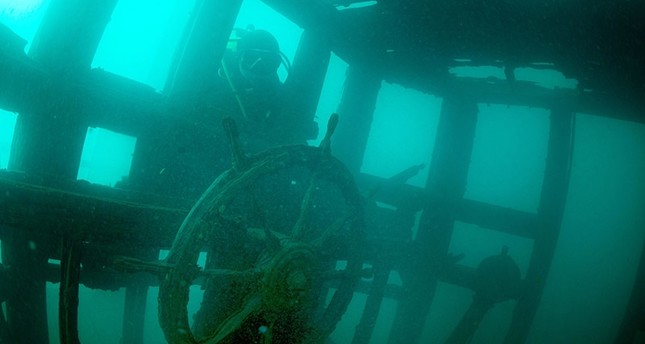
An underwater research team has discovered the shipwreck of a military cargo vessel made by the Russians in 1915 in Lake Van, located in Turkey's eastern Bitlis province, reports said on Thursday.After almost 18 months of research, the team found the 100-year-old Russian vessel, which was used for military freight shipment, and ran aground 23 meters down Lake Van during a storm in 1958.
The vessel is reportedly 40 meters in length and is still in good condition, despite the fact that it hit rocks before it sank.
Underwater Cinematographer Tahsin Ceylan, Lake Van Underground Research Association (VANSAD) Chairman Dr. Mustafa Akkuş and six more members of the team have been conducting research off Çanakdüzü coast in Reşadiye district, Bitlis, the Doğan News Agency reported.
The finding marks the first time a sunken-ship has been discovered in the lake.
Cinematographer Tahsin Ceylan said that the lake is full of 'mysteries' and the team is working collectively to solve these mysteries.
"We learned that there are three cargo vessels from the 1900s, which sank around Bitlis region" Ceylan said.
He continued by adding that they would love to work with a Russian team to find out the rest of the remaining shipwrecks under Lake Van.