HOT NEWS !
Stay informed on the old and most recent significant or spectacular
nautical news and shipwreck discoveries

Amelia Earhart plane search to resume next year

By Rossella Lorenzi - News Discovery
The search for Amelia Earhart's long-lost aircraft will resume next year in the waters off Nikumaroro, an uninhabited island in the southwestern Pacific republic of Kiribati where the legendary pilot may have died as a castaway.
Starting about the middle of August 2014, the 30-day expedition will be carried out by The International Group for Historic Aircraft Recovery (TIGHAR), which has long been investigating the last, fateful flight taken by Earhart 76 years ago.
Called Niku VIII, the new expedition is expected to cost as much as $3 million. It will rely on two Hawaiian Undersea Research Laboratory (HURL) manned submersibles, Pisces IV and Pisces V, each carrying a pilot and two TIGHAR observers.
“The plan for Niku VIII is built on the hard data gathered and the hard lessons learned during the previous expeditions carried out in 2010 and 2012,” Ric Gillespie, executive director of TIGHAR, said in a statement.
Equipped with high definition video, still cameras, mechanical arms and recovery baskets, the subs will search a mile-long underwater area down to a depth of more than 3000 feet.
“Live searching by three people aboard each sub looking at wide vistas illuminated by powerful lights is far superior to searching by looking remotely via the toilet-paper tube view provided by a video camera on an ROV,” Gillespie said.
The tall, slender, blond pilot mysteriously vanished while flying over the Pacific Ocean on July 2, 1937, during a record attempt to fly around the world at the equator.
Underwater pioneer recalls years when scuba was young
By Valerie Hill - The Record
Suffering through a slow recovery from hip replacement surgery, 86-year old Jack Youngblut is confined to an easy chair where he wiles away his time reflecting on a remarkable life.
"I started diving in 1958, and once you start diving, you always want to do something better," said Youngblut, an award-winning underwater photographer and one of the founding members of the now defunct Trident Diving Club in Kitchener.
What makes Youngblut's story compelling is that he started diving just four years after the first scuba certification course was offered in California. In 1956 renowned underwater explorer Jacques-Yves Cousteau shot the documentaryThe Silent World.
The film was one of the first to use underwater colour cinematography and went on to win several prestigious awards — including an Oscar. Scuba, particularly underwater photography, was virgin territory.
Don Wilkes, retired manager of Fathom Five National Marine Park and the Bruce Peninsula National Park, has known Youngblut for years and calls him "one of the grandfathers of scuba diving in Ontario.
"He built his own split lens camera in 1960 when scuba diving was new." The lens allowed Youngblut to shoot photos above and below the water's surface simultaneously.
Youngblut was on the cutting edge of an activity that had, up to then, been confined to the military. Much changed after National Geographic magazine ran an article in 1953 about Cousteau's underwater archeology near Marseille.
The public suddenly started demanding diving gear. Around the same time the term SCUBA was coined, an acronym for "self-contained underwater breathing apparatus."
Youngblut recalls those days with nostalgia — the excitement of doing something few others attempted and the fun of building equipment that wasn't available, including a housing for his underwater camera and the camera itself. But his experiences weren't always fun.
"We dove for the police, like once when a child drowned in a gravel pit," he said, the image of that dive near Waterloo still vivid.
Divers raising half-ton sunken fragment of Russian meteorite

From RT
Despite a string of ‘unbelievable’ hurdles, a diving operation to lift the biggest-yet discovered fragment of the famous Russian meteorite stuck in a mud lakebed has entered the final phase.
RT is scheduled to show live the recovery of the 50cm by 90cm space rock weighing an estimated 600kg, which plunged into the depths of Lake Chebarkul in February.
It is one of a few salvageable chunks of a massive meteorite, which exploded over Russia’s Chelyabinsk Region, producing a blast wave that injured some 1,600 people on the ground before circling Earth three times.
The recovery operation started on September 10 and was expected to last for about a week, but the process was stalled due to several obstacles.
The amount of sediments that need to be removed to uncover the meteorite fragment has proven to be bigger than the initial optimistic estimates. It took the team 10 days of pumping mud away from the site to come close enough to touch the rock with a probe.
“It’s like the little green men don’t want us Earthlings to get the celestial body,” Maksim Shipulin, one of the divers, commented to Rossiyskaya Gazeta. “We thought we’d be able to get the big meteorite from the depth of 14 meters, but it’s being sucked in deeper, and we are now talking about 16 to 20 meters.”
The divers have to work in zero visibility conditions due to the muddied waters. It’s quite risky because even an experienced diver can lose orientation underwater without visual cues. There are other hazards as well.
“One of the guys was almost trapped under a chunk of dense mud. It’s good for him that he didn’t panic,” Shipulin said.
Meteorites in Russia
Titanic sea burial photo valued at $8,000 - Henry Aldridge
/regions/2020/06/09/5edeb7fc7dbaf_titanic1-624x339.jpg)
From Paul Fraser Collectibles
An arresting photograph of victims of the Titanic being buried at sea after the 1912 disaster will sell through Henry Aldridge & Son on October 19.
The photograph shows a group of mourners gathered on the recovery ship CS Mackay Bennett, while two men drop a body over the side.
It is expected to sell for up to £5,000 ($8,108), along with other photographs.
The shot was taken just a few days after the tragic event, which occurred on April 15, 1912, when the massive liner hit an iceberg in the North Atlantic Ocean.
We can see the ship's priest, Reverend Hind, conducting the service, while bodies are piled three high in sacks on deck.
According to Andrew Aldridge, Reverend Hind presided over the funerals of 166 bodies, offering the same prayer for each:
"For as much as it has pleased Almighty God to take unto Himself the soul of our dear brother departed, we therefore commit his body to the deep to be turned to corruption; looking for the resurrection of the body (when the sea shall give up her dead) and the life of the world come, through Jesus Christ our Lord, who shall change our vile body, that it may be like unto His glorious body, according to the mighty working whereby He is able to subdue all things to Himself."
A rare image from the aftermath of the event, it was discovered when a descendant of R D "Westy" Legate, 4th Officer of the CS Mackay Bennett, took his collection to Henry Aldridge & Son for valuation.
The loss of the Titanic
Argh! Pirate booty found from 1717 shipwreck

From Fox CBS News
He calls it "the yellow brick road" because it's literally sprinkled with gold dust.
This road runs along Cape Cod's shifting seafloor, and undersea explorer Barry Clifford believes it leads to undiscovered treasure from the wreck of the pirate ship Whydah.
About two weeks ago, Clifford and his dive team took a trip back to the wreck site, and Clifford returned more convinced than ever that the road he's exploring is a path to riches. "We think we're very, very close," he said.
The Whydah sank in a brutal storm in 1717 with plunder from 50 ships on board. Clifford discovered the wreck site in 1984 off Wellfleet and has since pulled up 200,000 artifacts, including gold ornaments, sword handles, even a boy's leg.
But just this year, Clifford learned far more treasure may be resting with the Whydah, the only authenticated pirate shipwreck in U.S. waters.
Colonial-era documents discovered in April indicated the Whydah raided two vessels in the weeks before it sank.
Its haul on those raids included 400,000 coins, the records said.
A Sept. 1 dive during what was supposed to be Clifford's last trip of the season uncovered evidence he was near those coins.
That convinced Clifford he had to make another trip before summer's end. So Clifford and a seven-man crew went back on a three-day trip that ended Sept. 13.
Clifford headed for the "yellow brick road," which refers to a gold and artifact-strewn path extending between two significant sites at the Whydah wreck that are about 700 feet apart - a cannon pile and a large chunk of wood that Clifford thinks is the Whydah's stern.
Divers find huge trove of sunken treasure off the Dominican coast

From Fox News Latino
In the briny waters off the Dominican Republic, a Florida-based treasure hunting firm discovered the remains of a 450-year sunken ship with the largest cache of 16th century pewter tableware ever discovered, extremely rare Spanish silver coins from the late 1400s through the mid 1500s and several gold artifacts.
Divers from Anchor Research and Salvage working with the Punta Cana Foundation excavated the wreck site under contract with the Underwater Cultural Heritage division of the Dominican Minister of Culture.
It is one of a number of dive sites the Florida company has been working on in Dominican waters.
While it's possible to determine the price of the gold and silver found, the pewter – which includes plates, platters, porringers, salts and flagons – is going to take longer to nail down.
It could go well into the millions, experts say.
Shipwreck archaeologists estimate that there are several billion dollars of submerged treasures in the southern coastal area alone, and possibly 10 times that amount waiting in Anchor Research and Salvage target areas.
"Sample artifacts from these newly discovered wreck sites indicate that we may have found an entire fleet of early Galleons that wrecked on their way back to Spain carrying the riches of the new world,” said Robert Pritchett, the CEO of Global Marine Exploration, Inc., the parent company of Anchor Research and Salvage.
Divers find unexpected treasures in shipwreck off Dominican Republic
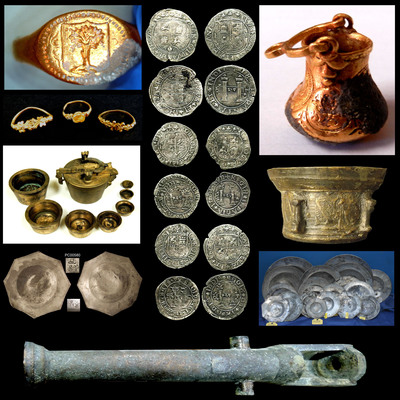
From E Turbo News
A Florida based treasure hunting firm has discovered a 450-year-old ship that wrecked off the Dominican coast.
Among its valuable cargo -- the single largest cache of 16th century pewter tableware ever discovered.
The ship was also carrying extremely rare Spanish silver coins from the late 1400's through the mid 1500's and several gold artifacts.
This unprecedented find of 16th century pewter will re-write history books, as many of the maker's marks stamped into the fine pewter have never been seen before.
While the value of the gold and silver recovered is easily determined, surprisingly, experts place the value of this four and a half century old pewter collection into the millions. The collection includes plates, platters, porringers, salts and flagons in an array of sizes and styles.
Divers from Anchor Research and Salvage (a Global Marine Exploration, Inc. company) working with the Punta Cana Foundation painstakingly excavated the wreck site under contract with the Underwater Cultural Heritage division of the Dominican Minister of Culture.
Edmund B. Fitzgerald dies at 87
From LA Times
Baseball historians know him as a businessman who helped bring Major League ball back to Milwaukee, but Edmund B. Fitzgerald is better known for his family connection to one of America's most famous shipwrecks.
All 29 sailors on the freighter Edmund Fitzgerald drowned in Lake Superior on Nov. 10, 1975. The next year, they were memorialized in Gordon Lightfoot's haunting ballad,"The Wreck of the Edmund Fitzgerald."
The reasons for the wreck are still uncertain, but its legacy followed Fitzgerald throughout his life.
In 1958, his mother, Elizabeth Fitzgerald, christened the massive iron ore freighter, whacking it three times before her champagne bottle broke.
The $8-million ship had been commissioned by Fitzgerald's father, an insurance magnate also named Edmund, whose board of directors honored him by putting his name on one of the largest ships ever to navigate the Great Lakes.
The younger Fitzgerald, sometimes called "young Ed" to distinguish him from his father, died Aug. 28 of natural causes at his home in Nashville, his family said. He was 87.
On the 30th anniversary of the wreck in 2005, he recalled meeting Lightfoot at a dinner hosted by the Canadian prime minister in the 1980s.
"I told him what my name was, and he looked rather surprised," Fitzgerald said of the Canadian singer-songwriter. Fitzgerald called Lightfoot's homage to the ship a "fine song."