HOT NEWS !
Stay informed on the old and most recent significant or spectacular
nautical news and shipwreck discoveries

Thrupenny bit a rich reward for history buff
By Alex Sinnott
Small change could prove a rich find for Warrnambool's Peter Ronald after he discovered a Queen Victoria threepence coin on a leisurely afternoon walk near Thunder Point.
The maritime archaeologist and former Flagstaff Hill director was walking with his dog Chino towards Shelly Beach when he found the coin.
"I found the coin in an Aboriginal midden along the coast - it was rather corroded but its black circular shape stood out," he said.
"It could possibly pre-date European settlement of Warrnambool in the mid-1840s, which would be a significant historical find. "The face side of Queen Victoria is still noticeable and given the design it could be from as far back as 1838 as the profile was used between that time and the late 1860s."
Mr Ronald said it was possible the coin was a small remnant of one of the numerous shipwrecks that occurred off the south-west coast in the 19th century.
"There was about 100 shipwrecks between 1835 and 1870 so it would be hard to determine which one exactly, but it is a possibility that it was from a shipwreck," he said.
Divers search for Armada treasure off Mull
By Paul Kelbi
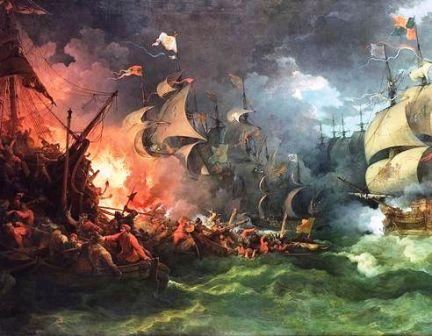
More than 400 years after a Spanish galleon loaded with gold and silver slid beneath the waves in the waters surrounding the Isle of Mull, a new mission has been launched to try to recover its hoard of treasure.
Divers will begin to sift through the silt at the bottom of Tobermory Bay in an attempt to recover the valuable cargo, reputed to have been intended to bankroll the ill-fated Spanish invasion of England in 1588. It is the second time that Sir Torquhil Ian Campbell, the 13th Duke of Argyll, has launched such a mission.
The mystery of where the battle-scarred ship lies has puzzled treasure hunters for centuries. According to local folklore, the vessel - laden with gold, jewels and priceless historical artefacts - is at the bottom of Tobermory Bay.
Following the armada's defeat at the hands of Sir Francis Drake, many Spanish ships fled north to escape the English fleet, but became caught up in violent storms.
Exactly how the Almirante di Florencia or the San Juan de Sicilia - the vessel's exact identity has never been established - foundered is unknown.
The world's first Illyrian trading post found
By Yngve Vogt
There is jubilation at the Museum of Cultural History at the University of Oslo in Norway. Marina Prusac, Associate Professor in the department of archaeology, has just returned home after conducting excavations in the border area between Croatia and Bosnia-Herzegovina.
In the course of several weeks of intense digging this autumn, her archaeological team found the very first traces of an Illyrian trading post that is more han two thousand years old.
The Illyrians were an ancient people who lived by hunting, fishing and agriculture. They were known as warriors and pirates.
Not only did they fight Greek colonists and Roman occupants, the various tribes also feuded among themselves.
However, the archaeological finds show that the Illyrians also had peaceful trade connections with the Romans.
“The find is unique in a European perspective.
We have concluded that Desilo, was the place is called, was an important trading post of great significance for contact between the Illyrians and the Romans,” Marina Prusac tells the research magazine Apollon.
By Bill Young
Knowledge of the process for conserving and/or preserving metal artifacts, coins or tombstones is very different from cleaning and preserving tombstones made out of stone.
First of all is the fact there are so many different combinations or alloys utilized in the making of an artifact, coin or tombstone.
Secondly and most importantly is to keep in mind whatever is attacking the metal object has been doing this over an extended period of time. With this in mind, stopping and reversing the process needs to be done at a very patient rate.
Metal artifacts recovered from a variety of archeological sites can have all kinds of negative processes working to destroy the object. For instance, any type of metal artifact recovered from a salt water environment such as the Gulf of Mexico has been going through changes ever since it entered the water.
Many readers may remember the excavation work carried out several years ago in the middle of Matagorda Bay. The remains of one of La Salle’s ships, The Belle, was discovered utilizing a remote sensing device dragged behind a boat.
Read more...
Shipwreck divers worry sanctuary limits will expand
By Catherine Kozak
Nearly 29 years have passed since the Monitor National Marine Sanctuary was created off the coast of Cape Hatteras, and since then significant parts of the Civil War ironclad it protects have been recovered in federal diving expeditions.
That's not all that has transpired. Other wrecks were discovered off the Outer Banks, oil companies had expressed interest in making explorations nearby and a new shipwreck museum on the tip of Hatteras Island is almost completed.
Now, plans to revise and update the management plan of the nation's first marine sanctuary have some recreational divers and watermen concerned that the National Oceanic and Atmospheric Administration may want to expand it.
"I'm totally against any more limited access and the inclusion of any more wrecks - that includes World War II wrecks," John Pieno, a Hatteras dive business operator, said Thursday at a public meeting about the plan.
"If we can't shipwreck dive, it's a detriment to our economy. The status quo is fine with us now."
Shipwreck clues could clear Blackbeard of sinking his ship to swindle his crew

By Jasper Copping
He was history's most feared pirate, striking terror into seafarers as he cut a bloodthirsty swathe through the Caribbean and North Atlantic.
But new research has found that Blackbeard may be innocent of one of the most notorious charges against him.
For almost 300 years, the British pirate captain has stood accused of deliberately sinking his flagship, Queen Anne's Revenge, so he could swindle his crew out of their share of loot they had plundered.
But marine archaeologists, who are conducting a diving expedition on the vessel's presumed wreck, now believe it may have run aground by accident. They have even found evidence suggesting that Blackbeard made repeated attempts to rescue the stricken craft.
They have discovered a large pile of ballast, including anchors and several cannon, in the middle section of the ship. They believe Blackbeard ordered the crew to move the heavy items from their original positions, near the bow of the vessel, back towards the stern in an effort to lift the vessel's bows from the submerged sandbank onto which it had run.
Underwater vehicles may change what we know about our reefs

By Tyler Treadway
Before two brand-new, first-of-their-kind autonomous underwater vehicles begin exploring the depths of the world's oceans, they'll get their feet wet in the water off the Treasure Coast.
Known as AUVs, the unmanned, untethered submarines will be aboard the Seward Johnson, a research vessel of the Fort Pierce-based Harbor Branch Oceanographic Institute, when it sets sail today on a mission to create high-definition sonar maps of the deep-water Lophelia coral reefs.
The Lophelia reef mapping is particularly important because the coral is threatened by bottom-trawling fishing boats and possible offshore oil exploration and drilling.
"If you destroy reef, you destroy habitat," said John Reed, a research professor at the Harbor Branch division of Florida Atlantic University who has been studying and working to protect these deep corals for more than 30 years. "And if you destroy habitat, you destroy fisheries. So by fishing on these reefs, we're shooting ourselves in the foot."
Turkey's Southern Coast Turns into Diving Hot Spot

From BalkanTravellers
Archaeological and natural attractions, as well as submerged planes and ships, make Turkey’s southern coast near the towns of Side and Manavgat, a new hot spot for divers.
To feed into the growing popularity of dicing tourism, many planes and ships were submerged at different points along Turkey’s southern coast, forming a shelter for many sea creatures as well as helping diving tourism, the Turkish Hürriyet newspaper reported.
A 30-metre long, 8-metre high coast guard boat was recently submerged off the port of the town of Side and an artificial reef was created near the port. This is the third purposeful sunk vessel, according to reports.
“Side and Manavgat had a great potential in terms of archaeology and natural richness. However, we have less underwater riches than the Aegean Region has.
For that reason, we submerged this boat donated by the Coast Guards to create different opportunities for tourism to ensure tourists coming to spend their holiday in our town have a better time.
This boat is the first leg of our project and we are planning to sink a few ships too,” Mayor if Side, Osman Delikkulak, told the publication.
Side, located 75 kilometres from the popular resort town of Antalya, is one of the best-known classical sites in Turkey, which dates back to the seventh century BC.