HOT NEWS !
Stay informed on the old and most recent significant or spectacular
nautical news and shipwreck discoveries

Rare lead bars discovered off the coast of Ibiza

From Science Daily
Dr. Marcus Heinrich Hermanns from the Department of Archaeology at the University of Cologne has recovered three lead bars which may originate from the third century before Christ, 39 meters under the sea off the north coast of Ibiza.
One of the bars has Iberian characters on it. According to the German Mining Museum in Bochum, the lead originates from the mines of Sierra Morena in southern Spain.
With the help of local volunteer divers, some of whom he also trained in crash courses in underwater archaeology financed by the local government, Dr. Hermanns examined the three lead bars.
A fourth specimen had already been found on an earlier occasion.
The characters on the upper surfaces of two of the four known bars are syllabary symbols from the script of Northeastern Iberian.
“The characters must have been added to the metal before it had set, shortly after it had been cast,” says the underwater archaeologist Dr. Hermanns, “in which case, the characters are more likely to be related to production as opposed to commercial information.”
Titanic tragedy display at Liverpool Museum

By Martin Thomas
Fascinating objects salvaged from around the wreck of the liner Titanic, 2.5 miles down on the ocean floor are new attractions at the Merseyside Maritime Museum.
The exhibits are a wrist watch, spectacles, a White Star Line cup, lead ventilation grill, a gold wristwatch, five tie pins and a five dollar banknote.
When the RMS Titanic sank on 15 April 1912, with the loss of 1,500 lives, she broke up as she plunged down into the depths. The bow and stern sections of the wreck lie 1,970 ft apart surrounded by debris scattered far and wide.
Explorers find wreck of rare daggerboard schooner in Lake Ontario
From the Associated Press
Finding a rare 19th-century dagger-board schooner in the deep water off the southern shore of Lake Ontario was a chance discovery, say two underwater explorers.
Jim Kennard and Dan Scoville located the 17-metre-long ship unexpectedly this fall while doing underwater surveys west of Rochester using deep scan sonar equipment.
On the very last survey run of the season, a faint image of something protruding from the bottom showed up at the very edge of the display screen. Another run was made to obtain a better image and the position of the object.
The two explorers returned to the site two weeks later and used a remote operated vehicle to explore and photograph the shipwreck.
Kennard said vessels of this type were used for a short time in the early 1800s. The dagger-board was a wood panel that could be extended through the keel to improve the ship's stability.
The dagger-boards could be raised when the schooner entered a shallow harbor, allowing the boat to load and unload cargo in locations that would not otherwise be accessible to larger ships.
The ship is the only dagger-board known to have been found in the Great Lakes.

By Gilly Pickup
Somewhere beneath the tranquil surface of this remote archipelago nestling in the Indian Ocean lies a fortune in gold and precious stones.
The story goes that French pirate Olivier le Vasseur buried a hoard of treasure here in the 1700s.
Rather disappointingly for would-be fortune hunters though, he went to the gallows with an extraordinary show of bravado and his lips firmly sealed as to its exact whereabouts...
...but besides fearsome skull-and-crossbone pirates and bloody battles for the islands’ bountiful treasures, there is no denying the Seychelles, 115 of the oldest oceanic islands on earth, does ‘different’ rather well.
For starters, think Jellyfish trees, the planet’s heaviest tortoise and the Coco-de-Mer palm which produces the largest seed in the world.
Radick made films about wreck recoveries
By Edmund Tijerina
When Jerry Radick was a young boy, he loved the water so much that he made a diving helmet out of his mother's favorite kitchen pot.
It worked down to 8 feet under water. Just an early indication of what would become a lifetime passion and later a source of his livelihood.
Radick, a one-time San Antonio police officer who left his job as an insurance salesman to form an underwater photography company, died Monday of chronic obstructive pulmonary disease. He was 73.
He was a Michigan native who began diving in the Great Lakes. As a young man, he went into the Air Force and was stationed in Alaska. Later, he was transferred to San Antonio, and decided to stay.
After the Air Force, he worked for four years with the San Antonio Police Department and then sold insurance for several years.
He opened his own business, Radick Method, which helped people process insurance claims.
During that time, he met his wife, San Antonio native Rose-Mary Dunkin, a pharmaceutical company representative.
Soon after they married, they decided to pursue their dream of adventure.
Did Noah's Flood start in the Carmel ?
By Etgar Lefkovits
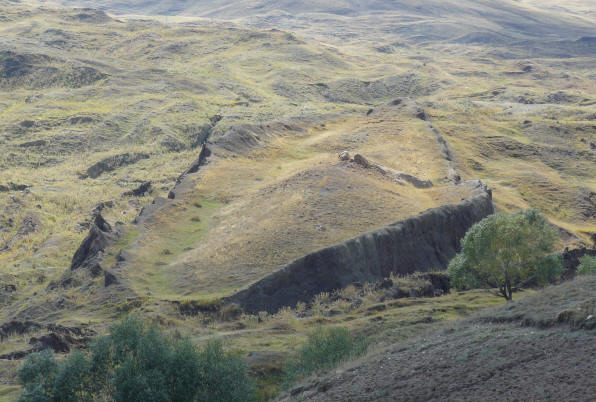
A deluge that swept the Land of Israel more than 7,000 years ago, submerging six Neolithic villages opposite the Carmel Mountains, is the origin of the biblical flood of Noah, a British marine archeologist said Tuesday.
The new theory about the source of the great flood detailed in the Book of Genesis comes amid continuing controversy among scholars over whether the inundation of the Black Sea more than seven millennia ago was the biblical flood.
In the theory posited by British marine archeologist Dr. Sean Kingsley and published in the Bulletin of the Anglo-Israeli Archaeological Society, the drowning of the Carmel Mountains villages - which include houses, temples, graves, water wells, workshops and stone tools - is by far "the most compelling" archeological evidence exposed to date for Noah's flood.
"What's more convincing scientifically, a flood in the Black Sea, so far away from Israel and the fantasy of a supposed ark marooned on the slopes of Mount Ararat, or six submerged Neolithic villages smack-bang in the middle of the Bible Land?" Kingsley said in a telephone interview with The Jerusalem Post.
Archaeologists explore sunken steamboat on first coast

By First Coasts News
On Crescent Lake, there are beautiful birds, turtles, and alligators. But a crew is looking for a different kind of alligator on the edge of the lake.
A team of archaeologists and volunteers are working on a wreck of a steamboat. They want to know if it could be the Alligator which carried cargo and tourists down the St. Johns and Ocklawaha Rivers around the turn of the century.
Dan Smith was one of the half dozen people on the east side of Crescent Lake. He smiled and said, "This is fun.
I've never done anything like this before. I'm trying to do my best not to get in the way of people who know what they're doing."
Smith is not an archaeologist but a retired meteorologist. However, he may be the man who knows the most about Alligator.
He has researched steamboats and Alligator for about 15 years. He asked the staff at the Lighthouse Archaeological Maritime Program (LAMP) in St. Augustine to help determine if the wreck on Crescent Lake is the wrecked Alligator that burned 99 years ago.
The Oculus 250-foot superyacht is half boat, half cyber whale
From Dvice
Probably now more than ever with the global economy the way it is, designer E. Kevin Schöpfer's "Oculus" yacht is the stuff of dreams.
Yet dreamy it is. At 250 feet long and featuring 12-foot ceilings, it's one roomy way to travel over the high seas at 25 knots.
Its hull is prominently styled after the creatures of the sea, with an open-mouth-like backside and something looking a bit like an eye socket.
The Oculus is just a concept, but it's the flagship design for Schöpfer's new yacht line.