HOT NEWS !
Stay informed on the old and most recent significant or spectacular
nautical news and shipwreck discoveries

-
Shipwreck off Gloucester listed on National Register of Historic Places
- On 04/03/2009
- In Parks & Protected Sites

By Martin Finucane
The wreck of an early 20th-century fishing schooner that is resting on the sea floor off Massachusetts has been listed on the National Register of Historic Places, the National Oceanic and Atmospheric Administration announced today.
The 105-foot-long Joffre, which was built in 1918 in Essex and sank in 1947 off Gloucester, represents technological change in the New England fishing industry as it transitioned from fishing with hooks to trawling, the NOAA said.
The Joffre fished with tub trawls, or hooks, until 1939, when it was converted to a diesel-powered eastern rig dragger, a type of trawler, the NOAA said in a statement. Trawlers catch fish by pulling nets behind them.
The conversion "reflected changes in the fishing industry, both at sea and onshore, that dramatically changed America's relationship to seafood," said Craig MacDonald, superintendent of the NOAA's Stellwagen Bank National Marine Sanctuary, which is where the wreck lies. "The shipwreck is a physical link to New England's rich maritime heritage." -
Declassified MI5 file shows nazi spy almost changed course of war
- On 03/03/2009
- In General Maritime History
By Michael Evans - The Times Online
A nazi spy came within days of uncovering one of the Allies' most important missions and possibly changing the direction of the Second World War.
The story of a Portuguese wireless operator and the dramatic decision to pluck him from his vessel on the high seas to prevent him from betraying the position of a huge convoy bound for North Africa is revealed for the first time in a declassified MI5 file released by the National Archives.
Gastao de Freitas Ferraz was being paid by German intelligence to send coded messages about convoys to U-boat commanders and was on the tail of the Allied warships.
The convoy included the USS Augusta, an American light cruiser that was carrying no less a person than General George S.Patton.General Patton was at that time in command of Operation Torch, the planned invasion of French North Africa, which was aimed at destroying the Axis forces fighting the British there and improving naval control of the Mediterranean.
-
Unearthed shipwreck buried again
- On 27/02/2009
- In Parks & Protected Sites
From Otago Daily News
A sailing ship wreck possibly more than 200 years-old has been buried again under the sand of a Northland beach after it was exposed by wave action.It was found several weeks ago under about four metres of water on the beach north of the Kaipara Harbour entrance on the west coast, an area well known for shipwrecks.
Maritime historian Noel Hilliam from the Dargaville Museum, said wave action had scoured away thousands of tonnes of sand to a depth of more than four metres.That had exposed the blunt bow of the ship at low tide but leaving the rest of the wreck still buried in the sand. The blunt bow design meant the ship was probably in service in the late 1700 or early 1800s, he said.
That was only a few decades after Captain James Cook's first voyage of discovery to New Zealand in 1769 on HMS Endeavour. The ship probably came to grief when it was unable to sail against the prevailing wind and currents and was washed onto the beach.
"They couldn't point up to the wind and sail off. They couldn't anchor out there and they wound up on the beach."
-
The clean, green, underwater car
- On 27/02/2009
- In Miscellaneous
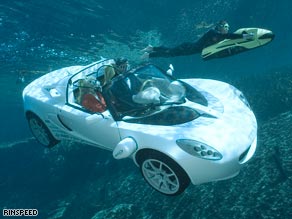
By Mike Steere
The heady days of James Bond are but a distant memory and, the sad fact is amphibious cars are just not that cool anymore.But a new fully submersible car inspired by Bond and updated for the new millennium could breathe fresh life into the sub-aqua sports car.
The Rinspeed sQuba is a fully submersible car designed by Swiss car designer Frank M Rinderknecht. Inspired by James Bond's submersible Lotus Esprit in the 1977 movie "The Spy Who Loved Me," the car drives on land, on water -- and under the water to a depth of ten meters.
Released as a prototype last year, the car is carbon neutral, entirely emissions-free and boasts electric motors and water jets to allow the driver to control the vehicle under the water.The sQuba also has a compressed air tank which allows the occupants to breathe under water and all of the body work is water-tight and water-resistant.
Rinderknecht, the chief executive of Rinspeed, told CNN that no further units of the car have been produced but commercial production was not out of the question.
"Since the sQuba was perceived as a prototype, the manufacturing has not been explored. However, we are open for anyone to take up the project to serial production," he said.
-
Marine treasure locked up in bank
- On 27/02/2009
- In Underwater Archeology
By Petronella Sibeene
Shipwreck treasure worth millions of dollars discovered last year in the Sperrgebiet by a diamond explorer has been taken to the central bank vaults for safe keeping.
Although there is no visible threat yet to the centuries-old treasure, Government recently said the treasure, which includes gold and silver coins, was moved to the Bank of Namibia vaults, where it will be kept for an unspecified period.
The coins will be on public display once they have been polished.
The Minister of Youth, National Service, Sport and Culture Willem Konjore, Spanish Ambassador to Namibia Alfonso Barnuevo as well as the Governor of the Bank of Namibia Tom Alweendo witnessed the arrival of the coins.
Konjore told New Era the find was transferred to the Bank of Namibia for safekeeping while experts returned to their home countries to find relevant instruments needed for polishing the coins.
“Experts will look and see what instruments are needed for cleaning. They are expected to come back to Namibia in the next few weeks, because the artifacts need quick action to be conserved and for the quality not to deteriorate,” the minister said.
During May 2008, Namdeb geologists in their search for diamonds offshore stumbled upon a shipwreck that is believed to be the oldest in sub-Saharan Africa, dating back to 1400 or 1500.
Found in Namdeb’s Mining Area 1, the site yielded a wealth of objects including six bronze cannons, several tonnes of copper, more than 50 elephant tusks, pewter tableware, navigational instruments, weapons and thousands of Spanish and Portuguese gold coins, minted in the late 1400s and early 1500s. -
Navy's secrets surface
- On 27/02/2009
- In Underwater Archeology
By Reg Little
Cannon brought up from a sunken Elizabethan ship by Oxford archaeologist Mensun Bound have offered up new secrets of English naval successes in the age of Drake.
Mr Bound recovered two guns from an Elizabethan ship that went down in 1592, off Alderney, in the Channel Islands, while carrying munitions to an English army fighting in Brittany.
After conservation work, one of the guns has now been replicated and tested to reveal the true firing power of English ships, just four years after the defeat of the Spanish Armada. And the results left Mr Bound and his team hailing the guns as our “first weapon of mass destruction”.
Mr Bound, a fellow of St Peter’s College, Oxford, said: “No gun of this type and period had ever been tested before and the results were surprising.Muzzle velocities were achieved that were almost the speed of sound and the shot that was fired was able to punch through four inches of oak with ease.
“The weapon was also remarkably accurate and was able to hit the target every time.”
The testing was carried out at a quarry, owned by the explosives company Alford Technologies, where the police send specialist units for explosives training. The actual discharging of the gun was undertaken by a specialist from the Royal Armouries. -
The navy has a top-secret vessel it wants to put on display
- On 26/02/2009
- In Marine Sciences

By Barry Newman
Anybody want some top-secret seagoing vessels ? The Navy has a pair it doesn't need anymore. It has been trying to give them away since 2006, and they're headed for the scrap yard if somebody doesn't speak up soon.
One is called Sea Shadow. It's big, black and looks like a cross between a Stealth fighter and a Bat mobile. It was made to escape detection on the open sea.The other is known as the Hughes (as in Howard Hughes) Mining Barge. It looks like a floating field house, with an arching roof and a door that is 76 feet wide and 72 feet high. Sea Shadow berths inside the barge, which keeps it safely hidden from spy satellites.
The barge, by the way, is the only fully submersible dry dock ever built, making it very handy -- as it was 35 years ago -- for trying to raise a sunken nuclear-armed Soviet submarine."I'm fascinated by the possibilities," Frank Lennon said one morning recently. Mr. Lennon runs -- or ran -- a maritime museum here in Providence. He was standing in a sleet storm on a wharf below a power plant, surveying the 297-foot muck-encrusted hulk of a Soviet submarine that he owns.
His only exhibit, it was open to the public until April 2007, when a northeaster hit Providence and the sub sank.
-
Salvage of the German submarine U-864
- On 26/02/2009
- In High Tech. Research/Salvage
From Det Norske Veritas As
The German submarine U-864 was torpedoed by the British submarine Venturer on February 9, 1945 and sunk approximately two nautical miles west of the island Fedje in Hordaland. U-864 was carrying about 67 metric tonnes of metallic mercury that implies a threat to the marine environment.
In September 2007 The Norwegian Costal Administration commissioned Det Norske Veritas to further investigate different alternatives to salvage the wreck and remove the mercury from the seabed.The objective of this supplementary study is to propose a survey method, or combination of methods, that will give the best probability of detecting sub-bottom mercury canisters around the wreck of U-864.
DNV’s overall conclusion is: A combination of single caesium vapour magnetometer and pipetracker, positioned by acoustic LBL technique, is the preferred method to locate sub-bottom canisters.The searching will take at least six days and all surface debris must be cleared from the site prior to operation.
Read more...