HOT NEWS !
Stay informed on the old and most recent significant or spectacular
nautical news and shipwreck discoveries

-
China to salvage 400-year-old merchant vessel off southern coast
- On 12/03/2009
- In Underwater Archeology
From China View
Chinese archaeologists will start later this year to salvage a ship thought to be a Ming Dynasty merchant vessel that sank off the Guangdong coast 400 years ago, the State Administration of Cultural Heritage (SACH) said Wednesday.
The SACH approved the excavation plan early this year, it said in a statement to Xinhua. The administration hasn't yet announced all details of the salvage plan, but the Guangdong provincial cultural heritage department will organize an excavation team, the statement said.
The 10-meter-long ship was found buried in the silt on the sea floor, about 5.6 nautical miles offshore from Shantou City, Guangdong Province.
About 200 pieces of porcelain were recovered when the ship was found in 2007. The ship could have been carrying some 10,000 pieces of porcelain, most made during the reign of Emperor Wanli of the Ming Dynasty (1573-1620).However, the earliest piece found so far dated back to the Song Dynasty (960-1279).
The ship was probably a Guangdong merchant vessel, since most of the porcelain items found so far were produced by local workshops, said Cui Yong, an archaeologist with the Guangdong Provincial Institute of Archaeology and Relics. -
Sailors help restore museum's relics
- On 11/03/2009
- In Conservation / Preservation
By Dan Broadstreet
Not far from the building’s interior relics, including copper ingots from a sunken Spanish Galleon, Naval Surface Warfare Center Panama City (NSWC PCD) Commander, Capt. Andrew Buduo III, and a team of volunteer Sailors painted the Man in the Sea Museum’s exterior exhibits Feb. 20 before entering for a tour of the museum’s artifacts.
“What we’re painting here are the Remote Minehunting Systems prototypes, which the Navy Base donated to the museum some time ago,” Buduo said.
Some time ago dates back to the late 70s, according to Museum Manager, Leslie Baker, who is a diver with experience in the Underwater Crime Scene Investigation (USCI) program at Florida State University. Baker’s diving background also includes diving on wrecks.
“The museum is a non-profit organization owned by the Institute of Diving, which was formed in 1977,” Baker said. “Before the museum was established at its current location in 1982, it used to reside in the lower level of a local restaurant, which doesn’t exist anymore. Long-time residents knew this dining spot as ‘The Four Winds.’”
Baker said the museum exists to preserve the history of diving, much of its heritage having originated locally at the Naval Support Activity Panama City. She said the NSWC PCD, the Naval Diving and Salvage Training Center and the Navy Experimental Diving Unit (NEDU) have all contributed, quite literally, to putting ‘man in the sea.’ Baker pointed out one of the largest exterior exhibits in particular.
“Sea Lab—that big red capsule-shaped chamber displayed out front was the very first underwater habitat that people actually lived in under the ocean, and it was built right here at our Navy Base,” Baker said. “Bob Barth, a former employee at NEDU and a current member on our board of directors, was actually one of the four aquanauts who lived inside of it.”
-
SS Mendi's war grave status means soldiers finally "buried"
- On 11/03/2009
- In Parks & Protected Sites
From the Witness
The wreck of the SS Mendi on which 616 South African soldiers lost their lives in 1917 will be granted official war grave status later this year following a campaign by British underwater photo-journalist and shipwreck historian Ned Middleton.
“The wreck site will be designated a protected place under the Protection of Military Remains Act 1986 later this year,” said Middleton. “As a protected place, my understanding is that she may still be visited by scuba divers but not touched.”
According to African traditional religious beliefs, those who died on the Mendi were unable to join their ancestors as they had not been buried.“That these people needed to be buried in order to reach their afterlife was sufficient reason for me to try and do something about getting them buried,” said Middleton.
“Of course, nobody was considering physical burial; all that was required was an official designation to war grave status which has the same effect.”
On February 21, 1917, the crowded troopship the SS Mendi was heading for France when it collided with the SS Darro.The Mendi was carrying a contingent of the South African Native Labour Corps. Over 600 men died in the icy waters of the English Channel in one of South Africa’s greatest military disasters.
The names of the men who died appear on war memorials at the Hollybrook Memorial in Southhampton, England, and at the Delville Wood Museum in France.In South Africa, there are memorials in Port Elizabeth and at the Avalon graveyard in Soweto, which was unveiled by Queen Elizabeth II in 1995.
In 2007, the SS Mendi memorial in Cape Town was unveiled on the Mowbray campus of the University of Cape Town.
-
Ike may have uncovered Carolina
- On 10/03/2009
- In Parks & Protected Sites
By Dale Lezon
The ghostly image of an object recently found on the floor of the Gulf of Mexico just off Galveston Island is little more than a shadow.But experts believe the sonar scan could be that of a well-known but never before discovered ship that sank nearly 150 years ago as it tried to break through the federal blockade of Galveston during the Civil War.
The Carolina, also known as the Caroline, was a merchant ship that left Galveston in July 1864 with a load of cotton.Federal gunships followed the ship for hours until its crew ran it aground in shallow water between Galveston and San Luis Pass, then set it ablaze rather than let the enemy capture it.
Experts know little more about the ship except that it was privately owned and sank in the area where workers took the sonar image, said Steven Hoyt, state marine archeologist with the Texas Historical Commission.
Hoyt said he will research the ship’s size, style and other characteristics so that he and other divers can determine whether the object is the ship or part of it. It could be a more modern shipwreck or other debris. But experts said the shape of the image suggests it is a ship.
Hoyt said he expects divers to investigate the site in the spring or summer when the Gulf’s waters are calm. Even then, the cloudy water makes visibility near zero, and divers may have to identify the object by touch.
“It’s certainly significant if it turns out to be a historic wreck, as we think it is,” Hoyt said. “That’s really exciting.”
State officials won’t disclose the site’s location to prevent the public from plundering what could be a historically important discovery.
-
Sail like an Egyptian
- On 10/03/2009
- In Marine Sciences
By Jeremy Hsu
An archaeologist who examined remnants of the oldest-known seafaring ships has now put ancient Egyptian technology to the test.She teamed up with a naval architect, modern shipwrights and an on-site Egyptian archaeologist to build a replica 3,800-year-old ship for a Red Sea trial run this past December.
The voyage was meant to retrace an ancient voyage that the female pharaoh Hatsheput sponsored to a place which ancient Egyptians called God's land, or Punt.Ship planks and oar blades discovered in 2006 at the caves of Wadi Gawasis provided a basis for the ship reconstruction.
"The planks that we looked at from the archaeological site are in great condition," said Cheryl Ward, the maritime archaeologist at Florida State University who headed the effort.
The nearly 4,000-year-old timbers even contained shipworms which had tunneled into the ships during sea voyages, leaving behind tube-like shells that filled up the wood like a sponge.Ward was able to estimate from the shipworms that the ship endured a six-month, 2,000-mile round trip to Punt -- located in modern Ethiopia or Yemen.
A French production company called Sombrero and Co. approached Ward with the idea of recreating the ancient journey for a documentary, and so her team set about resurrecting a ship for the modern expedition. -
Winged luxury submarines 'fly' underwater
- On 07/03/2009
- In Marine Sciences
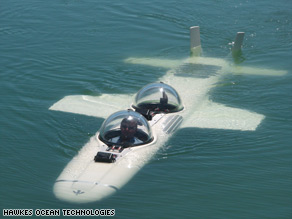
By Steve Almasy
Most people have had dreams of flying. Graham Hawkes had dreams of flying -- underwater. Hawkes has been in the business of building underwater craft for more than a decade. In the early days, his company, Hawkes Ocean Technologies, built vehicles for researchers and moviemakers.
But in the past few years, the ultrarich have increasingly looked for cool playthings for their ocean adventures. What better toy to have on the end of your 200-foot yacht than a submarine capable of diving to 1,500 feet below the sea's surface ?Whoops. Did we say submarine ? It's a submersible that can "fly" underwater.
The Deep Flight Super Falcon looks like a fighter jet, with its thin body, two seats, two sets of wings and two tail fins.
"We just had to tear up everything we knew about submersibles and start again on winged subs -- underwater flying machines," Hawkes said.
He said Deep Flight submersibles are designed to be more agile than any creature living in the ocean -- with the exception of dolphins.The company says that because of the wings, the Super Falcon can go barrel-rolling with dolphins while traveling at speeds much faster than other private submarines.
-
Mystery of Whitby shipwreck at bottom of the Baltic
- On 07/03/2009
- In Parks & Protected Sites

By Jon Stokoe
For many people in and around Whitby, the name General Carleton will mean nothing but for a number of families it will bring back painful memories of one of the town's most tragic seafaring disasters.
The General Carleton was a 400-ton merchant ship which was built in Whitby but sank to the bottom of the south Baltic Sea in 1785 with its crew during a storm off the Polish coast near the mouth of the River Piasnica.
Now, thanks to an exhibition at the Polish Maritime Museum in Gdansk, as well as the release of a fascinating book (you can order a copy by clicking on a link at the bottom of this story which takes you directly to the Polish Maritime Museum's online store), the memory of the brave sailors will live on after the wreck was excavated with some startling finds.
The leader of the excavation project, Dr Waldemar Ossowski of the maritime museum, led his team to years of fascinating discoveries from the bed of the Baltic. -
NOAA seeks applicants for advisory council seat
- On 06/03/2009
- In Parks & Protected Sites

From NOAA
NOAA’s Monitor National Marine Sanctuary is seeking to fill one seat on its advisory council, which ensures public participation in sanctuary management and provides advice to the sanctuary superintendent.
The sanctuary is accepting applications for the advisory council seat representing North Carolina maritime museums. One primary member will be selected for the seat.
The Monitor Sanctuary Advisory Council consists of 13 members, including nine non-governmental voting seats representing recreational diving, heritage tourism, education, conservation, maritime museums, marine archaeology research, and recreational/commercial fishing; and four governmental voting seats representing the United States Navy, North Carolina Department of Cultural Resources, Virginia Department of Cultural Resources, and the National Park Service.
Applicants will be chosen based on their expertise and experience in relation to the seat for which they are applying. Consideration includes knowledge of sanctuary resources, community and professional affiliations, residency in the sanctuary area, and views regarding the protection and management of marine resources.
Applicants who are chosen as members should expect to serve two-year terms. The council usually meets at least quarterly throughout the year.