HOT NEWS !
Stay informed on the old and most recent significant or spectacular
nautical news and shipwreck discoveries

-
Maritime history reveals itself
- On 21/05/2009
- In Parks & Protected Sites

By Tim Connell - Great Lakes Advocates
With rough seas unearthing a Forster shipwreck, divers have found the sands parted to reveal an underwater playground and a century-old crash site.
The wreck, off Forster’s Main Beach, inspired Tuncurry snapper Shane Chalker to get these submarine shots.
“I’ve seen it before, but the big seas we’ve had have chewed a lot of sand away and exposed a lot of it,” he said.
“The top of it’d only be a metre below the surface.”
But which ship is it ? The late Great Lakes historian Elva Carmichael quotes “a reliable authority” claiming there are about 700 vessels on the sea floor between Harrington and Sydney’s North Head – with “probably the greater percentage between Port Stephens and Cape Hawke”.
From newspaper clippings provided by the Great Lakes Historical Society, it seems the ship is one of four pummeled to shore on the bitter night of June 2, 1897.
“In the darkness, and the deafening roar of the gale and waves as they dashed in their fury on the beach, the helpless crews of these vessels stood by waiting in breathless anxiety,” the Sydney Morning Herald reported. -
Fishing risk to Channel wrecks
- On 21/05/2009
- In Treasure Hunting / Recoveries

From BBC News
Many shipwrecks in the English Channel are in danger of being lost forever, partly due to damage done by fishing trawlers and dredges, experts say.
Wreck Watch has analysed a new sea bed survey and said historically important wrecks are being destroyed and should be raised.
Some 267 shipwrecks have been found, 115 of which showed permanent damage, said its leading marine archaeologist.
The wrecks include Royal Navy warship HMS Victory, lost in 1744. The ship went down with Admiral Sir John Balchin, 1,100 sailors and 110 bronze cannon.
Wreck Watch has identified ten key sites that they believe warrant further study, mapping, excavation and selective artefact recovery.It said the process would also benefit fishermen, identifying wrecks of non-archaeological value which could be safely fished.
The loss of expensive fishing equipment would also be minimised, said their report.
But trawler crews have disputed the claims they are to blame and questions have also been raised by some sceptics because the research was carried out by a US salvage company, which makes money selling sunken treasure.
Christopher Vinnicombe, of the Cornish Fish Producers' Organisation, said they tried to avoid the "thousands" of wrecks in the Channel because it often damaged their equipment. -
1,000 years of Brunei-China ties to be documented
- On 21/05/2009
- In Underwater Archeology
By Azlan Othman - Brudirect
The more than 1,000-year relations between Brunei and China are to be documented in a special television programme to be telecast in conjunction with the 63rd birthday anniversary of His Majesty the Sultan of Brunei.
The project to trace the history of Brunei-China relations will be implemented in June, jointly by Radio Television Brunei, Brunei History Centre and the Museums Department in collaboration with the Chinese community in Brunei.
This was highlighted in a working paper by Dr Muhammad Hadi bin Muhammad Melayong, Director of the Information Department, and Pg Dr Karim bin Pg Hj Osman from the Museums Department and presented to the media yesterday at the office of Ang Swee Chuan, Vice-President of Brunei-China Friendship Association. Also present was Dr Hj Kamaruddin bin Dato Seri Paduka Hj Talib, President of the association.
The project is also undertaken to mark the Silver Jubilee of the country's National Day celebration and will comprise seven episodes.The first episode will showcase the start of trade and diplomatic relations between both countries. The filming in Brunei will focus on the Sg Limau Manis site, dating back to the Song Dynasty in China during the 10th-13th century.
The site was discovered in 2002 and was one of the important archaeological findings after Kota Batu. A number of artifacts believed to be from China were found including gold, bronze, beads and so on.
The sunken ship at the tip of Borneo, Tanjung Simpang Mengkayau in Kudat, Sabah was found in 2002 together with the same type of artefacts discovered in Sg Limau Manis.The ship was believed to be on its way to Brunei and sank in Sabah waters.
-
Gregg Stemm: is taking treasure from shipwrecks piracy ?
- On 21/05/2009
- In People or Company of Interest

By Tim Bouquet - Times OnlineHe has made millions liberating treasure from shipwrecks, and is accused of bounty hunting. But Gregg Stemm says he is preserving history.
These days the word conjures up images of audacious hijackings of container ships off the horn of Africa, but when, in October 2007, César Antonio Molina told reporters: “There have always been navies . . . to combat pirates”, Spain’s culture minister was referring not to Somali gangs but to the American entrepreneur Greg Stemm.
Stemm is probably the only “pirate” to run a publicly quoted company, filing financial statements with the US Securities and Exchange Commission (SEC).These reveal that he earns $350,000 a year on top of his $6.14 million shareholding, and that his investors include the founder of Dollar Car Rental, a former Finance Minister of Bermuda and Barclays Global Investors.
A fusion of Jacques Cousteau, Ernest Hemingway and Donald Trump, the 52-year-old is Chairman of Odyssey Marine Exploration (OME), which specialises in finding treasure-laden wrecks.Stemm has the precise handshake and manners of a Southern gentleman, but when we meet in London he is itching to get back to his diesel-smelling dive ship Odyssey Explorer in Cornwall, and what he calls “mucking about on the ocean”. And while he denies being a bounty hunter, he admits having no problem “marrying archaeology with a business model”.
In 2003, OME discovered the American Civil War-era SS Republic, 1,700 ft below sea level, 100 miles southeast of Savannah, Georgia.The 14,000 objects that were subsequently recovered from the paddlewheel steamship, along with 51,000 gold and silver coins, have so far netted more than £29 million in salvage fees and sales, one of the richest treasure hauls ever.
A year earlier, Stemm signed a deal with the British Government to dive on HMS Sussex, an 80-gun English warship that was lost in 1664 off the coast of Gibraltar. OME believes that its cargo has “a potentially-substantial numismatic value”.
-
Trawlers are destroying historic wrecks, say explorers
- On 21/05/2009
- In Treasure Hunting / Recoveries
By Frank Pope - Times Online
The wreck of HMS Victory, a British warship sunk in the English Channel in 1744, is being destroyed by fishing trawlers, according to the American treasure hunters who discovered the site last year.
“We were shocked and surprised by the degree of damage we found in the Channel,” said Greg Stemm, chief executive of Odyssey Marine Exploration.
“When we got into this business, like everyone else we thought that beyond 50 or 60 metres, below the reach of divers, we’d find pristine shipwrecks.We thought we’d be finding rainforest, but instead found an industrial site criss-crossed by bulldozers and trucks.”
Odyssey — the world’s only publicly-listed shipwreck exploration company — surveyed 4,725 sq miles (12,300 sq km) of the western Channel during its search for high-value shipwrecks.It discovered 267 wrecks, of which 112, or 41 per cent, show evidence of damage from a type of fishing known as bottom trawling.
-
Delving the secrets of HMS Victory
- On 20/05/2009
- In Treasure Hunting / Recoveries

By Stephen Smith - BBC 2
The squat yellow box, with its protruding arms and hoses, drips salt water onto the deck of the ship.If you did not know any better, you might take the cuboid for a hardy piece of space junk - an old lunar module, perhaps - which had splashed down in the English Channel.
It is in the exploration business, as it happens, though its terrain is the bottom of the sea rather than the oceans of the moon. It is a Remotely-Operated Vehicle (ROV) known as Zeus, which is dunked in the briny in order to examine the seabed for shipwrecks.
The people behind Zeus claim that it has helped them to solve one of the great maritime mysteries of all time - and also to uncover a major threat to Britain's marine heritage.
Odyssey, a US-based exploration company, has found HMS Victory, the predecessor of Nelson's flagship, and the most formidable vessel on the high seas in its day. -
Who Went With Columbus ? Dental Studies Give Clues
- On 19/05/2009
- In General Maritime History
By Kari Lydersen - the Washington Post
The first planned colonial town in the New World was founded in 1494, when about 1,200 of Christopher Columbus's crew members from the 17 ships that made up his second journey to the Americas settled on the north coast of what is now the Dominican Republic.
Beset by mutiny, mismanagement, hurricanes and disease, the settlement of La Isabela lasted only a few years.The ruins remained largely intact until the 1950s, when a local official reportedly misunderstood the order from dictator Rafael Trujillo to clean up the site in preparation for visiting dignitaries, and had them mostly bulldozed into the sea.
Little remained but the skeletons below ground in the church cemetery, which lay undisturbed until excavations began in 1983.
In the past few years, sophisticated chemical studies of the skeletons, especially their teeth, have begun to yield new insights into the lives and origins of Columbus's crew.The studies hint that, among other things, crew members may have included free black Africans who arrived in the New World about a decade before the slave trade began.
La Isabela was not the first settlement established by Columbus. When the Santa Maria ran aground off Hispaniola on Christmas Eve, 1492, during his first voyage, the 39 stranded sailors built a fort they christened La Navidad. When Columbus returned the next year, the fort had been burned and the crew massacred.
The study of the La Isabela skeletons grew out of a project in Mexico's Yucatan peninsula, where in 2000 researchers were surprised to find the remains of West Africans among those buried in a mid-16th-century church cemetery in Campeche.Vera Tiesler and Andrea Cucina from the Autonomous University of Yucatan invited T. Douglas Price, director of the Laboratory for Archaeological Chemistry at the University of Wisconsin at Madison, to do isotopic analysis of those skeletons' teeth.
-
Mapping the world's oldest submerged town
- On 19/05/2009
- In Underwater Archeology
By Kerri Smith - Nature News
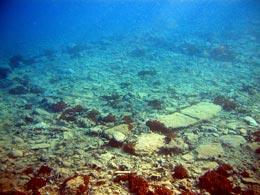
Underwater archaeologist Jon Henderson is hoping to reveal the secrets of the ancient Greek town of Pavlopetri.
A few metres under the sea, near the town of Neapolis at the southern tip of Greece, lies Pavlopetri. Discovered and mapped in the 1960s, it will become the first underwater town to be digitally surveyed in three dimensions.Nature News caught up with Jon Henderson, an underwater archaeologist at the University of Nottingham, UK, before the project began on 18 May.
What does Pavlopetri look like ? The site is submerged in about 3–4 metres of water, and covers an area of about 500 square metres, about 50-60 metres offshore.
There are about 15 buildings made up of three or four rooms, some streets, rock-cut tombs and courtyards — and there could be more underneath, because so far there has been no excavation.Some ruins date from at least 2800 BC, but we think the town Pavlopetri itself dates from the Mycenaean period, about 1600–1100 BC.