HOT NEWS !
Stay informed on the old and most recent significant or spectacular
nautical news and shipwreck discoveries

Shipwrecked army plaque returned

From BBC News
A plaque commemorating the deaths of Nottinghamshire soldiers has been returned to their regiment after it was recovered from a 97-year-old shipwreck.
The brass memorial was aboard the SS Oceana bound for Bombay when it sank off the Sussex coast in 1912.
It was found by diver Jamie Smith, who handed it back to the 2nd Battalion the Mercian Regiment at a special ceremony.
The plaque names soldiers who died serving in India from 1819 to 1838. It will be displayed at Nottingham castle. Most of the regiment of 800 men, as well as many of their family members, died during the posting due to illness.
Major Oliver Hackett said: "It's a very strong link to the past, which reminds us of the hardships our predecessors and their families had to undergo in an overseas posting."
Mr Smith, of Tunbridge Wells in Kent, who uncovered the plaque in August, said: "When you go diving you go into history and when you find something as significant as this you realize it has to be done."
Saving the wrecks of the Channel

By Dalya Alberge - Wall Street Journal
Marine archaeologists have discovered a 17th-century shipwreck in recent months with a cargo that includes the world's earliest pocket calculator -- a wooden carpenter's rule -- while exploring the seabed of the English Channel.
It offers a tantalizing taster of treasures that may lie within nearly 270 wrecks that have been identified, but whose survival is under serious threat from 21st-century trawlers working the busy channel between the Continent and Britain.
Some historic vessels that fell victim to the sea or cannon fire centuries ago could disappear within five years, according to a leading British marine archaeologist, Sean Kingsley, who is an adviser on the most extensive archaeological deep-sea survey of the Channel ever undertaken.
"Incalculable wreck destruction has already occurred," says Dr. Kingsley, who heads Wreck Watch International, a specialist consultancy. "Sites of major archaeological significance have been or are being completely destroyed.
Without a swift resolution, future generations may judge us as having signed the death warrant for some of the world's most important archaeological sites."
The first museum under the sea to open at Silba
From Croatian Times
The first museum under the sea in Croatia will open in Pocukmarak Bay off the shore of little Silba Island near Zadar.
Pocukmarak Bay is an area where a team of young experts led by Professor Zdenko Brusic from Zadar University has found a sarcophagus that may be 1,500 years old.
They discovered the stone sarcophagus and two covers last autumn.
The sarcophagus is the first indication of a Roman presence on the island. But considering the specific details on the covers, it is assumed they could also date back to late antiquity (fourth to sixth centuries AD).
The daily Slobodna Dalmacija has reported the team has started a second phase of research.
They are planning to prepare a location for the museum under the sea that will be available to all who can swim.
The area is easily accessible since the water there is only three meters deep and there is no need for diving equipment.
Zadar archaeologists are planning to clean the sarcophagus and to mark its location in order to make it available to all swimmers who want to see it.
Descubren el pecio de un galeón del siglo XVIII en la costa de Menorca
From El Mundo
La fundación Argo Maris ha notificado al Consell de Menorca el descubrimiento de los restos arqueológicos sumergidos de un galeón del siglo XVII-XVIII en la costa norte de la isla, tras el aviso dado por un pescador de Fornells.
Según informan fuentes de esta entidad privada, las primeras inspecciones realizadas mediante vehículos dirigidos por control remoto han constatado la presencia de restos evidentes de un barco naufragado a unos sesenta metros de profundidad.
Estos restos, diseminados en un radio de cuarenta metros incluyen algunas anclas de gran tamaño, cañones de hierro y maderas de la estructura del barco. La presencia de estos objetos indica que se trata de una fragata o un galeón de guerra del siglo XVII o XVIII.
Una vez realizados los primeros trabajos de prospección arqueológica, dirigidos por el equipo de arqueólogos del Ecomuseo Cap de Cavalleria, con el apoyo de la fundación Argo Maris, se ha presentado el resultado a la dirección de Patrimonio de la Conselleria de Cultura y Patrimonio del Consell de Menorca.
La presentación se ha hecho con un fotomosaico realizado a partir de las más de 2000 fotografías submarinas zenitales obtenidas.
Florida Aquarium maps and explores archaeological treasures
By Janet Zink - Tampa Bay
Casey Coy stood on a boat on the Hillsborough River two weeks ago, monitoring the breathing of divers below and watching cars cruise along the interstate above.
"The thought struck me: I'm anchored over a sunken Civil War battleship, and these people are driving to and from work and have no idea what they're driving over," he said.
Coy, the dive director at the Florida Aquarium, hopes all that will change in coming years as the aquarium maps and explores shipwrecks and other underwater archaeological treasures in the Tampa Bay area.
So far, aquarium divers have discovered two Confederate blockade runners — the Scottish Chief and the Kate Dale — sunk in the Hillsborough River, a Union ship called the Narcissus and two unidentified wrecks near Egmont Key.
Plans call for searching the Hillsborough River for a third blockade runner — the Noyes — next summer. The aquarium has three state grants of nearly $50,000 for the explorations.
Diamond Coast shipwreck gets spot in National Geographic
By Werner Menges - All Africa
The centuries-old shipwreck that was discovered in Namdeb's Mining Area 1 near Oranjemund in May last year has earned itself a place in the latest issue of National Geographic magazine.
The gripping story of the discovery of the remains of a ship that, loaded with a treasure of gold and silver coins, ivory, copper and other trading goods, met its end on a desert beach in one of the world's richest diamond areas close to 500 years ago, is told in an article in the October 2009 issue of National Geographic.
The article continues the international headlines that have been devoted to the shipwreck since its discovery during mining operations by Namdeb on April 1 last year.
"It is by far the oldest shipwreck ever found on the coast of sub-Saharan Africa, and the richest," it is stated in the article.
The wreck is now accepted to be the remains of a Portuguese ship that was sailing to India when it foundered on the Namibian coast after a huge storm at sea.
Portuguese maritime archaeologists have now concluded that the wreck is probably that of the Bom Jesus - the 'Good Jesus' - which was part of a fleet of trading ships sent from Portugal to India in 1533.
New Cape library features exhibit on shipwrecks
Less than a mile east of the Schiavo Library in Strathmere, the wreckage of the General Slocum - which was involved in one of the most notorious maritime disasters in U.S. history - lies beneath the sea.
Several miles northwest of that shipwreck, the remains of the Sindia sit under the sand of Ocean City's 17th Street beach.
They are only two of the thousands of known shipwrecks off the coast of New Jersey, which has the highest number of shipwrecks per square mile in the nation, but they are undeniably two of the most famous.
The newly opened Schiavo Library, a privately funded library at Putnam and Commonwealth avenues in memory of the late Dr. Rita C. Schiavo, unveiled a small exhibit of these shipwrecks Saturday night that is expected to be on display for most of the winter.
"Strathmere is a community whose people do a lot of boating, sport fishing, surfing and scuba diving.
They are water-type people," said Marion Ingram, a volunteer at the library.
"And since one of our main goals here is to promote New Jersey history, an exhibit of shipwrecks seemed fitting. Especially considering one of them is right off the coast from us."
By Kathryn Quinn - Romanian Times
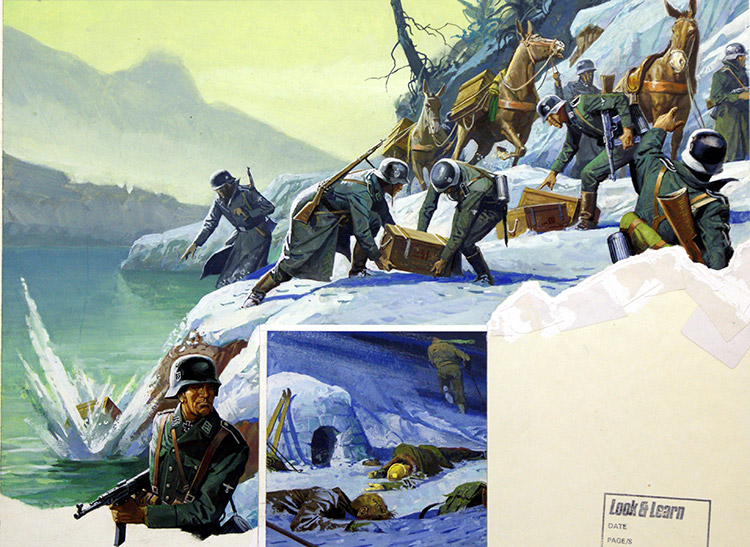
A secret hoard of nazi diamonds worth millions may stay at the bottom of a lake forever after Austrian authorities said they're seeking a ban on all expeditions to find it.
SS general Ernst Kaltenbrunner is said to have sunk the secret loot in Toplitz Lake as Allied forces swept through Europe at the end of World War II.
Previous dives have discovered hundreds of thousands of pounds of forged British currency and boxes of top secret SS documents.
But now Austrian nature experts are to demand a 99 year ban on all future dives because the constant hunt for treasure is disturbing local wildlife.
The Bundesforste forest authority says diving expeditions have become so big that they risk losing species from the lake, near Bas Aussee.
"These Indiana Jones types are very bad news for the animals that make their home around the lake," said one expert.
Austrian-born General Kaltenbrunner was the final general in charge of SS stormtroopers as the German army fell apart and the highest ranking SS officer to be executed for war crimes.