HOT NEWS !
Stay informed on the old and most recent significant or spectacular
nautical news and shipwreck discoveries

-
China to beef up protection of underwater cultural heritage
- On 23/11/2010
- In Parks & Protected Sites
From Xinhuanet
The two Chinese central government agencies chiefly responsible for safeguarding underwater cultural heritage on Monday signed an agreement pledging closer cooperation.
Under their agreement, the State Administration of Cultural Heritage (SACH) and the State Oceanic Administration (SOA) will work more closely together in various fields including underwater archaeology and management of underwater relics.
The two agencies will also strengthen cooperation in regular surveys of underwater relics and in preventing damage to the relics, according to the agreement.
SACH director Shan Jixiang said at the signing ceremony that the agreement was a state-level move to ensure the safety of China's underwater cultural heritage amid a worldwide boom in ocean development in recent years.
Sun Zhihui, director of the SOA, said the SOA would actively provide support and assistance in the protection of underwater relics by enhancing cooperation with the SACH in fields such as enforcement of maritime laws and marine disaster forecasting.
The two agencies will also seek to establish a long-term cooperation mechanism by conducting pilot cooperation programs. -
Chinese porcelain recovered from sea bed on sale
- On 23/11/2010
- In Auction News

From This Is Douth Devon
A treasure trove of Chinese porcelain, which lay on the sea bed for more than 100 years after a Titanic-scale shipwreck, is going on sale in Dartington.
A total of 350,000 items of porcelain were snapped up at a Stuttgart auction ten years ago by a businessman who lives in the Buckfastleigh area and refuses to reveal his identity.
Now he is planning to put part of the unique collection on sale through the former Cider Press Centre at Dartington — recently re-named The Shops at Dartington.
The porcelain collection consisting of bowls, plates, saucers, carafes, tea bowls and trinket boxes went on sale at the Home Bazaar shop on Saturday with prices ranging from £45 to £175 per item.
The sale is set to continue until the end of January.
The centre's managing director, Barbara King, explained: "We were offered the unusual opportunity to exhibit and sell these beautiful and very collectable antiques and we jumped at the chance.
"They're a perfect fit for our Home Bazaar store and will make a fantastic Christmas gift."
The collection of porcelain was on board the huge merchant sailing junk Tek Sing (meaning True Star) in 1822 when the ship ran aground on the Belvedere Shoals in the South China Sea.
Only 208 people out of the 1,600 on board survived — earning the wreck the title of the Titanic of the East.
A large cargo of silk and tea went to the bottom along with the porcelain.
In May 1999, the wreck was discovered by British marine salvor Mike Hatcher and much of the cargo was recovered and later described as the largest sunken cache of Chinese porcelain ever recovered.
Remarkably, much of the delicate porcelain remained in perfect condition and it was put up for auction in Germany in 2000. A large portion of the recovered porcelain was bought by the Buckfastleigh businessman for an undisclosed price.
The Tek Sing was a huge ship for her time and weighed more than 1,000 tonnes but when she set sail with her cargo of porcelain she was so overloaded that sections of cargo had been strapped to the outside of her hull.
Also on board were 1,600 Chinese emigrants heading for a new life in the sugar plantations of Java. Disaster struck when the captain decided to take a short cut through the Gaspar Straits and hit a reef.
Read more...
Other link to check -
Divers aim to uncover stories behind shipwrecks
- On 23/11/2010
- In Parks & Protected Sites
By Emily Ann Holman - Herald Times
The seven men aboard the Floretta escaped in a lifeboat just a half-mile away as the iron ore schooner sank at the bow and exploded off the shore of Manitowoc in September 1885.The wreckage of the 134-foot-long, 26-foot-wide schooner sits in 180 feet of water where it sank in Lake Michigan, said maritime archeologist Tamara Thomsen.
"The Floretta sits there basically as if she went down yesterday," Thomsen said. "Everything that was on board the ship in 1885 is down there and hasn't deteriorated at all."
In about a year, Thomsen and state archaeologist John Broihahn will take the 180-foot dive to document the Floretta and four other Lake Michigan shipwrecks with $170,000 from a $1 million federal grant awarded to the Wisconsin Historical Society in November by the Federal Highway Administration Transportation Enhancement program.
Documentation includes digital photo mosaics, measured sketches, photographs, site plans and historic research. The five wrecks were chosen because they represent significant vessel types and evolution in construction. Broihahn, Thomsen and a team of 10 divers will spend about two weeks on the Floretta. -
Recounting our underwater heritage
- On 19/11/2010
- In People or Company of Interest

From Gibraltar Chronicle
Dr Geraldine Finlayson has returned from Portsmouth where she had been invited to deliver a lecture at the Annual Conference of the Nautical Archaeological Society (NAS) held at the Portland Building, Portsmouth University.
NAS is dedicated to advancing education in nautical archaeology at all levels; to improving techniques in excavating, conservation and reporting; and to encouraging the participation of members of the public at all stages. It is a non-government organisation formed to further interest in our underwater cultural heritage.
It aims to preserve our archaeological heritage in the marine environment, by acting as a focus for coastal and marine archaeology. To do this they involve everyone - divers and non-divers, scientists, historians and anyone with an interest.
Our underwater heritage is not renewable, and is at constant threat from natural and human agencies. Preserving a record of the past is vital, and it is important that this record is as accurate as possible.
To achieve this NAS aims to improve archaeological techniques and encourage publication and research. In this context Dr Finlayson’s presentation, on what has become widely known as “the Gibraltar Method”, was particularly relevant.
In her presentation she described the method, which had initially been developed by the Gibraltar Museum team for land sites, and its application to submerged sites. The submerged heritage method, a tool in management and conservation, is in the process of publication.
Dr Finlayson’s paper was very well received with many enquiries regarding its application to other countries. The prestigious international conference also heard from invited speakers from the United States, Sweden, and South Africa as well as from the United Kingdom.
The Society’s president, Phil Harding of Time Team fame, closed the conference commenting on the high standard of the lectures from the invited speakers.
Gibraltar’s involvement with NAS over the years has placed it in a central position regarding the study and protection of submerged heritage. In 2003 the Gibraltar Museum team was awarded the first prize in the NAS’ “Adopt-a-Wreck” programme for their work on the armed trawler HMS Erin.
The Museum team, with Dr Finlayson and Dr Darren Fa who are qualified underwater archaeological instructors, have run approved NAS courses for divers on the Rock and are discussing future projects with NAS. -
Shipwreck unearthed at Nauset Beach
- On 19/11/2010
- In Parks & Protected Sites
By Doug Fraser - Cape Cod Times
Nauset Beach took a pounding last week and lost 10 to 15 feet of sand, but the multiday storm also uncovered a small portion of a wooden shipwreck that hasn't been seen in a long time.
"I've never seen one in that spot," said Orleans Parks and Beaches Superintendent Paul Fulcher, a veteran town employee who said he first noticed the wreck on Monday.Orleans resident Lisa Scapellati was walking south on the beach Sunday afternoon when she first spotted the wreck and reported it to the Cape Cod National Seashore.
About a half-mile south of the patrolled beach, the spot where the wreck is located is an area that routinely gets washed over during big storms. It's a low spot where the barrier dunes have been flattened by previous storms and the incoming tide and waves frequently wash over the beach and into Pleasant Bay.The wreck appears to be resting on its side. It's unclear whether more of the ship is buried in the sand or if what's visible is all that remains.
Approximately 50 feet of timbers have been exposed, projecting less than a foot above the sand. Round wooden pins and 6-inch-long square brass rivets fasten thick planks to the ship's ribs.
The construction seems similar to a shipwreck that was found on Newcomb Hollow Beach almost two years ago. That ship was possibly a late 1800s- to early 1900s-era schooner of the type that often plied the coastal waters delivering coal, lumber or other coal goods.
More than 3,500 ships foundered and went down in Cape waters between 1850 and 1980. Most of those wrecks occurred in the late 19th century when an extensive coastal trade carried cargo along the Eastern Seaboard. Experts say it is often hard to identify a ship without seeing the name on quarterboard or finding a nameplate inside the wreck.
The Cape Cod National Seashore has been notified of the shipwreck. Unless the ship has historic value, such as the British warship HMS Somerset, which ran aground off Truro in a storm in 1778, the policy is generally to note the location and a description, then let nature take its course. Still, the park service does not allow people to take any portions of a shipwreck without permission.
-
Hi-tech robots search ocean floor for ancient shipwrecks
- On 19/11/2010
- In Famous Wrecks
By Laura Allsop - CNN
Once lost to the deep, shipwrecks lying on the ocean floor are now accessible thanks to cutting-edge submersibles.
Autonomous and remotely operated vehicles are capable of trawling the ocean floor at depths of up to 6,000 meters, to document ancient and recent shipwrecks, and recover key objects.
"RMS Titanic" is the most famous shipwreck to be visited by these vehicles. A recent expedition brought back images documenting the current state of the ship, nearly 100 years after it sank following a collision with an iceberg.
Impressive 3D-HD images of the ship's bow show it looking relatively intact, though seemingly dripping with eerie stalactites created by rust-eating microbes.
Alex Klingelhofer is the Vice President of Collections at Premier Exhibitions, Inc., which puts on exhibitions such as "Titanic: The Artifact Exhibition," currently on at the O2 Centre in London.
It is also the parent company of RMS Titanic, Inc., which has exclusive recovery rights to "Titanic."
Klingelhofer told CNN that the primary goal of the recent expedition was to "map the wreck, and recover as much information as possible, so that we could really examine what the 'Titanic' site is."She continued: "A lot of the scientific information and imagery that we recovered during this expedition will be compared with what we already have from previous expeditions, and hopefully we will arrive at some sort of guess-timation of its condition."
The plan to digitally map the ship is part of a virtual preservation project that Klingelhofer hopes will protect the ship for future generations.
Though famous, "Titanic" is not alone; the ocean floor is littered with wrecks that are frequently visited by submersible robots. -
History: Bermuda and the Blockade Runners
- On 19/11/2010
- In General Maritime History
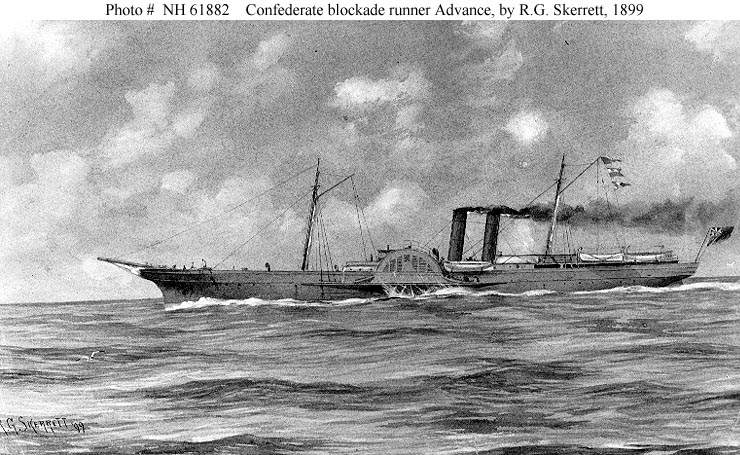
From Bernews
April, 2011 will mark the 150th anniversary of the Confederate bombardment of the Federal Army’s Fort Sumter in Charleston, South Carolina — initiating the devastating American Civil War (1861-65) and turning Bermuda into a mid-Atlantic front in the bloodiest conflict in US history.
The island can likely anticipate some cultural tourism starting next year as Americans hold somber, nationwide observations to mark the outbreak of the Civil War — during which an estimated 600,000 people were killed. more than combined US casualties in World War One, World War Two, Korea and Vietnam.
Beginning in December, 1860, a total of 11 Southern states started to secede from the Union. Among other things, the slave-holding states disagreed with the anti-slavery views of the Union.
During the war, Union forces used their navy to create a blockade of Southern ports — hoping to break the South’s economy, deprive its troops of materiel and munitions and force the newly-created Confederate States of America to surrender.Known as the Anaconda Plan, this blockade stretched from Maryland down the Eastern seaboard, around Florida, and into the Gulf of Mexico.
As a consequence of the naval blockade, Bermuda — along with the Bahamas and Cuba — became a centre of Confederate commerce. A steady stream of fast-running ships from the South clandestinely skirted the Union blockade, passing through St. George’s carrying cotton from Charleston, South Carolina and Wilmington, North Carolina for English manufacturers; they made the return journeys freighted with European armaments.
Bermuda was both a transhipment point where cotton was directly exchanged for British weapons warehoused here and a refuelling depot for Confederate blockade runners making transatlantic runs. -
First Americans 'reached Europe five centuries before Columbus discoveries'
- On 19/11/2010
- In General Maritime History
 PoodlesRock/Corbis
By Giles Tremlett - The Guardian
Scientists claim first Americans arrived long before Columbus bumped into an island in the Bahamas in 1492.
When Christopher Columbus paraded his newly discovered American Indians through the streets of Spanish towns at the end of the 15th century, he was not in fact introducing the first native Americans to Europe, according to new research.
Scientists who have studied the genetic past of an Icelandic family now claim the first Americans reached Europe a full five centuries before Columbus bumped into an island in the Bahamas during his first voyage of discovery in 1492.
Researchers said today that a woman from the Americas probably arrived in Iceland 1,000 years ago, leaving behind genes that are reflected in about 80 Icelanders today.
The link was first detected among inhabitants of Iceland, home to one of the most thorough gene-mapping programs in the world, several years ago.
Initial suggestions that the genes may have arrived via Asia were ruled out after samples showed they had been in Iceland since the early 18th century, before Asian genes began appearing among Icelanders.
Investigators discovered the genes could be traced to common ancestors in the south of Iceland, near the Vatnajˆkull glacier, in around 1710.
"As the island was practically isolated from the 10th century onwards, the most probable hypothesis is that these genes correspond to an Amerindian woman who was taken from America by the Vikings some time around the year 1000," Carles Lalueza-Fox, of the Pompeu Fabra university in Spain, said.