HOT NEWS !
Stay informed on the old and most recent significant or spectacular
nautical news and shipwreck discoveries

-
Shipwreck's 'oldest beer' to be analysed, brewed again
- On 09/02/2011
- In Conservation / Preservation

By Jason Palmer - BBC News
Samples of the world's oldest beer have been taken in a bid to determine its recipe - and brew it again.
In July 2010, a Baltic Sea shipwreck dated between 1800 to 1830 yielded many bottles of what is thought to be the world's oldest champagne.
Five of the bottles later proved to be the oldest drinkable beer yet found.
The local government of the Aland island chain where the wreck was found has now commissioned a scientific study to unpick the beer's original recipe.
Divers found the two-mast ship at a depth of about 50 metres in the Aland archipelago, which stretches between the coasts of Sweden and Finland in the Baltic Sea.
The ship was believed to be making a journey between Copenhagen in Denmark and St Petersburg, then the capital of Russia.
The salvaging operation to bring up 145 champagne bottles - since determined to include vintages from Heidseck, Veuve Clicquot, and Juglar - had one casualty: a bottle that burst open at the surface, revealing itself to be beer. -
Govt plans to recover centuries-old sunken ship in Mentawai
- On 09/02/2011
- In Underwater Archeology
The Maritime Affairs and Fisheries Ministry is planning to lift the wreckage of an ancient Chinese ship, which historians estimate sunk between the 15th and 17th Centuries, off the coast of West Sumatra's Mentawai Islands.
The wreck was found shortly after the quake-triggered tsunami that struck Mentawai in October last year.
“A permit to lift the sunken ship off the waters of South Pagai, Mentawai, is currently being processed in Jakarta,” West Sumatra Maritime Affairs and Fisheries Agency chief Yosmeri said in Padang on Tuesday, as quoted by kompas.com.
“A fairly large amount of funds and some special equipment will be required to lift the ship because of its position, at a depth of 25 meters below the surface,” he said.
Yosmeri said the Maritime Affairs and Fisheries Ministry in Jakarta would appoint a party to manage the operation.
According to a previous survey, the ship was about 20 meters in length and contained Chinese ceramics from the 13th Century.
Yosmeri said it was the first ship of its kind found by a local fisherman, and the exact location was currently being kept secret to prevent theft. -
Search for lost ship continuing
- On 08/02/2011
- In Underwater Archeology
By Bob Kostoff - Niagara Falls Reporter
The long saga of a mysterious and often frustrating search for the Griffon, built three centuries ago on the Niagara River in the La Salle section of the city, may be in its final year. Progress depends on the cold weather and ice in Lake Michigan.Whether this final phase of the archeological search will actually turn up the Griffon or prove to be some other sunken historical treasure remains to be seen.
This new year of 2011 will see completion of Phase II of the so-called "non-intrusive" survey of the suspected site of the Griffon. This phase, under formal agreement, is to be completed by the beginning of next year.
Officials believe this phase will finally determine if the site is the resting place of the actual Griffon and whether it will be worthwhile to try to retrieve artifacts from the ship.
Over the years, many sites have been touted as the resting place of the Griffon, and several stories in these columns have detailed the hopeful searches. But Steve Libert, president of Great Lakes Exploration Group, believes he has found the actual site. He studied the Griffon for many years and in 2001 discovered the current site in northern Lake Michigan.
The Griffon was built under orders of French explorer Rene Robert Cavelier, Sieur de La Salle, at a site off the Little Niagara River across from Cayuga Island. Father Louis Hennepin, who accompanied LaSalle on his expeditions, and Henri Di Tonti, LaSalle's one-handed second in command, helped plan the project, accomplished amid some consternation and harassment from Native Americans.
In 1679, the newly constructed ship, the largest to ply the Great Lakes at that time, set sail up the Niagara into Lake Erie and on to Michigan.There it was loaded with valuable furs to be taken back to Fort Niagara and forwarded to France.
The ship began its return voyage on Sept. 18, 1769, without La Salle, Hennepin or Tonti aboard. The next day there was a violent storm, and the Griffon disappeared without a trace, never to be seen again. -
Shipwreck in a cornfield fills kinky museum
- On 08/02/2011
- In Museum News
By Betsa Marsh - Travel Arts Syndicate
Travellers who are “goin’ to Kansas City,” like the old song says, usually set their GPSs for hot jazz and spicy barbecue.
But another contingent zeros in on the region’s quirky collections, from Marilyn Monroe’s locks at Leila’s Hair Museum to TWA’s paper flight attendant dresses at the Airline History Museum. And who can resist the bullet hole in the Jesse James Home where “that dirty coward” Robert Ford shot the outlaw in 1882?
But lovers of the roadside bizarre hit the jackpot with Kansas City’s Arabia Steamboat Museum.
Museum owner David Hawley was as susceptible to the lure of shipwrecks and buried treasure as the next explorer. His distinctive siren call, however, drew him not to the Atlantic or Pacific, but to a Kansas cornfield.
His quest was for the Arabia, a side-wheel steamboat that was only three years old when she rammed a log and sank in the muddy Missouri River in 1856. Hawley was undaunted when his research indicated that the wreck was probably under Judge Norman Sortor’s corn crop.
The Missouri River had moved east a half mile, leaving the steamboat shell and her mystery cargo buried under 14 metres of river-bottom silt. Once the Sortor family gave permission for exploration, Hawley arrived with his proton magnetometer.
“I walked back and forth across that field,” Hawley recalled. “It didn’t take long before the metal detector picked up the boilers.” -
Video: “Reefs, Wrecks and Renegades”
- On 08/02/2011
- In Miscellaneous
From BerNews
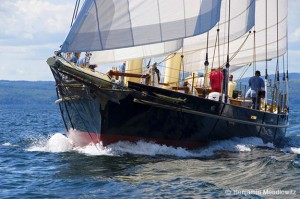
LookTV has produced a new film chronicling a voyage of archeological discovery by Bermuda Middle School students who helped to identify a previously unknown shipwreck in Castle Harbour.
“Reefs, Wrecks and Renegades: A Voyage of Discovery Aboard the ‘Spirit of Bermuda’,” captures an exciting interdisciplinary education initiative which was a collaborative project between Bermuda Sloop Foundation and National Museum of Bermuda. It also involved the Bermuda Institute of Ocean Sciences, the Custodian of Wrecks from the Department of Conservation Services and 500 local Middle 3 school students.
During the 2009/2010 academic school year, all Middle 3 students attending Government supported Middle Schools, and a number of those attending local private schools, participated in a five-day learning expedition aboard the sail training vessel “Spirit of Bermuda”.
While aboard, the students were engaged in the authentic process of registering, surveying and documenting a previously unexplored shipwreck located in the shallow waters of Castle Harbour, near Nonsuch Island.The film produced by LookBermuda, follows the students on their voyage as they apply for a license to explore the wreck from the Historic Wrecks Authority, seek environmental advice, survey and dredge the wreck and attempt to figure out the ship’s identity.
-
The battle for the 'Mercedes' millions
- On 08/02/2011
- In Illegal Recoveries
By Dale Fuchs - The Independent
For 200 years, the silver coins settled silently into the Atlantic seabed, 3,000 feet beneath the waves. They gathered in clumps like rocks across a vast swath of ocean floor near southern Portugal, crusting over with sediment and weighing a total of 17 tonnes.
The coins were certainly of no use to the 250 sailors who carried them from Peru on what was probably the Spanish frigate Nuestra Señora de las Mercedes, which sank in 1804, torn apart by British cannon fire.But now, transported from their watery-yet-lucrative grave to litigious landlubbers, those 600,000 idle coins, reportedly worth up to $500 million, are working overtime.
They have sparked a high-stakes legal battle in the United States between Spain, which claims ownership of the bounty, and Odyssey Marine Exploration, the American shipwreck-hunting company that detected it with hi-tech robots, extricated it from the seabed and flew it in bucketfuls to Florida in 2007.And they have dredged up murky questions about ownership and preservation of the three million shipwrecks that Unesco believes still rest on the world's ocean floors.
Most recently those crusty coins, believed to be the largest collection from a single deep-water site, have a caused diplomatic embarrassment too, thanks to US State Department cables released by WikiLeaks.They revealed the latest, and highly unlikely, weapon in the transatlantic skirmish over the sunken treasure: an impressionist painting by Camille Pissarro, entitled Rue Saint-Honore, Apres Midi, Effet de Pluie.
This painting, valued at $20 million, hangs in Madrid's Thyssen-Bornemisza Museum, ostensibly sharing nothing in common with naval strife or shipwrecks except perhaps the rain water which splashes on Pissarro's grey Parisian street. -
Treasure hunters eye underwater cultural heritage in Mexico
- On 07/02/2011
- In General Maritime History
From Mangalorean
Hundreds of sunken boats and thousands of other items lying hidden in the ocean, rivers, lakes, and cave pools, which make up part of Mexico's cultural heritage each year, are the much-desired booty of marine treasure hunters.
According to Pilar Luna, a pioneer of marine archaeology in Mexico, there are up to 250 sunken boats registered in the Gulf of Mexico and the Caribbean. But it is estimated that there are thousands of vessels, both large and small, that sank off the country's coasts.
In addition, some 30 areas of items have been tallied in cenotes and sunken caves, where ancient civilizations like the Maya deposited bodies, personal objects, and food in conducting their spiritual rituals.
The treasures of Mexico are exposed to looting by adventurers who erase the traces of the country's forebears, said Pilar Luna, an expert with the National Institute of Anthropology and History (INAH), who has devoted over 30 years of work to the investigation and preservation of underwater cultural heritage.
The boats that sank in Mexico belonged to the series of fleets that, starting in the 16th century, were used by the colonisers to transport people and merchandise from the New World to Spain.
These vessels were mainly loaded with cargos of gold, silver, and precious stones that the colonies sent to Madrid as a tribute to offset the expenses of the Spanish monarchy.
"The interests have not changed. It continues to be the precious metals that are pursued by treasure hunters at any cost and by those who forget that, beyond their economic value, it is history and culture," Luna said.
Since 1970s, INAH has declined over 30 requests to do salvage work on sunken vessels that have been found in Mexican waters.
One of those requests came from Florida-based Odyssey Marine Exploration, Inc., which became famous in 2007 after salvaging $500 million in gold and silver coins from the wreck of a Spanish ship that sank in an 1804 battle off the coast of Portugal, though US courts must still decide whether the treasure rightfully belongs to the firm or to the Spanish government. -
Displays dish on the deep
- On 05/02/2011
- In Miscellaneous
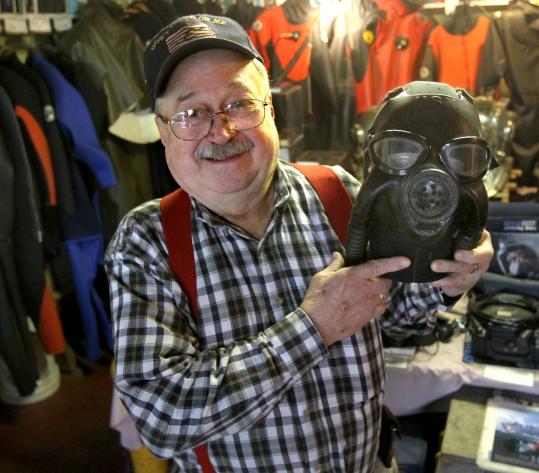
Photo John Blanding
By Joel Brown - Boston
A visit to the Diving Locker induces its own sort of rapture of the deep, with symptoms including giddiness and mild disorientation.Visitors descend from the street to a low-ceilinged harborside basement, with two rooms smelling of rubber and old canvas and a hint of mildew.
All around are diving suits and scuba tanks, helmets and masks, books and pictures. Here and there sit a shipwreck artifact such as a cannonball or a row of old bottles, rescued from the briny deep. Look up and there is a mannequin in a dry suit apparently swimming through the room, which seems perfectly fitting.
The basement is a small part of the Gloucester Maritime Heritage Center, an educational and tourist attraction at 23 Harbor Loop. But the Diving Center is really Paul Harling.
It’s his ever-growing collection of equipment and memorabilia, from light scuba tackle to heavy commercial diving helmets. Harling hand-writes the labels. He’s here all summer, greeting tourists six days a week. He’s here in the winter, too, welcoming a trickle of diving enthusiasts and cronies even though the Heritage Center is mostly closed.
The stories are all his. Harling has dived for lost dentures, and he’s been down to the wreck of the Andrea Doria. At 77, he’s dived as recently as 2009, right outside by the center’s Burnham Brothers Marine Railway, a facility for hauling boats out of the water for maintenance.
“We like to tell the story of the industrial waterfront and the history of the fishing industry, and certainly commercial diving was a part of all that,’’ said Harriet Webster, executive director of the Heritage Center. “One of the things we like to do as much as possible is to use people to tell stories, not just artifacts. Paul is a storyteller, and people enjoy that.’’