HOT NEWS !
Stay informed on the old and most recent significant or spectacular
nautical news and shipwreck discoveries

-
Blackbeard's Queen Anne's Revenge wreck
- On 29/05/2011
- In Underwater Archeology
By Jasper Copping -The Telegraph
Divers exploring the wreck of Blackbeard’s flagship Queen Anne's Revenge are bringing to the surface new evidence of the terrifying tactics used by the pirate.He was a real-life pirate of the Caribbean, who carefully cultivated a bloodthirsty reputation that struck fear through seafarers.
Now, almost 300 years after Blackbeard's death, marine archaeologists have discovered a huge anchor and an arsenal of "improvised" ammunition from the wreck of his flagship, Queen Anne’s Revenge.
New evidence about the terrifying and deadly tactics employed by Blackbeard is emerging from the diving expedition on the vessel’s presumed remains. The divers have discovered that weapons used by the pirate were not only intended to kill but were designed to strike terror into survivors and force them into a swift surrender.
The shipwreck lies in about 25ft of water just off the coast of the American state of North Carolina and the expedition to recover artefacts is being led by the state’s Department of Cultural Resources.
During the two-week exploration, the team aimed to recover a 1.4 ton (3,000lb) anchor from the ship, which they have now successfully raised.They are also searching for three large “artefact conglomerates” – or “clusters” of metallic objects – which, as they have deteriorated, have stuck together. Once on the surface, the items can be separated up into their constituent parts and identified.
The “conglomerates” – which cover areas of up to a metre and a half by a metre square of the sea bed – are thought to contain an unusual assortment of “improvised” missiles and weaponry used by the pirate to inflict both terror and casualties on enemy ships.
On earlier dives, the researchers have found evidence of a range of “makeshift” devices, such as canvas bags filled with a lethal mass of lead shot, nails, spikes and glass and then fired from the cannon, pouring a deadly hail of projectiles onto opponents. This type of bundled ammunition was known as “langrage” and was not used by Royal Navy ships, according to 18th-century documents.
The ship’s unusual arsenal already identified also includes nine-inch bolts, which were pushed down in the barrels of cannons and would by fired out by a cannonball loaded behind them, as well as “double-headed” cannonballs – where two are linked together by a bar or chain – and which produced a spinning effect when fired from cannon and were effective at bringing down rigging.
The researchers’ bid to bring the ordnance to the surface comes as Blackbeard himself is resurrected in the new film Pirates of the Caribbean: On Stranger Tides, which was released earlier this month. His ship is also depicted in the new film, in which the pirate is portrayed by British actor Ian McShane, while his fictional daughter, Angelica, is played by Penelope Cruz. -
Conquistador silver may not have sunk Spain's currency
- On 28/05/2011
- In General Maritime History
By Sara Reardon - Science Mag
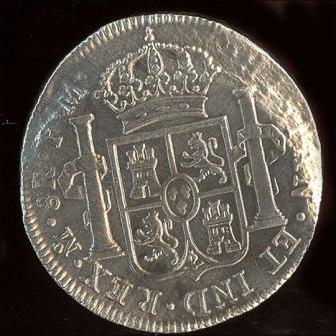
Between 1520 and 1650, Spain’s economy suffered crippling and unrelenting inflation in the so-called Price Revolution.Most historians have attributed that inflation, in part, to the importation, starting in 1550, of silver from the Americas, which supposedly put much more currency into circulation in Spain.
But in a report out this week, a team of researchers argues that for more than a century the Spanish did not use this imported silver to make coins, suggesting that the amount of money circulating in Spain did not increase and could not have triggered the inflation.
Between the 16th and 18th centuries, the Spanish extracted as much as 300 tons of silver per year from mines in Peru and Mexico.
If the heavy bars managed to survive the hazards of the Atlantic, both natural and piratical, they could either be coined into pieces of eight or be traded with other countries to offset Spain's many costs, which at this time included financing wars in the Netherlands and importing porcelain and silk from China.
But did the Spanish actually use the imported silver to make coins ? To find out, archaeometrist Anne-Marie DeSaulty and colleagues at the University of Lyon in France used mass spectrometry to measure the ratios of several metal isotopes—atoms of the same element with different numbers of neutrons in their nuclei—in 91 old coins: 24 ancient coins from Greece and Rome, 23 medieval coins from around Europe, 25 coins minted in Spain from the 16th and 18th centuries under a succession of different kings, and 19 coins minted from Latin American silver.
The Latin American coins generally had a broader mix of different silver, lead, and copper isotopes than the European coins, likely because of the geologic complexity of the volcanic caves that hosted the New World’s most prolific silver mines, the researchers report online this week in the Proceedings of the National Academy of Sciences.
The ratio of the silver-109 isotope to silver-107 turned out to be much higher in New World silver than in the European coins.More important to the debate over the Price Revolution, the researchers discovered that coins with dates and heads indicating that they were minted in Spain prior to the reign of Philip V (1700 to 1746) had an isotopic makeup similar to medieval European coins.
-
Shipwreck exhibit offers tales of danger in New Castle
- On 26/05/2011
- In Museum News
By Joey Cresta - Sea Coast Online
What started as a search for the details behind an old family photograph has blossomed into an exhibit on 400 years of shipwrecks around the island.
Fort Stark State Historical Site Director Carol White and Assistant Director Joan Hammond have been working on the project for 2½ years.White said the two history buffs began researching shipwrecks in the area because of a photograph passed down through the family of Andy White, Carol's husband.
The black-and-white picture shows the Camilla May Page, a four-masted schooner, wrecked on a rock ledge near Fort Stark on Nov. 18, 1928. White said some of the town's older residents may remember rushing out with burlap sacks and picking up pieces of coal that washed out of the wrecked ship.
That is just one of the stories highlighted at the new shipwreck exhibit that will be unveiled at the historical site on Wild Rose Lane from 2 to 4 p.m. Saturday, May 28.
White and Hammond scoured old newspaper articles, keeper's logs and wreck reports at the Portsmouth Athenaeum and the public library, and the National Archives in Waltham, Mass., while conducting their research.
White said they found out early on that no one had ever looked closely at the history of New Castle shipwrecks.
"This was a whole new line of research, which became exciting," she said.
They found that more than 100 shipwrecks occurred around the island since the 1600s. Not all of those were dramatic, ship-sinking wrecks, however. Similar to reports on car accidents today, White said, even minor shipwrecks required the filing of reports.
Eight of the more dramatic wrecks are highlighted on displays inside the Fort Stark visitor's center.Most of them occurred around Jerry's Point, the peninsula on the southeast corner of the island where Fort Stark is located.
-
Discoverer of Queen Anne's Revenge disagrees with upcoming excavation
- On 26/05/2011
- In Underwater Archeology

By Dustin Etheridge - WECT
The Queen Anne's Revenge is considered by many to be one of the most well preserved and historic shipwrecks of the modern era.
Last week it was announced that the main anchor of that ship would be excavated. One man who doesn't agree with that is the Queen Anne's Revenge discoverer, Captain Mike Daniel.
"We all need to look at this and 'go wait a minute.' Everyone needs to be aware of what's about to happen here," said Daniel. "When this anchor is removed, we're tearing it out of a concretion."
Concretions are vital to the preservation of the ship. They cover the exterior and loose artifacts, making them part of a natural reef.
Captain Daniel believes archaeologists are more concerned with the ship's artifacts than with preserving the ship itself.
"Archaeology is a destructive science. What it does is it dismantles a historic site, gathering information from that site as they destroy it," explained Daniel. "We don't have to do that right now.
The type of artifacts they're hoping to find under this anchor in general are more of the same: cannon balls, cannons. There's no reason to think that there's something underneath there that is unique."
Daniel surrendered his rights to the ship for what he assumed was the greater good.
"When we discovered the ship wreck I was instrumental in talking my partners with Intersal Incorporated into giving our shares to the people of North Carolina. A concession we were given was we would have input on what would happen to the ship wreck," said Daniel.
"Unfortunately that is not taking place. This whole thing with the anchor I hadn't even heard about it until it hit the press."
Full story... -
More deep dives reveal true identity of Bermagui shipwreck
- On 25/05/2011
- In Wreck Diving

By Stan Gorton - Marooma News
Volunteer extreme scuba divers have come up with a surprising revelation about the real identity of a World War II shipwreck off Bermagui.
The wreck formerly thought to be the BHP freighter Iron Knight is now believed to be another wartime ship sunk by a Japanese submarine.
Divers from the Sydney Project extreme diving group have continued their programs of dives on ships where they lie 120 to 140 metres down on the edge of the continental shelf.
The dives are not without risk as the project lost one of their own when diver Sven Paepke died in 2007 diving on the wreck formerly thought to be the Iron Knight. His body has never been recovered.
The ship first located by trawlers operating out of Bermagui was incorrectly identified as the Iron Knight the year before thanks to Sydney Project dives.
The NSW Heritage Office then organised a ceremony of relatives of the Iron Knight to lay wreaths on the site, but now it is believed that wreck is more likely out beyond 40 kilometres in the shipping lines and at least 4 kilometres down where it will probably never be found.
The real identity of the wreck formerly thought to be Iron Knight has become clearer thanks to the continued efforts of the Sydney Project.
“The public during war and even now didn’t realise how much submarine activity there was,” Sydney Project diver Samir Alhafith said.
“The depths make it harder but we’re bringing to history to life and revealing how many ships and lives were lost during the war.”
Mr Alhafith and his colleagues have dived on the wreck and another nearby wreck known to be that of the Liberty ship William Dawes six times in the last year or so.
Each time they have been taken out and assisted by local charter boat operator Keith Appleby.
Diving on a wreck 120 metres down entails dropping quickly to the bottom for a bottom-time of just 20 to 25 minutes and then slowly coming back with a decompression time of up to five and half hours.
Mr Alahfith said the certain factors about the shipwreck formerly thought to be Iron Knight were just not adding up with underwater scooters allowing the divers to transverse the full length of the wrecks. -
Hostile Bay fishermen ruin survey wreck-dive
- On 25/05/2011
- In Miscellaneous
By John Cousins - Bay of Plenty Times
An archeological survey of a 130-year-old shipwreck off the Western Bay of Plenty turned sour for a team of divers on Saturday after they encountered a hostile reception from fishermen.
The divers managed to map the stern half of the steamship, which sank in 1881, but not before the expedition suffered abuse from recreational fishers and had its seabed survey baselines hooked and dragged up.
The team, which underwent specialist archeological training for the mapping of the SS Taupo, was not expecting a hostile reception when the weather conditions finally improved enough to allow them to dive on the wreck.
SS Taupo settled on the sandy bottom of the Bay, 11km out from Tauranga Harbour's northern Bowentown entrance, after a patch to its hull failed to hold and it sank under tow between Tauranga and Auckland.
A member of the dive team and Tauranga photojournalist, Shane Wasik, said the day began badly when they arrived to find two boats on the wreck site.
After telling the fishermen they were there to perform a marine archeological project and would be putting down a number of divers on to the wreck, Mr Wasik said they were told where to go "in not so many words".
A number of other boats then turned up and started motoring around where the team was trying to set up the archeological grid, with two getting their anchors entwined before leaving soon after.
"Later in the day, one boat anchored right over the top of the divers and fished directly under their ascent line - despite our warnings.
"In the end, our baseline tape measure, which we were using to survey was caught by the fisherman's lines, pulled up, and so ruined one pair of divers' data. -
Deep-sea explorers fight Spain over shipwreck treasure
- On 25/05/2011
- In Treasure Hunting / Recoveries
From the Washington Post
Florida deep-sea explorers asked a federal appeals court Tuesday to overturn an earlier ruling that 17 tons of treasure recovered from a sunken Spanish galleon belongs to Spain, deepening a long-running battle over a trove worth an estimated $500 million that has unfolded not on the high seas but in federal courtrooms.
Attorneys for Odyssey Marine Exploration asked the three-judge panel of the 11th Circuit Court of Appeals to uphold the “finders keepers” rule that would give the treasure hunters the rights to silver coins, copper ingots, gold cufflinks and other artifacts salvaged about four years ago from the galleon off the coast of Portugal.
Spain’s lawyers countered that U.S. courts are obligated by international treaty and maritime law to uphold Spain’s claim to the haul.The ship, called the Nuestra Senora de las Mercedes, was sunk by British warships in the Atlantic in 1804 while sailing back from South America with more than 200 people on board. Odyssey created an international splash in May 2007 when it announced that it raised more than 500,000 silver coins and other artifacts from the wreck and flew the treasure back to Tampa.
Spain went to the U.S. District Court in Tampa, where the company is based, claiming ownership while Odyssey disputed the Spanish government’s ownership of the valuable cargo.
A federal judge sided with Spain in the first round of the tug-of-war in June 2009, accepting the Spanish government’s argument that it never surrendered ownership of the ship and its contents. But the two sides — along with a horde of other lawyers representing outside parties — were back in court Tuesday to argue a case that could spill over to treasure hunts for years to come.
Much of Tuesday’s arguments centered on whether the Mercedes was classified as a warship or merchant ship. That’s an important distinction because Odyssey’s attorneys argued that if the vessel was destroyed during commercial activity, Spain would have no firm claim to the property.International treaties generally hold that warships sunk in battle are protected from treasure seekers.
“There is no vessel. There is no ship. There is no graveyard,” said Odyssey attorney Melinda MacConnel, who added that the company never raised any remnants of the actual ship.“The commercial activity of this ship could not be more clear.”
-
Underwater Ming Dynasty tomb resurfaces as result of drought
- On 24/05/2011
- In Miscellaneous
From Xinhuanet
Several submerged sections of a tomb built for the ancestors of Ming Dynasty (1368-1644) founder Zhu Yuanzhang recently resurfaced in east China's Jiangsu Province as the result of a severe drought that is still affecting the region.
Located on the west bank of Jiangsu's Hongze Lake, the tomb was built by Ming Dynasty emperor Zhu Yuanzhang in AD 1386 to honor his ancestors.
The mausoleum was flooded in 1680, when the Yellow River broke its banks, changed course and converged with the nearby Huai River.
A drought in the 1960s caused Hongze Lake's water level to drop, revealing external portions of the tomb as well as several stone statues. However, the tomb itself remained underwater.
Tales of a royal tomb buried under the lake traveled quickly among the lake's residents. The government considered sending archaeologists to investigate the lake, but the lake's residents voiced their opinion that it was better not to disturb the royal burial site. The tomb remained untouched.
The issue of preserving the tomb after uncovering it was another problem for the local government at that time, according to Hu Rensheng, head of a management committee for the newly-discovered tomb.
It was not until recently that local residents got to take their first look at the tomb, which hadn't seen the light of day in more than 300 years.
Stone arches and other parts of the tomb emerged on Thursday as the lake's water level continued to recede because of the recent drought. Local residents also got a look at a paved path leading to the tomb.
Although the majority of the tomb is still buried under the lake's muddy floor, the mere sight of the tomb's outer structure was enough to thrill local residents.