HOT NEWS !
Stay informed on the old and most recent significant or spectacular
nautical news and shipwreck discoveries

-
'Mystery' shipwreck artifacts will tell unwritten story about Civil War-era Mobile
- On 03/06/2011
- In Parks & Protected Sites

By David Ferrara - Blog.al
A Gulf Shores company plans to tell a previously unwritten story about the Civil War era along the Alabama coast today by unveiling artifacts from a “mystery” shipwreck.
Marking the 150-year anniversary of the shipwreck just southwest of Fort Morgan, David Anderson, CEO of Fathom Exploration, the archaeological group that discovered the ship, said it was part of an exploration first launched about seven years ago.
“We’re adding to the very early history of the war,” Anderson said. “There are not many things that fall through the cracks, but if you look closely, you can find them. And this is certainly one.”
This ship, which has a name Anderson would not disclose, was not listed in any compilation of ships lost in the Mobile area, he said.
“If you look at the ships that are listed as being lost in Alabama in that time period, there’s only one or two,” Anderson said. “And this was not either one of them.
“That begs a really interesting question: what’s not in the history books ?”Anderson said he learned more about the ship when he discovered a captain’s log from a Union blockade and researched newspaper articles that referenced the incident from the side of the Confederacy.
Along with state and local officials, Anderson plans to reveal the artifacts and their significance to Mobile’s history during an event at LuLu’s at Homeport Marina at 11:30 a.m. today.
The artifacts are part of a 2004 Fathom Exploration discovery of 4 sites about 2 nautical miles southwest of Fort Morgan. At that time, the company filed a federal lawsuit to secure the location. A federal judge’s decision on who owns the artifacts has been on hold while Fathom Exploration analyzed what was found.
The exploration itself was put on hold during the BP oil spill, Anderson said, and resumed late last year. -
Gardaí investigate looting of U-boat site
- On 02/06/2011
- In Illegal Recoveries

From the Irish Times
The 49-metre, 400-ton German vessel UC-42, which sank in 1917 during a mine-laying operation, also appears to have been damaged by salvagers attempting to remove one of its propellers.
The Garda National Bureau of Criminal Investigation’s antiquities unit was alerted by the Department of Arts, Heritage and the Gaeltacht’s underwater archaeology unit. Also involved are the Customs maritime unit, the National Museum of Ireland and, now, locally-based gardaí.
Connie Kelleher, of the underwater archaeology unit, said she had received several reports from divers about the desecration of the site through removal of crew members’ effects.
“Included in these reports to us, from concerned divers who do not agree with the pillaging of the site, are details of human remains being evident on the wreck site,” she said.
“To date, we have received reports of the structure being recently damaged by divers attempting to remove parts of it; of items that belonged to the crew being taken off the site; and that one of the propellers was being made ready to be recovered, as evidenced by recent work to it.”
She added that she and other divers with her unit intended to dive on the site to assess it as soon as weather permitted.
She has alerted the Irish Underwater Council (IUC), the main representative body of diving clubs in Ireland, seeking its assistance in raising awareness of the problem and said she had also contacted the Naval Service.
Martin Kiely, the IUC’s national diving officer, said the council’s code of conduct forbade members from interfering with wrecks or sea life and required them to respect all dive sites. “We would take a very dim view of people taking stuff from wrecks,” he said.
Ms Kelleher said the German embassy had indicated its “legitimate interest” in the wreck’s protection and preservation.
“The site has a particular sensitivity due to it being a relatively recent German naval loss with crew who are known by name, many of whom are likely to have close living relatives,” she said. -
NOAA commemorates the 100th birthday of RMS Titanic
- On 01/06/2011
- In Famous Wrecks

From NOAA News
The world’s best known shipwreck turns 100 today. Maritime historians generally consider the date of a ship’s launch to be its “official birth date” and the Belfast, Northern Ireland, shipyard of Harland & Wolff launched RMS Titanic on May 31, 1911. Once afloat, RMS Titanic was then completed by shipyard workers before setting out on its tragic maiden voyage nearly a year later.
The 100th birthday of Titanic is a landmark event in that the wreck is now considered an archaeological resource site as defined under the United States Archaeological Resources Protection Act.
After it struck an iceberg and sank on April 15, 1912, the Titanic became the catalyst for the development of international law on safety of navigation, including the International Convention for the Safety of Life at Sea, as well as for the establishment of the International Maritime Organization, a United Nations agency with responsibility for the safety and security of shipping and prevention of marine pollution by ships.The wreck of RMS Titanic was discovered in 1985 by a joint U.S.-French expedition in more than 12,400 feet of water in the North Atlantic. In recognition of the discovery of the wreck site and its historical and cultural significance, Congress passed the RMS Titanic Memorial Act of 1986.
The legislation authorized the negotiation of an international agreement and the adoption of guidelines to designate the site as an international maritime memorial to those who lost their lives. Negotiation of this international agreement by the U.S., France, Canada, and the United Kingdom was concluded in 2000.
While the international agreement has not yet entered into force, NOAA developed the guidelines in 2001, and mounted two scientific expeditions to the wreck in 2003 and 2004 with a variety of partners.
Full story... -
Roman ship had on-board fish tank
- On 01/06/2011
- In Underwater Archeology
The Nautical Archaeology Society
By Jo Marchant - Nature
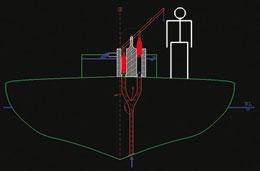
A Roman ship found with a lead pipe piercing its hull has mystified archaeologists.Italian researchers now suggest that the pipe was part of an ingenious pumping system, designed to feed on-board fish tanks with a continuous supply of oxygenated water.
Their analysis has been published online in the International Journal of Nautical Archaeology.
Historians have assumed that in ancient times fresh fish were eaten close to where they were caught, because without refrigeration they would have rotted during transportation. But if the latest theory is correct, Roman ships could have carried live fish to buyers across the Mediterranean Sea.
The wrecked ship, which dates from the second century AD, was discovered six miles off the coast of Grado in northeastern Italy, in 1986.It was recovered in pieces in 1999 and is now held in the Museum of Underwater Archaeology in Grado. A small trade ship around 16.5 metres long, the vessel was carrying hundreds of vase-like containers that held processed fish, including sardines and salted mackerel.
Carlo Beltrame, a marine archaeologist at the Ca' Foscari University of Venice in Italy, and his colleagues have been trying to make sense of one bizarre feature of the wreck: a lead pipe near the stern that ends in a hole through the hull. The surviving pipe is 1.3 metres long, and 7–10 centimetres in diameter.
The team concludes that the pipe must have been connected to a piston pump, in which a hand-operated lever moves pistons up and down inside a pair of pipes. One-way valves ensure that water is pushed from one reservoir into another. The Romans had access to such technology, although it hasn't been seen before on their ships, and the pump itself hasn't been recovered from the Grado wreck. -
Blackbeard fever hits North Carolina after anchor raised
- On 01/06/2011
- In Famous Wrecks

By Kathy M. Newbern and J.S. Fletcher - The Raleigh Telegram
The summer blockbuster "Pirates of the Caribbean 4: On Stranger Tides," has Captain Jack Sparrow, played by Johnny Depp, going up against the notorious Blackbeard and boarding his flagship Queen Anne’s Revenge.
After watching the film opening night, back at our oceanfront room at The Sheraton Atlantic Beach, we marveled just how close we are to the real deal here on the Crystal Coast.
Blackbeard’s actual ship sank in 1718 right off the coast here, not far from Fort Macon. Its discovery in 1996 caused a stir; national attention refocused on the shipwreck Friday morning when one of four anchors was brought to the surface. It weighs 3,000 pounds.
And now, some of the ship’s excavated “treasures” are about to be shown to the public in a new exhibit (no, not gold, but pieces of pirate history).
Talk about timing — North Carolina researchers and tourism promoters are ecstatic.
The new Blackbeard’s Queen Anne’s Revenge Exhibit opens June 11th at Beaufort's North Carolina Maritime Museum unveiling nearly 300 exhumed relics from the 90-foot frigate.
Regarding the film, Claire Aubel, the museum’s public relations coordinator, said no one from Hollywood contacted the museum. “So how did they get their concept of Queen Anne’s Revenge?” she asked with a laugh and a shrug. Movie makers live by their own rules, kind of like pirates.
Not so at the museum. Here, the documented recovery has been painstakingly slow, and true. At the wreck site, 40-50% of the artifacts are now “off the ocean floor,” she says. “That leaves us with another 50% roughly to get up by 2015, which is our goal. It’s completely weather dependent as you might imagine.” -
World Record $366,000 Titanic plan marks doomed ship’s 100th anniversary
- On 31/05/2011
- In Auction News

From Paul Fraser CollectiblesCommemorative events are taking place in Belfast today to mark the 100th anniversary of RMS Titanic's launch. The ship left Harland & Wolff shipyard on May 31 1911, 11 months before its fatal maiden voyage.
Meanwhile, a plan of the Titanic used in the inquest into its sinking sold for £220,000 at a nicely-timed auction over the weekend...
The document brought well above its £150,000 estimate and a World Record price for a Titanic artefact at auction - evidence, if any were needed, that the tale of the Titanic continues to enthrall alternative investors.
The 33-foot long technical drawing is marked with arrows and notes, depicting where survivors of the disaster thought the iceberg had struck.
It was used during the British Board of Trade's 36-day inquiry between May and July 1912, which took place just weeks after the disaster.
Ninety-six witnesses were called to the investigation, including crew members and maritime experts. It concluded that excessive speed was to blame for the disaster.
Only three passengers were questioned - all of them first class travellers.
Alan Aldridge of auctioneer Henry Aldridge & Son commented: "The plan is one of the most important pieces of Titanic memorabilia ever sold and this price reflects it."
-
Bottoms up ! 170-year-old bottle of bubbly could fetch $70,000 at auction
- On 31/05/2011
- In Auction News

By Lesley Ciarula Taylor - The Star
The best thing the winning bidders for two bottles of the world’s oldest champagne can do is pop the cork and drink it.
Sheltered 50 metres deep in a shipwreck in the chilly, dark Baltic Sea for nearly two centuries, the 170-year-old champagne is still in perfect condition, auctioneer John Kapon told the Star on Monday from Estonia en route to tiny Mariehamn, the capital of the Aland islands.
Likely destined for the Imperial Court of Tsar Nicholas I in St. Petersburg, Russia, the liquid history could still conjure up the very different tastes of the early 19th century, said Rainer Juslin, Permanent Secretary of the Government of Aland Department of Education and Culture and host of Friday’s auction.
“It is quite different from the modern product, but characteristic of the times,” he said. “More like a dessert wine, much more yellow coloured. Very sweet, but still very good.”
But it won’t last.
“The champagne after a couple of years will be destroyed,” explained Juslin,
“It was produced to drink.”
Juslin was among the select few who had a taste from one of the 145 bottles discovered and brought up last year from the shipwreck.
The bubbly remains “phenomenally youthful,” said Kapon, who represents the auction house Acker Merrall & Condit, one of the oldest wine auction houses in the world.
Pronounced still fresh and ready to savour by Swedish champagne expert Richard Juhlin, the two bottles represent the defunct Champagne house Juglar and the still-thriving Veuve Clicquot, which is a partner in the auction and will bring some of its own rare vintages to the block.
Investigators are still trying to pinpoint the history of the wreck, a two-masted schooner that likely sank in one of the Baltic’s ferocious storms in the early 1840s. Plates found on board date from the Rorstrands porcelain factory between 1780 and 1830. -
Even recovered, ship's gold remains mystery
- On 30/05/2011
- In Treasure Hunting / Recoveries
By Kathy Lynn Gray - Dispatch
The proposal seemed preposterous: Tommy Thompson, an engineer and shipwreck-enthusiast, said he could find a steamer that had sunk in 1857 off the Carolina coast with 21 tons of gold in its hold.
Wealthy central Ohio men and women listened, and one by one anteed up money so Thompson's expedition could move forward. The chance that Thompson would find the ship was one in a million, they knew.On the other hand, he was so confident, so persuasive, so sure he could find it.
Still, perhaps no one was more surprised than those 161 investors when Thompson actually found the SS Central America in 1988 - 8,000 feet down - and eventually brought up a treasure-trove of gold coins and bars worth up to $400 million.
But as difficult as the search-and-recovery expedition was, unraveling who is entitled to the riches has been even more difficult.Twenty-three years later, investors have not seen a cent of profit, and crew members who claim they are owed part of the proceeds haven't received that, either.
A trial is scheduled in federal court late next month that could untangle some of the secrecy that has always surrounded the "gold ship."
Nine people hired by Thompson to help find the wreck say that, under their contract, they're entitled to about 2 percent of the sale proceeds of the treasure because they helped to pinpoint the wreck with sonar and other devices.
Thompson argues in court documents that they have been paid what they're due - a fee for their work. He says their work did not pinpoint the wreck site, so they're not entitled to the additional amount, estimated at $2million to $5million.
That's just one of a flurry of lawsuits that have been filed over the years since the gold's discovery. Another was filed by The Dispatch Printing Company and Donald C. Fanta in 2005 in Franklin County Common Pleas Court. Fanta is a former president of The Ohio Company, an investment firm that was bought by Fifth-Third Bancorp in 1998. Dispatch Printing owns The Columbus Dispatch.
Dispatch Printing and Fanta invested a total of $1.5million in the treasure hunt and have sued four directors of Thompson's company - Columbus Exploration Limited Partnership - to obtain an accounting of the expedition's profits.
That lawsuit argues that investors have not received any "meaningful information" about the companies' finances or what happened to the investors' money since 2000.