HOT NEWS !
Stay informed on the old and most recent significant or spectacular
nautical news and shipwreck discoveries

-
Ship was Blackbeard’s vessel
- On 12/06/2011
- In Underwater Archeology
Photo Robert Willett
By Jay Price - Nashua Telegraph
North Carolina has quietly decided that the cannon-laden shipwreck just off Fort Macon is absolutely that of Blackbeard the pirate’s flagship, the “Queen Anne’s Revenge,” ending 15 years of official uncertainty.
No more caveats, not in news releases, scholarly presentations by state archaeologists or on museum exhibits about the ship like the one that opens Saturday at the North Carolina Maritime Museum in Beaufort.
“We have now changed our position, and we are quite categorically saying that it’s the Queen Anne’s Revenge,” said Jeffrey Crow, deputy secretary for the Office of Archives and History of the N.C. Department of Cultural Resources, which oversees the efforts to recover and display the remains of the ship.
After so many years of historical research and the recovery and analysis of tens of thousands of artifacts, the body of evidence was overwhelming and convincing, said Crow, who had been one of the main voices urging caution against declaring a positive identification too early.
Crow said he had believed for years that it was the Queen Anne’s Revenge. Professionalism as a historian, though, dictated caution, despite arguments from supporters of the recovery project that not only was the evidence good enough, but that a firm identification would make it easier to win ongoing state funding for the effort.
From the beginning, archaeologists on the project have had to piece together funding from a hodgepodge of sources. The Legislature has never regularly funded their work, despite the huge tourism potential of such an old wreck even if the ship wasn’t Blackbeard’s, and despite the risk that a large storm could damage the site, which had been covered by a protective blanket of sand for much of its history.
The positive identification may make it easier to get private money needed to raise the rest of the ship and artifacts by the target date of late 2013 – $100,000 for each of the next three years. But the decision wasn’t about money, Crow said, it was about overwhelming evidence.
Finally tipping the scales, he said, was the acceptance of a paper flatly declaring the identity of the wreck by the respected scholarly journal “Historical Archaeology.” The paper, written by Mark Wilde-Ramsing, a deputy state archaeologist and head of the Queen Anne’s Revenge project, and Charles Ewen of the anthropology faculty at East Carolina University, is expected to be published later this year or early in 2012.
It cited key facts such as the location, historical accounts, dates on various artifacts and dates and places of origin that can be extrapolated from others with known makers or periods of manufacture. -
Life under the sea
- On 11/06/2011
- In Underwater Archeology
By Zhang Zixuan - China Daily
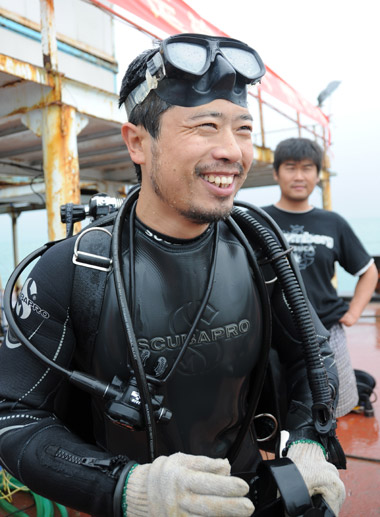
When bubbles float up to the surface of the sea, divers on the workboat know that their colleague Liu Zhiyuan is ready to get out of the water.Following a guide rope, Liu finds the ladder and takes off his fins while a colleague helps to lift the two 50-kg oxygen tanks off his back.
Liu, an underwater archaeologist, is excavating the sunken ship Nan'ao No 1, which experts believe went down during the reign of Emperor Wanli (1563-1620) of Ming Dynasty.
It was found in 2007 in the South China Sea near the appropriately named Nan'ao Island in Guangdong province.
If everything goes well, Liu and his colleagues will be able to salvage all the cultural relics on it by mid-July.
So far they have recovered mostly porcelains, as well as copper coins and an iron cannon, which may have been for protection against pirates.
China started its underwater archaeology in the 1980s after British marine explorer Michael Hatcher discovered the wreck of the Dutch ship Geldermalsen, which sank in the South China Sea in 1751, and removed 150,000 Chinese porcelain artifacts.
Those relics were sold for $20 million at a Christie's auction in Amsterdam in 1986.
International law on underwater salvaging can be vague and inconsistent between countries, so when the Chinese government found no way to sue the explorer it decided to build its own underwater archaeology team.
Since 1989 the center has trained more than 90 underwater archaeology divers.
Liu, 34, who is also deputy director of the Underwater Cultural Heritage Protection Center of Guangdong Archeology Research Institute, holds certificates for 10 different diving categories, such as nighttime diving and underwater photography.
Like many other archaeologists, Liu took to his profession because "you never know what you'll find" in each excavation - or in Liu's case, each dive.
Since 2005 Liu has participated in 90 percent of all underwater archaeology projects in China, mostly in the southeast coastal areas.
However, as underwater excavation is extremely subjective to wind, water temperature and visibility, each year Liu and his colleagues have only two to three months to work on the sunken ship, usually from late April to mid-July, when it is warm enough and the monsoon season has not arrived. -
Exhibit opens on Queen Anne’s Revenge
- On 11/06/2011
- In Museum News

By Jannette Pippin - EncToday
A ship’s bell that was one of the first artifacts raised from the Queen Anne’s Revenge shipwreck now stands at the entrance of the most comprehensive display of artifacts from the wreck believed to be the flagship of infamous pirate Blackbeard.
The bell, pewter plates, cannons and coin weights are among the more than 300 artifacts that are now part of the new Blackbeard’s Queen Anne’s Revenge Exhibit at the N.C. Maritime Museum in Beaufort. The exhibit opens to the public on Saturday.
The artifacts date the QAR shipwreck from 1700 to 1725 and help to tell the story of Blackbeard, his flagship and the place piracy had in North Carolina’s history.
“They are all like bits of clues (into that time period),” said David Bennett, a museum collections intern who helped to give tours for those who got an early preview.
The exhibit begins with a bit of history about Blackbeard, and from the start it’s clear that many mysteries still remain about the man, who was also known as Edward Teach or Edward Thatch and spent time as a licensed privateer before turning to piracy.
A model of how the Queen Anne’s Revenge likely looked sits in one corner of the exhibit and not far from it are display boards that tell of its demise. In 1718, Blackbeard ran his ship aground in Beaufort Inlet, roughly two miles from where the museum stands today. A map shows what shoaling may have looked like in the area at that time, but it’s still not known whether it was shifting sands or other reason that led to Blackbeard’s actions.
“We don’t know exactly why he ran aground,” Bennett explained. “It could have been accidental, that’s one possibility. A second possibility is that he intentionally grounded the ship.”
In one section of the exhibit, small vials hold flecks of gold dust recovered from the QAR site, but absent from the inventory of artifacts has been a large find of gold. -
Rings and worms tell the tale of a shipwreck found at Ground Zero
- On 11/06/2011
- In Parks & Protected Sites

By Lynne Peeples - Scientific American
Researchers were stunned to find an 18th-century ship that had been unearthed by construction workers at the World Trade Center where the Twin Towers once stood. With great care they followed clues in the well-preserved wood to trace the craft's history to the era of the American Revolution.Twenty-three duct-taped packages chilled in a refrigerator at Columbia University's Lamont–Doherty Earth Observatory in Palisades, N.Y., for months before scientists finally got up the nerve last December to pull them out and peel them open.
Neil Pederson's team had initially chickened out. His tree-ring experts knew that the 200-year-old fragments inside were of interest to more than just their fellow dendrochronologists.
That's because the packages were the precious raw data derived from an unusual discovery last July made by workers at the World Trade Center construction site in New York City. Three stories below street level, buried among rotten piers and other landfill once used to extend Manhattan's shoreline, emerged a well-preserved skeleton of an old wooden ship.
The aged wooden planks were in a very delicate state, making any investigation into their age and origin especially daunting.
In the days that followed the find archaeologists overseeing the excavation at the massive construction site carefully documented and pulled from the pungent mud about nine meters of what remained of the USS Adrian—named after the construction site supervisor. The original vessel is estimated to have been at least twice that long.
But the rest of the ship's story remained buried. Where was it built, and when? Where did it sail, and why?
"This shipwreck gives us a glimpse of the past—the last chapter in a complex story. We can start rebuilding and rewriting those other chapters of a ship's life by doing things like dendrochronology," says tree-ring specialist Pearce Paul Creasman of the University of Arizona, in Tucson. -
How did Cousteau inspire you ?
- On 10/06/2011
- In People or Company of Interest

Photo Arxiu Catala-Roca
By Enric Sala - National Geographic
June 11 is the 101st anniversary of Jacques Cousteau, the Commandant, the man with the red cap who opened our eyes to the ocean like nobody did before.
And no one after him has been able to share the passion about the ocean and all the life in it, and making us fall in love with it like he did. Cousteau was the first global environmental celebrity, as known worldwide as all-time soccer stars and movie stars.
Thanks in great part to Jacques Cousteau, I am now a National Geographic explorer. When I was a child growing up in Spain, Cousteau was everything: my hero, role model, and inspiration.
I couldn’t wait for Sunday evening to arrive so that I could watch a new episode of “The underwater world of Jacques Cousteau.” I dreamed about being one of the Calypso divers, exploring exotic locations and making new discoveries every day.
While my friends had posters of soccer players on their bedroom walls, I had photos of the red-capped divers diving in remote coral reefs, or climbing an iceberg in Antarctica. My friends dreamed about driving powerful cars and motorbikes; I dreamed of having a bunk bed on the Calypso.
That childhood dream fueled my passion for the sea for years to come. I studied biology, got a PhD in marine ecology, and then became a Professor of Oceanography and spend 10 years in academia, before joining the ranks of the National Geographic Society.
I never met the Commandant, but now I am living my childhood dream, exploring and studying remote corners of the ocean, and inspiring leaders to save the last wild places of the ocean before they succumb under the global human footprint. -
Appeal over sunken treasure remains unresolved
- On 10/06/2011
- In Illegal Recoveries

By Jan Gamm - Round Town News
Deep-sea explorers Odyssey Marine Exploration, based in Florida, appealed on Tuesday to have a previous Tampa court decision overturned: that a 17-ton treasure estimated to be worth $500 million recovered from the wrecked Nuestra Senora de las Mercedes off the coast of Portugal belongs to Spain.
The Mercedes was sunk by the British Navy in 1804. Although Spain was neutral in the war between Britain and France it had shown signs of declaring an alliance with France.
In a confrontation off the Portugese coast, the commander of the Mercedes, Rear-Admiral Don José Bustamente, was requested by British Vice-Admiral Sir Graham Moore (a close friend of Admiral Lord Nelson) to change course and set sail for England. Bustamente refused and instead fired on the British gunships. A brief skirmish resulted in the sinking of the Mercedes and the surrender of the rest of the fleet.
In May 2007, Odyssey started an international row with Spain when it announced that it had raised more than 500,000 silver coins and other artifacts from the wreck and cheekily flown the treasure back to Tampa.
Spain promptly registered ownership with the US District Court in Tampa and Odyssey countered with its own dispute of the valuable cargo, claiming it was recovered from a commercial vessel (treasure recovered from a vessel involved in commerce is ‘finders keepers’, whereas cargo recovered from a warship is not).
The case rests on whether the ship was classed as a merchant vessel. Odyssey’s lawyers claim the ship’s gun deck was crammed with merchandise rendering it unable to fight. Spain insists the wreck was a “sacred grave” and the US should hand the case over to be resolved in the Spanish courts.
The results of the case could alter the outcome of many more legal battles over treasure hunts and the American Justice Department is now also applying pressure to have the case transferred to the Spanish courts to protect jurisdiction over the legal status of future discoveries: the US has around 3,000 sunken warships and planes on the ocean floor.
The outcome of this case is expected to set a benchmark for the legal framework of global treasure hunting. -
Mel Fisher days to honor legendary shipwreck salvor July 14-17
- On 09/06/2011
- In People or Company of Interest

From Newman PR
The late shipwreck salvor Mel Fisher is to be honored Thursday through Sunday, July 14-17, with a festival that also commemorates the 26th anniversary of his discovery of the sunken Spanish galleon Nuestra Señora de Atocha.
Fisher and his crew uncovered a $450 million cache of Atocha treasure and artifacts July 20, 1985, after a 16-year search. The galleon sank in 1622 approximately 35 miles southwest of Key West.
Fisher’s son Kim Fisher and grandson Sean Fisher, who direct the ongoing search for still-missing Atocha artifacts and treasures, spearhead the festival each year.
Scheduled events begin at 6 p.m. Thursday, July 14, at the Schooner Wharf Bar, 202 William St. in Key West’s Historic Seaport. On tap are games recalling Mel Fisher’s exuberant lifestyle, a treasure-themed bikini contest and authentic treasure prizes.
From 3-9 p.m. Friday, a street carnival celebrating Fisher is to take place in the 200 block of Key West’s Duval Street with live concert entertainment, a silent auction, rollicking games and more.
Saturday, July 16, a Midnight Gambler Texas Hold ‘Em Poker Tournament salutes Fisher’s adventurous spirit. The fun is set for 8:30 p.m. to 2 a.m. aboard Sunset Watersports’ Party Cat catamaran. -
Sea hunt for ancient Chinese ship off African coast
- On 09/06/2011
- In General Maritime History

By Erin Conway-Smith - Global Post
Did the Chinese come to East Africa before the Europeans ?
China says yes, as do a growing number of Western historians. To prove the theory, Chinese and Kenyan archeologists are now searching the African coast for the fabled wreck of a Ming dynasty junk — an ancient Chinese sailing vessel — from the fleet of legendary 15th-century explorer Zheng He.
A new report, obtained by GlobalPost, reveals that the researchers have identified several shipwrecks of interest off the Kenyan coast near the World Heritage site of Lamu.
Despite years of excitable hype by China’s state media, the underwater archaeologists involved in the search are warning that the newly discovered wrecks could be from any era or country — and even if a sunken Chinese ship is found, it may no longer be intact or even identifiable.
Some reports in the Chinese and Kenyan media have implied that the wreck of a ship from Zheng He’s fleet has already been found — and by extension, irrefutable historical proof that Chinese explorers visited Kenya before the Europeans.Evidence that China had friendly trading relations with Africa before the colonialists arrived would add luster to the Asian giant’s rapidly expanding presence on the continent.
According to this historical perspective, 600 years ago, Chinese sailors swam ashore after their vessel was shipwrecked off the coast of Pate Island, near Lamu. The Chinese sailors married the local people, and their descendants can still be identified by their almond-shaped eyes and light skin.
But the problem is that so far, there is no concrete proof that this tale is true. While archeologists have found Chinese coins and ceramics in Kenya, these could be explained by ancient trade routes that took Chinese goods through the Malacca Strait, and into India and the Arab world.
China state media claims that DNA tests have proven Chinese ancestry for some of the residents of Pate Island, but results have not been released. The light skin of these residents could just as well be explained by longstanding trade between the area and India, and migration from the Arab peninsula to the Swahili coast.
The first phase of a $3 million, three-year project to try to find conclusive evidence of Zheng He's journey occurred between late December and January.A draft of the archaeology team’s first progress report, obtained by GlobalPost, lowers expectations that this missing ship will be found, warning that “we are not searching for the Zheng He or the Chinese shipwrecks alone,” but rather looking for “underwater archaeological heritage” from any era.
The report does tout the success of researchers in locating several potential shipwreck sites, found through interviews with local fishermen, seabed imaging, literature reviews and probe diving.
In the Lamu archipelago, three underwater sites were identified to have features likely to be shipwrecks: the area just off Mwamba Hassan — a large rock off Pate Island that the Chinese ship is said to have hit — as well as areas off Manda Toto island and Shela village on the island of Lamu. Five other shipwrecks were discovered, one believed to be from the 14th century, near the coastal city of Malindi.
“The discovery of these sites in Lamu, where Zheng He’s ship is believed to have sunk, was a major success and step towards discovery of this shipwreck,” says the report.
The second phase of the project, scheduled to begin in November, will further study the shipwreck sites by using diver surveys and analysis of artifacts.
“Since we know how Chinese junks were built and their likely cargo of that time, they are easy to identify,” the report says. “However this depends on whether the ship is well preserved under the sea."