HOT NEWS !
Stay informed on the old and most recent significant or spectacular
nautical news and shipwreck discoveries

-
Isle of Wight's sunken World War II tanks studied
- On 29/07/2011
- In World War Wrecks
BBC News
Maritime archaeologists have investigated ways for World War II tanks at the bottom of the sea near the Isle of Wight to be protected.
The tanks and other equipment were being carried on a landing craft which capsized and lost its cargo as it was heading for the D-Day landings in 1944.
They sit on the seabed between the east of the island and Selsey, West Sussex.
Hampshire and Wight Trust for Maritime Archaeology is looking at how land legislation can be applied to the sea.
The charity is working together with Southsea Sub-Aqua Club, which discovered the crafts in 2008, to investigate and chart the site.
Victoria Millership, from the trust, said it was not just ancient wrecks such as the Mary Rose that should be protected.
"The nature of seawater and the underwater environment preserves a lot more material than is often available on land and the things that are under water are often in a better state of preservation."
The Mark V landing craft tank (LCT) 2428 set off for Normandy on the evening of 5 June 1944 but developed engine trouble in the Channel and was taken under tow by the rescue tug HMS Jaunty.
On its way back to Portsmouth the landing craft capsized and lost its cargo.
HMS Jaunty fired upon the upturned hull until it sank to make sure it did not cause an obstruction. None of the crew were lost. -
City of Ainsworth wreck assessed
- On 29/07/2011
- In Wreck Diving
By Greg Nesteroff - Nelson Star
An expedition this month to the SS City of Ainsworth found the historic Kootenay Lake shipwreck remains in generally good condition.
“We were all very excited to see that the vessel hasn’t deteriorated as much as we might have thought,” says Bill Meekel of the Underwater Archaeological Society of BC, who led the search.
“At least the hull and main structure of the [lower] deck and paddlewheel were all still pretty much intact. It’s still three dimensional.”
Meekel’s party included society members Eric and Bronwen Young, plus Darren Muntak, and Brian Nadwidny.Working from the Kaslo Shipyards vessel Candide, they used sidescan sonar and a remotely-operated vehicle to locate and inspect the ship, which has only been seen a handful of times since it sank in 1898, taking nine lives.
Meekel also led an expedition last fall, which inspected the Ainsworth’s debris field.
He says their first challenge this time was finding the ship, which rests 117 metres underwater off Crawford Bay. Although they had global positioning coordinates from a 1990 survey of the wreck, they no longer apply under today’s system.
“We didn’t really have even a starting point last year when we were looking,” he says.“We went back to the original data, based on some simple angles and triangulation off a couple landmarks. We used that and satellite images to come up with new lattitude and longitude for where the wreck should have been.”
Although they had some problems with shifting winds, the sonar confirmed something was down there. But they had to wait a day for better weather before they could drop the video camera-equipped robot and verify it as the Ainsworth.
-
Search for lost French naval vessels on hold
- On 28/07/2011
- In High Tech. Research/Salvage
By Dan Bellerose - The Sudbury Star
It will be at least another year before a search is mounted for two French naval vessels that mysteriously disappeared crossing Lake Superior more than 90 years ago.
The Great Lakes Shipwreck Historical Society deployed its research vessel, the David Boyd, on a two-week sonar search for the 630-tonne minesweepers off Michigan's remote Keweenaw Peninsula nine years ago, in 2003, turned up little interest, and wants to organize another expedition.
"We are currently fine-tuning a business plan and archeological research design plan we can take to potential partners and sponsors," said Tom Farnquist, former executive director of the Michigan Sault-headquartered Historical Society, and driving force behind the project.
He expects the plans, being pulled together by the Society and the Centre for Maritime and Underwater Resource Management (CMURM) out of lower Michigan, will be presentation-ready within a few months.
"We have been doing our homework ... We need to be able to wow our audience with what we are proposing, including the significance of such a search along with the hard numbers," said Farnquist, who became the Society's 'director emeritus' following reorganization earlier this year.
Potential partners of interest include the prestigious Woods Hole Oceanographic Institute, based out of Woods Hole, Mass., and Michigan Technological University in Houghton.
Woods Hole is being targeted for its expertise and access to autonomous underwater vehicles (AUVs).
The unmanned AUV, says Farnquist, can be programmed to scan 10 square miles of lake bottom before needing to resurface after 70 hours and have its batteries replaced.
Michigan Tech is being considered, he said, because of its recent commitment to areas like underwater archaeology.
"We're hoping to search for at least a month, possibly two, and want to be underway next spring or summer," he said.
-
'Mutiny on the Bounty' captain's medals are set for $273,000 auction
- On 26/07/2011
- In Auction News
From Paul Fraser Collectibles
Two medals awarded to Captain Bligh, who survived the 1789 mutiny aboard the HMS Bounty, are coming to auction this week.
The medals, which postdate the mutiny, are estimated to achieve a combined $273,000 when they appear at Noble Numismatics in Melbourne, Australia on Thursday, July 28.
The first, estimated to make $55,000, was awarded to Bligh by the Society for the Encouragement of Arts, Manufactures and Commerce for successfully bringing back breadfruit from Tahiti in 1794.
The second, known as a Naval Gold Medal 1795, was awarded following Bligh's successful 1797 Battle of Camperdown against the Dutch. It has a $218,000 estimate.The medal features an inscription which reads: "William Bligh esquire the Dutch fleet defeated".
The fame attached to Bligh, who managed to return to England via Timor after he and several others had been set adrift in the Pacific Ocean by 18 mutinous crew members, should ensure that these medals from his later career are valued highly by collectors.
"You'll never see the likes of the Bligh medals again. They're so historical," a spokesman for Noble Numismatics said.
"He's one of the most famous sea captains in history and I doubt there would be many other gold medals around from that period."
-
Shipwreck off North Carolina offers clues about Blackbeard the pirate
- On 26/07/2011
- In Underwater Archeology
From Voice of America
Jim TEDDER: Beaufort, North Carolina, is a small town in the southeastern United States. Many people who live in this part of the country are fishermen. They make their living in the nearby Atlantic Ocean.
Three hundred years ago, Beaufort was the home of Edward Thatch, who also made his living on the water. But he was not a fisherman. He was feared by many and known as Blackbeard the Pirate.
One of Blackbeard’s ships, Queen Anne’s Revenge, was discovered under seven meters of water near Beaufort fifteen years ago. Since then, scientists have been studying the ship and bringing to the surface many of the artifacts -- things made by hand -- that they have found.
An exhibit of those objects opened last month at the North Carolina Maritime Museum in Beaufort. David Moore is the museum’s Nautical Archeologist.
David Moore: “One of the first items that came up from the site back in nineteen ninety-six, when it was first discovered, was a bell. Part of the inscription on the bell was the date … seventeen-oh-five. And so when you can find an artifact that very comfortably dates the site to the appropriate period, that’s exciting for an archeologist.”
Christopher CRUISE: David Moore believes that Blackbeard once had three or four hundred men and four ships under his command. They sailed up and down the Atlantic Coast and stole anything of value from other ships.
David MOORE: “Most of what these guys were grabbing was food, alcoholic beverages, spare cannons, sails, anchors -- anything that they needed to get by on a day to day basis.
Christopher CRUISE: But what about the stories of pirate treasure…silver and gold and jewels? How much of that has been found?
David MOORE: “Very small, tiny bits of gold that would have been picked up in streams in West Africa, and panned, and collected. And what we have on Queen Anne’s Revenge is probably somewhere around fifteen grams, five thousand little tiny bits of gold.” -
Artefacts halt site works at Bathers Beach
- On 26/07/2011
- In Underwater Archeology
By Anni Fordham - Fremantle Cockburn Gazette
Site works at Bathers Beach have been suspended after asbestos and historically significant artefacts were found.
A statement from the City of Fremantle said the findings were being taken seriously but would have a minor impact on the development.
University of Notre Dame archaeologist Shane Burke is assessing the significance of the artefacts, which are believed to be domestic items from the period 1850 to 1900.
The artefacts include items such as black glass alcohol bottles, perfume bottles, clay smoking pipes and ceramics. City of Fremantle chief executive Graeme Mackenzie said finding the artefacts was a “bonus”.
“While these findings are considered low-level in terms of their historical significance, they are nonetheless still important and we will closely monitor any additional findings.” Council officers and architects will work with Mr Burke with a view to incorporating the archaeological finds into the project’s heritage interpretation scheme.
Mr Burke, a senior lecturer in archaeology, told the Gazette it was common to find artefacts when work was carried out on heritage sites in Fremantle. He said each of the “hundreds” of items found would be catalogued and identified if possible.
“We’ll cache them and give them a clean and some of the fancier objects, or some that people identify, might go on show. It would be good if that was the case.”
It was difficult to say how historically significant the items were, but they represented “tangible links with an area of Fremantle that’s changed completely”.
-
Gold rush frenzy for nazi loot
- On 24/07/2011
- In Treasure Hunting / Recoveries

From The Sun
Germany is in the grip of a Gold Rush sparked by a priest who says nearly 20 boxes of Nazi loot lie hidden in a lake.
An army of treasure hunters have flocked to the site after a local 77-year-old priest claimed the precious metal was hidden somewhere under the surface.
A total of 18 boxes of pure gold were allegedly buried in lake Stolpsee, an hour from Berlin, by Polish workers at the request of notorious nazi Luftwaffe commander Hermann Goering whose country retreat Carinhall was located nearby.
He emptied his home of prized valuables before ordering the home be razed with dynamite in the closing weeks of the Second World War as the Russian army marched on the capital.
It is said the men took the gold to the middle of the lake in inflatable boats to throw overboard.
But the boats were then allegedly shot and sank and the workers slaughtered with machine guns.
A mission to trawl the lake with SUBMARINES is being financed by a group of unidentified businessmen.
Previous attempts to find the gold have failed.
In 1986, East Germany's Stasi secret police boss Erich Mielke had the lake searched after a 'treasure map' was discovered that appeared to reveal the gold was hidden there. -
Sunken WWII destroyer off Cape May holds family's fascination and its fate
- On 24/07/2011
- In Wreck Diving
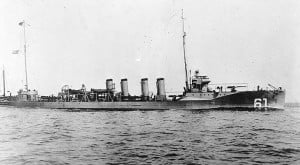
By Michael Miller - Press of Atlantic City
Retired U.S. Navy Master Chief Joseph Tidwell will return to Cape May on Sunday for the first time since he was rescued during a submarine attack off the coast in World War II.
Tidwell, 91, worked in the engine room aboard the USS Jacob Jones, a destroyer that was hunting German submarines off Cape May County.
He was one of only 11 survivors in the Feb. 27, 1942, attack that sunk the ship and killed 131 sailors. He is returning to Cape May all these years later because his grandson, U.S. Navy Cmdr. Eric Tidwell, dived on the wreck 25 miles off Cape May.
The dive Friday marked an intersection of generations and career choices that have defined the two men. The events of that freezing morning off Cape May 69 years ago nearly spelled oblivion for Tidwell and his descendants.
“It was quite a day,” Tidwell recalled by phone from his home in Middleburg, Fla.
The destroyer was named for Commodore Jacob Jones, a naval hero who defeated the British ship Frolic off the Delaware Bay during the War of 1812. The massive ship, more than 300 feet long, was built in Camden and launched in 1918 in a ceremony that featured Jones’ great-granddaughter.
Tidwell and his destroyer steamed out of New York Harbor on Feb. 27, 1942, to patrol the New Jersey coastline.German U-boat attacks were an increasing menace off the American coast in the early years of the war, prompting the hasty construction of lookout towers such as the one in Lower Township that still stands today.
Almost immediately, the crew was dispatched to the sinking oil tanker R.P. Resor about 5 miles off Manasquan Inlet.Smoke and flames from the torpedoed tanker could be seen from beaches in Monmouth County, an account in the Asbury Park Press states.
Finding no survivors, the destroyer continued its patrol that night, heading south to the Delaware Bay. Tidwell and the rest of the 141 men aboard had no idea they were being stalked by the same German U-boat that sank the tanker.