HOT NEWS !
Stay informed on the old and most recent significant or spectacular
nautical news and shipwreck discoveries

-
Concerns over future of historic City of Adelaide ship
- On 22/03/2012
- In Parks & Protected Sites

From BBCHeritage campaigners have called for an urgent rethink of plans to move the world's oldest surviving clipper to Australia.
The Sunderland-built City of Adelaide is due to be transported from Irvine, North Ayrshire, after an Australian group was named preferred bidder.
Rescue: The British Archaeological Trust said it had concerns over the funding to secure the clipper's future. Heritage Scotland said it believed the plans would mean a sustainable future.
The announcement in 2010 that Clipper Ship City of Adelaide (CSCoAL) Ltd was the preferred bidder came after a report commissioned by Historic Scotland into a number of options. The Sunderland City of Adelaide Recovery Fund (Scarf) has mounted a long-running campaign to bring the clipper back to the city where it was built.
Scarf chairman Peter Maddison is currently on board the vessel in protest at the plans to move it to Australia.The archaeological trust's Rescue News editor Pam Irving challenged Historic Scotland to prove it had evaluated CSCoAL was financially capable of giving the ship a sustainable future and claimed it had not met a series of conditions.
She said she would like to see the full justification for the Australian team acquiring the ship to be made public.
She said: "CSCoAL is being put under pressure to deliver something they can't do. They have to be let off the hook.
"This is being rushed through to a deadline. That has to be scrapped."
Mrs Irving said her fear was the ship would be moved but then left in a situation similar to that in Scotland and would continue to deteriorate.
"I think we need to have one last go to see if we can't rise to the challenge of preserving the ship in the UK where it belongs", she said.
-
Mary Rose skeletons studied by Swansea sports scientists
- On 21/03/2012
- In Conservation / Preservation

From BBC
Skeletons recovered from the wreck of a King Henry VIII's warship the Mary Rose are being studied to discover more about life in the 1500s.
Swansea University sports scientists are hoping to find out more about the toll on the bodies of archers who had to pull heavy bows.
It is documented that archers were aboard the ship when it sank in 1545.
The wreck was raised from the Solent in 1982, containing thousands of medieval artefacts.
The ship, which is now based in Portsmouth where a new museum is being built to house her, also had 92 fairly complete skeletons of the crew of the Mary Rose.
Nick Owen, a sport and exercise bio mechanist from the College of Engineering at Swansea University, said: "This sample of human remains offers a unique opportunity to study activity related changes in human skeletons.
"It is documented that there was a company of archers aboard when the ship sank, at a time when many archers came from Wales and the south west of England.
"These archers had specialist techniques for making and using very powerful longbows. Some bows required a lifetime of training and immense strength as the archers had to pull weights up to 200lbs (about 90kg)." -
Van por tesoro hundido en el Golfo de México
- On 21/03/2012
- In Underwater Archeology
Impreso Milenio
En mayo próximo un grupo internacional de investigadores zarpará en un buque de la Universidad Nacional Autónoma de México en busca de un galeón hundido en 1631 en el Golfo de México, frente a costas de la Sonda de Campeche, cargado de oro y diversos objetos, señaló Roberto Junco, investigador de la subdirección de Arqueología Subacuática del Instituto Nacional de Antropología e Historia (INAH).
En entrevista durante el Segundo Coloquio de Cultura Subacuática en México, Roberto Junco dijo que el buque hundido ha sido asediado y codiciado por cazadores de tesoros desde hace varios siglos.
Se trata de una nave considerada patrimonio nacional que será localizado por investigadores del INAH, quienes consideran que aportará información histórica muy importante.
Durante mes y medio los investigadores estarán en alta mar sobre el buque de la UNAM Justo Sierra y realizarán estudios de geofísica, sin inmersión.
Detalló se trata de un galeón español muy importante y codiciado por buscadores de tesoros y el objetivo es que no caiga en manos de cazadores furtivos, que pretendan explotarlo personalmente.
Flor Trejo Rivera, investigadora también del INAH, señaló que en nuestro país existen más de 100 tesoros arqueológicos bajo el mar, que han sido poco investigados y promovidos.
-
Secret of shipwreck solved after five-year conservation
- On 20/03/2012
- In Conservation / Preservation
From Hurriyet Daily News
Scholars have revealed that artwork and tons of pillars and winch barrels that were discovered by underwater archaeologist and researcher Can Pulak in 1993 close to the Aegean district of Çeşme originally came from Apollon Temple in Claros.
Five years of conservation work have revealed that the ship, known as the Kızılburun shipwreck, took its name from the ancient name of Marmara Island, “Prokenessos,” and sank during a storm in Kızılburun while carrying cargo to the Apollon Temple in the ancient city of Claros, according to Underwater Research Institute (INA) Director Tuba Ekmekçi.
Half of the conservation of the works that were discovered have been completed, she said.Some 16 archaeologists from the United States, Europe and Turkey brought large marble winch barrels, capitals, anchors, marble gravestone, a Hermes statue and amphoras to the Underwater Archeology Museum in the southwestern district of Bodrum.
The shipwreck was discovered during a dive by Pulak and was unearthed in 2005 as a result of work carried out by the Turkish Culture and Tourism Ministry, INA and Texas A&M University. Ekmekçi said they were waiting for permission from the ministry to exhibit the works.
-
Export permit to be issued for Baymaud shipwreck
- On 20/03/2012
- In Parks & Protected Sites
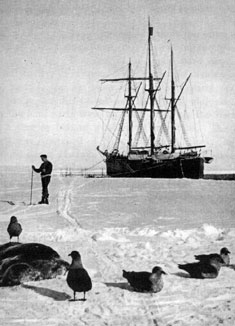
By Jeanne Gagnon - Northern News Service Online
The Canadian Cultural Property Export Review Board has directed the Canada Border Services Agency to issue an export permit for the Baymaud shipwreck, located outside Cambridge Bay, according to the project manager of Maud Returns Home.
The Baymaud, originally called the Maud, first belonged to Norwegian explorer Roald Amundsen, the first person to successfully traverse the Northwest Passage by ship.
Jan Wanggaard presented his case, outlining the group's project and emphasized the cultural importance of the ship to Norway, before the review board on March 15.
"I think they feel we have a good plan and we are well prepared to do this," he said, when reached in Ottawa.
He added they will start preparations this summer but the salvage operation itself will be for the summer of 2013.
"That is great news for us and we can now go ahead making plans and prepare ourselves for the great challenge to finally bring Maud home," said Wanggard in an e-mail statement.
Maud Returns Home, a Norwegian group supported by investment company Tandberg Eiendom, wants to bring the shipwreck back to Norway and eventually build a museum. -
Vanished shipwreck’s secret revealed
- On 20/03/2012
- In Parks & Protected Sites
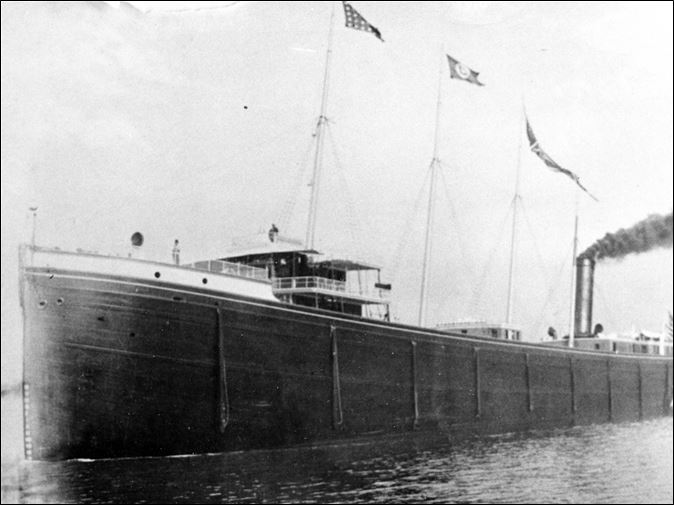
By Erica Blake - Toledo Blade
Twice during its 122-year history, the C.B. Lockwood has been swallowed up by Lake Erie.
On course from Duluth, Minn., to Buffalo and battling the fury of an October storm, the 285-foot wooden steamer first sank in 1902, crashing more than 70 feet below the waves just east of Cleveland.
The location of the Lockwood was not a mystery. With one look at historical data, its exact location — 13½ miles north by northwest off Fairport Harbor — easily can be found.
But despite being armed with a figurative “X marks the spot,” shipwreck hunters have for decades been stumped by the empty expanse of Lake Erie muck where the Lockwood should be. Until now.
More than a century after its sinking and with the use of sophisticated equipment, researchers recently determined that the Lockwood never moved, it simply sank again.
“It sank twice, once to the bottom and once below the bottom,” said shipwreck hunter David VanZandt, the director and chief archaeologist for the Cleveland Underwater Explorers, or CLUE, who discovered the twice-sunken ship.
“The entire ship was under the lake bottom,” he said. “The lake swallowed up a 300-foot wreck.” But how ?
What is known about the Lockwood has been learned through newspaper articles and maritime records. Launched from Cleveland on June 25, 1890, the Lockwood was at the time the largest wooden steamer on the lakes and the first lake propeller ship to measure 45 feet in width.
According to records provided by CLUE, the Lockwood broke a Sault Ste. Marie-to-Duluth speed record one year after its launch. But it sailed for only a dozen years when it came across bad weather while hauling a cargo of flaxseed.
The ship sank on Oct. 13, 1902, forcing its crew into two lifeboats. One boat made it to shore, the other did not. Ten crew members died. -
Groupon sells ultimate underwater bargain: a visit to the Titanic
- On 20/03/2012
- In Famous Wrecks

From GrouponThe film Titanic was more than an excuse for director James Cameron to meet his idol, Celine Dion. It was also an account of an actual event, the 1912 sinking of the RMS Titanic.
A century after the infamous shipwreck, Deep Ocean Expeditions is offering a once-in-a-lifetime package: a DVD signed by professional Leonardo DiCaprio impersonator Frank Lloyd Roberts—and the chance to descend 2 miles into the depths of the icy North Atlantic to see the "unsinkable" ocean liner at her final resting place.
A team of scientists, engineers, and RMS Titanic historians will be on hand for the 13-day expedition on a large support ship, which sets sail July 26 from St. John's, Newfoundland.
Days 1–2: A group of no more than 20 meets in St. John's at the Sheraton Hotel Newfoundland, which overlooks the harbor where the expedition will launch the following afternoon. On day 2, you'll have a chance to take in the colorful houses and mazy streets of St. John’s—the oldest English-founded city in North America—before beginning the 380-mile sea voyage toward the RMS Titanic wreck site.
Day 3: The crew of scientists and Titanic experts lecture on topics ranging from basic marine biology to the Titanic captain's preferred brand of mustache wax.MIR submersible pilot Dr. Anatoly Sagalevitch and USC professor of ocean engineering Dr. Don Walsh will share their deep-sea expertise to ready the group for the upcoming dive.
Days 4–10: On the morning of day 4, the support ship will float high above the sunken remains of the RMS Titanic. For the next week, pairs of participants and a pilot will take turns descending 12,500 feet to the ocean floor in the self-propelled MIR I or MIR II deep-sea craft. You'll get three to four hours to observe and photograph the shipwreck that few others have seen in person. In addition to century-old artifacts, you might encounter unusual marine life, including rattail fishes, squat lobsters, and anemones.
Expeditions can take place both day and night, depending on prevailing conditions.
-
Drakes Bay to being named explorer's official landing site
- On 20/03/2012
- In General Maritime History

By Bob Norberg - The Press Democrat
Exactly where Sir Francis Drake sought refuge from a storm on the West Coast 441 years ago has been a matter of study and often colorful debate for six decades, a debate that is about to be settled.
Professional and amateur archaeologists and historians since before World War II have promoted a number of different spots, from Drakes Bay at the Point Reyes Seashore to Campbell Cove in Bodega Bay and even places along the Oregon coast.
The debate even spurred a highly publicized hoax by members of E Clampus Vitus, a Gold Rush-era historical fraternity, who in 1936 fashioned an authentic-looking brass plate purportedly left by Drake that ended up enshrined in UC Berkeley's Bancroft Library.
Now, the federal government is about to put its official imprimatur on Drakes Bay in the Point Reyes National Seashore as the likely spot by granting it National Historic Landmark status.
“It is a significant step, It is the final step,” said John Dell'Osso, chief of interpretation and resource education at Point Reyes National Seashore.
The nomination was approved in November by the National Park Service's landmarks commission, a panel of scientists and archaeologists that gives all nominations a grueling and exacting review.It subsequently was endorsed by a parks service advisory committee.
Landmark status now awaits just one more step, the signature of Secretary of the Interior Ken Salazar.
“They give it another look.
They are looking to see if there are any flaws,” said Ed Von der Porten of San Francisco, a maritime archaeologist and historian.