HOT NEWS !
Stay informed on the old and most recent significant or spectacular
nautical news and shipwreck discoveries

-
Titanic band leader letter has $200,000 estimate ahead of auction
- On 27/03/2012
- In Auction News

From Paul Fraser Collectibles
A letter from the leader of Titanic's band, which played on as the ship sank, is coming for auction in the US next month.
Survivors in lifeboats are said to have recalled the band playing Nearer, My God, to Thee, before being swept into the icy waters.
The letter, written by band leader Wallace Hartley to his parents in England, is dated April 10, 1914, five days before the ship sank in the Atlantic.
"Just a line to say we have got away all right," it reads.
"It's been a bit of a rush but I am just getting a little settled. This is a fine ship & there ought to be plenty of money on her.
"We have a fine band & the boys seem very nice."
It's expected to realise between $100,000-200,000 at an online auction ending on April 26.
Hartley's body was found many weeks after the tragedy. More than 40,000 people lined the route of his cortege.
Titanic artefacts have a strong history of performing well with collectors.
A two-page handwritten letter written aboard RMS Titanic achieved $40,700 at a New York auction house earlier this month.
The fascinating tale of the band is likely to push the price of this piece much higher.
-
‘Titanic’ director reaches bottom of the world in dive
- On 26/03/2012
- In Famous Wrecks
From The Jakarta Globe
“Titanic” director James Cameron reached the deepest part of the Pacific Ocean in his solo submarine Monday in a record-setting scientific expedition.
Mission partner the National Geographic said Cameron reach depth of 35,756 feet (10,898 meters) at 7:52 a.m. on Monday in the Mariana Trench in his specially designed submersible.
Cameron is the first person to make a solo dive to the Pacific Ocean valley known as the Challenger Deep, southwest of Guam, and the first to do it since 1960, according to his team.
His first words on reaching the bottom were “All systems OK,” according to a mission statement.
He then tweeted: “Just arrived at the ocean’s deepest pt. Hitting bottom never felt so good. Can’t wait to share what I’m seeing w/ you.”
He planned to spend up to six hours on the Pacific Ocean sea floor, collecting samples for scientific research and taking still photographs and moving images.
The research vessels Mermaid Sapphire and Barakuda, were waiting for Cameron to make his long ascent.
“We’re now a band of brothers and sisters that have been through this for a while,” marine biologist Doug Bartlett told National Geographic from the ship before the dive.
Cameron’s goal is to bring back data and specimens from the unexplored territory. He was expected to take 3D images that could help scientists better understand the deep sea environment.
Upon touchdown, Cameron’s first target was a phone booth-like unmanned “lander” dropped into the trench hours before his dive.
Using sonar, “I’m going to attempt to rendezvous with that vehicle so I can observe animals that are attracted to the chemical signature of its bait,” Cameron said before the dive. -
Tsunami ghost ship spotted off British Columbia
- On 25/03/2012
- In Maritime News
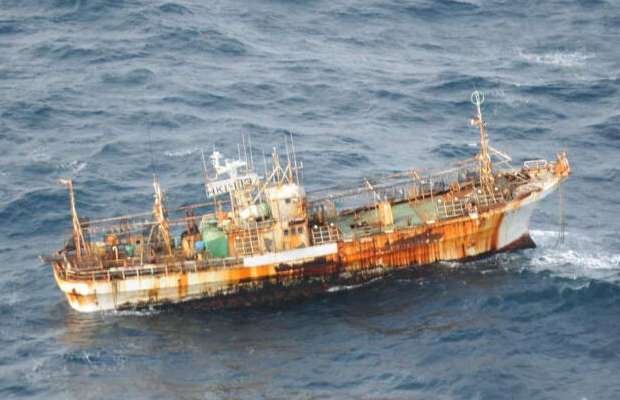
By Mike Schuler - gCaptainMore than a year after the 2011 earthquake and tsunami devastated Japan, a Japanese fishing boat has been found drifting aimlessly off the coast of British Columbia.
The beat up 150-foot trawler was spotted on March 20 by an aircraft while on a routine patrol approximately 150 nautical miles from the southern coast of Canada’s Haida Gwaii islands, drifting south.
Officials have traced the boat to a squid fishing company in Japan, who had confirmed no one was believed to be on the vessel when the tsunami struck.
NOAA, among other organizations, have been warning that marine debris generated by the earthquake and tsunami that struck Japan in March 2011 would be making its way across the Pacific, posing navigational hazards to vessels and threatening coastlines, but what, when, and where the debris is expected to wash up has been difficult to predict.
For more information on tracing marine debris from Japan’s earthquake and tsunami check out this video below and read gCaptain’s coverage on Tracking Marine Debris from the Japanese Tsunami.
-
Archaeologists reconstruct diet of Nelson's Navy
- On 24/03/2012
- In Miscellaneous
From EScience News
Salt beef, sea biscuits and the occasional weevil; the food endured by sailors during the Napoleonic wars is seldom imagined to be appealing.
Now a new chemical analysis technique has allowed archaeologists to find out just how dour the diet of Georgian sailors really was.
The team's findings, published in the American Journal of Physical Anthropology also reveal how little had changed for sailors in the 200 years between the Elizabethan and Georgian eras.
The research, led by Professor Mark Pollard from the University of Oxford, focused on bones from 80 sailors who served from the mid-seventeenth to the mid-eighteenth centuries and were buried in Royal Naval Hospital cemeteries in Plymouth and Portsmouth.
"An isotopic analysis of bone collagen from the recovered skeletons allowed us to reconstruct average dietary consumption," said Dr Pollard. "By comparing these findings to primary documentary evidence we can build a more accurate picture of life in Nelson's navy."
In the late 18th century the Royal Navy employed 70,000 seamen and marines. Feeding so many men was a huge logistical challenge requiring strictly controlled diets including flour, oatmeal, suet, cheese, dried pork, beer, salted cod and ships biscuits when at sea.
The team's analysis shows that the diet of the sailors was consistent with contemporary documentary records such as manifests and captain's logs.
As well as validating the historical interpretation of sailors' diets, this finding has implications for the amount of marine protein which can be isotopically detected in human diets.
The bones in Portsmouth were also able to show where the sailors had served. The team's results show that even when serving in naval theaters ranging from the UK and English Channel to the West Indies or the Mediterranean, the sailors converged in dietary terms into a 'naval average', due to the strict consistency of diet.
The results also showed that sailors in buried in Plymouth spent more time off the American coast than those buried at Portsmouth, which is consistent with the sailing records. -
Coins from shipwrecks become wearable treasures
- On 24/03/2012
- In Miscellaneous

By Molly Mosher - The Walton Sun
Before La Vie Est Belle’s pearl and leather jewelry was famed along County Road 30A, the shop’s shipwreck coins were altering the course of history.
Owner and local artist Wendy Mignot has been crafting pearl and leather jewelry since 1994, but did not start pairing the pieces with shipwreck and ancient coins until 2008, giving customers a beautiful opportunity to wear history.
The coins are sourced from shipwrecks and from ancient times, and are all authentic and guaranteed.
La Vie Est Belle manager Aimee Alderson says some of her favorite salvaged coins come from the ship El Cazador, which went down in the Gulf of Mexico in 1784.
The ship was commissioned by Monarch Philip III of Spain and was traveling from Vera Cruz, Mexico, to the Louisiana Territory to stabilize the Spanish monetary system there.
Laden with 450,000 pesos of silver reales, the ship sank for unknown reasons.
Spain lost its hold on the Louisiana territory, and the land was sold to France’s Napoleon. France was also unable to financially support the colony.
“For that reason, France sold the Louisiana territory to the United States,” said Alderson of our 1803 acquisition.
Another of the treasure troves from which La Vie Est Belle sources its coins is the 1681 shipwreck of Santa Maria de la Consolacion, also a Spanish galleon.Captained by a man named Sharpe, the ship was pursued by pirates, and eventually ran aground on a reef on Isla de la Muerto near Guayaquil, Ecuador.
To thwart the pirates’ efforts, Sharpe evacuated his crew and set the ship aflame. Rumor has it the island where the ship ran aground is called “The Island of the Dead” because the pirates, in anger, killed the crew members.
Now coins from the berths of the two ships have been given new life by Wendy, who sets them in golden bezels. -
New pictures of Titanic wreckage
- On 23/03/2012
- In Famous Wrecks

From KPLR11“Some of the richest people in the world board in France, some of the poorest people in the world board in Ireland, and a mix survive,” said Robert Sullivan, managing editor of Life Books in New York City.
“It turns out to be an extraordinary variety of stories.”
The book begins with the construction of the Royal Mail Ship RMS.L Titanic as one of three sister ships built by the White Star line to usher in a new era of opulent sea travel.It offered the finest accommodations to first-class passengers such as New York notables John Jacob Astor IV, his pregnant wife Madeleine, and Benjamin Guggenheim on its first sailing from Southampton, England to New York, via Cherbourg, France and Queenstown, Ireland.
They were joined by lesser lights such as Margaret, now popularly referred to as “Molly”, Brown. Born in Missouri to Irish immigrants, Brown’s husband, from whom she had separated by the time of the voyage, had made a fortune in mining.
Other people travelled in less luxurious quarters, including Clear Annie Cameron, a 35-year old personal maid in London seeking her opportunity in America.For many, the separation of class and wealth ended when the Titanic sank beneath the waves. There are no photographs of the Titanic’s final moments.
But included in the book are remarkable images taken by an Irish Cleric Father Frank Browne who boarded the boat in Southampton, travelled to Cherbourg and then disembarked in Queenstown, the ship’s final departure point before it headed across the Atlantic.
They offer perhaps the only public glimpse into ship board life aboard the Titanic.The book also details the ill-fated and random rendezvous with the ice berg, the attempts to get help using then state-of-the-art radio, and ultimately the horror as hundreds of passengers realized there were too few lifeboats and in allowing women and children first, many men would die.
Among them Isidor Straus, co-owner of Macy’s department store. Alongside him his wife of 40-years, Ida, who decided they should die together.
“What do you do in the moment of truth ?,” said Life's Sullivan. “These stories, you can’t make them up.”
Hundreds of passengers in the few available lifeboats were rescued by the Carpathia, captained by Arthur Henry Rostron, only hours after the sinking. But too many died in the icy Atlantic. -
Coastal development destroying reefs off phuket
- On 22/03/2012
- In Maritime News

By Pongphon Sarnsamak - Nation Multimedia
Massive land development in Phuket province will be strictly controlled by environmental regulations after findings that large amounts of sediment caused by construction has destroyed a large area of coral reefs and marine ecosystems.Over 250 square kilometres of coral reef surrounding Phuket's Tang Khen Beach had been covered by a massive amount of sediment from land development, according to a study by Phuket Marine Biological Centre.
It said that previously over 250 rai of coral reef at the end of Cape Panwa's Ao Tang Khen was alive. However, coral reefs, particularly staghorn corals, had been totally destroyed. It was now covered by a large amount of sediment - from the seaport and building of three hotels in the area.
There has been massive land development in coastal areas of Phuket over the past five years. Over 100 areas on the coast and mountains, especially western beach areas such as Patong, Ka Ta, Karon and Kamala, were opened and dredged to build resorts.
The large number of building and land projects would hit marine resources, particularly coral reefs around Phuket province, which is a top destination for tourists around the world.
Niphon Pongsuwan, a coral expert who conducted the study, said he was worried the removal of land surfaces in mountainous and coastal areas would accelerate the amount of sediment flowing into the sea, harming reefs and aquatic animals and plants.
His team is now monitoring the changing of coral reefs and marine ecosystems, especially "at risk" areas such as Patong, the north of Ka Ta, the eastern part of Phuket, and Koh Rad.
An evaluation will be conducted every six months. Preliminary investigation results have found that staghorn coral can no longer live there due to the changing marine ecosystem.
-
Gypsy Blood, boat involved in fatal dive Sunday
- On 22/03/2012
- In Maritime News
By Stephanie Loder - Ashbury Park Press
A man who died Sunday while diving off the Gypsy Blood is the third person to either die or be injured in a dive since 2008 aboard the same ship.
The name of the man who died Sunday was not released by the Coast Guard because of the ongoing investigation, which involves two previous incidents in 2010 and 2008.
On July 31, 2010, a woman was pronounced dead at Jersey Shore University Medical Center in Neptune after a diving accident in the ocean about 15 miles east of Shark River.
The woman, whose name wasn’t released, was found under water after she failed to surface from a dive from the Gypsy Blood.
A crew member aboard the Gypsy Blood contacted the Coast Guard in 2010 to say the woman had been missing for about 35 minutes. A dive master aboard the Gypsy Blood, which is home ported in Brielle, soon located her under water, according to the Coast Guard.
In the 2010 incident, the woman was administered CPR until a Coast Guard Air Station Atlantic City helicopter crew arrived and flew the woman to the hospital. She was transported directly from the Gypsy Blood, according to a statement by Jim Wilson, the boat’s captain in 2010.