HOT NEWS !
Stay informed on the old and most recent significant or spectacular
nautical news and shipwreck discoveries

-
Advanced images shed new light on Titanic
- On 05/04/2012
- In Famous Wrecks

From Hydro International
Newly released images of the Titanic wreck site have provided the first unrestricted view of the maritime heritage site.These images supplement the collection of images published in the April 2012 issue of National Geographic magazine.
For the first time, both the public and marine archaeologists can view the wreck as if the ocean were removed from the site.
The image mosaics are part of a collection containing over 200 optical mosaics created by the Advanced Imaging and Visualization Laboratory (AIVL) at the Woods Hole Oceanographic Institution (WHOI).
The AIVL, led by Bill Lange, used optical and sonar images collected during the expedition by a specially equipped remotely operated vehicle (ROV) and two autonomous underwater vehicles (AUVs), to stitch together the richly detailed, comprehensive views of the ship and wreck site.
The vehicles carried a combination of sonar used to make wide-area maps and advanced 3D camera systems used to conduct detailed forensic-type investigations.
Although the individual robotic systems provided new information about some pieces of Titanic, the fusion of the imagery provides for the first time a comprehensive view of the wreck site.
-
James Cameron: 'Avatar' sequels to draw on 'master navigators'
- On 05/04/2012
- In People or Company of Interest
By Rebecca Keegan - Baltimore Sun
James Cameron's alpha geek extracurricular hobby of deep-sea diving has always influenced his day job.
The bioluminescent life on Pandora in “Avatar,” the story-framing voyage to the wreck in “Titanic” and the underwater traumas of “The Abyss” all emerged from how the director spends his downtime — way, way down in the ocean.
Now Cameron’s recent record-setting solo dive to the Mariana Trench is providing further inspiration for the “Avatar” sequels, which will head to the oceans of Pandora.
The filmmaker said the seven-year preparation for his dive–a plunge of nearly seven miles to the deepest point in the world in a torpedo-shaped, one-man submersible called the Deepsea Challenger — sparked ideas for the “Avatar” followups by exposing him to the small island nations of the Western Pacific where he staged the project.
“The best inspiration I got for ‘Avatar’ 2 and 3 was dealing with the culture in Micronesia,” Cameron said by phone from Tokyo on Friday, where he attended the Japanese premiere of “Titanic 3D.”
The Micronesians, a seafaring culture who navigated the Pacific for centuries without the aid of compasses or charts, already have a lot in common with the blue Na’vi residents of Pandora — they’re an indigenous, matrilineal culture, colonized by outsiders.
And the cerulean and aquamarine tones of “Avatar” and its inhabitants seem drawn from postcards from the watery Micronesian region.
-
IU archaeologists keep up Caribbean shipwreck work
- On 05/04/2012
- In Museum News
From Indy Star
Silver coins and other artifacts recovered from shipwrecks off the Dominican Republic coast by Indiana University researchers over the years went on display Tuesday at the Children's Museum in Indianapolis.
The artifacts were collected as part of the university's ongoing efforts to work with the Caribbean country to establish underwater museums in the many shipwrecks off its coast.
The artifacts found by IU underwater archaeologists over the years include silver coins recovered from the 1725 wreckage of the Spanish merchant vessel Nuestra Senora de Begona, as well as older items from the indigenous Taino tribes, The Herald-Times reported.
Charles Beeker, director of IU's Office of Underwater Science, said the items on display represent spillage from the wreck, but he is confident the remains of the ship are nearby.
IU investigators learned after a trip to examine records in Saville, Spain, that the Begona was a merchant vessel that made stops throughout the Caribbean before it encountered rough weather in the Caribbean Sea and ultimately had to be beached by the captain. It broke up and sank off what is now the Dominican Republic.
-
Revisiting the dramatic story of HMS Drake
- On 04/04/2012
- In Festivals, Conferences, Lectures
From Coleraine Times
The dramatic story of HMS Drake and its watery resting place off the coast of Rathlin Island is just one of the subjects in the spotlight at Flowerfield Arts Centre on Wednesday April 4, as maritime heritage authority Ian Wilson comes to Portstewart for an illustrated talk.
The evening, which starts at 8pm, is being offered in association with Rathlin Island Books, who have just published the latest book by Ian, a former history teacher at Coleraine Inst.
HMS Drake: Rathlin Island Shipwreck tells for the first time the full story of the sinking in October 1917 of the Royal Navy armoured cruiser, now forever associated with Rathlin Island and the north coast.
Ian Wilson, the foremost authority on Ulster’s maritime history, whose publications include amongst others, Shipwrecks of the Ulster Coast, Donegal Shipwrecks, and Ulster’s Ships and Quaysides has now focused his attention on HMS Drake, arguably the most famous shipwreck in Northern Ireland waters, lying in Church Bay, Rathlin Island.
Accompanied by historic and contemporary stills and moving images, Ian will be presenting a look back over his career charting the role of ships, shipwrecks and maritime culture in the context of their times, and today’s.
The dramatic story of the day that some of the horrors of the Great War came to Rathlin’s quiet shores will be vividly brought to life:
‘A light westerly breeze is lifting early morning mist over calm waters… Kapitanleutnant Rohrbeck observes with sudden excitement a cruiser through his periscope. She has four tall funnels and two masts.
-
Action should be taken to protect shipwrecks
- On 04/04/2012
- In Parks & Protected Sites
By Troy Patterson - Kincardine News
Marine heritage experts are looking at the condition of two local shipwrecks as an opportunity for their host communities to act and prevent further degradation of the sites that claimed lives over a century ago.
The clear, calm and noticeably low Lake Huron water levels on March 21 revealed a far greater amount of the shipwreck Ann Maria on Kincardine's Station Beach than had been in recent years, while increasingly landlocking the Erie Belle boiler on Boiler Beach down the shore in Huron-Kinloss.
The Ann Maria was an American schooner that missed the harbour entrance on Oct. 7, 1902 and was smashed by waves in the shallows off of Kincardine's beach.
It has been visible for years as water levels have receded. Most of the time, the keel is visible as waves lap at its rusting hull spikes and the massive timber that has weathered winters for over 106 years.
A combination of the lack of ice cover this past winter and wave action has uncovered even more of the ship, with a large portion of the Ann Maria's hull ribbing visible and over 12 feet of the keel visible just under the waterline and another eight feet on shore, with spikes sticking up out of the sand.
The Walker House Museum, which sits across the street from the historic Kincardine Lighthouse and Ann Maria anchor, which was placed there in 1966, has shown interest in protecting the wreck alongside the municipality, but neither has the knowledge or experience to know how to handle such a project.
Last November, after a The Kincardine News feature on local shipwreck artifacts from the Erie Belle, Carter and George R. Clinton was published and the items were donated to the museum, the Ontario Ministry of Tourism and Culture scolded the museum and diver Carl LaFrance for retrieving the artifacts, which under Ontario law is against the law, but wasn't when LaFrance retrieved them before the Ontario Heritage Act was put in place in the 1980's.
The MTC later gave its blessing to see the artifacts; the Erie Belle compass, brass steam vent, chain link and other items, along with the ships log from the J.N. Carter, preserved in the local museum.
The Kincardine News then questioned the MTC and Ontario Underwater Council as to why Kincardine's wrecks are allowed to fall victim to nature along the shoreline.
The MTC also revealed that none of the Kincardine-area wrecks are registered with the government agency.
-
Is this the iceberg that sunk the Titanic ?
- On 03/04/2012
- In Auction News
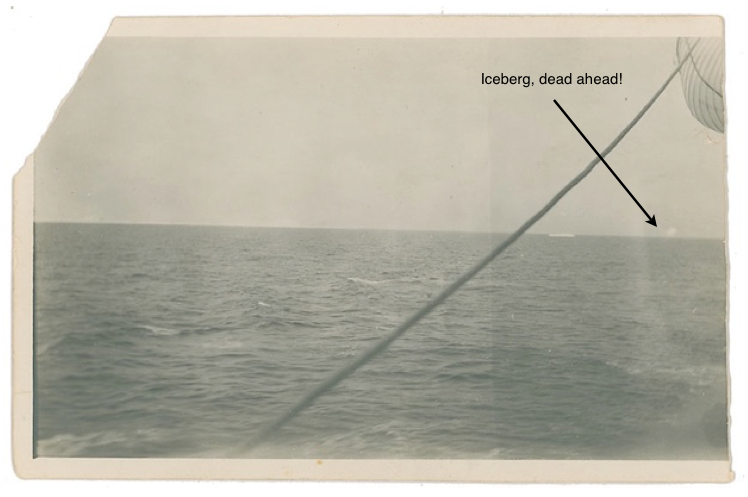
By Mike Schuler - gCaptainAuctioneers have unearthed an original photograph of the gigantic iceberg that sunk the Titanic nearly 100 years ago, or at least so they claim.
The photo was taken just hours after the ship went down by a passenger aboard the RMS Carpathia, a Cunard Lines transatlantic liner made famous after rescuing over 700 survivors from their lifeboats.
Now, whether or not the iceberg is the actual iceberg responsible for sinking the unsinkable can be debated, but how many massive icebergs were in the immediate vicinity of the scene and large enough to do the duty? Judging from the photograph, not many.
The photograph, along with other Titanic memorabilia, is being auctioned off on April 19th as part of RR Auction’s 100-Year Anniversary Titanic auction Bidding for the photo starts at $300.
-
Shipwrecks Symposium draws record crowd
- On 02/04/2012
- In Festivals, Conferences, Lectures

By Maryanne Firth -The Tribune
It's the best place for divers — aside from the water, of course.The 18th annual Shipwrecks Symposium hosted by Niagara Divers' Association drew a record crowd to Centennial Secondary School on Saturday.
More than 500 people attended the day-long event, which featured a wealth of impressive speakers well-known to the scuba-savvy community.
"It's a record day," said organizing committee member Ian Marshall, adding this is the first time in its lengthy history the event has cracked the 500-person mark.
He chalks it all up to the calibre of speakers that were on this year's program, including the likes of Jill Heinerth, a pioneering underwater explorer and award-winning filmmaker, Robert Osborne, an avid diver and senior field producer for the CTV documentary program W5, and Mike Fletcher, known for his work as dive co-ordinator for the series The Sea Hunters on National Geographic Channel, as well as for lending his expertise to other broadcasters such as History Television and Discovery Channel.
Presenters covered a variety of topics, including water conservation, underwater photography, and, of course, experiences with the wealth of shipwrecks found in the Great Lakes and beyond.
Along with the intriguing topics, Marshall believes the unusually warm spring temperatures helped encourage the increase in attendance.
The warm weather is a reminder the dive season is nearing, he said, and people begin to get anxious.
Some have even put their wetsuits on and taken a dip already thanks to Mother Nature's warmer-than-normal season opening.
People travel from as far as Newfoundland, Calgary, and even England to attend the symposium, which Marshall calls the "only one of its kind."
It's the only symposium that focuses mainly on shipwrecks, he said, and it does so because of its proximity to the Great Lakes — where the "best wreck diving in the world" can be found.
For many people, the event is an annual tradition that unofficially kicks off the approaching dive season. About 60% of the crowd, on average, returns years after year.
While there are always a number of recognizable names on the registration list each year, this time around there was an increased number of new faces in the crowd — a sight the association is always happy to see.
-
Ship swallowed by Lake Erie, then by lake bottom
- On 02/04/2012
- In Parks & Protected Sites

Photo Scripps Media
By Erica Blake - News Net5Twice during its 122-year history, the C.B. Lockwood has been swallowed up by Lake Erie.
On course from Duluth, Minn., to Buffalo and battling the fury of an October storm, the 285-foot wooden steamer first sank in 1902, crashing more than 70 feet below the waves just east of Cleveland.
The location of the Lockwood was not a mystery. With one look at historical data, its exact location -- 13 1/2 miles north by northwest off Fairport Harbor -- easily can be found.
But despite being armed with a figurative "X marks the spot," shipwreck hunters have for decades been stumped by the empty expanse of Lake Erie muck where the Lockwood should be. Until now.
More than a century after its sinking and with the use of sophisticated equipment, researchers recently determined that the Lockwood never moved, it simply sank again.
"It sank twice, once to the bottom and once below the bottom," said shipwreck hunter David VanZandt, the director and chief archaeologist for the Cleveland Underwater Explorers, or CLUE, who discovered the twice-sunken ship.
"The entire ship was under the lake bottom," he said. "The lake swallowed up a 300-foot wreck." But how ?
What is known about the Lockwood has been learned through newspaper articles and maritime records. Launched from Cleveland on June 25, 1890, the Lockwood was at the time the largest wooden steamer on the lakes and the first lake propeller ship to measure 45 feet in width.
According to records provided by CLUE, the Lockwood broke a Sault Ste. Marie-to-Duluth speed record one year after its launch. But it sailed for only a dozen years when it came across bad weather while hauling a cargo of flaxseed.
The ship sank on Oct. 13, 1902, forcing its crew into two lifeboats. One boat made it to shore, the other did not. Ten crew members died.
Within days of its sinking, the Lockwood was found and charted. Within weeks, the wreck was marked with buoys. But yet, decades later, scuba divers can find only a few empty lifeboat cranes and some strange markings in the muck when they go to the site.
"The difficulty about it (is) we had excellent location information," said CLUE chief researcher Jim Paskert, who began looking for the Lockwood in the mid-80s.
"We redid the map and checked all the information, and `Boy, this is where it should be, and we're here, and there's nothing here.'?"