HOT NEWS !
Stay informed on the old and most recent significant or spectacular
nautical news and shipwreck discoveries

-
Hungarian combat divers Of Debrecen explore shipwreck
- On 01/06/2012
- In World War Wrecks

From Xpatloop
After 60 years, combat divers of the Hungarian Defence Forces are to dive into sea again.They are participating in mapping the wreck of SMS Franz Joseph I, a battle cruiser of the Austro-Hungarian Monarchy lying at a depth of 45 meters.
WO Bence Miklós, S/Sgt. Zsolt Horváth, Sgt. Lajos Bíró and L./Sgt. Péter Hollós, the combat divers of the HDF 5th ‘Bocskai István’ Infantry Brigade 24th ‘Bornemissza Gergely’ Reconnaissance Battalion set out for the Adriatic Sea on May 25.
The ship christened “SMS Kaiser Franz Joseph I” took part in several sea battles until it was allocated to France after World War I.
It sank at the entry to Cattaro Bay on October 17, 1919 when it foundered during a storm.
The fact that it lies exactly on the Montenegrin–Croatian border makes the exploration of the shipwreck more difficult, so that for several decades, the Hungarian specialists had not received permits for documenting its condition.
It was the staff of Czakó Diver Ltd that took the first photos of the battle cruiser in 2007.
On May 25 the Hungarian divers are to visit the battle cruiser “Franz Joseph I” again.
László Czakó, the leader of the expedition told us that this time they are allowed to swim into the ship to take photos and video footages but they cannot remove anything because Croatian laws give protection to artifacts older than 70 years.
They have such a small window of opportunity to explore the wreck that the only way for them to do a thorough and quick job is by requesting assistance from the divers of the Hungarian Defence Forces who are tasked with underwater security and observation, and carry out other missions to help the documentation process.In this way, by doing professional work they provide assistance with the detailed exploration of the sunken cruiser’s condition.
-
First underwater museums in Africa to be built in Mombasa
- On 01/06/2012
- In Museum News
From The Star
The National Museums of Kenya is in the process of setting up Africa’s first underwater museums to study marine life and shipwrecks in the coast region.
Archeological studies have already discovered over 35 ship wrecks in the Coastal line in the Indian Ocean which could be turned into underwater museums.
The museums, according to the experts, would not be like the normal museums with buildings but the old shipwrecks that shall be turned to attraction sites where visitors could visit and see them.
Head of Archaeology at the National Museum of Kenya Cesar Bita said because of the heavy costs of setting up the project, they had identified five shipwrecks that would be set up for a start before embarking on the others.
Speaking on the phone, he said study and excavation work for the three shipwrecks in Mombasa was complete with all the information gathers and expected the construction work to begin soon adding that the first museums will be ready after two years.
“Under water museums are not buildings but entails the development and preparations of shipwrecks that are underwater for people to be able to see,’’ he said.
He said the ships wrecks were spread all over Lamu, Mombasa, Malindi , Watamu and the South coast adding that each individual shipwreck would act as a Museum of its own.
Bita said experts would dive under the water and install information and clean the area to ensure safety measures are put in place for those who would tour the museums.
-
Wreck of jewel-laden ship 'found' near Stockholm
- On 31/05/2012
- In Treasure Hunting / Recoveries
From The Local
Divers working in the Stockholm archipelago believe they have discovered the wreck of the legendary Swedish royal ship the “Resande Man” which famously disappeared carrying the crown jewels en route to Poland in 1660.The missing wreck of the Resande has near mythical-status in Swedish maritime history, as the ship was said to have been carrying a wealth of royal treasure to Poland when it sank in tempestuous weather.
The divers, who made the discovery off the shores of Nynasham, south of Stockholm, believe the evidence points towards their find being the same ship, wrote the Svenska Dagbladet newspaper (SvD).
We have the 17th century sources about the sinking and we’ve studied the currents and the winds and gone through earlier recorded searches for the ship,” explained expedition leader Michael Ågren to the paper.
The ship we’ve found is in the right relation to the currents and winds that caused the accident, is from the right era, and is the same size as the Resande.
Ågren has also speculated on what may remain inside the ship, even though some of the relics were salvaged in 1661, wrote SvD.
We chose to search for this ship because it has such an interesting and well documented history. And not everything was salvaged. There may be gold, as well as jewels and seal of the crown,” he told the paper.
The divers had access to such precise information of the ship’s sinking thanks to a crewman who survived the ordeal and wrote meticulous notes about the incident.
The ship, which carried over 60 passengers and crew, sank on the 18th November in 1660. -
Uncorked: Wines from a 200-year-old shipwreck
- On 31/05/2012
- In Miscellaneous
By Pat Kettles - Anniston Star
First we had fake wines allegedly belonging to Thomas Jefferson. The bottles were even engraved with his initials. Although, upon examination by experts, the engraving was determined to be the product of a modern-day dentist’s drill.
More recently, Indonesian national Rudy Kurniawan was indicted by a federal grand jury in New York on four counts of mail and wire fraud for selling counterfeit wines. The FBI raided Kurniawan’s Los Angeles home and found a complete lab for producing fraudulent wines.
In both cases, questionable wines were vetted by top auction houses and connoisseurs. Wine professionals waxed ecstatic over these old wines, and rich collectors paid out the wazoo for them.
In their defense, the New York indictment describes Kurniawan as “a wizard at concocting fake wines by mixing and matching younger, less valuable wines that mimicked the taste, color and character of rare and expensive wines.
Given these scenarios, I cautiously relate the following tale. In July 2010, news outlets reported a rare find by seven Swedish divers, who discovered a cache of 30 ancient bottles off the Finnish Aland Islands at a shipwreck site 200 feet down on the ocean floor.
A dive instructor brought up a single bottle, hoping to determine the age of the wreck. Upon opening, the bottle contained sweet champagne tasting of oak and tobacco.
The wine was thought to be from the Champagne house of Veuve Clicquot, founded in 1772. Divers believed this cache might have been destined for Imperial Russia, sent by King Louis XVI of France.
The oldest known bottle of champagne still in existence is a bottle of Perrier-Jouët from 1825.
These found bottles could have dated from the 1780s. A wine still drinkable at this age is remarkably rare. Its drinkability was attributed to ideal preservation conditions on the dark, cold floor of the Baltic Sea.
The first bottle, believed to be Veuve Clicquot, was auctioned by New York auction house Acker, Merrall and Condit last June. It was snapped up by an anonymous bidder in Singapore who paid around $40,000.The same bidder paid around $30,000 for an earlier offering of a single bottle of Juglar, a now defunct champagne house. The cache at the time of the auction was said to be 148 bottles.
-
Shipwreck mystery surfaces
- On 30/05/2012
- In Parks & Protected Sites

By Charles Waterhouse - The MercuryA mysterious ship wreck has emerged again from its sandy grave at Long Beach in Sandy Bay.
Recent stormy seas and winds this week exposed the rotting wooden hull of the vessel the identity of which remains unknown.
Elizabeth Bondfield, maritime heritage co-ordinator at the Tasmanian Museum and Art Gallery and the Maritime Museum of Tasmania, said stormy weather sometimes removed enough sand to bring buried treasures, such as the wreck, to the surface.
The wreck last made news in April 2006 when theMercury reported it was protruding from its sandy home.
Ms Bondfield said while photographing wrecks was encouraged it was important people did not touch shipwrecks because often sand protected them so future generations could learn about them.
-
Ancient shipwrecks unearthed in landmark waterway
- On 30/05/2012
- In Underwater Archeology
From China
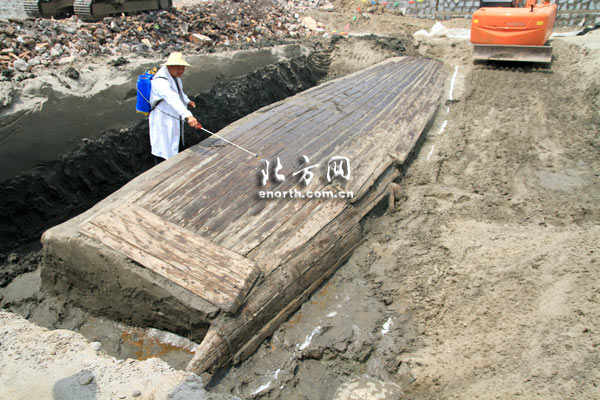
Archaeologists in Tianjin announced on Monday they have excavated two shipwrecks that were buried for centuries under the Grand Canal, the longest artificial waterway in the world.More than 600 artifacts have been recovered from the sunken vessels, which date back to the Ming Dynasty (1368-1644), according to the Tianjin Cultural Heritage Protection Center.
The wrecks first came to light in April, after workers dredged a section of the canal in the northern municipality of Tianjin, said Mei Pengyun, director of the center.
After the month-long excavation, experts revealed fragments of one ship and the well-preserved structure of another. A large numbers of bricks, ceramic pieces, bone and wooden wares were found scattered around the site, Mei added.
The second ship, measuring 13 meters long, is believed to have been a barge that once plied the 1,776-km canal, which stretches through several provinces in north and east China.
The discovery will provide precious insights into the development of ancient Chinese ships and China's water transport history, as well as benefit China's application to secure World Heritage status for the Grand Canal.
The Beijing-Hangzhou Grand Canal was once a major waterway linking Beijing and resource-rich Hangzhou, capital of east China's Zhejiang Province.
The oldest sections of the canal were built 2,500 years ago, and they were linked together in the Sui Dynasty (581-618). Part of the canal is still in use today.
-
U.S. Navy exploring Curtiss SB2C Helldiver WWII wreckage
- On 30/05/2012
- In Airplane Stories
By Evan Axelbank - WPTV
Divers from the United States Navy have set up shop off the coast of Jupiter.
They're exploring a plane wreck from World War II discovered by local diver Randy Jordan.
"I really feel like, finally, we're going to find out who belonged to that airplane and if somebody is in it," Jordan said.
He stumbled upon the wreckage of a Curtiss SB2C Helldiver in December. Instructed to not touch the tiny two-seater, all he could do was wonder. "I was starting to lose hope we were going to find out too much about it. It's in 185 feet of water," Jordan said.
But two weeks ago, the Navy called to say they'd be coming with a team of divers and with archeologist Heather Brown.
"We're here to preserve the history and heritage of the Navy. This is one of the planes that helped fight World War II," Brown said. Brown suspects that the plane was part of the many training missions conducted near South Florida.
But to find out for certain -- and whether anyone went down with the plane -- is to find the plane's records. Divers unscrewed this corroded data plate from the plane's tail Thursday.
-
Warren whaling ship wreck found in Argentina ?
- On 30/05/2012
- In Underwater Archeology

By Ted Hayes - East Bay RI
A shipwreck that lies half buried in the muck and sand of an Argentinian bay could be the last remains of a whaling vessel that was built in and sailed out of Warren during the waning years of American whaling.Marine archaeologists from Argentina's National Institute of Anthropology believe they may have found the remains of the Dolphin, a 110-foot whaling bark built in 1850 by Chace and Davis, a shipbuilding firm in operation between Company and Sisson streets for much of the 19th century.
The wreck is beached along the coast of Argentina at Puerto Madryn in Bahia Nueva (New Bay), 5,900 miles by air from Warren. Parts of it show signs of having been burned and it is partially visible at low tide.
Much of the structure above the keel is gone, leaving a section of wreckage about 80 feet long.
Argentinian archaeologist Cristian Murray said that while some locals had known about the wreck for many years, it was first noted by archaeologists in 2002 when shifting sands revealed a larger area of wreckage than was previously visible.
Field work at the site is mostly complete, and the focus now is on coming up with a preservation plan to prevent its deterioration, and positively identifying the wreck.
The detective work has been aided by the Warren Preservation Society and Walter Nebiker, the author of a comprehensive history of Warren whaling that is as yet unpublished.
"The archaeological evidence is consistent with the documentary evidence that we have already found about this ship, but we can not confirm (the identity) until we make comparisons with other documents, like the ship plans, that we could not find yet," Mr. Murray wrote in an e-mail to the Times this week.