HOT NEWS !
Stay informed on the old and most recent significant or spectacular
nautical news and shipwreck discoveries

-
Excavation of famed Chinese warship underway
- On 03/08/2016
- In Underwater Archeology

From Victor Ning - CRI
The shipwreck that was code-named "Dandong No.1" has been tentatively identified as the Cruiser Zhiyuan of the Beiyang Fleet.
But Song Jianzhong with the National Center of Underwater Cultural Heritage says it is still too early to make a final conclusion on the ship and its history."The relics and information currently in hand indicates it's the wreck of the warship Zhiyuan, but more work needs to be done before the publishing of the final conclusion."
The shipwreck was first discovered in 2013.
In the past month, over a hundred relics have been salvaged from the depths of the Yellow Sea, including canons, shells, and other artillery. The most crucial piece of evidence for the ship's identity is a shattered porcelain plate that features the words 'Zhiyuan' written in the middle of its back.
Song Jianzhong says all of the recovered items will studied further.
"Archaeology mainly focuses on the investigation, excavation, study and protection of cultural relics. Items to be found during the current underwater probe will be sent to labs where they will undergo procedures of de-watering, desalination and de-sulfated before being renovated and pieced together."
Also among the findings is a boiler cap found 30 meters away from the wreck at the bottom of the sea.
Sa Su, a Chinese scholar of Japanese studies, says the artifact could reveal details of the final moments of the brave sailors who operated the ship during combat.
"It's said that the sailors sealed the boilers at last in the hope of enabling them to generate more power and make the ship run faster than usual. Only with that, could it catch up with Japanese warships that were more advanced. But as seawater poured in after Zhiyuan's hull was penetrated by shells, the boiler exploded with the cap blown out."
The 2,300-tons warship, with 246 officers and soldiers aboard, was lost in the Battle of the Yellow Sea on September the 17th, 1894, during the first Sino-Japanese war.
-
US WWII tank from Barents Sea bottom
- On 25/07/2016
- In Salvage

From TASS
Russia’s Northern Fleet divers have raised a US Sherman WWII tank from the bottom of the Barents Sea during drills, acting Head of the Fleet’s press office Andrei Luzik said on Tuesday.The Sherman tank is the second combat vehicle recovered from the US Arctic convoy ship Thomas Donaldson sunk by a German submarine during World War Two.
"In addition to the tank, a 102mm gun, an antiaircraft machine gun and a pair of locomotive wheels, as well as a number of small items like artillery shell casings and projectiles were brought to the surface," the officer said.
The Northern Fleet personnel are using two diving boats with operational pressure chambers and a team of medical specialists for descents to the sea bottom, the officer said.
Also, remotely operated vehicles are being used to survey objects under the water, he added.
-
Recovered gold from SS Islander up for sale for $4 million
- On 25/07/2016
- In Treasure Hunting / Recoveries

By Paul Gilkes - Coinworld
Twelve-hundred troy ounces of Alaskan Gold Rush gold recovered in 2012 from the 1901 shipwreck of the SS Islander is being offered for $4 million exclusively through private treaty by Fred N. Holabird from Holabird Western Americana Collections LLC.The gold is unrefined placer gold contained in five original leather pokes, all sealed, and the contents of a sixth leather poke that broke open during the recovery process, according to Holabird.
Holabird is acting as the exclusive agent for the salvors. Placer gold is often found in alluvial deposits of sand and gravel in modern or ancient stream beds.
The Islander, a 240-foot-long steamship owned by the Canadian-Pacific Navigation Co., was bound from Skagway, Alaska, to Victoria, British Columbia, Canada, in the early morning hours of Aug. 15, 1901, when the vessel struck a submerged iceberg in Stephens Passage, next to Douglas Island, shearing the port bow.
The ship sank in 20 minutes, claiming the lives of 40 among the 107 passengers and 61 crewmembers reported aboard. Records suggest that gold valued then at $275,000 was aboard the Islander, a total that subsequently was quickly reported in news accounts as high as $2 million to $3 million.
The gold was in the form of placer gold that was secured in either locking leather mail sacks or gold pokes — elongated leather sacks containing the unrefined gold from Alaska’s Klondike.
-
Titanic survivor or storyteller ?
- On 03/06/2016
- In Famous Wrecks

By Kate Hill - ABC"Survivor invited to premiere" was the headline that appeared in Mount Gambier's Border Watch newspaper in April 1959.
The story told of local man John Butler who had been asked to attend the premiere of the new film about the Titanic — A Night to Remember — being the only Australian survivor of the 1912 maritime disaster the theatre was able to locate.
The story spun a tragic tale of the nights events, saying that Mr Butler was one of eight quartermasters on board the fateful cruise liner when it hit the iceberg and how he had been put in charge of Lifeboat No. 7 along with 40 survivors, which "rocked in the icy seas for about 14 hours before its occupants were picked up by rescuers".
The former ward councillor told the Border Watch he would not be attending the Adelaide premiere, because the film would recall "too many memories".
"I do not like to think about it," Mr Butler was quoted as telling the reporter.
"I have never liked to talk about the sinking of the Titanic.
It was an incredible story and one that raised the eyebrows of South Australian historian and author Dave Gittins, who extensively researched the one of the world's greatest maritime tragedies for his book Titanic: Monument and Warning.
"It certainly made a good headline, didn't it ?" he said.
"There is a chapter in my book called Legends, Myths and Ratbaggery — and Mr Butler gets a guernsey."
-
Italian diver found WWII British submarine wreck
- On 30/05/2016
- In World War Wrecks
By Umberto Bacchi - International Business Times
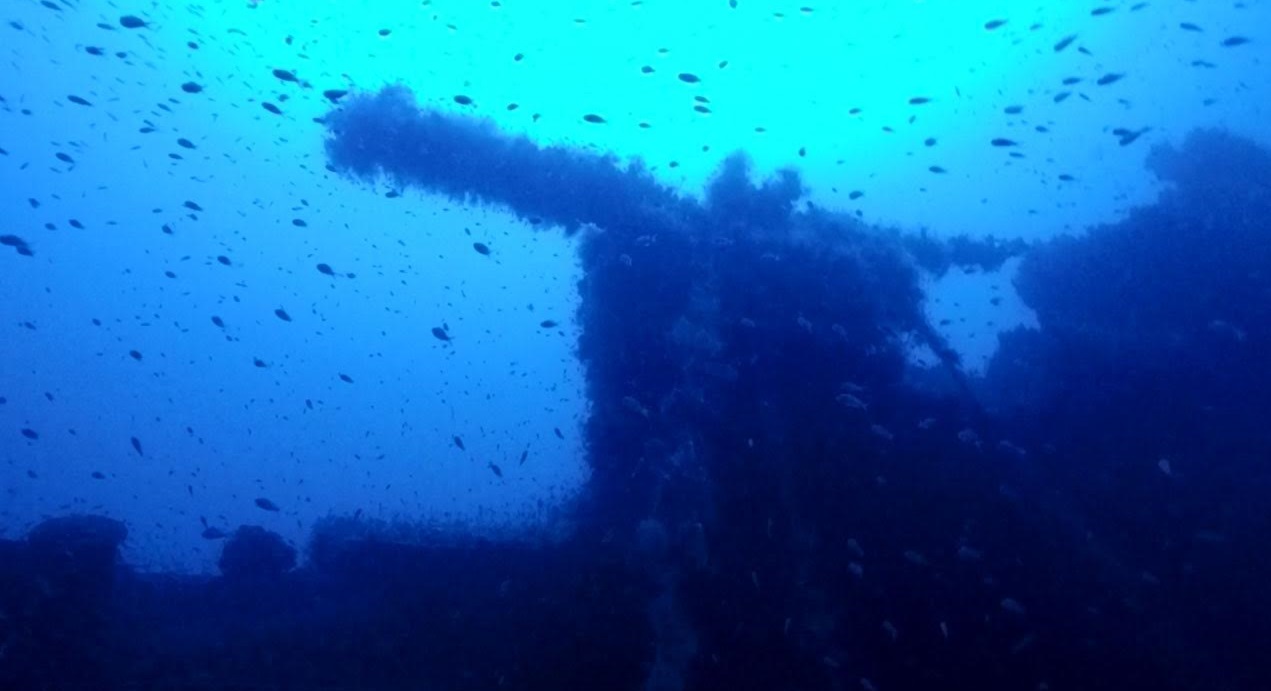
A seasoned Italian diver who found a submarine wreck off the Sardinian coast said he was all but sure it was the long-lost British HMS P311 that disappeared in Mediterranean waters during World War II.In his first extensive interview since the discovery, Massimo Domenico Bondone told IBTimes UK he was proud of having brought closure to the families of the vessel's 71 crew members who never returned home.
The 59-year-old shipwreck hunter found the stricken vessel on the seabed at about 90m of depth five miles east of the island of Tavolara during a dive last weekend (22 May).
He said the type of hull, its location and on-deck cargo left little doubt it was HMS P311.
A seasoned Italian diver who found a submarine wreck off the Sardinian coast said he was all but sure it was the long-lost British HMS P311 that disappeared in Mediterranean waters during World War II.
In his first extensive interview since the discovery, Massimo Domenico Bondone told IBTimes UK he was proud of having brought closure to the families of the vessel's 71 crew members who never returned home.
The 59-year-old shipwreck hunter found the stricken vessel on the seabed at about 90m of depth five miles east of the island of Tavolara during a dive last weekend (22 May). He said the type of hull, its location and on-deck cargo left little doubt it was HMS P311.
-
Sunken American WWII torpedo bomber
- On 26/05/2016
- In Airplane Stories
From Fox News
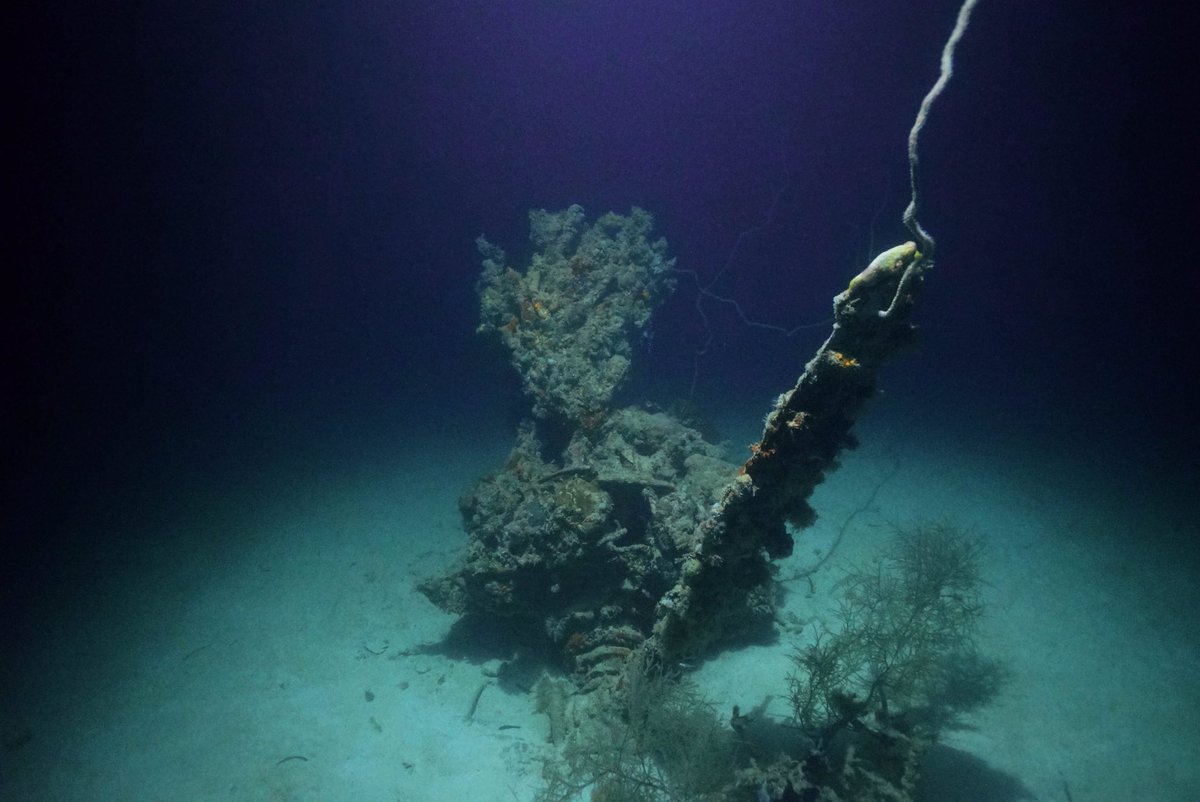
In July of 1944, an American warplane, a TBM-1C Avenger torpedo bomber, went down in the Pacific.Now, 72 years later, the Navy plane has been identified near Palau, the Scripps Institution of Oceanography at the University of California San Diego has announced.
Eric Terrill, an oceanographer at Scripps, explained that the remains of the aircraft are resting under 85 feet of water within a lagoon. It wasn't until his team dove the wreck this April and May that they identified it as the Avenger they had been looking for.
“The plane had a number of Japanese targets that it was focused on in World War II, and was hit by anti-aircraft fire, and then crashed within the lagoon a few miles overshore from the target that it was going after," Terrill told FoxNews.com.
Avengers, which took off and landed from aircraft carriers, had a crew of three.
"We’re hopeful that this will eventually lead to the recovery of three MIA," Terrill added, pointing out that a report stated that one person had parachuted out before the crash.
"This particular aircraft had a lot of fire-damage associated with it, which is consistent with the after-action report," Terrill added. He said it's the U.S. government's purview at this point to identify the individuals associated with the plane, and that his team had given a report to the government.
-
3D prints of shipwrecks off Drumbeg and Folkestone
- On 24/05/2016
- In Underwater Archeology
By Steven McKenzie - BBC.com
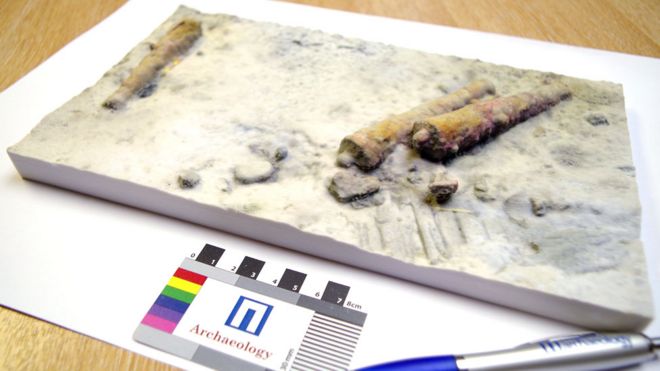
Two shipwrecks in UK waters are among the world's first underwater archaeological sites to be recreated using 3D printing technology.Archaeologists have made a full colour model of a wreck near Drumbeg, in Sutherland, thought to date from the late 17th or early 18th century. A print has also been made of HMHS Anglia, a World War One hospital ship lost off Folkestone in Kent in 1915.
The steamship, built in Dumbarton in 1900, sank after it struck a mine. 3D printing involves machines that can create a three dimensional object from an image by laying down thin layers of materials such as plastic - or in this case plaster of paris - on top of each other.
Wessex Archaeology worked with printing firms in Scotland and England after first investigating and scanning the wreck sites.
The first of the wrecks to be printed was the Drumbeg shipwreck. The wreck lies at a depth of 12m (39ft) in Eddrachillis Bay and consists of three cannon, two anchors and partial hull remains that lie on and below the seabed.
The cannon are heavily encrusted and colonised by small red seaweeds. Local scallop divers Ewen Mackay and Michael Errington discovered the wreck in the 1990s.
Archaeologists are still working to confirm the identity of the wreck, but Wessex Archaeology said one "intriguing possibility" is that it is the Crowned Raven, a Dutch trading vessel.
The ship was known to have been lost in the bay the winter of 1690 or 1691 during passage from the Baltic Sea to Portugal with a cargo of timbers and hemp.
Surveys of the wreck were first undertaken by archaeologists from Wessex Archaeology working on behalf of Historic Environment Scotland in 2012.
-
The mysterious shipwreck...
- On 22/05/2016
- In Famous Wrecks

By Peter Holley - The Washington Post
For decades, the Andrea Doria has lured daring treasure hunters and obsessive thrill seekers to the bottom of the Atlantic Ocean in search of the luxurious ocean liner, which sank off the Massachusetts coast on a foggy night in July 1956.Forty-six people died after the Andrea Doria collided with another ocean liner, shocking observers who considered the vessel unsinkable and tarnishing the romantic allure of the post-war passenger liners that plied the Atlantic.
Despite having less name recognition than the Titanic or the Vasa, the Italian wreck is now considered by many to be the Mount Everest of underwater exploration, according to CBS News.
The ship rests about 60 nautical miles from Nantucket on the border of the continental shelf, where the seabed disappears into the abyss.
The remoteness of the wreck, some divers maintain, only deepens the seductive mystery surrounding it.
"The Andrea Doria stands out as the premier shipwreck in American waters," Stockton Rush, co-founder and chief executive of a Washington state-based ocean exploration company known as OceanGate, told CBS.
The company is organizing the first manned expedition to the wreck in two decades, according to the AP. Using a five-man submersible known as Cyclops I, organizers hope to retrieve high-definition video and 3-D sonar images of the shipwreck, the AP reported.
The ship's popularity can be explained by the money and artifacts that are still on board, as well as the unique time period encapsulated within the ship's wreckage, which sits about 240 feet below the surface, according to CBS.